GERMÁN RUBIANO CABALLERO
I have always been surprised by Carlos Rojas’ tremendous dedication to his work. His is constantly producing and works full time. His studio is never at rest. His paintings—the genre in which the artist works exclusively now—proliferate day after day. It could almost be said that they emerge without let up or respite of any kind.
From excess, from fatigue, a torrent of ideas emerges—many of them contradictory—and overflows into the canvases to generate ten, a hundred, a thousand individual works. Large, medium-sized, small paintings. Horizontal and vertical canvases. Paintings, many paintings.
I have followed Carlos Rojas’ trajectory for 10 years, and I have always found it difficult (because of its superabundance, not its intention) to grasp his work and analyze it in detail, which would require freezing and preserving his creative process, as vital and dynamic as it is. Rojas’ work is open, vibrant, relentless, and, because of all that, extremely difficult to explain.
But, can any explanation of an abstract-art oeuvre like Carlos Rojas’ be justified? Is it necessary for someone to tell us what the artist did with his sensibility and his intelligence to organize a set of colors and shapes on a canvas surface? Maybe not. Nevertheless, it is possible that an attempt at explanation helps someone with no interest whatsoever in abstract painting or “sophisticated” music “see” something in works of art that are so simple, “filled with such pretty colors but little else.” It can also be that the analysis of a work of art begins to reveal its clarity, its diaphanous character, which numerous “academic” interpretations may have covered under nonsensical words, extravagant fables, and untruths. The necessary conclusion is, then, that something else must be said about such an outsize, cohesive, and lucid oeuvre as Carlos Rojas’.
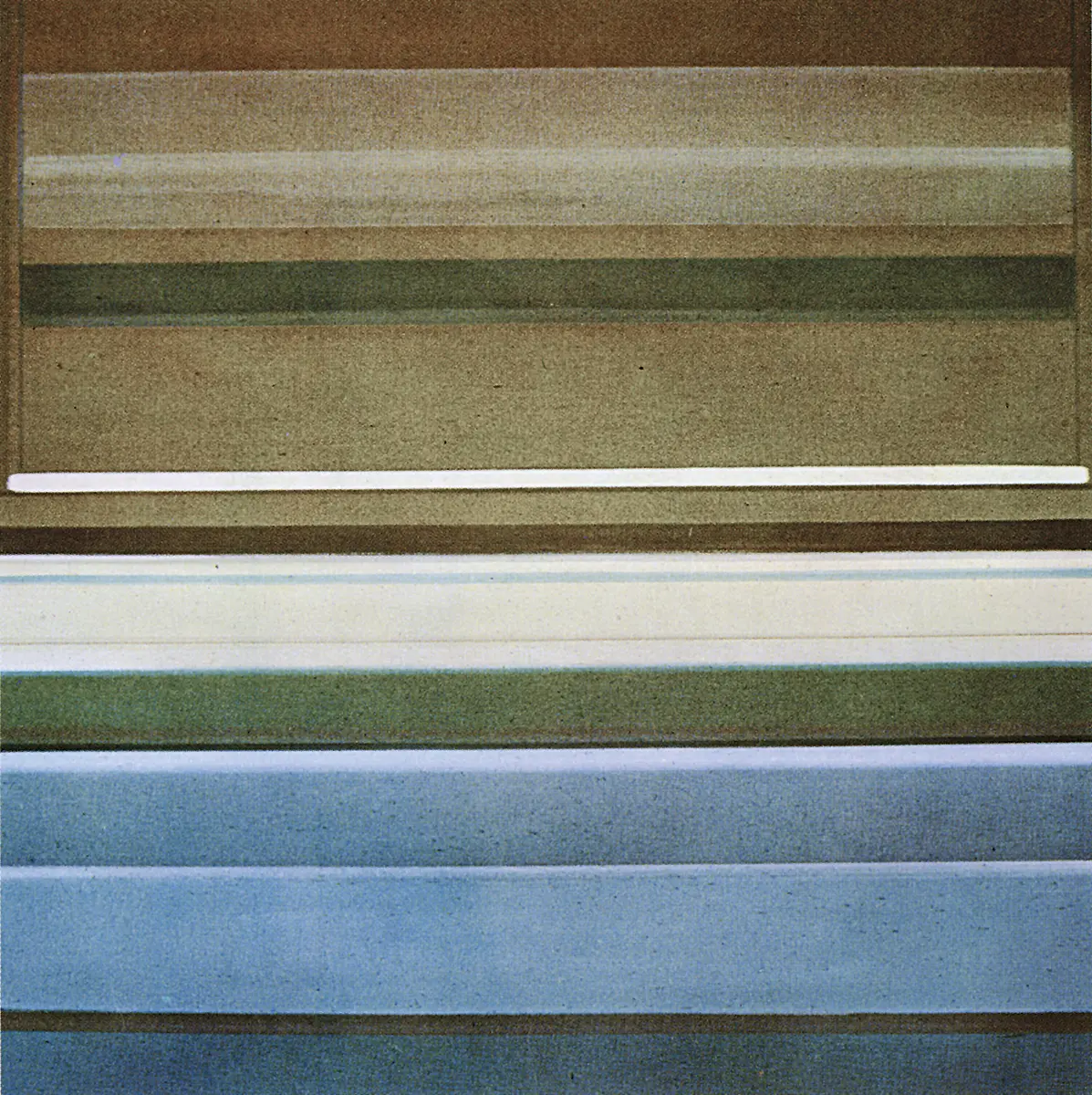
Rojas latest paintings have their starting point in some canvases from 1974. I am talking, of course, about his rolled-up works or those set in iron frames, of Rojas’ 1976 vintage. In some paintings from two years ago there appeared the first color planes with imprecise boundaries, with slightly stained frames. Shortly thereafter came his canvases in various formats where the strict arrangement of superimposed planes almost apparent volumes, defined through cutting linear elements, occasionally using iron rods gave way to a rich range of variations, almost all arranged in a horizontal direction inside the pictorial space: lines, line-blotches, defined planes, planes that are ambiguously outlined, aerial planes, solid or transparent volumes. These canvases created around his contribution to the São Paulo Biennial last year were the origin of this year’s chromatic arrangements.
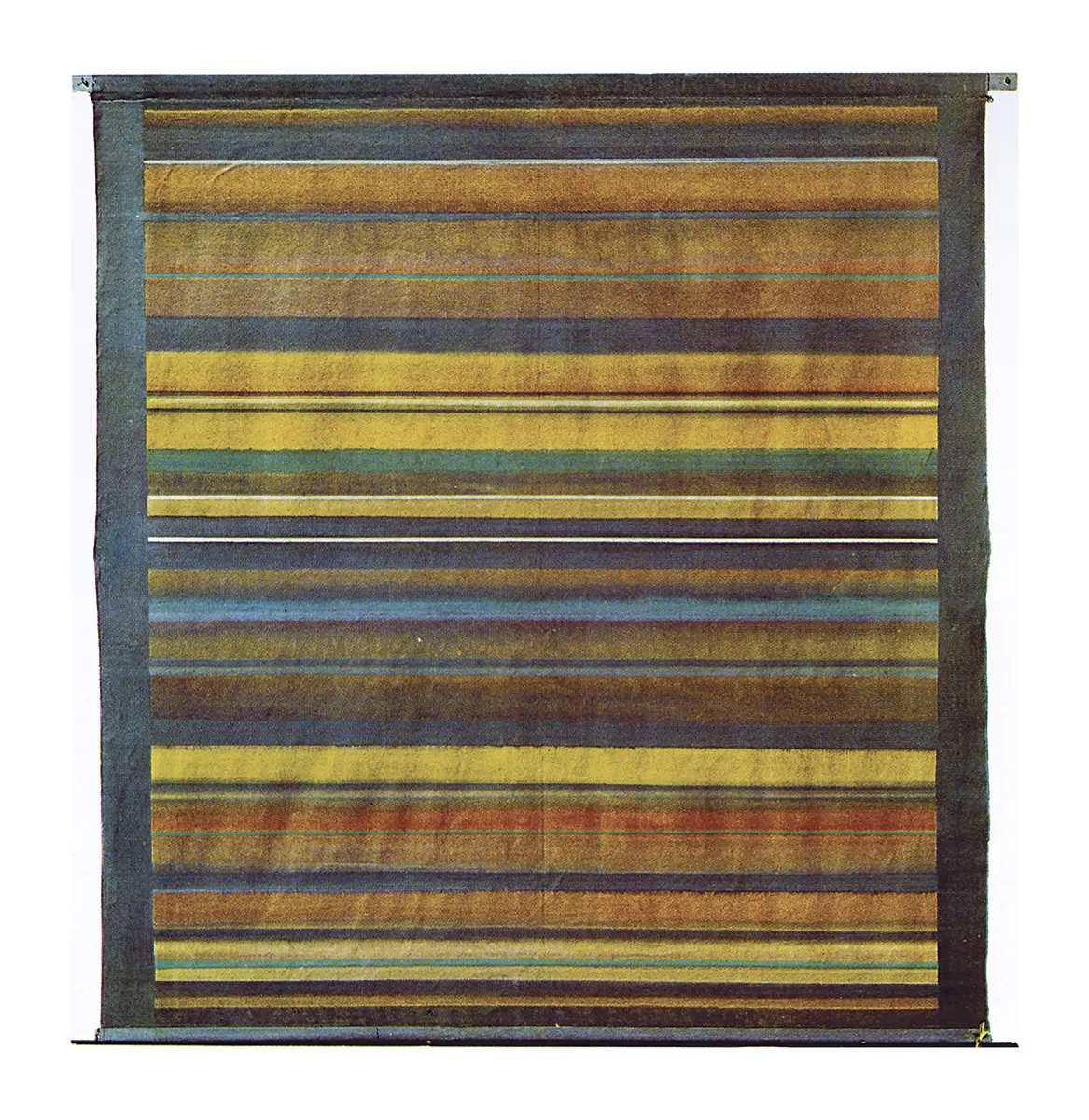
All of Rojas’ recent works have their foundation on color and its subtlest relationships and combinations. The assuredness and variety of his treatment were experienced in previous years. His Limited Horizons, Vertical Horizons, and Transparent Horizons (all 1974-75) already display a marked interest in color and its combinations, albeit as a complement of other, more deeply rooted concerns: linear, planimetric, and volumetric games in the unreal space of the painting, mentioned before. Color as a tread in a plot or a very narrow tonal zone emphasizes its validity as such and eliminates any reference to other issues. In this way, a continuous, infinite totality is built that can very well be compared to the woolen fabrics of popular handcraft artisans. This is why Rojas’ recent works have no stretcher frames and, like textiles ready to come off the loom, can be rolled anywhere or be left unfolded as uninterrupted ribbons, or they can be place in frameworks that would showcase the unity of their weaving.
That extraordinary range of colors, tonalities, and hues (achieved using watered acrylics mixed with such strange substances as mercurochrome) in the artist’s current production has no precedent in Colombian art nor, much less, in international art.
Carlos Rojas has created an absolutely original body of work that only makes reference to the fabrics of our popular weavers. This is not the first time that the artist uses autochthonous elements to fill his work with unexpected accents. Between 1970 and 1971, Carlos Rojas worked, for example, on a series titled The Towns, which included paintings of horizontal or vertical bands on rhomboid formats, their colors inspired on the façades of many houses found in Colombian villages and towns. Also, the artist has always believed, as he confessed to Bernice Rose in 1973, in Latin America’s predilection for geometric abstraction ad its inherent spirituality.
These words will help us remember that Rojas’ current canvases, although distanced from his works in The Engineering of Vision, from 1969, retain a clear predilection for the reiterative decorative molds of pre-Columbian and, obviously, all kinds of geometric shapes. In this way, Rojas generates an admirable abstraction that, set on a rational structure, recalls our indigenous ancestor’s will to geometric organization, the rich range of colors that reveal a refined sensibility, and the artificial or artisanal world of infant swaddles, woolen fabrics for cold climates, and tropical tarpaulins.
GERMÁN RUBIANO CABALLERO
Art historian.