Equally woman, artist, bisexual, political activist, and co-protagonist of a plastic movement such as Mexican muralism, of unusual importance in the development of art in our century
MIGUEL GONZALEZ
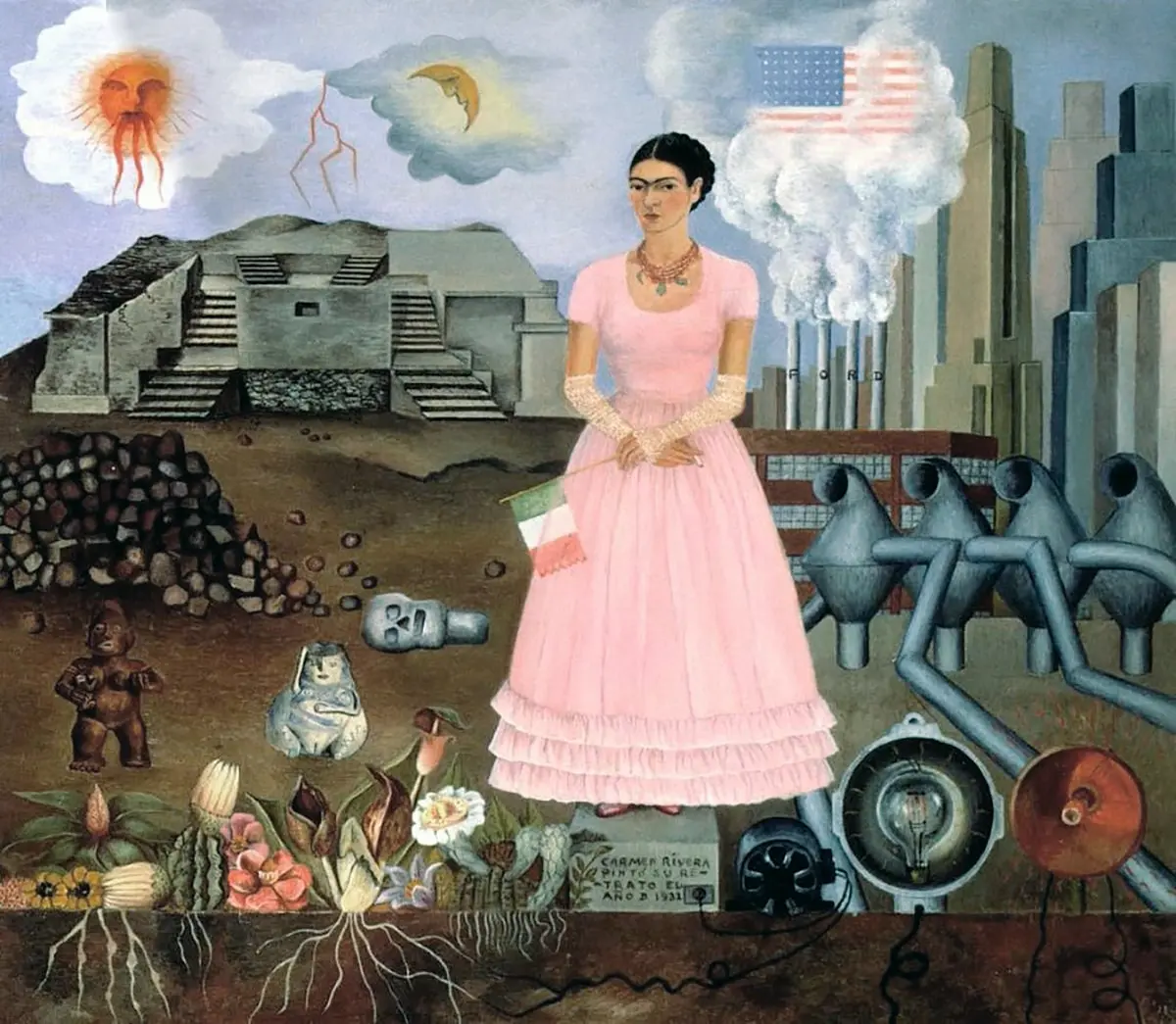
In 1955, the painter Diego Rivera, established the irrevocable trust with the Bank of Mexico, granting it his inheritance, including the house of Coyoacán, currently the Frida Kahlo museum, inaugurated on July 12, 1958. In this residence, the artist was born, lived, and died. It was also the scene of significant issues, among which hosting León Trotsky stands out. He arrived at the port of Tampico in January 1937 and was a guest of the Riveras until May 1939. In 1938, André Breton visited Mexico, got to know Frida's paintings, and stayed at the Casa Azul. In that year, he wrote his well-known text Frida Kahlo de \ Rivera 1, and the artist showed her work individually in New York 2. The following year, Breton and Marcel Duchamp 3 jointly worked towards exhibiting her paintings in Paris 4. But the Coyoacán house is also a reference to the most permanent place where the artist produced and where it is necessary to find the elements that fed her: pre-Hispanic sculptures and ceramics, various manifestations of popular crafts, some dresses and jewelry, the valuable and revealing diary illustrated with vignettes, an important selection of her portraits and self-portraits, the collection of anonymous Central American paintings from the 18th and 19th centuries, her sickbed and the study with her last painting: an unfinished portrait of Stalin, in addition to the collection of works by other artists: Cubist paintings by Rivera, landscapes by José María Velasco, two graphics pieces by José Clemente Orozco, and works by Tanguy, Klee, and Duchamp.
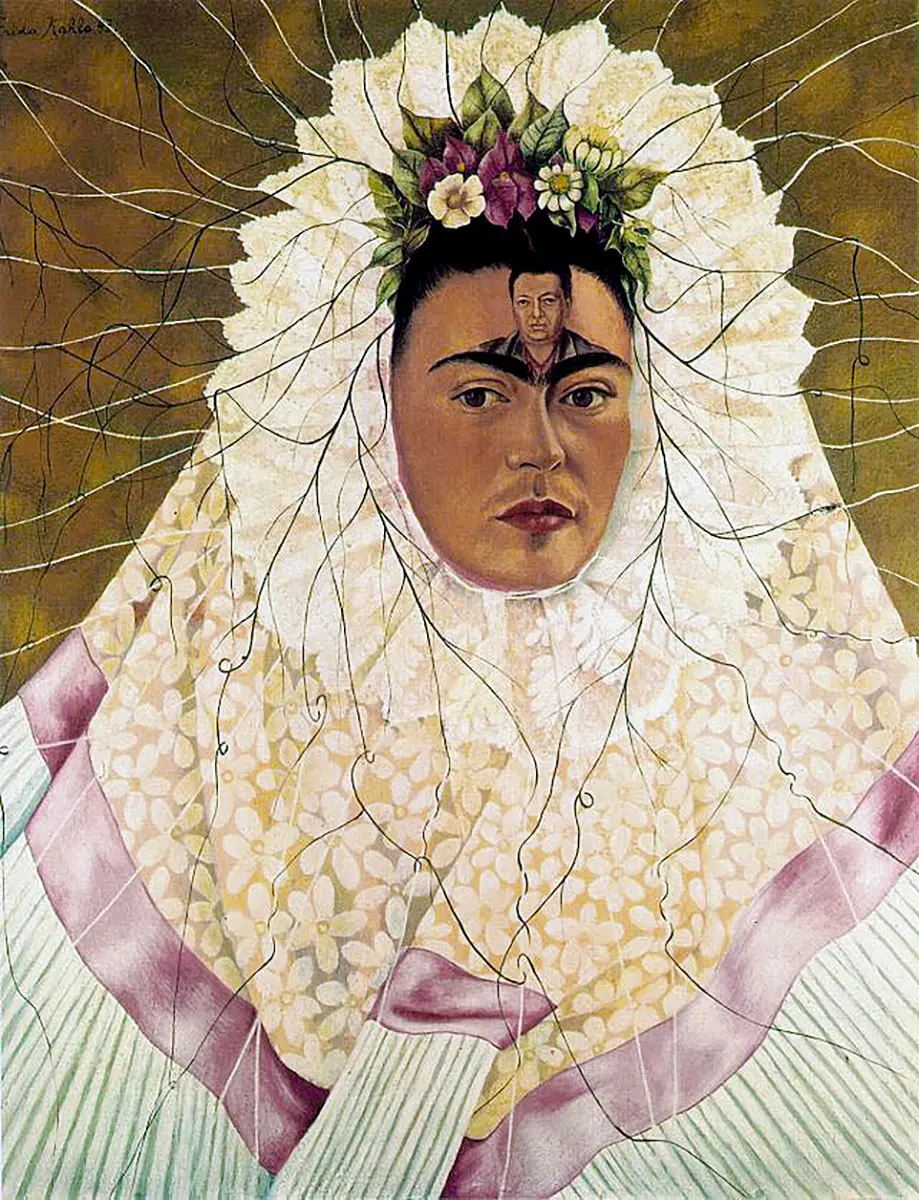
Frida Kahlo's art is inseparable from that environment in which she reconstructed sentimental pieces from a select Mexico, while it is easy to see her bourgeois intellectual condition. Elements that allowed her an introspection that was animated by the libertarian ideas of communism, surrealism, and psychoanalysis, international thoughts that she knew how to tame under her time of nationalism and sophistication, not without a deliberate dose of naive ingredients.
Frida Kahlo (1907-1954) married Diego Rivera in 1929 5, whom she had met when they were both members of the Mexican Communist Party, through the Italo-Mexican actress, photographer, and model Tina Modotti.
Frida was already painting and had chosen this profession as the most important activity of her life. Rivera was the most prestigious figure in Mexican Muralism, a rival of José Clemente Orozco, and a friend of David Alfaro Siqueiros. Upon his arrival from Europe, he became part of the government program that the intellectual and Minister of Education José Vasconcelos had outlined, inspired by the Lunacharsky cultural policy, willing not only to provide mass literacy but also necessary official sponsorship to the arts. Vasconcelos aspired to art with characteristics of grandeur, as well as epic and with exalted nationalist ingredients. Rivera was willing to illustrate those ambitions, or, as Laura Mulvey and Peter Wollen describe it: "Rivera's aim was to reverse the current of art history so that instead of the exotic or the primitive feeding European art, the opposite should happen: that the lessons of European art that he had brought with him fed the native Mexican tradition 6. Vasconcelos' attitude was the affirmation of post-Mexican revolution thought, which aspired to consolidate itself based on a resounding feeling of the national, a starting point for the new philosophy. The Porfiriato had relied on feudal values and allowed imperialist and neo-colonial intervention.” The new proposal of the Obregón government was opposed to these postulates. Among other considerations, it struggled to take root in pre-Hispanic and popular cultures, which before were not considered or rejected.
Mexican Muralism was modern, monumental, and American. Rivera went back to Giotto’s frescoes and was seduced by various aspects of Gauguin’s and Cézanne’s works. He also took advantage of his direct knowledge of Cubism. The interesting thing about Frida Kahlo's opposite work is its marked difference. When the latter term is used, one cannot fail to refer to the sexual condition and the man-woman dichotomy whose virtual oppositions we find in the examples as close as they are distant from Rivera and Kahlo. The response of an immense, epic, public, historical, and other characters of civic art, which can be seen as a sign of masculinity, differ from the intimate, existential, domestic, and suspicious work which would correspond to a feminine operation.
Frida Kahlo got her first visual experiences in her own home. Guillermo Kahlo 7, her father, of Jewish-Hungarian-German origin, was a prominent photographer in Mexico. In 1925, she received drawing classes from the engraver Fernando Fernández. Her manual works dating from 19158 and drawings, made when she was 15 years old, have been kept 9. But her continued artistic production started in 1926 when she decided to paint as her main activity, which she carried out for 28 consecutive years.
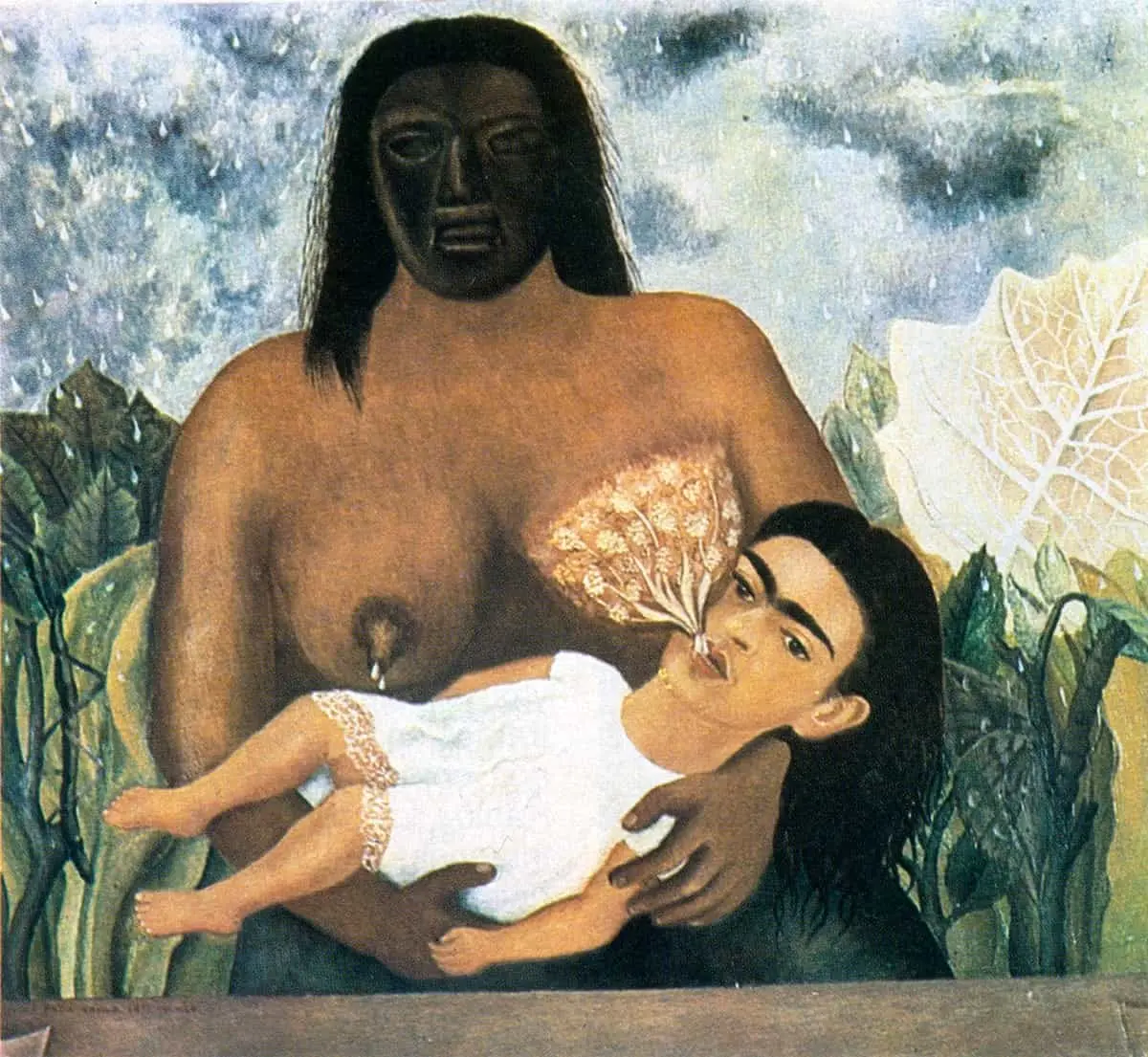
Frida Kahlo's physical life served as plot support for her paintings. She was in charge of narrating it and spying on events in realistic and narrative paintings that are also symbols and allegories. In 1916, she suffered a polio attack 10, and at 15 years of age, an accident occurred that made her an intermittent patient 11. These two facts helped to stimulate her fantasy; at the age of six years old, "she had an imaginary friend who ended up becoming her favorite confidante and companion. The friend danced and moved with amazing agility, and Frida learned to imitate all her movements.'' 12 Continuing with those magical coincidences, the accident of 1925 gave Frida the image of a disabled dancer. "Among the remains of the vehicle, she was dying, covered in blood and gold dust that someone was carrying and, broke the container, spread over her body. The dancer! People exclaimed.” The cry returned through the years, to her memory, to her letters: “Last night I dreamed I danced in a great empty theater..." "I only like the music of the town, the ‘corridos,’ or the music that I would like to dance..." "In that hospital, death dances at night around my bed." 13 When Frida Kahlo died, she had endured nearly thirty operations, miscarriages, and others incited by medical order and several suicide attempts, which made her say she was "murdered for life." In 1954, four months before she died, she noted in her diary: "My leg was amputated six months ago. It feels like I have endured centuries of torture, and at times I have almost lost my reason. I still feel like committing suicide. Diego is the one who it stops because of my vanity to believe that he may need me.” The important thing about this macabre, tortuous, and challenging itinerary is the meticulous reconstruction that takes place in the great arguments of her painting, supported both by the strength of her narcissism and the violent disturbances occurred by a cure without rest and the "I am desperate," which she recorded in her diary.
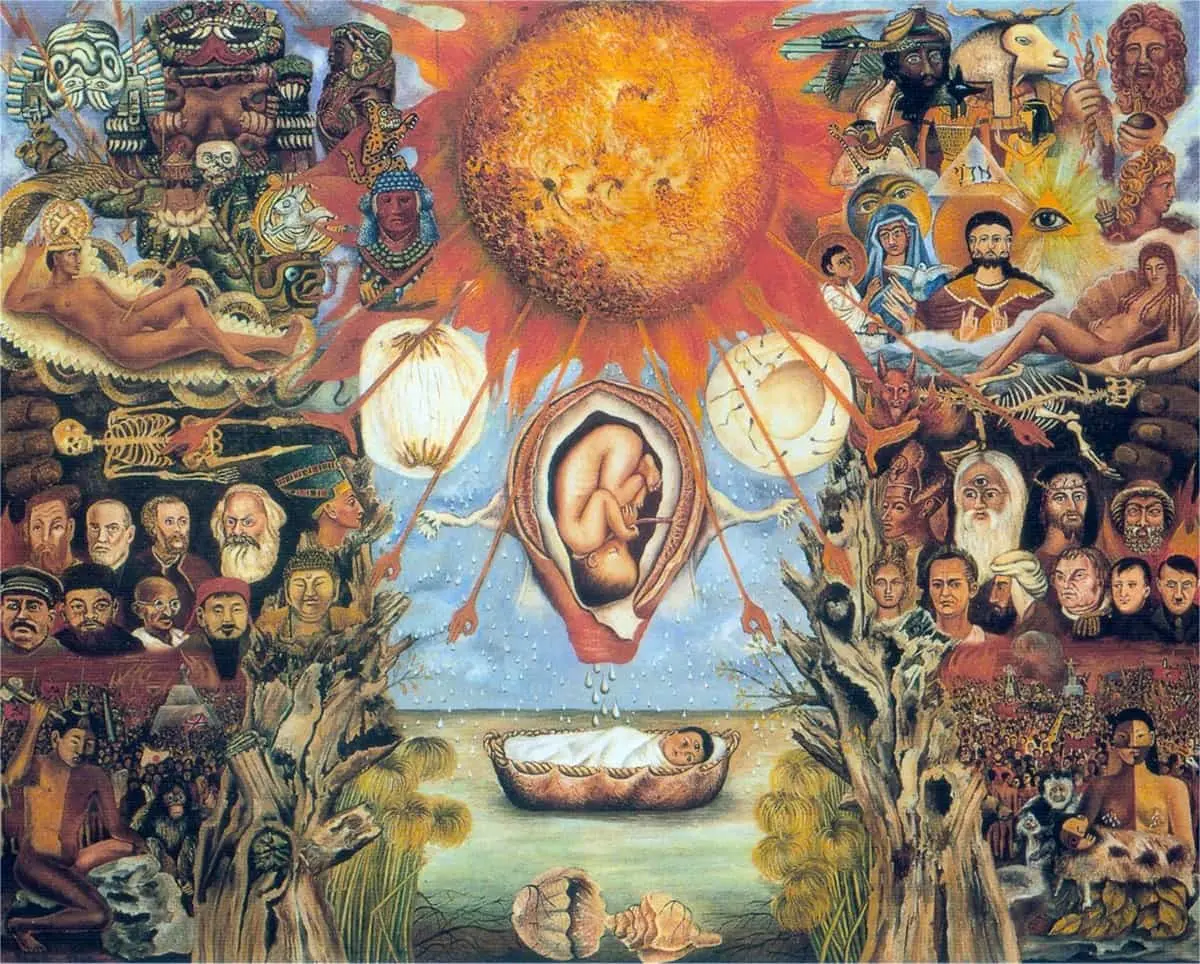
The strength of her proposal was established by narrating her story during different periods, reconstructing a long expedition through an inner world, which, although based in a moving autobiography, morbidly incorporated diverse cultural interests. Among the painters who fascinated her were Hieronymus Bosch, Bruegel, and the customs officer Rousseau, from whom she received conceptual and formal influence. At the same time, her lively interest in Mexican popular art, from the graphics of José Guadalupe Posada to the Judas and the ceramics of indigenous crafts, including votive offerings and colonial and republican altarpieces, gave her production a hieratic and cultured air, a starting point for speculation on itself, a mixture of concentrated realism and fantastic art.
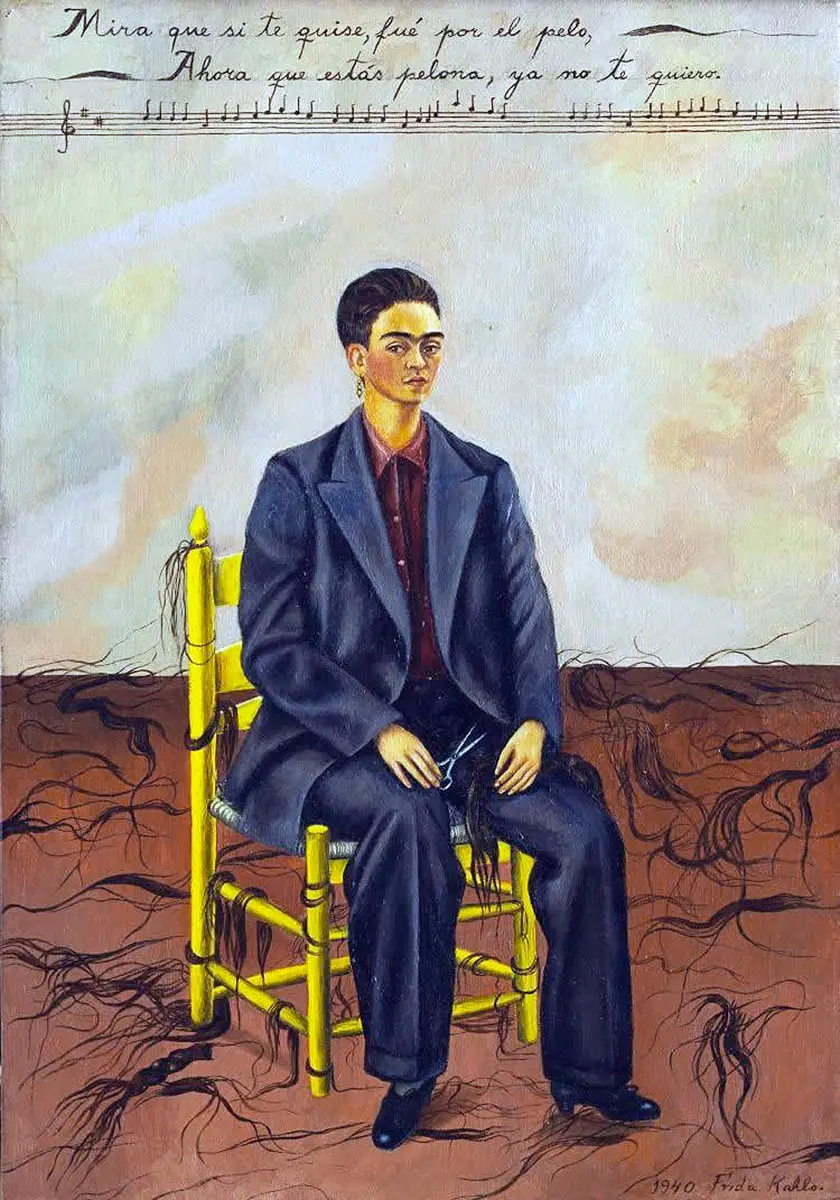
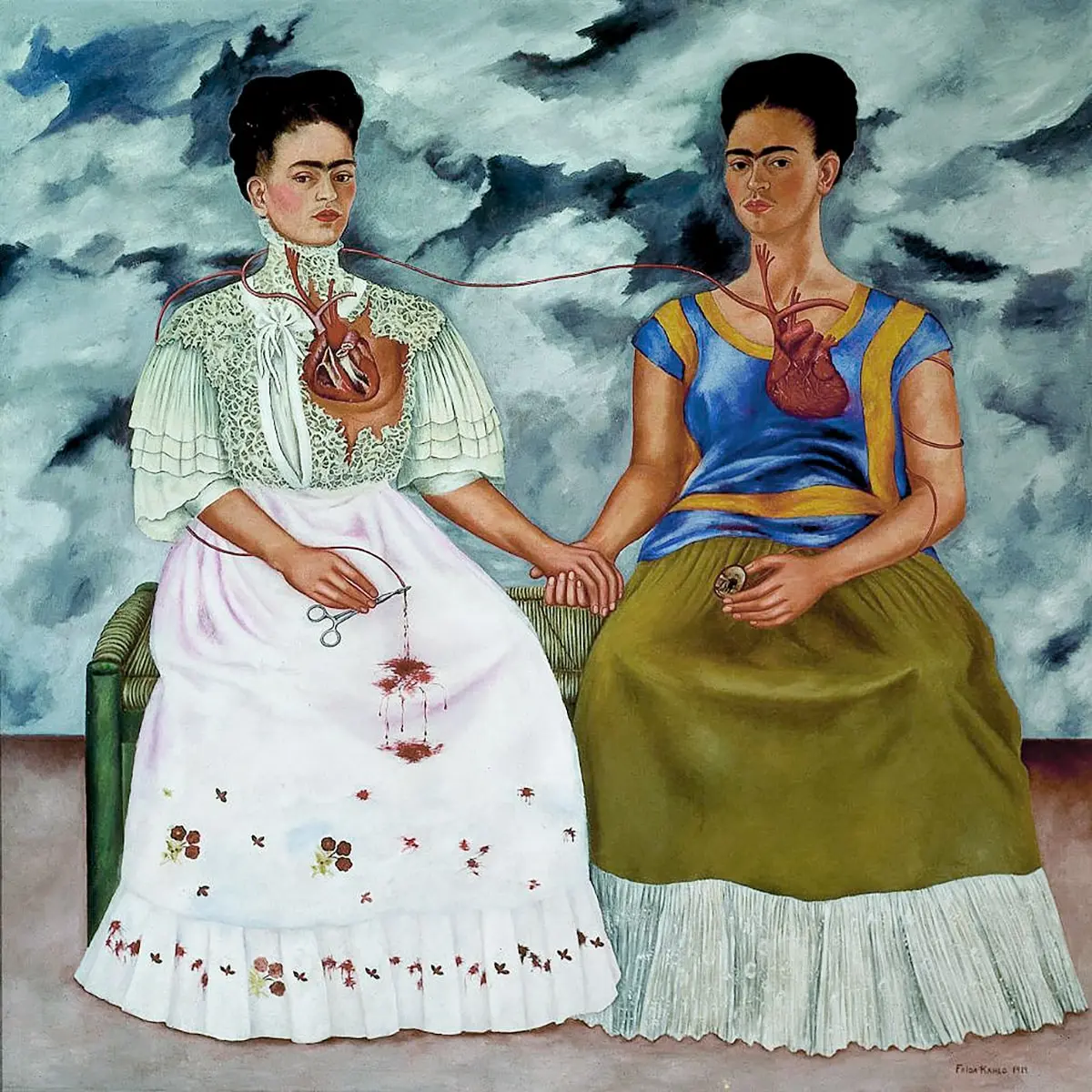
Frida Kahlo resolved her descriptions by going to the medium and general planes. Although there are others whose approach to the face seems to go deeper into the effort to tell intimate emotions, her masculine and feminine face is not easy to go unnoticed, although she often sets out transcendent objectives when tying, braiding, letting go of her hair until she is pruned, as in the Self-portrait with a haircut (Cutting my hair with scissors), from 1940 15, or tying the hair to the face until the corners of the mouth become tense, or the gaze that opens definitively like a seagull’s 16, or becomes a third eye in Calavera, 17 or with the portrait of Diego 18. Tears, nails, flowers, crossed her face to communicate psychological states and reveal the inner drama. Expanding on the descriptive fervor are the full-length self-portraits that relate her illness - in the manner of Christian torture - while others refer her to life forces, her origin, and the Eros-Thanatos, beauty-horror, and martyrdom-redemption, dualisms.
Hence, paintings such as The Two Fridas (1939), The Broken Column (1944), The Little Deer (1946), are open areas for the speculation of multiple readings. Her choice also included portraits of her friends, still lifes and allegories of life and death, rounding out a pictorial production motivated by a desire for things that happened (and exalted) and the impossible.
Frida Kahlo managed to paint and combine this profession with all the other activities of her life. She was able to radiate personal power around her with an apparently unbearable taste. The ornamentation of the house continued in the decoration of herself, like a living sculpture, which reminds the saints to be dressed present in colonial imagery. This eccentric and poetic activity was in part due to the necessary concealment of her body and the fervor with which the legacy of popular art was introduced into life and work. That human icon impacted those who knew her and could see her as an original entity. Vanity Fair, Harper’s Bazaar, and Vogue 14 celebrated her appearance, both as an alternative in the conception of a world of fashion and the profession of painters. Breton encouraged her to celebrate her individual exhibitions and opened the possibility of selling her paintings. Even though in many of the most important North American museums and galleries her works had been shown in group exhibitions 20, Frida Kahlo's art and personality seemed to be unjustly relegated to international oblivion, since only in Mexico biographies, articles, and testimonies were written 22.
In 1976 a famous writing by Hayden Herrera, published in the magazine Art-Forum 23, predicted the very complete, passionate, and revealing biography published in 1983 Frida a Biography of Frida Kahlo. The book has contributed to an intercontinental enthusiasm caused by the whole climate in favor of fantastic realism, looking to the past, feminist movements, and her very status as an artist so captivating for any professional discipline, both as aesthetic potential and as a human and unequivocally morbid. Frida Kahlo was probably a genius. Equally female, artist, bisexual 24, political activist, and co-protagonist of a plastic movement such as the Mexican muralism, of unusual importance in the development of art in our century. Mexican director Paul Leduc has just taken her life to the cinema 25. We hope that the fervor for a mirror art will definitely infect multiple audiences.
NOTES
1. Later reproduced on the book Le Surréalisme et la Peinture (1945)
2. Julien Levy Gallery
3. The painting Naked Woman Going Down a Staircase, a reproduction made by Duchamp of her eponymous work (32 x 20 cm), can be found at the Frida Kahlo Museum.
4. Renau and Colle Gallery
5. In 1939 she divorced, and on December 8, 1940, she remarried. Rivera was 54 and Frida 30 years old
6. Frida Kahlo and Tina Modotti, Museo Nacional de Arte, Catalog, p. 98, Mexico, 1983
7. Frida Kahlo painted a portrait of her father and placed on it a legend that says that she has epilepsy. Portrait of Don Guillermo Kahlo, 1952. Oil on canvas, 62 x 48 cm. Frida Kahlo Museum
8. Little House, embroidered in petit point, and Tray of Roses, oil on canvas, 40.5 cm in diameter, n.d., exhibited at the Exposición Nacional de Homenaje, 1977, Mexico City, Palacio de Bellas Artes
9. Teresa del Conde, The Painter Frida Kahlo, Artes Visuales magazine, Museo de Arte Moderno, Mexico, October-December 1974
10. "At six years old, I had polio. Since then, I remember everything clearly. I spent nine months in bed. It all started with a terrible pain in my right leg, from the thigh down. I washed my leg in a little ink with walnut water and cloths. The little leg was skinny. At the age of seven, I used booties. At first, I assumed that the teasing would not make a dent in me, but later it did, more and more intensely." Quoted in the book by Raquel Tibol, Frida Kahlo, Crónica, Testimonios y Aproximaciones, p. 26, Ediciones de Cultura Popular, Mexico, 1977
11. "...the crash pushed us forward, and the railing went through me like a sword to a bull. A man saw me with a tremendous hemorrhage, carried me and put me on a billiard table until the Red Cross picked me up. I lost my virginity, my kidney softened, I couldn't urinate, and what I most complained about was the spine. No one listened to me. Furthermore, no x-rays were taken." Raquel Tibol, ibid, pp. 2 and 32
12. Frida Kahlo Pintora, Teresa del Conde, Catalog, Frida Kahlo Exposición Nacional de Homenaje, Instituto Nacional de Bellas Artes, Mexico. 1977
13. A Testimony about Frida Kahlo. Alejandro Gómez Arias, Catálogo Frida Kahlo y Tina Modotti, pág. 80. Museo Nacional de Arte, México, 1983
14. As is known, Frida Kahlo belonged on several occasions to the Mexican Communist Party. She welcomed Trotsky into exile and had photographs of Marx, Lenin, Stalin, and Mao in her bedroom. She was even persecuted politically, not only for her socialist activity but for her rejection of Nazism. According to the testimony of Diego Rivera, in the book by Luis Suárez, Confesiones de Diego Rivera, Biblioteca Era. Mexico 1962: "Two Nazi agents prepared an attack against my wife. Frida Kahlo, anti-Nazi activist, working in organizations to help German personalities escape from the clutches of Hitler, and daughter of an honest and anti-Hitlerist German" p. 144
15. The painting has the following inscription: “Look, if I loved you, it was because of the hair, now that you are a hairless woman, I don't love you anymore.” It belongs to the collection of the Museum of Modern Art in New York, oil on canvas, 40 x 28 cm
16. Drawing, self-portrait, dedicated to Marta R. Gómez, pencil on paper, 38.5 x 32.5 cm, 1946. Private collection. Mexico
17. Pensando en la muerte, 1943, óleo sobre masonite, 63 x 61 cm Colección particular México. Diego y yo, 1949, óleo sobre tela pegada sobre masonite, 28 x 22 cm
18. Thinking About Death, 1943, oil on masonite, 63 x 61 cm. Private collection, Mexico. Diego and me, 1949, oil on canvas glued on masonite, 28 x 22 cm
19. Schiaperelli was inspired by her Mexican folk costumes, especially that of the Tehuana. Bertran Wolfe wrote an article on the occasion of her exhibition at the Julien Savy Gallery: "Rise of Another Rivera,” Vogue, No. 1, 1938
20. Golden Gate International Exhibition, San Francisco (1940); Boston Institute of Contemporary Arts, "Modern Mexican Painters" (1941); "20th Century Portraits," organized by the Monroe Wheeler Museum of Modern Art (1942); "Mexican Art Today,” Philadelphia Museum of Art (1943). A self-portrait was included in the exhibition "Women Artist" in the space of Peggy Guggenheim Art of this Century Gallery (quoted in her book Confessions of an Art Addict).
21. In 1953 an important exhibition of her works was held at the Contemporary Art Gallery; in 1977, she participated at the National Tribute Exhibition, already mentioned; in 1983, she was featured in the famous show Kahlo-Modotti. Raquel Tibol has written two biographies and a compilation of a series of articles. Teresa del Conde, Laure Mulvey, and Peter Wollen have done studies on the artist.
22. Frida Kahlo: Her Life, Her Art. p. 38-44. New York, May 1976
23. Hayden Herrera. Frida. A Biography of Frida Kahlo, Harper Colophon Books, New York, 1983. Regarding her homosexual experience, pp. 43, 198-199, 370, 400
24. Frida, protagonista (Frida, Protagonist), Ofelia Medina, feature-length, 16 mm., Mexican production, independent, 1985