The idea of questioning sculptor Édgar Negret (Popayán, 1920) about the concerns driving his work throughout this decade developed after the complete and important retrospective presented by the Museo de Arte Moderno de Bogotá to commemorate the 50 years of his professional life.
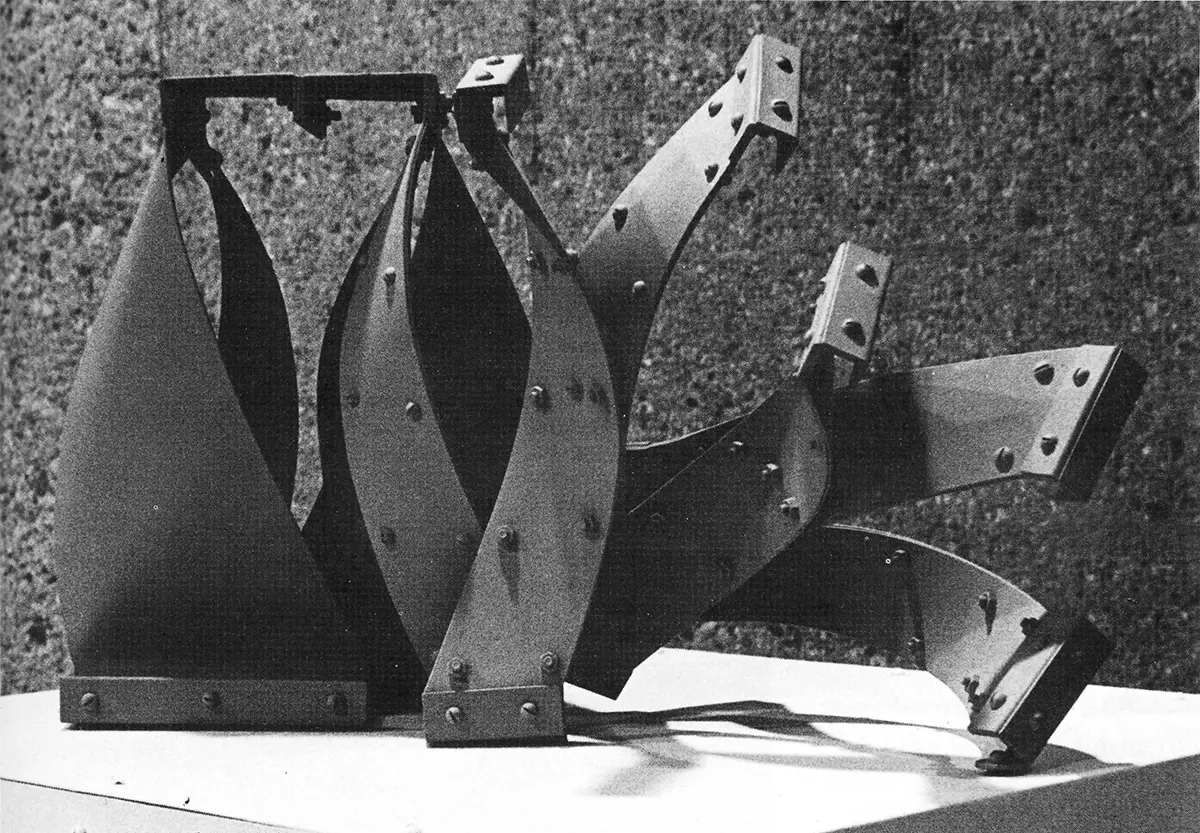
The exhibition spotlighted the profound coherence that has animated his proposals since an initial formative period —1938-1953— in which the artist drew and sculpted in plaster his earliest figurative academic exercises, and later focused on religious themes and direct allusions to nature: The Head of the Baptist (1946), God’s Hand (1947), Annunciation (1948), The Face of Christ (1949), or Walt Whitman-Landscape (1945) and Vase With a Flower (1949), which also incorporate materials such as bronze, iron, and wood. Starting in the second half of the 1950s, Negret’s work finds the materials, the matte paint, and the basic solutions of his sculptural project, which until the beginning of the following decade were grouped as Aparatos Mágicos, shapes usually achieved using aluminum, wood, nuts, and bolts, as well as the exclusive use of the colors red, blue, black, white, and eventually yellow (with transparent Plexiglas sheets in his Eclipses, from 1960). Over the subsequent twenty years, Negret’s work seemed to arrive at an astonishing degree of maturity, which immediately resulted in its recognition in a variety of international stages. His works at the time were titled Cabo Kennedy, Puente, Edificio, Escalera, Columna, alluding to architectural constructions and engineering projects, without emphasizing the ritual and religious elements: Máscara and Templo. It seemed that these unusually powerful themes, where the sculpture had been able to capture space, folding the aluminum sheets into curves, projecting his assemblages on the diagonal, and marking anchoring points with undisguised nuts and bolts, were set to continue boasting of their own appeal, serenity, and frankness. But at the turn of this decade, Negret crossed paths with Bolívar as a character, hero, and conceptual motif: the encounter was to drive him to approach the Americas as a totalizing territory, and this seduction would take him all the way to the Inca empire and its cosmogony. What is surprising is that Negret’s sculpture has returned to its old presuppositions with regard to mysticism as a concept and to nature as a persuasive element, in contrast to the assembled devices of his previous associations.
Negret corroborates the source of his current experiences by retelling his encounter with the oldest pre-Hispanic traditions and his direct knowledge of Inca civilization.
What was your initial contact with pre-Columbian geometry?
When I look back, it seems to me that my interest was more focused on what was happening in Europe, when I went there, really without knowing this continent all that much. My starting concerns were issues in contemporary sculpture and their possible solutions. When I came back, what caught my attention above all was the lack of order and rigor, which are permanent interests in my work. I believe that it was the lack of proportion in the workings of our society that ultimately prompted me to work in the opposite direction. But my true encounter with Latin America was through Bolívar, when in 1980 I canceled all my international commitments and began to study him for the Monument. I ended up encountering Inca civilization, which meant reaching the great Latin American myth.
Thus motivated, I traveled to Peru, which was magical. Not only for what I saw there but for what I felt. It touched me deeply and it definitely took me much deeper into these issues.
What happened when you actually saw the buildings, structures, and settings of that past?
An element came back to the surface which I had somehow lost before magical and religious elements. Naturally, it is very difficult to find magic in machines. With the Aparatos Mágicos, I confronted the problem of starting from the machine and moving towards nature, or the other way around, always running the risk of not making it all the way. Nevertheless, in that machine/nature duality, I achieved mysterious elements that had been revealed to me, in truth, since childhood, when I saw religious rituals at church. In Machu Picchu, I felt that emotion with the same intensity, which is what I was after.
This motivated me to begin studying and I found all that extraordinary richness and depth; then, I went back to developing my work based on a topic, which I bring to my world of machines, already established under an organizing vision.
What thematic elements impressed you the most and which ones did you use in your work?
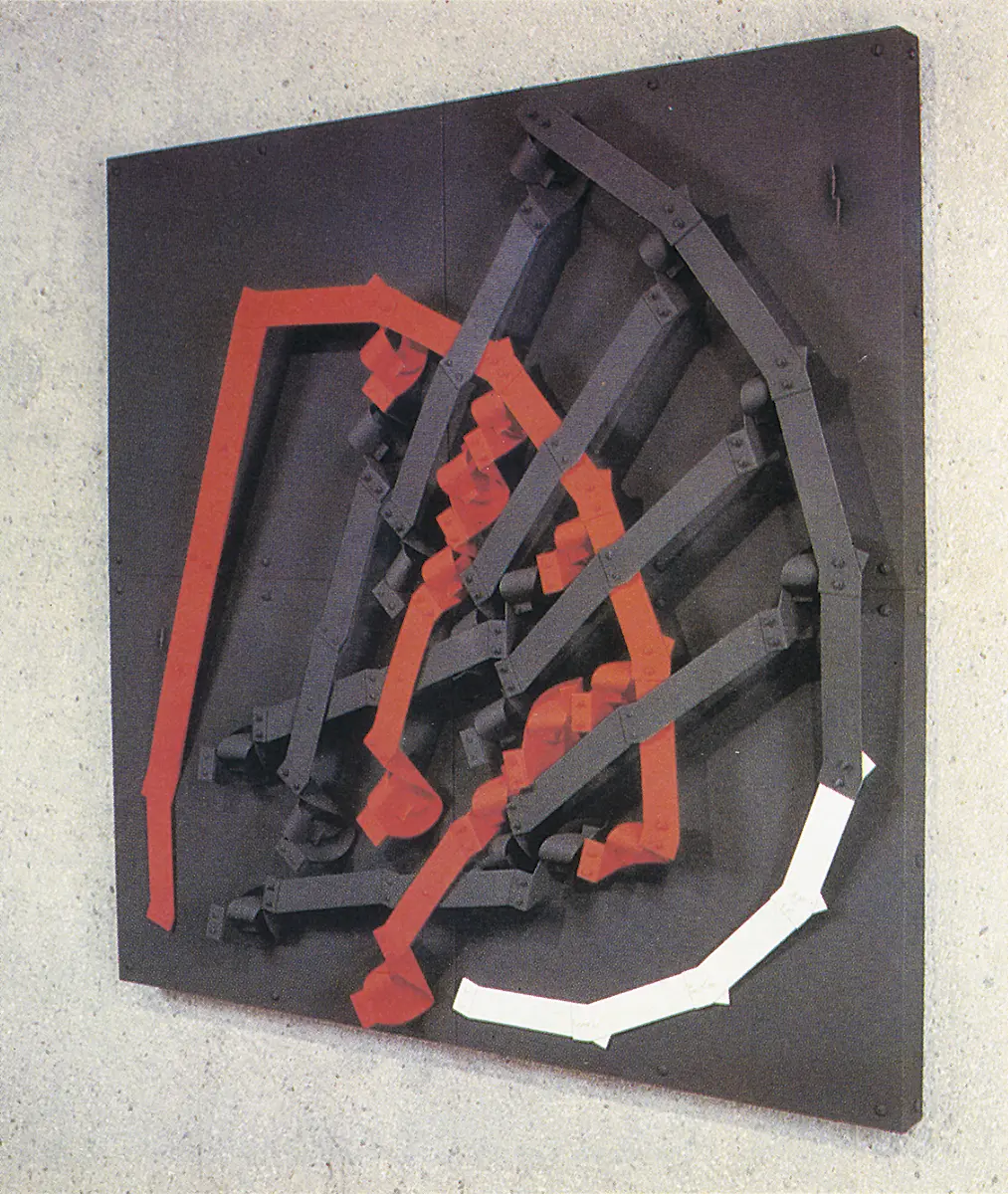
When I confronted the totality of what the Inca civilization offered, I found, for instance, that the themes that would later be included in my exhibitions were already present at the Coricancha, the great temple. Even some that I had already used, such as the trees, the rainbows, the serpent, the Sun, the Moon, all elements that were illuminating for me as magical signals infused at once with mystery and depth. The serpent, for example, is posited as a vertical body, standing on its tail, traversing the three worlds: the world where death is turned into life, the world of everyday, and, finally, the world of the chosen; naturally, the latter was inhabited by the Inca, something like Heaven is for us. Next to those elements that I have taken as themes for my work, there was Huaca, the term they used for all that is different and strange. When the monotony of nature faltered and was revealed through exceptions, that was the Huaca for them. Strange and sometimes inexplicable things. Blind people, armless people, all that was different our outside the norm, all were Huaca. Huaca was sacred and became a kind of divinity. This seemed so rich to me, so impressive, that it truly showed me things that strike a metaphysical and contemporary note but they had asked them since forever. There also appears the eternal conflict between mountain people and plains people, separated by mutual incomprehension. While highlanders adored what was highest, the eagle, the condor, spiritual elements, the Moon, and the Sun, valley dwellers preferred the serpent, the jaguar, earth-bound beings who don’t have the ability to fly but possess a special sensuousness.
Besides this large-scale worldview, there are other myth systems. Lake Titicaca as an epicenter, the Sun locked in the lake, the great darkness that comes until Jaguar appears to light it all up with his scintillating eyes, all of this, the religious element, was used with the purpose of domination: as a means to communicate their truth and triumph.
What can you tell us about the use of a color like yellow, which had been deployed sporadically but was then fully incorporated, and others like those of the rainbow?
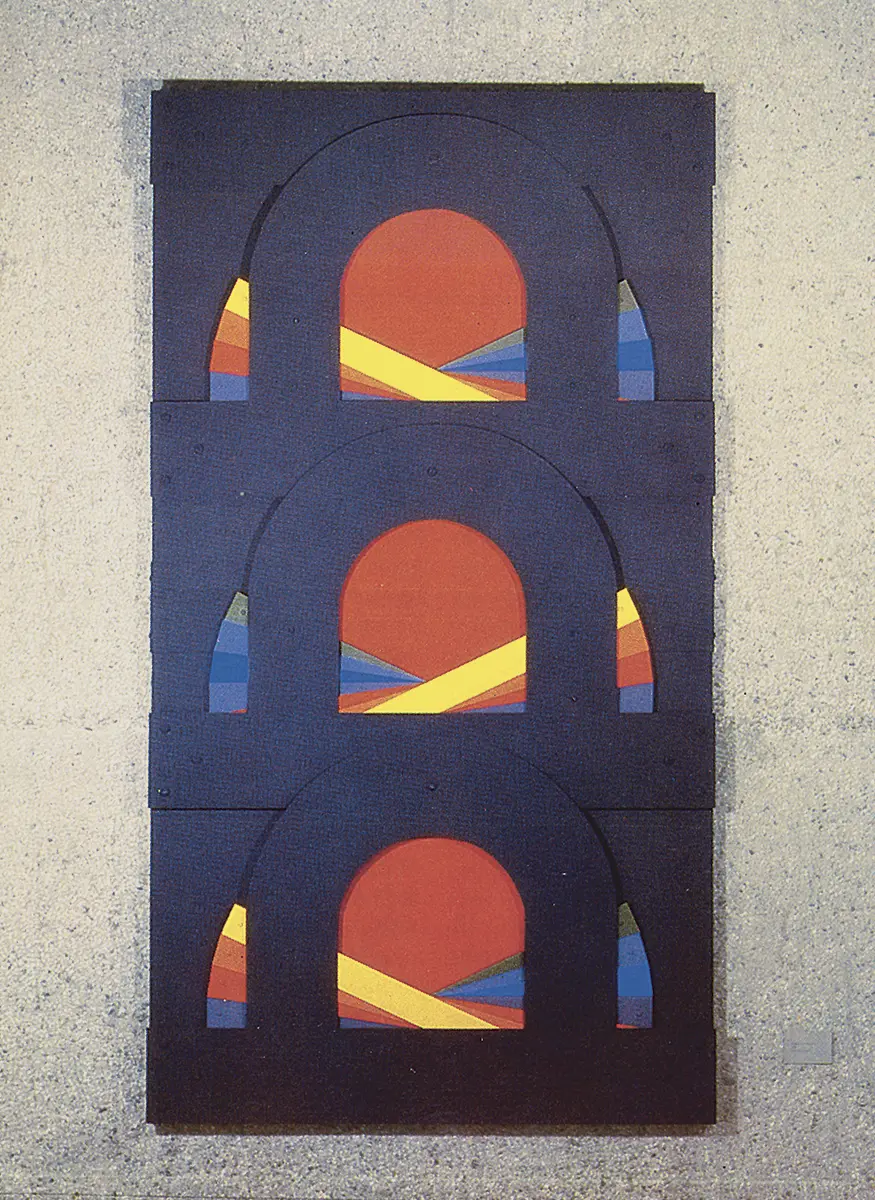
The color yellow is a symbol of gold. The Eclipses I did in the 1960s using Plexiglas were sporadic. Later I revisited this color for the suns, the caves, and other works that had to do with El Dorado as a myth and sign of wealth. With regards to the Inca flag, with the seven colors of the rainbow as a totalizing element, the Inca thought and were convinced that they were the center of the universe; for them, the world they knew was the only one possible, so I realize how important it is for me. The Inca flag demanded seven colors, and I decided to do it.
With respect to conceptual and formal influences from the pre-Columbian world, what have been the results of these ideas in your recent work?
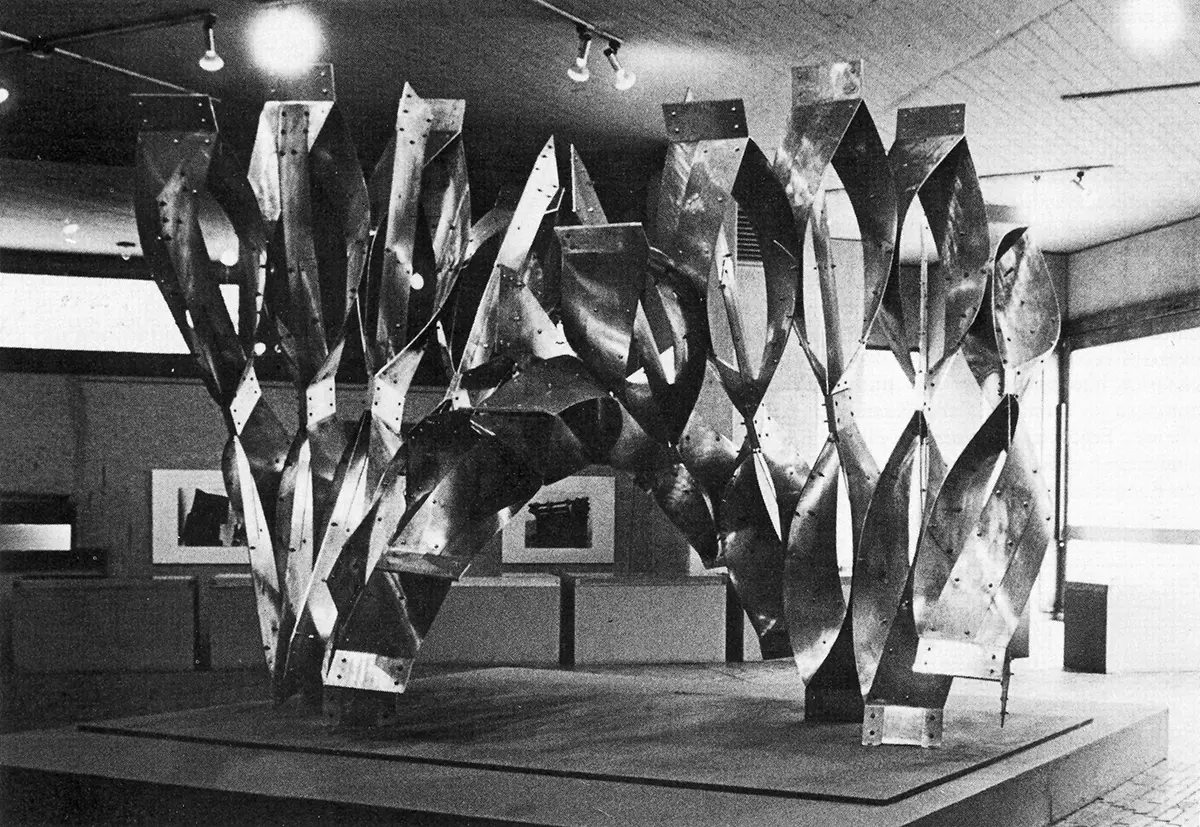
What I do is connect the expressive forms already acquired, from an engineering, mechanically-marked world, to the themes that develop and adapt to my way of seeing things. Themes concern me tremendously now. They have enriched my form; for example, in my most recent works, Terrazas, a crease becomes an expressive element that gives articulation to the dorm. The terraces are elements of the landscape that have been corrected by human hands, altering and folding the natural order. These works show clearly a contrast between baroque elements and forceful, clear spaces. It is an interpretation of the language that adapts to my machine-focused vision.
The theme of the Cóndores was also posited on the basis of the myth that presents them as sacred characters, filled with majesty and grandeur… my solution was to begin with a large symmetric, imposing, and violent element. At the same time, I am obsessed with that exact repetition of shapes. Not only in the elaboration of the same element at different scales but in the correspondence between two phases.
In Casa de la Serpiente, the problem is to create a great contrast between the rotund, heavy design of the setting, and the winding lines that move inside it.
In truth, each work and now each theme is an adventure. Contrary to what others think, I don’t feel disappointed every time I finish one of my works; for me, it is the other way around, I am even more astonished at everything that happens. Truly, each form I set for myself begins from scratch, and the final results surprise me.
What was your direct experience with the archaeology and the landscape of the Andes?
When I was in Peru, in reality, I found an anti-Inca undercurrent, which accused them of having been imperialistic. Even knowing that their purpose was to impose their religion and social system. In truth, they practiced a socialistic system that, had it been continued, would have prevented us from having to seek it somewhere else later on. It was a tragedy to lose it. That exemplary social and political organization generated in this continent and on this landscape is what touched me most deeply. I have read about aspects of the Maya civilization with great interest, but it never moved me like my experience with the Inca did.
The Inca had a very clear understanding of abstraction and geometry and their relationship to them; this aspect interests me particularly. When one looks at their production, one sees the world of Klee, Mondrian, and Miró already formulated back then.
How are you able to give materiality to the idea based on the themes you have? Can you talk about your construction system, the sheets, or the design of your modules?
I don’t really have a special system. I start with a general idea, which I bring my way to my acquired world, and I find solutions. For the Terrazas, I found some aerial elements that solved that first rotund, heavy impression.
It is a marvelous thing to be able to bring the past into our present. That contemporariness has always interested me, I have never attempted to disguise the materials or the elements at the foundation of my work. Naturally, in order to talk about ancient matters, one needs a contemporary language, able to communicate today the great impressions of the past.
MIGUEL GONZÁLEZ
Professor, curator, and art critic.