When we say that culture in Latin America and the Caribbean is the result of a crossbreeding between Europe and pre-Colombian America or Africa, we are thinking above all of an ethnocultural fusion, and we tend to forget that its actual formation was at the same time the result of a historical-cultural hybridization. Emphasis is placed on a synthesis of different races and cultures, although little attention is given to the fact that the syncretized cultures differed not only in their respective identities but in their degree of historical development.
The origin of Latin American culture, both Western and non-Western, was not determined solely by an ontological crossbreeding of Europeans, Indians, and Africans as such. It also involved the integration of men living under feudalism and capitalism with men formed under primitive communal systems, with “Asiatic production methods” and other forms belonging to the pre-capitalist era. In addition to this syncretism at the level of consciousness, capitalism in the Americas adopted archaic methods —slavery, land tenure systems, etc.— which were characteristic of earlier production methods.
Latin America has been like a time machine and we Latin Americans are also hybrids of time. This has meant that in our consciousness there still persist with remarkable force ways of thinking which are both magical and mythological, which dominate consciousness at specific stages of economic and social development and —an even more characteristic aspect— which form an organic unity with Western thought, typical of capitalist development. The genetic integration of the fantastic and the “primitive” with the Cartesian and the modern has been the basis of such notions as the “marvelous reality” and “magical realism”. On the other hand, synthesis has many forms and proportions, and if it is correct to speak of a general process, then this too will occur in phases that also vary according to the specific cases, with indigenous masses who to a large extent still retain their original culture. In this way, the Americas are a multicultural and “multitemporal” conglomeration.
The art of the Cuban Manuel Mendive (Havana, 1944) is the result of all these special circumstances. He was brought up in a family that retained traditions of Yoruba origin —the culture of present-day Nigeria which has been very influential in Cuba and Brazil— and maintained in santeria or the Regia de Ocha, a syncretic Afro-Cuban cult which Mendive practices. At the same time, he graduated from the Academy of Fine Arts and studied the history of art. Mendive is not a naif: he is a painter who uses a “primitive" language which is nevertheless within the sensibility characteristic of modern Western art and with professional skills to transmit all the contents of the magical and mythological “primitivism” of his cosmovision. Only in such a context is it valid to speak of the “primitive" dimension of his art. In other words, it is “primitive” not so much in plastic terms as in the actual artist's consciousness.
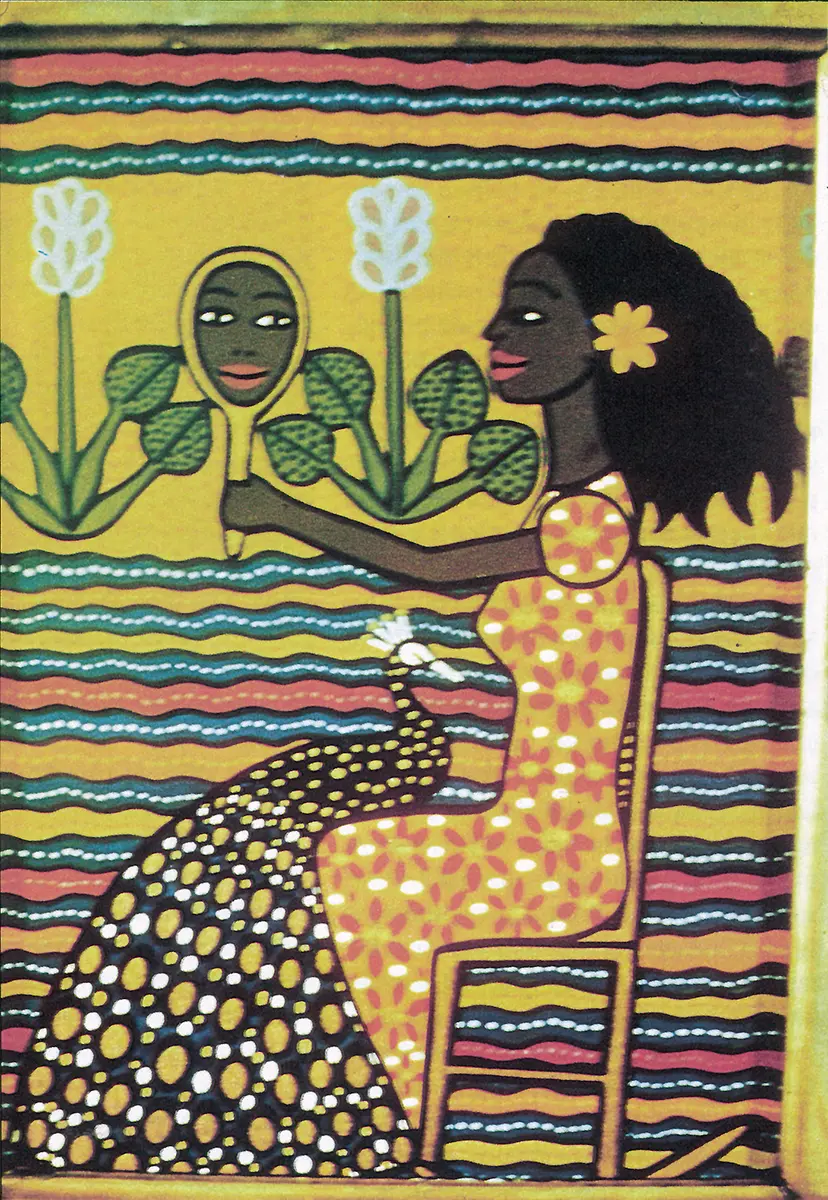
In contrast to the case of Wifredo Lam or the sculptor Agustín Cárdenas, the formal influence of African or Afro-Cuban art is only indirect in Mendive. He uses the basic resources of “primitive” art, its structural and narrative characteristics, etc., more as an iconographical foundation, incorporating an entire language that expresses a vision of the universe.
Mendive makes use of living mythology as a way of depicting the world and reflecting upon the general problems of man. He does so with the naturalness characteristic of many Cubans when they interpret events and situations of modern life from a mythological point of view or when they use magic in their daily lives to influence such situations. And indeed, the painter projects the myth towards life and reality. For this reason, his art, in addition to presenting pure Afro-Cuban mythology with a sense of universality (for example, in Endoko the sexual act between Changó, god of fire and virility, and Ochún, the Yoruba Venus, is shown to be a universal union), deals with historical, political, generic and topical themes within the framework of a mythologizing interpretation. Myth for Mendive is an artistic medium in so far as it is the application in art of a system of daily thought. For Mendive, like some bard from heroic times, mythology is real in the full meaning of the term.
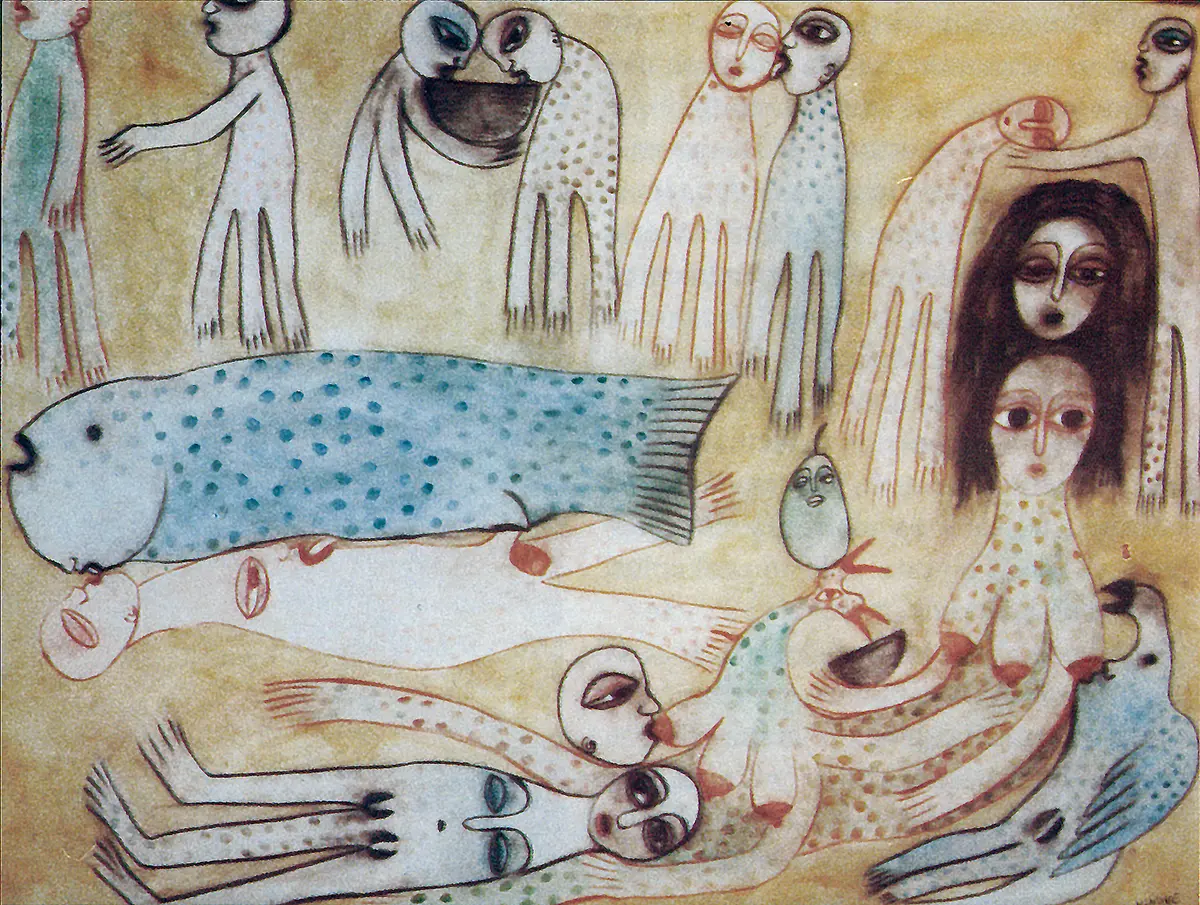
The development of his work can be seen as a process of exploring myth as a vehicle for artistic expression. Mendive began in the mid-1960s with a very lively and profound vision of the myths of Yoruba origin which had been preserved in Cuba, in what to date continues to be the most valuable period of his career in artistic terms. This is the “dark period”: somber works fusing painting and sculpture, made with cast-off materials, medallions, including amulets and pieces of human hair, burned with fire or acid, an impressive manifestation of magical real objects. We could say that these works bore witness to an artistic recreation of myth from within, by a practitioner of magical-mythological thought who is also a modern painter. This is so, without the slightest trace of anything folkloric, because his vision transcended the specific details of myth and emphasized its universality, by reflecting upon life, man, and the world... With his characteristic personality, Mendive was one of the actors on the expressionist stage which offered the best of Cuban art during the second half of that brilliant decade, along with Cabrera Moreno, Chago, Antonia Eiriz, Raúl Martínez, and Umberto Peña.
In 1968, this original orthodoxy began to break up and be replaced by a “clear period”: there was a reduction in sculptural elements and collage and an increase in painting, the expansion of color, stylization, and “sweetening”.
Myth opened up to historical events, daily life, local color, and political topicality, in line with the general development of Cuba during the 1970s. But in the case of Mendive, the process involved an organic development in his own creative urge rather than any forced adaptation to the demands of an epoch –one of the basic reasons for the falling-off of art and literature in Cuba during this time. Some of his works at the beginning of the 1970s are amongst the most valuable of the decade, precisely because they were not typical. Unfortunately, his painting then began to lose much of its meaning and fell into an over-sweet decorative style which persisted until the 1980s.
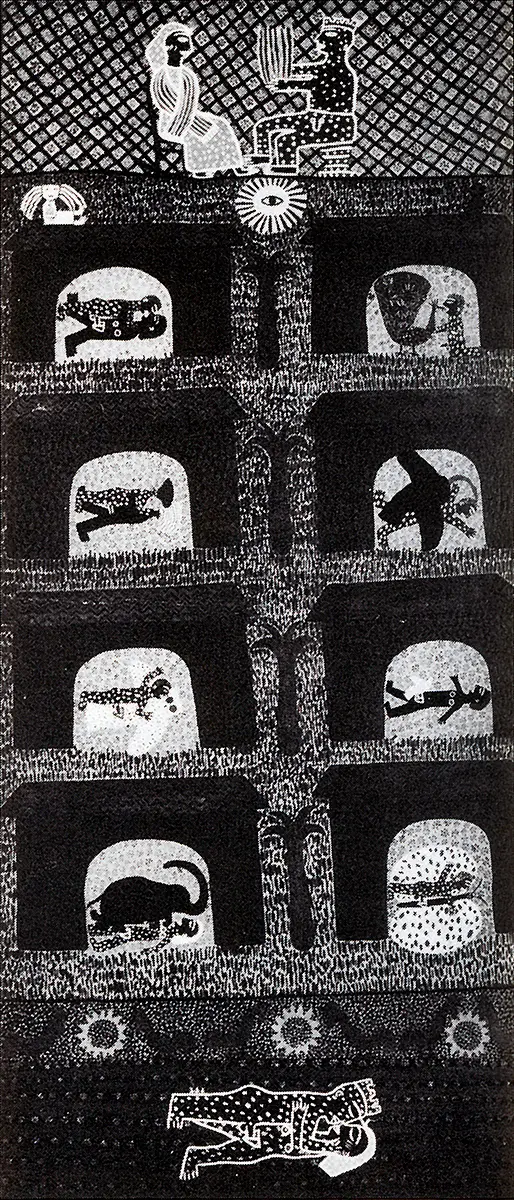
The trips that Mendive made to the USSR and Bulgaria in 1981-1982 led to the initiation of a transitional period. During these trips Mendive applied without any contradiction his artistic vision to scenes that he encountered in these countries, incorporating certain legendary local figures and demonstrating even more that his painting was not just the result of myth as a theme, but also as a method; or, to be more exact, as a cosmovision which acts in an overall manner on artistic creation, daily life, and existential orientation.
But it is above all his trips to Africa in 1982 and 1983 that led to the emergence of a new period in his work. There was an overflowing of fantasy that brought about a frenetic invention of fabulous creatures that were not taken nor inspired by any myth but by his own imagination. The febrile fabulation was accompanied by a certain baroque spirit that attentuated the somewhat static character of his designs, endowing them even today with greater proliferation, dynamism, and complexity without compromising the order in which structures their constructed.
The formal changes included a growing preference for the low key and earth tones, currently reflected in the use of chiaroscuro, transparency, and other more “pictorial” resources, which mark a break with the almost emblematic flat colors and dotted lines of his style. A sort of desire to separate himself from anything that seemed to be decorative and commercial began to appear, a search for a more dramatic form of painting that would emphasize the expressionist component. Even so, his drawing and figuration remained unmistakable.
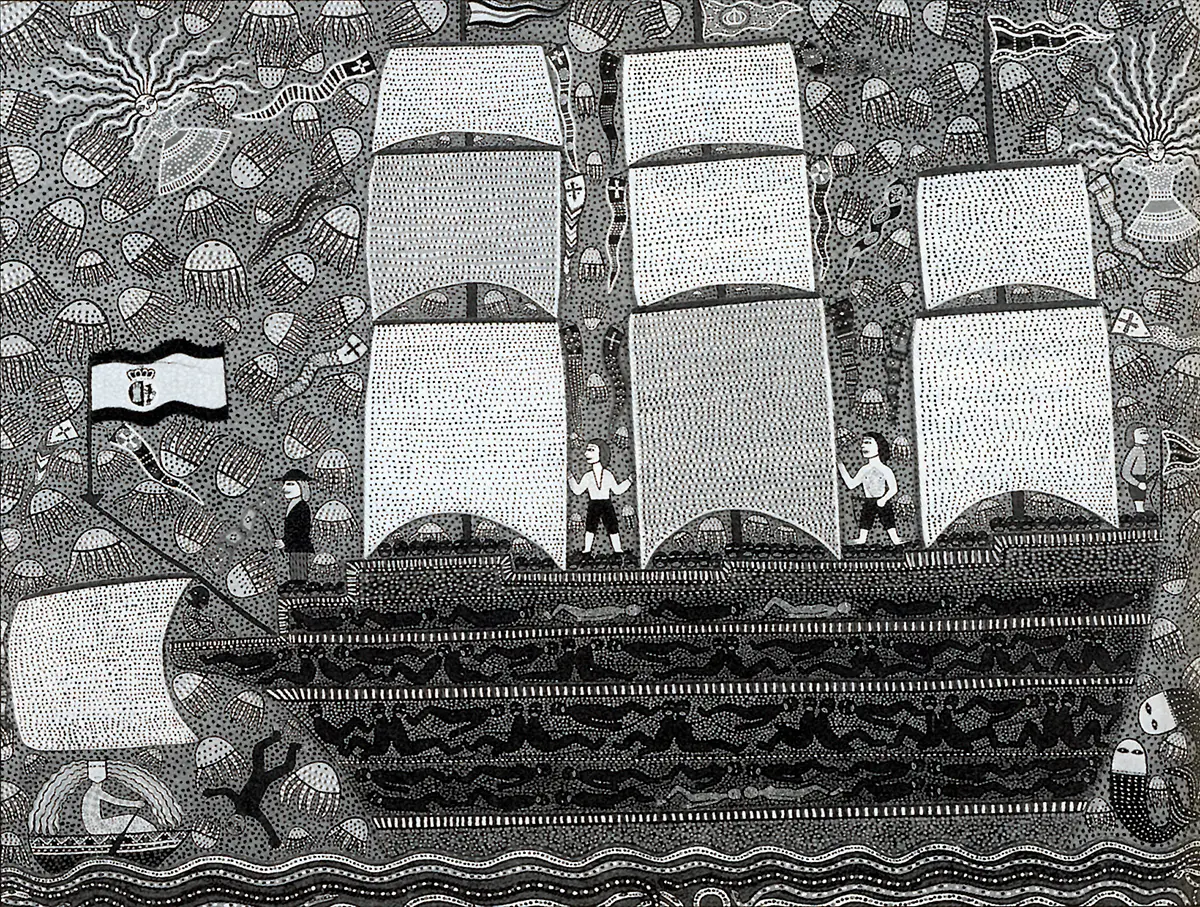
Throughout this new period which emerged around 1984-1985, the gods disappeared, along with the specific references to daily life, history, and current affairs. The images became more general, more abstract. Mendive likes to say that he is offering us life itself, and indeed that is what it is. His painting is a metaphor for the elemental forces of the world, an anthropomorphic world in which nevertheless man is not at the center, but only an element in the order of nature. It is a “living nature” —to use a phrase that Fernando Ortiz applied to Lam— in which everything is animated in the most literal sense of the word.
We are face to face with an artistically determined animistic and mythological vision of reality in which the latter is interpreted as a system that guarantees the balanced transformation of everything that exists. Men, animals, plants, and mountains participate in one another and lose their taxonomy by being fused in a kind of vital continuum. Rather than elements they are functions of a cosmos that devour, love, communicate, and give birth to one another, in a chain that establishes a universal equilibrium. A “fantasmagorical ecology”, as Robert Knafo has said.
Myth has disappeared as a basis for anecdotes and becomes the foundation of the artist’s methodology. Now it is “below”, facilitating the projection of Mendive’s fantasy, an imagination that is systematic despite its exuberance. For this reason, it is not only the narrative character of this painting that recalls the novels of the Nigerian writer Amos Tutuola, which are a linear succession of events with fantastic beings, closely related to the Yoruba folklore tales and not to religious myths. Several painters of the “Oshogbo school” have also given free and personal expression to fables taken from oral traditions. This appears to be a tendency that is common to many modern African artists who have not had any academic training.
Of course, I am speaking only of a similarity that may well have its oblique cultural bases. Mendive is a professional, although his origins are working class, and was brought up in an environment that preserved African traditions. He is an artist who neither in his work nor in his personal life has broken with his popular culture. He is now creating his own myths instead of following traditional ones, although they have their roots in tradition and are the fruit of a mythological way of thinking, a mythogenesis that is living and familiar and which the artist has made his own. Mendive is not an African living in the Americas: his very Cuban painting captures the complex synthesis of the Caribbean, its ethnocultural fusion, and the crossbreeding of time. This fusion has occurred in Cuba to a greater extent than in other countries characterized by that multiplicity which the Surinam poet, Dobrú, has celebrated in his verse; “One tree/so many leaves/one tree”. But in the art of Menive, the African source is very powerful, especially the Yoruba traditions, and this can result in transatlantic connections.
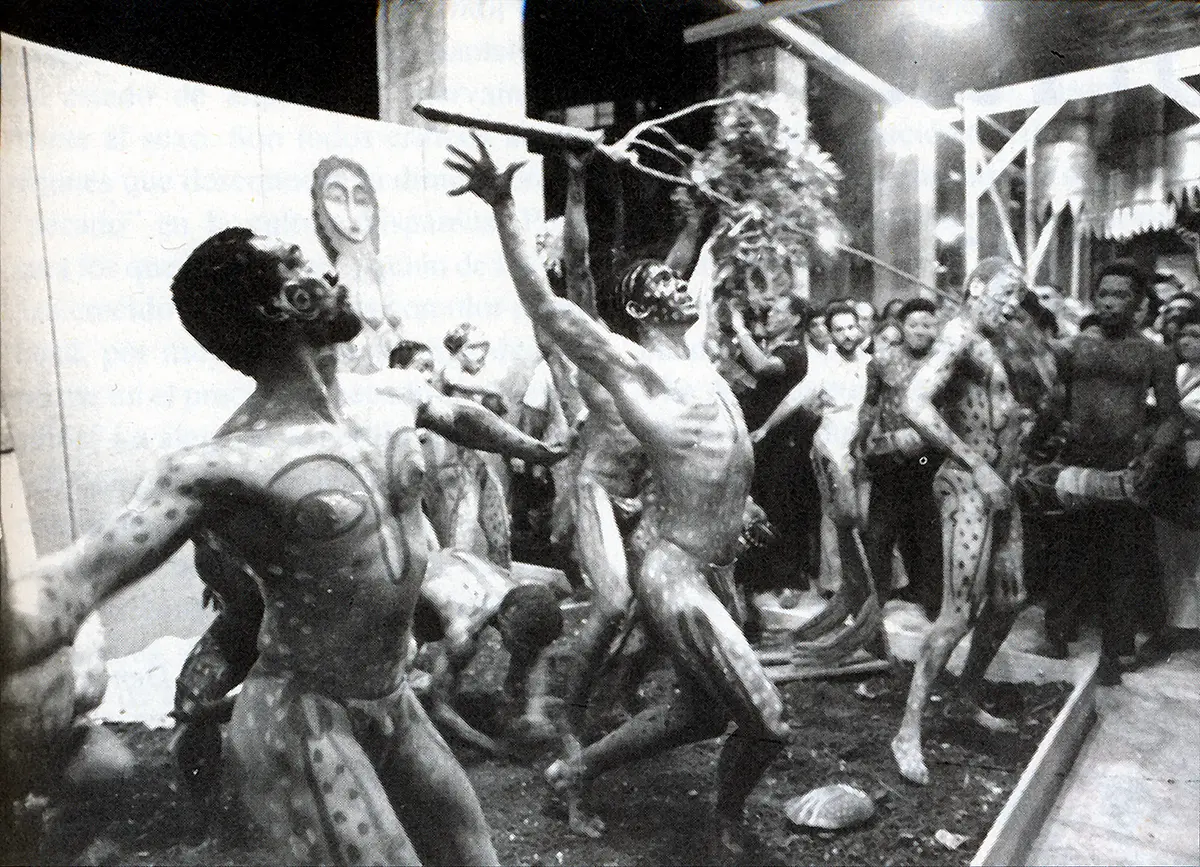
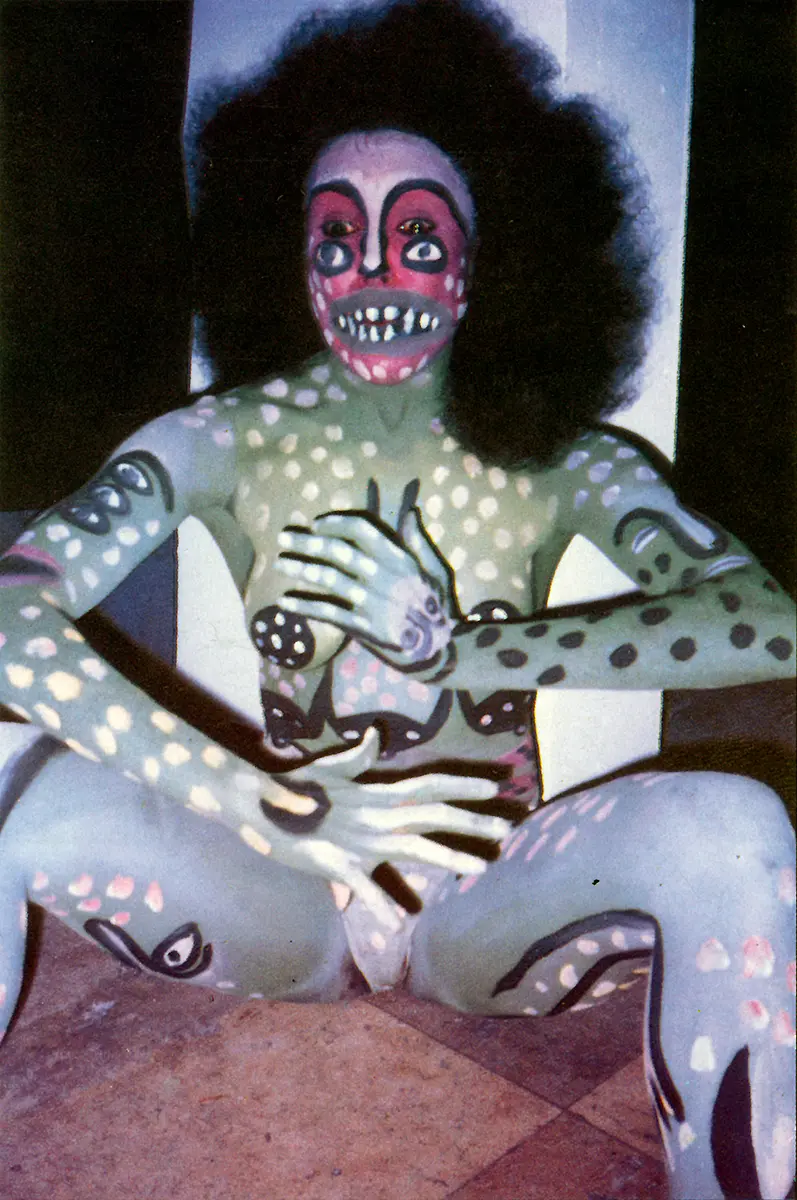
Mendive is now busy with interdisciplinary works in which he paints the bodies of dancers and animals. It is an art full of movement and sound, an impressive mixture of painting, sculpture, dance, music, pantomime, body art, song, sound, ritual, spectacle, performance, masquerade, and procession in which once again “culture” and “popular art” are interwoven. One of these works was awarded first prize at the II Havana Biennial (reproduced on the cover of Arte en Colombia, No. 33); the works were subsequently exhibited in London and Panama and at this year’s Venice Biennial.
Over and above the refreshing morphological bazaar of these creations, their value, when successful, lies in the way they transcend the concept of spectacularity and codify a complex message of strange poesy, consonant with the structure of the artist’s current painting. Once again there is no literal reference to Afro-Cuban dance, ceremony, or myth: the representation is generalized and only marginally allusive. The Afro-Cuban elements are used once more as a basis on which Mendive develops his talent, through the use of bata drums, Yoruba songs, the gestures and movements of the dancers and musicians, and the possible symbolism of the animals that participate... The result is interesting as a spectacle of synthesis, as an ethnocultural phenomenon, and as a meaningful artistic work.
Such acts of courage, when they do not slip towards the carnival atmosphere that constantly threatens to overwhelm them, could prove decisive in the work of Mendive, who is in need of a jolt that will regenerate the freewheeling power characteristic of his early work. At all events, they constitute an unusual experiment in popular communication.