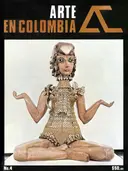
In an exclusive, Arte en Colombia presents this interview with Mexican artist Manuel Felguérez and Colombian engineer Mayer Sasson, collaborators in a singularly important project involving the appropriation by the arts of the most advanced resources of contemporary technology.
INTERVIEW BY ROBERT A. PARKER
For more than 30 years, the work of Mexican artist Manuel Felguérez has explored the language of space. Since his earliest sculptures from the 1950s, through his large mural relieves from the 1960s, to his efforts today to unify the two-dimensional and three-dimensional realms in what he calls multiple space, Felguérez has manipulated reality in search for a new aesthetic vision.
The content of Felguérez’s work, to put in the simplest way, are geometric shapes. The artist acknowledges that his oeuvre has been greatly influenced by the visual images of today’s technology. Las year Felguérez took a key step in his effort to express the characteristic features of reality (shape, color, texture, size, proportion) and combine them in two dimensions, so that, as Octavio Paz has said, multiple spaces open in silence before us and become another space, to the point that they believe in and build themselves in front of our eyes.
Given that he word with symbols from the world of science (circles, triangles, squares, etc.), it should not come as a surprise that Felguérez sees science as a basic ingredient of our culture. But his decision to use technological resources may have been truly inevitable. This is why, as if he had made a count of the years of creativity he had left, Felguérez took on the computer for the first time at the age of 48. He is perhaps the first artist to use a space-age device in order to dominate the time he needs for creative explorations.
Manuel Felguérez’s work has been exhibited in Europe, Latin America, and the United States for more than 20 years. In 1975 he received the Grand Honor Prize at the 13th São Paulo Biennial. Last year he was the recipient of a Guggenheim fellowship to attend Harvard University, and there he continued to use computers in his exploration of “multiple space”. His success in this effort was not complete until he met in New York with his old friend Mayer Sasson, the internationally renowned Colombian electronics engineer, author of more than 50 papers on computer-related subjects and a fixture at international seminars and conferences in London Barcelona, Bucharest, São Paulo, and New York City. The pair began to collaborate in early 1976, and the initial results where exhibited at Harvard’s Carpenter Center that same year.
Although Felguérez’s work with computers must not be allowed to obscure the aesthetic scope of his entire work, the use of these devices does satisfy his criterion that art objects must include new and original elements. And, naturally, the attention of the art world and its audience focuses on what could become a revolutionary technique of true historical import.
Why did you begin using computers?
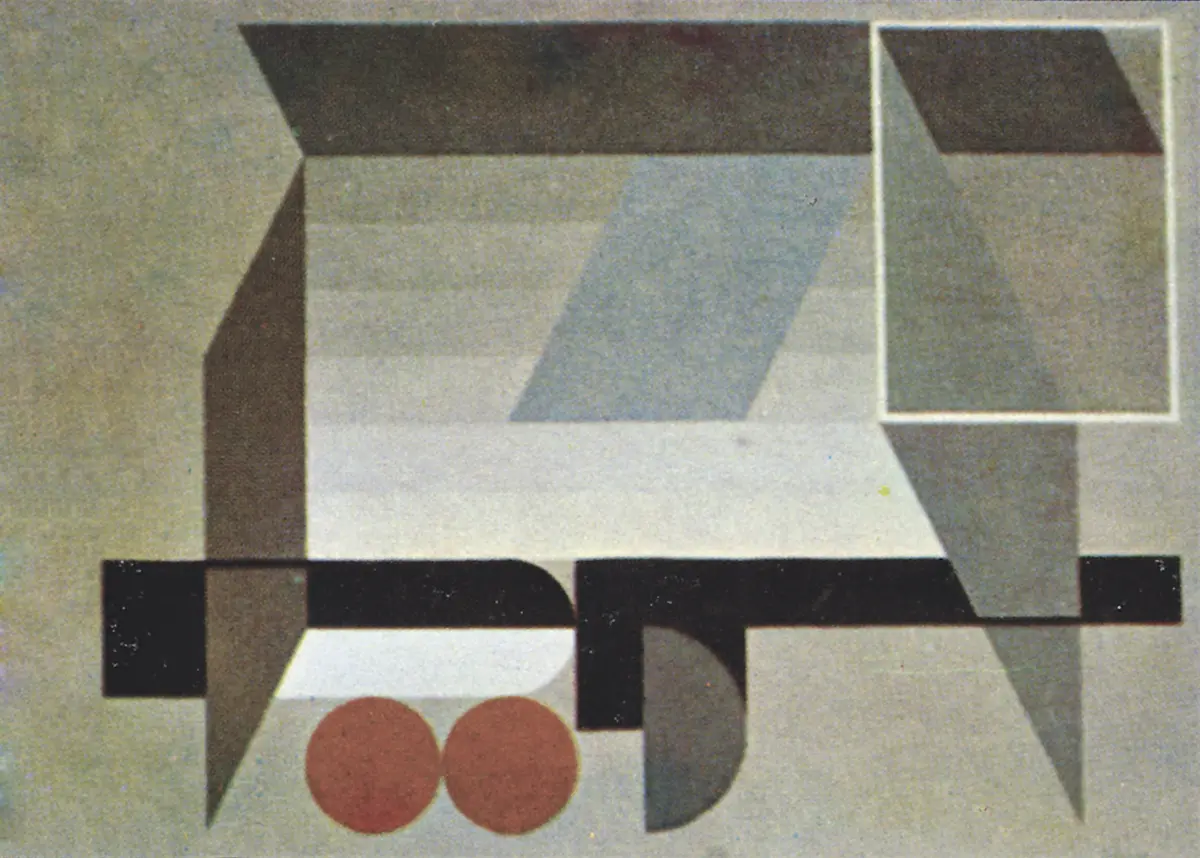
Felguérez: Two reasons. First, the fact that since 1967 my work has been based in the construction of geometric shapes. When one works with geometry, one begins with mathematics. And, what better instrument can there be for mathematics than a computer?
The second reason came out of the classes I taught at Universidad de México. When you teach art, you encounter two different knowledge fields: one that is rational and one that is irrational. The latter cannot be taught, because it depends on sensibility. But rational knowledge can be taught, and in doing so I was surprised to see that I was using the resources of logic and mathematics. My style was conceived in mathematical terms, and this made me wonder whether computers could be of help. But I wasn’t sure about they could do, so I decided to use them in an intuitive way. Nevertheless, before I actually set to do it I went through three years of analysis and three more years before I started working with Mayer.
How do you answer those who say that the computer is a false aid, not a legitimate tool for an artist?
Felguérez: What you describe is a common reaction. If the computer was the creator of the work, I would be in agreement with its detractors. But if the machine can serve my creativity, what is wrong with that?
When a engineer or a scientist use a computer to augment their creativity, no voices are raised in protest. It must be said clearly that a machine is creative only because the person who uses is creative. And if the machine can have its own artificial intelligent when it is manipulated by an intelligent person, couldn’t an artist, as a sensitive individual, find ways to put his sensibility in the computer? I think the answer is yes. And I also think that the success of my work, its originality and the collaborative work e have developed, come from having fed into the computer’s memory a knowledge that is entirely subjective.
Isn’t there a risk that the computer influences your ideas more than is convenient?
Felguérez: No, because from the beginning, in Mexico, I tried to relate to the computer from the standpoint of what was already my style. An artist’s style is as distinctive as his fingerprints. I sought to identify the features that defined my style I didn’t care whether that style was good or bad; what mattered was that, after 25 years making art, my work possessed a language ruled by a syntax that only I used. And it seemed to me that if I was able to input into the computer the combination of elements that make up my style, and kept the work of the machine strictly within those boundaries, then the computer would be unable to invent anything new, or go beyond.
Sasson: At this point I want to interject a couple of comments. First, I think that there is a possibility for the computer to break the boundaries of Felguérez’s style. Because, in the same way his ideas may change from one year to the next as a result of experiences he could not have foreseen, the computer can discover their possibilities and anticipate them, based on the information he has been given the machine but the ultimate meaning of which he ignores. The second comments refer to the fact that the majority of people believe that a computer is only useful t make mathematical calculations at great speed. What the public almost always ignores is that a computer can follow any logical sequence of ideas. It can be used, then, to study philosophy, since that discipline is based on logic, which in turn is structured by mathematics. Mathematics are the universe of the computer. So that the device can be used to carry forward the most basic thought processes. From a conceptual point of view, there is no difference between saying that three is greater than two, that A is different from B, or that idea A is more general than idea B. Because ideas relate to each other in the same way numbers do. I want to be very clear on this, as I have always tried to make it understood that many important aspects of human thought can be expressed by mathematical means.
How did you begin to reduce Felguérez’s art to mathematical formulations?
Sasson: The solution was to analyze Felguérez’s style in order to discover its essential features. This is what he had done, and it implied defining thousands of intangible laws. We decided then to move in the opposite direction, observing his works in order to build a model through the synthesis of many components. This is what is called systems identification.
Felguérez: Already in Mexico I had discovered that my geometric constructions could be reduced to fifteen basic forms. After many years of analysis, I knew that the greatest number of circles I had ever used in a single work was 10, and the least was 2; the greatest number of rectangles I had used in a single work was 15, and the least was 5. And I had also studied the relative size of each shape, the largest and the smallest shapes I had used, and the position of each within the format of the painting. What was most fascinating about all this was that, since artists work intuitively, I had never before had this information about my own work. And it wasn’t until I spoke with Mayer Sasson that I found simple ways to translate it all into a mathematical language. One of his ideas, for example, was that by working with a square in a two-dimensional space and with a cube in a three-dimensional one, we could determine the localization of each shape using two numbers for the square and three for the cube. Similarly, we could program their sizes using numbers for their height and width, or height, width, and depth. Today, as Mayer has suggested, the identification of the system that exists in my mind has brought a new richness to my work.
Sasson: The computer is like a new set of eyes to look into oneself.
When an why did you begin discussing these matters with Mayer?
Felguérez: In 1975 I created my first computer-based work, in Mexico, but there were defects that I couldn’t solve. Then I received a Guggenheim Fellowship to travel to Cambridge, Massachusetts, where MIT and Harvard are located and where I could use the most advanced computer technology in the United States. In one of my trips to New York City, I noticed that Mayer was very interested in what I was doing. You could say that I set snares for him to participate in my work. In truth, it was great, because in more than we sense we were speaking in the same language.
Mayer, and what did you think of Felguérez’s idea?
Sasson: In immediately took his concerns to the terrain of my own preoccupations in computer research. This was doubly stimulating because, frankly, a specialist in my field encounters very few people with whom to talk passionately about what we do. Besides, I had been interested in art for a long time, as it is my wife’s profession.(1) In one of his visits to our home, Manuel and I debated until the wee hours. The next morning, I made several calculations and at breakfast, discreetly because I was afraid of offending him by seeming to preempt something that was entirely his, I asked him if he would be upset to hear some suggestions. He answered that the only thing hat could upset him would be not to have a chance to hear my ideas.
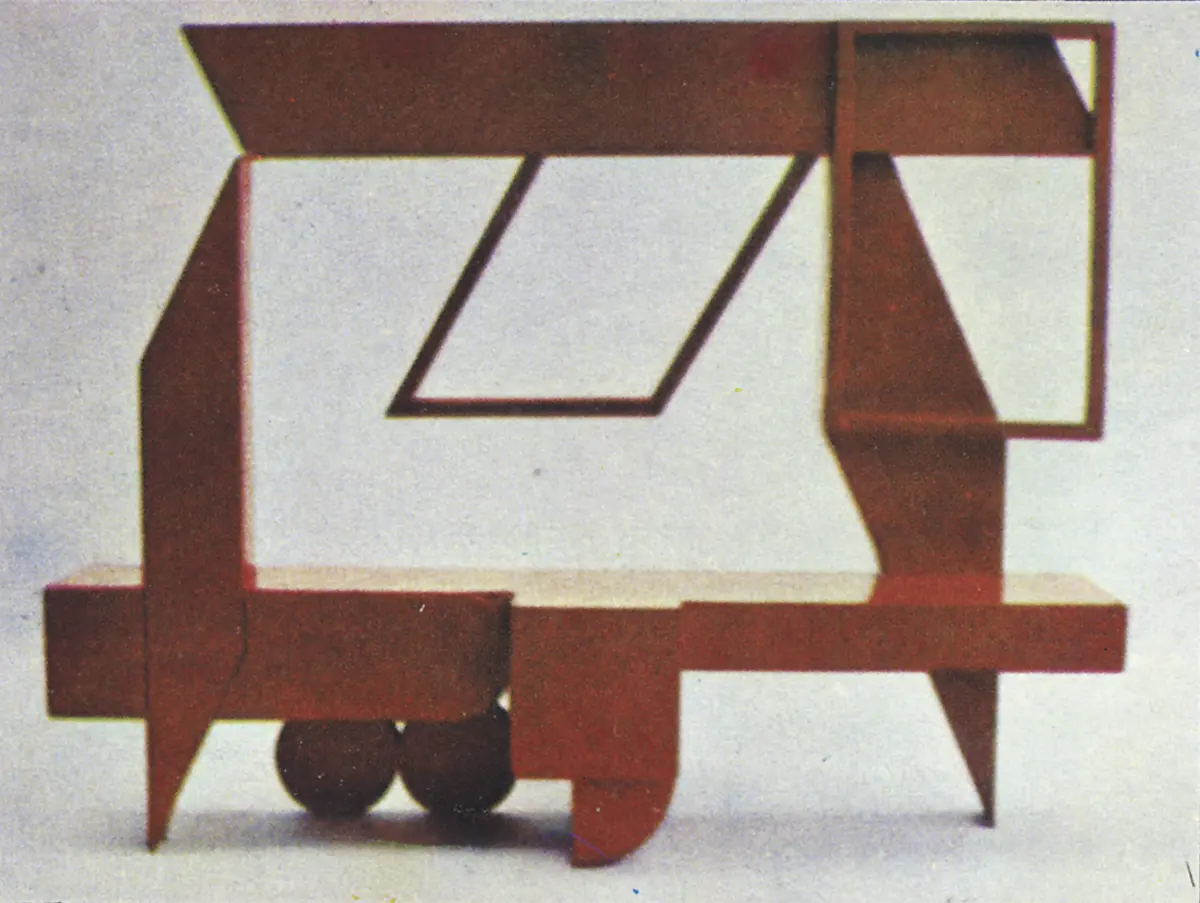
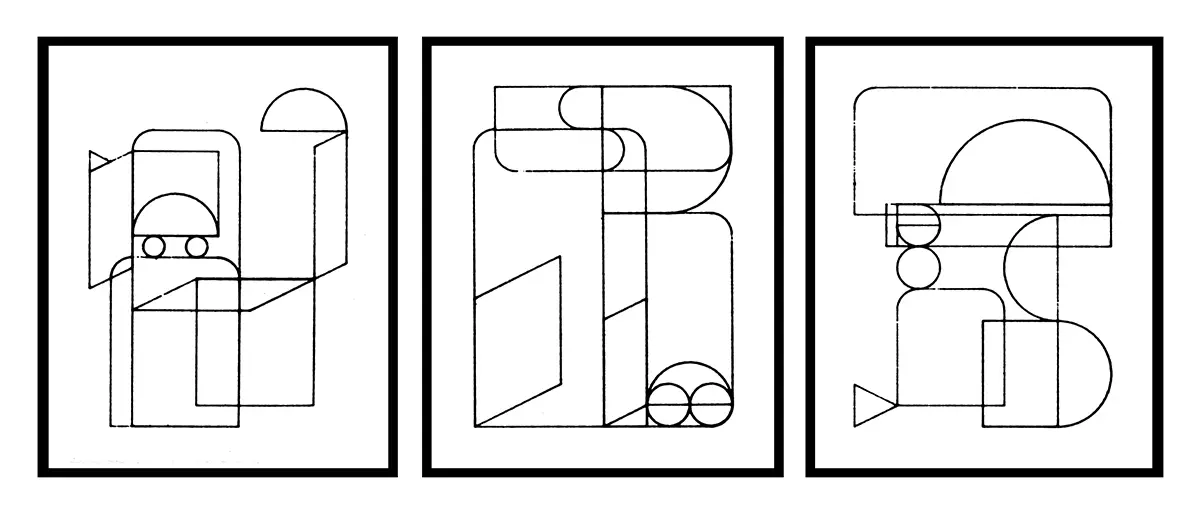
Felguérez: since Myer was in new York City and I was in Cambridge, we worked out the initial concept by mail. I had already analyzed 300 of my paintings and had selected 50 that I considered the most unique ones. In that way, the model we were to create would reflect the wider scope of my ability to invent shapes. We then trimmed my basic shapes from 25 to 8, and for each of the 50 paintings I had to turn the quantities, sizes, and positions of the basic shapes into numbers, using the system designed by Mayer. I sent him the numbers and Mayer’s program turned them into 50 sketches, which I then reviewed to verify their precision. In three months we had summarized my 25-year career and translated it into a set of equations that we called mathematical models. Then, we instructed the computer to produce, working within the boundaries of my style, a first set of drawings following the rules specified by the model. I think that this step in the process is comparable to what an astronomic observatory foes with a comet approaching Earth: recording the information derived by its 8-day of visible presence, the observatory can predict the course of the comet thousands of years ahead. Those sketches were like observing the proverbial 8 days of my work.
Sasson: Once we obtained the mathematical model from the 50 sketches, we asked the computer to produce the first shape ideas as linear drawings, which we arbitrarily reduced to 208. It was very exciting to get the initial results, because up to that point it had all been entirely theoretical. But when Felguérez saw the first drawings made by the computer and exclaimed that that was indeed his world, I knew our experiment had been a success. From then on it was a matter for the artist to select 54 from among the 208 drawings to work on. Then we put the 54 revised drawings, which were new information, into the computer, alongside the previous 50 ones. With this feedback, the computer produced 208 new drawings, each one of them represented an enrichment that Felguérez found even closer to his current style. From this second group of drawings, he decided to work with those that seemed to have the greatest aesthetic potential.
Felguérez, what is the mental process when you begin to transform the computer drawing into a creative work?
Felguérez: That process has an emotional and a rational component. From the set of 208 drawings the computer puts out, I choose those I like best, and that is a strictly emotional and subjective decision. Because I don’t know why one is more appealing to me than others. But once the choice is made, the rational part of the process begins. I may decide that the circle here needs to move there, and that the size of this rectangle, which I subjectively like, must be reduced for compositional reasons. In sum, I decide which drawings justify the weeks or the month it will take me to make them into a painting or a sculpture.
Do you think you will have enough time to work on every drawing you have selected? From the first 22 formal ideas, only 18 oils and 10 metal sculptures were exhibited at Harvard.
Felguérez: If I were able to work as fast as the computer can, undoubtedly I would create a marketing problem. The computer produces a linear drawing in only ten seconds. What will likely happen is that I will get bored after a few paintings and by then my ideas will surely have changed. At that time, there will be new information to be fed into the computer, and I will in turn receive new formal ideas or drawings that will stimulate me anew. In this way, we will create a system in order to break it afterwards, so that we can create a new system that will also be broken. Due to this continued state of change, the system remains alive and my creativity is constantly being challenged.
What pathways do you foresee for your computer-based work?
Sasson: For now, the drawings are schematic and only show us the outlines of shapes. But we could introduce other elements, be it shadows or textures, to create richer surfaces. We could also introduce sculptural elements to add another dimension to the drawings.
Felguérez: Before I started working with computers, I was already concerned with the possibility of changing the two-dimensional shapes that characterize my style into three-dimensional ones, following the logic of their own construction. This is why in Harvard I exhibited not only paintings, but also sculptures intended to prove that ideas of form can unfold in space. In this way, I burrowed even further in my theory of multiple space. But this kind of inquiry doesn’t have to be exclusive to the visual arts. Nowadays, we have musicians and poets who investigate the possibilities of the computer. And they are getting closer and closer to reaching their goals. But I believe that ours is the first case in which the computer’s aesthetic capacity has been demonstrated.
Sasson: And it is possible that, even as we speak, another artist helped another electronics engineer has confronted the same challenge in a different way, to pen up territories different from the one we have already explored.
What future do you anticipate for your way of approaching art? If the times change, do you think it will lose its validity?
Felguérez: Nobody can answer that question. At least y work will remain as an example of what was done in the Twentieth Century. On my part, I know than when I show critics my computer-based art, those who were familiar with my previous work thought it was a logical evolution. They didn’t speak of novelties or distinctions, since the computer process was not what interested them. I think they wee surprised by something that is so new in the field of art, but they did recognized as mine. In it you still find the balance and simplicity of forms that relate to each other in terms of size and color to create a harmony equivalent to that of music, which lacks symbolic meaning and is simple pleasing to the eye.
Are you saying that your art, by itself, will determine its validity in the future?
Felguérez: Yes, because I have never wanted to believe that a work of art requires explanation; not even those that refer t the process used to create it. Nevertheless, when we look at a Greek vase from the year 800 B.C., an understanding of the historical and cultural context of its origin can enrich any appreciation we have of it.
Sasson: In the case of his work, however, many are disconcerted by the fact that the computer acts as an enhancing agent. They forget that each new works emerges from the artist’s total experience, and that the creative process is usually the result of many complex factor that mature slowly in the creator. People want to see and understand immediately.
Felguérez: History has already taught us that those who understand more quickly are those who were previously interested in the field in question. I mean that the first to discover a new composer are other composers, and the first to discover a new artist are pother artists. Why? Because those who have a prior interest, this is to say, the professionals in the field, understand not only the visible results but also the process.
Sasson: Generally what follows is a period during which the work of art reaches it own value.
Felguérez: Our work, however, is too new to have reached that level.
NOTE
1. Sasson’s wife is Bogotá-born Colombian artist Fanny Sanín. Her work with large bands in homogeneous colors, seemingly modulated on the basis of logical reasoning, reveals her fascination with shapes equivalent to those that would comprise some kind of universal language. In light of his comments in this interview, it is not difficult to imagine the influence Sasson may have had on Sanín’s aesthetic vision.
ROBERT A. PARKER
American writer.