With his multiplicity of political and religious readings, with his accurate aesthetic reference to the past and to the avant-garde, Elso managed to create a visual icon that expresses itself not collective property.
LUIS CAMNITZER
Sometime in March 1988 the Cuban artist Juan Francisco Elso Padilla was diagnosed as having cancer. Eight months later, at the age of 32, he was dead. In a sense, the whole process was more painful for those of us he left behind. His image of the world and of himself allowed him to reduce his demise to the scale of a small incident. During the months of his agony, Elso wrote: "For me art is a long process of apprehending the world and myself as part of the world. The processes and perceptions are more important than my work. They operate almost like a kind of mystical apprenticeship experience and give form to my attitude towards life (...) All this experience is based on a Latin American spirituality which only now are we beginning to project as a system of values. (...) This development will produce cultural changes and some of us will be its modest forerunners. ".1
With the death of Elso his work will now be evaluated in ways which he would probably not have liked. Within the context of an open-ended future, his work was a solid basis which promised much. Confidence in a process of self-betterment which would occur in his as yet uncreated work made for a sharper critical response to the work which he had actually done. With the cruel disappearance of that hope, what was a mere prelude has now become the final symphony. A critical assessment of his work must now be limited by his interrupted production and its true dimension would require the mounting of a retrospective exhibition.2 However, it is clear that Elso was not simply a “modest forerunner”. With exceptional precision, he achieved a strange fusion of secularity and mysticism, magic, and ethics. This fusion was present in all his actions, both in his art and in his life. The constant oscillation between the questions and answers which constituted his inner dialogue might be interpreted as a game pursued within idiosyncratic parameters. In a different kind of society, this could have led Elso to an alienated individualism. But he lived in Cuba and his lucidity, his almost physical awareness of forming part of a complex social fabric, his pantheistic vision of the universe, all this became transformed into what was perhaps a “Latin American spirituality”.
Elso was imbued with spirituality, without thereby losing his commitment to the socialist ethic. This fusion, which he called a dialectic, defined him as a Cuban. It also helped him to transcend himself as a Latin American. He wanted to depict “Marti and Bolivar taming the heavens". He spoke of “a death mask which could look out at one and encourage self-awareness, along with the instruments with which the world was created and other pieces which represented the ethical bases and mechanisms of the universe."3
The suffering and hopes of Latin American were the raw material which fueled the work of Elso, a fuel which he absorbed through his very pores. While this gave him a precise sense of direction, it also became a burden that he had to bear. His work was produced at a painfully slow pace. Each little twig and clod of earth which he used “was" the universe. In a sense, there are no means but only ends in his work, infinite and tiny ends which taken together form a grandiose whole. If there was a means, it could only be himself, conceived in the most modest way possible. The slowness with which he worked is now a source of resentment and rage, like his death itself. But this is nothing more than an egotistical fury, a consumer-like rage which contradicts all the things which Elso himself symbolized.
Elso was part of the Cuban Renaissance, the process of artistic renovation which began shortly after Armando Hart Davalos took over the Ministry of Culture. He was one of the artists included in the exhibition 6 New Painters4 which was planned for 1978 but subsequently canceled and in 1981 formed part of Volume I, an exhibition which was considered to be the vehicle for the transformation of Cuban art. Like many of his colleagues, he was interested in the dynamics of colonization suffered by Cuba and the Latin American continent and, at the same time, in santería. But his main emphasis was placed on mythical pre-Spanish America. His interest was not limited to the reorganization of nature or as in the case of other artists in the possibilities of rituals linked with origins. Elso pointed towards new mythology, a continental one; conscious of its history. He was very close to Ana Mendieta, both as a friend and from the esthetic point of view. Many of Mendieta’s works appeared to rely on those of Elso, but whereas Mendieta worked introspectively, Elso tried to transcend individualism and achieve a continental dimension.
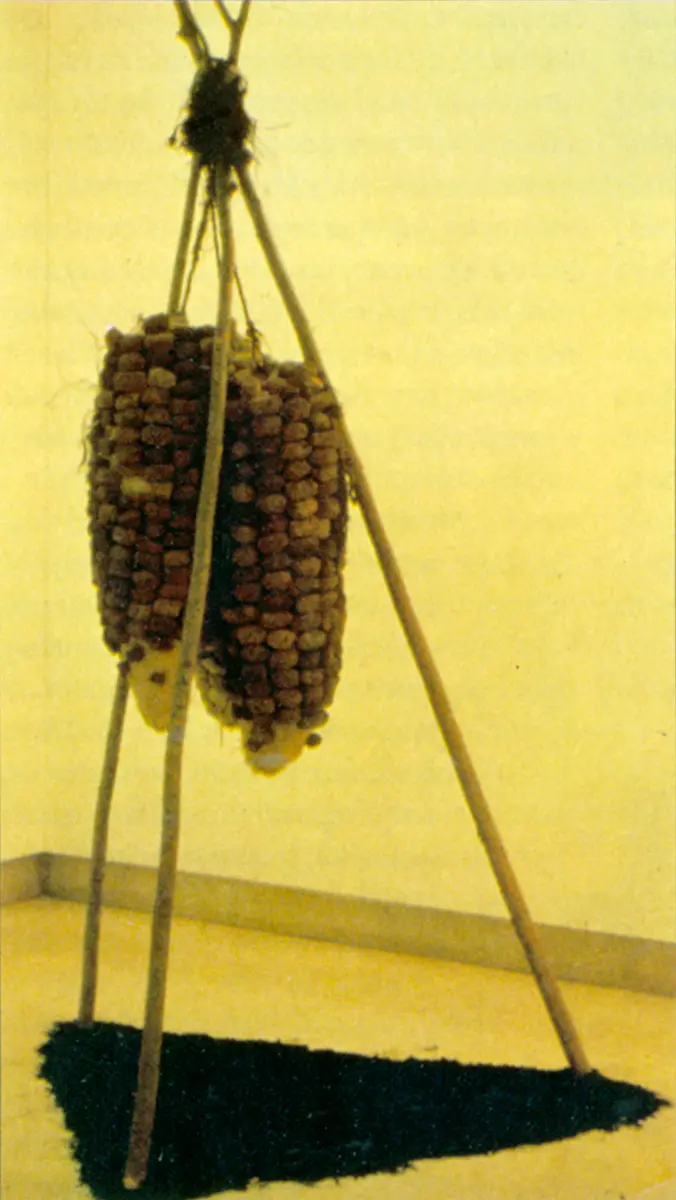
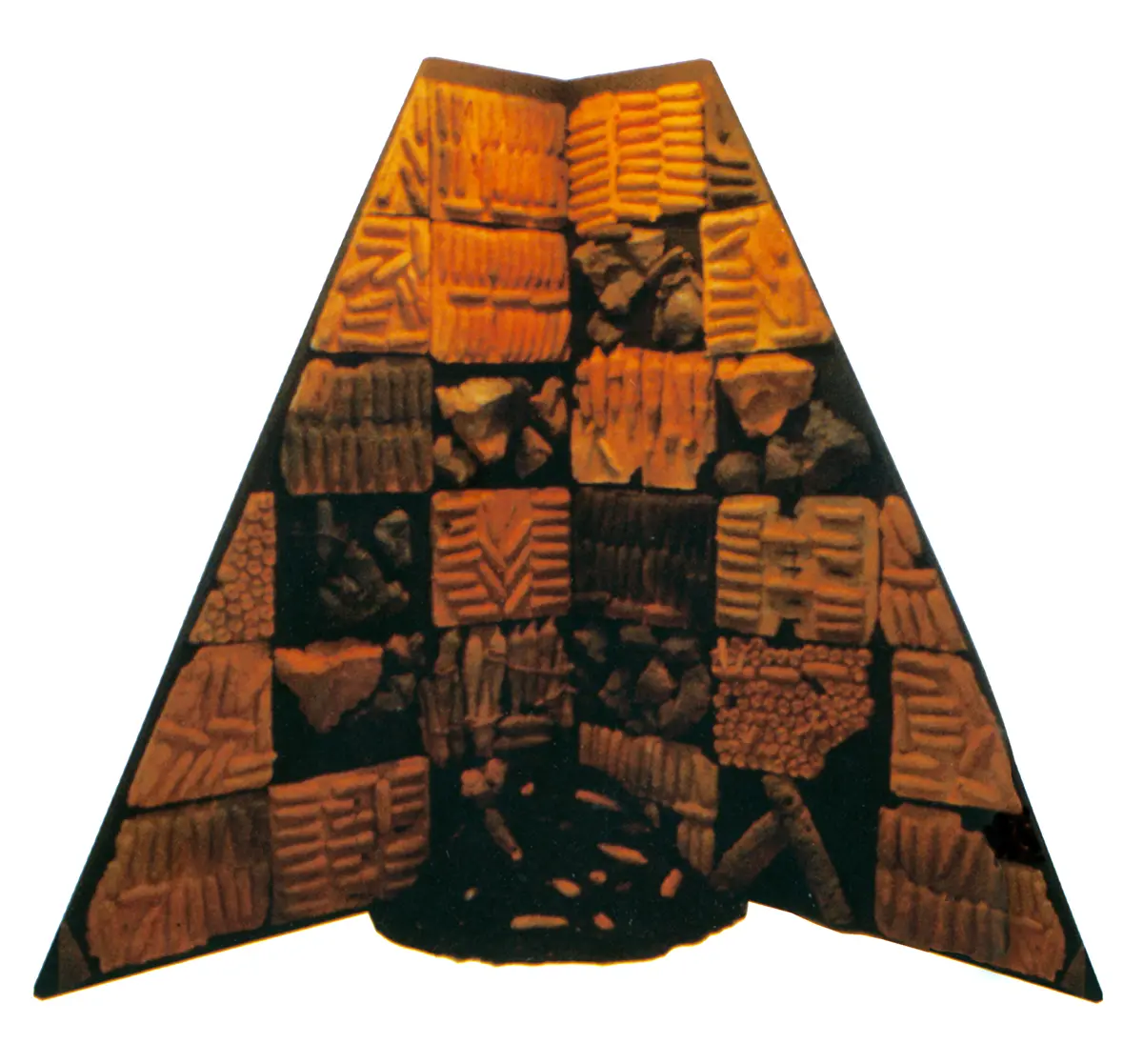
At the beginning of the 1960s Elso's work was characterized by the use of installations, done above all in ceramics, and in which real elements were combined with reproductions. The theme of this work was corn and its role in some of the Amerindian cultures. Laden as they were with a pre-established symbolic force, the references were oriented to customs and myths and established links between corn, and pyramids and calendars. These works culminated in an exhibition entitled Land, corn, life in 1982, a show which enabled Elso to feel that he had freed himself from his artistic training and had managed to explore his own language.5 The exhibition was accompanied by texts and a soundtrack which included songs by the Bari Indians. Elso tried to show not only how the Indians were dependent on corn but how corn itself was dependent upon the Indians, thus establishing a symbiotic relationship.
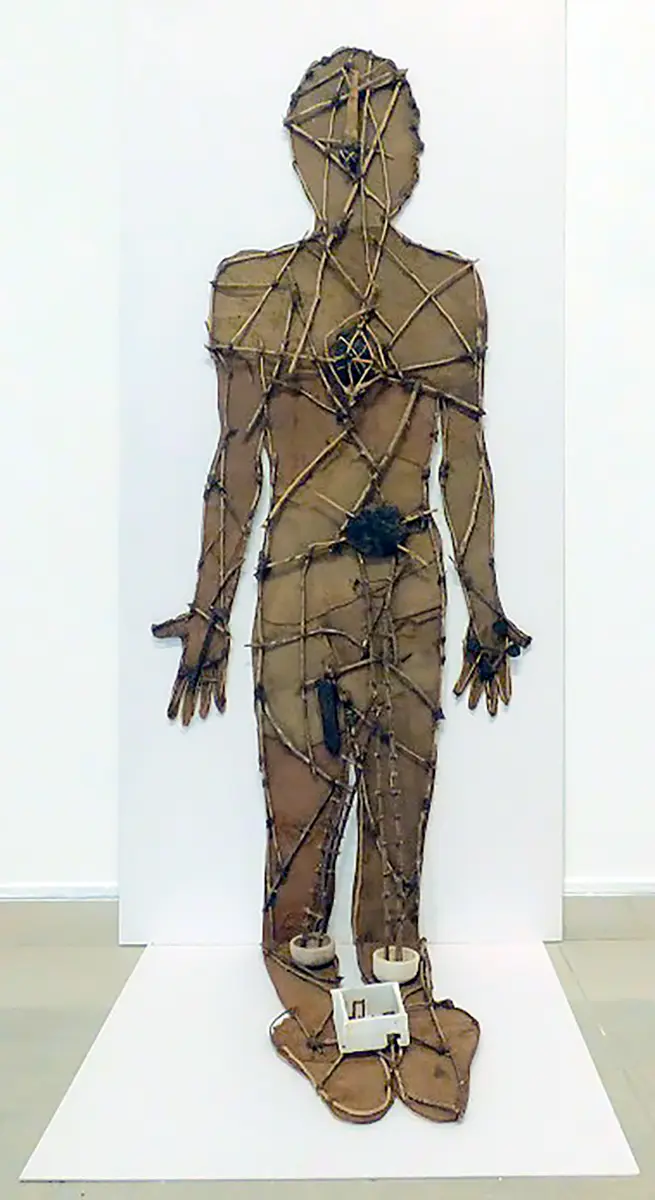
His work at the first Havana Biennial opened the way to his subsequent production. Titled The Mountain, it consisted of a human silhouette done with burlap, with symbolic details marked by means of small twigs. Elso was very critical of his own work and more rigorous than many art critics. Although he accepted that The Mountain was a work which opened up different paths, he also found it too descriptive; “the narrative parts did not manage to become a whole and did not achieve the magical state which I wanted”.6 While the Afro-Cuban tradition was something living for Elso, the Amerindian tradition was something culled from books. It was, in the beginning, an idealized and superficial tradition. He needed time to understand the good and bad things in these cultures, as opposed to the stereotype of bad being equated with Spain and good with the Indians. The relativization of these concepts and their subsequent integration in his interpretation of the Afro-Cuban rituals of santería, an interpretation which was deeply ethical, constituted Elso’s ethical and esthetic concepts from that time on. There was a certain process of demystification of Amerindian cultures which allowed him to approach them with new respect, particularly during a subsequent trip to Mexico.
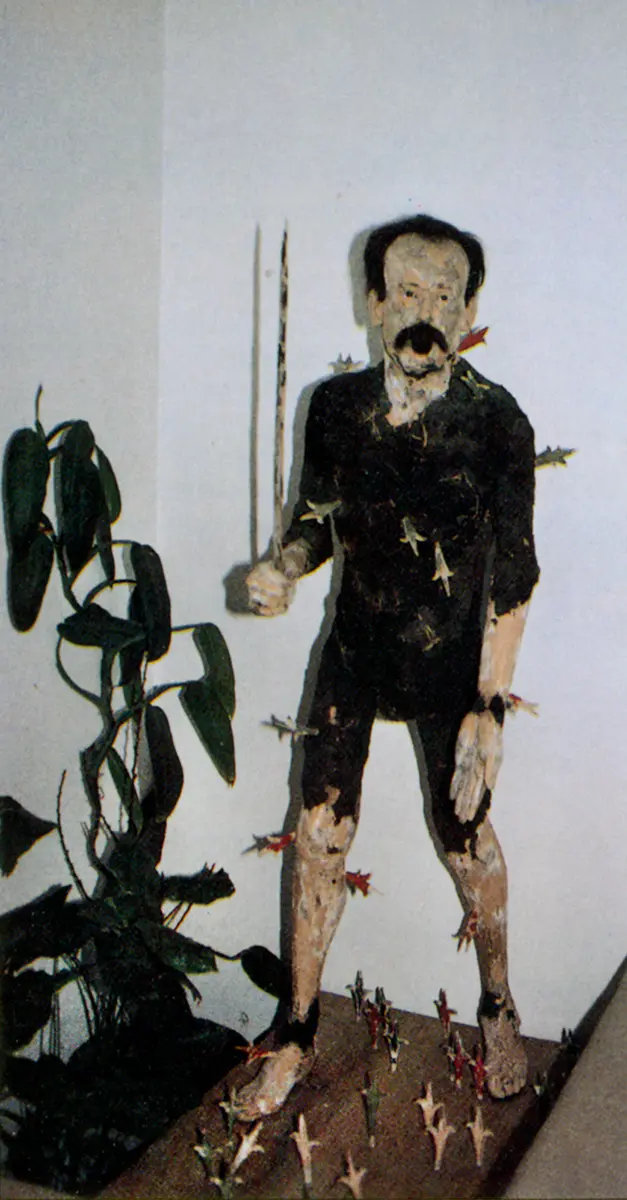
Without any prior contacts, Elso entered into the world of santería as an intellectual researcher. Through friends, he had direct access to rituals and his experience allowed him to establish parallels between santería and socialism, both of which he saw as having a profoundly ethical basis, the objective of which was the betterment of mankind. The combination of his Afro- Cuban and Amerindian experiences produced what is probably his most memorable work: For America. An effigy of Marti on a 3:4 scale, the work consists of a sculpture in wood and plaster constructed in the style of the saints in Colonial churches. Partially covered with dry clay, the body is full of red and green arrows; the red symbolizes the blood flowing from the wounds of aggression and the green recalls the young shoots of a fertile rebirth. The work was awarded a mention at the second Havana Biennial, but amongst the more than 2,000 works on show in the event, it remains in our memory as the only piece at the show which was able to project us as a continent. With its multiple political and religious interpretations, its unerring esthetic reference to the past and the avant-garde, it was a visual icon in which expression took the form of collective property. It was a work which lived only for itself, which did not need to be individualized by the signature of any artist.
But For America is also part of Elso himself. Using elements taken from the rituals of santería, Elso “prepared” the work so as to endow it with his own life. He mixed his own blood with the work and added personal objects and pieces belonging to the Mexican painter Magali Lara, who was to become his second wife. Friends from the world of santería commented that Elso’s use of the rite for the purposes of poetic aesthetics was a dangerous and unpardonable error.
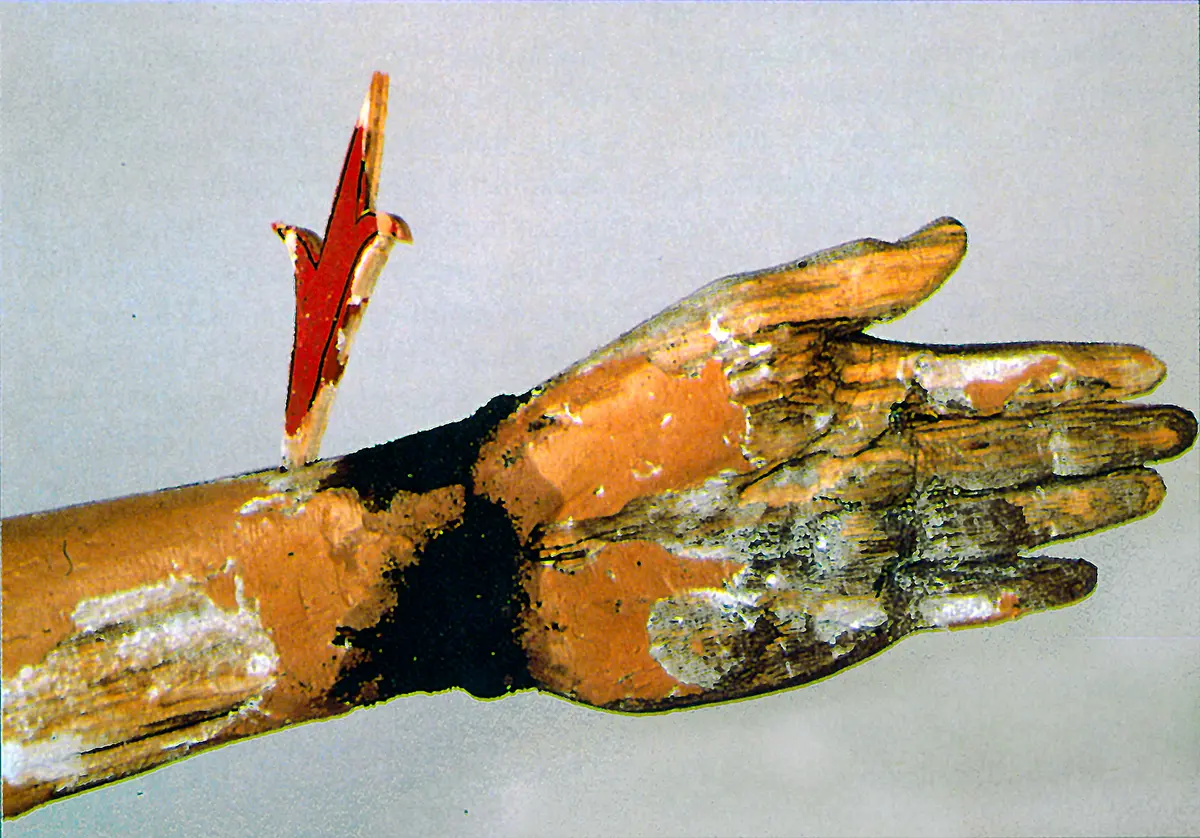
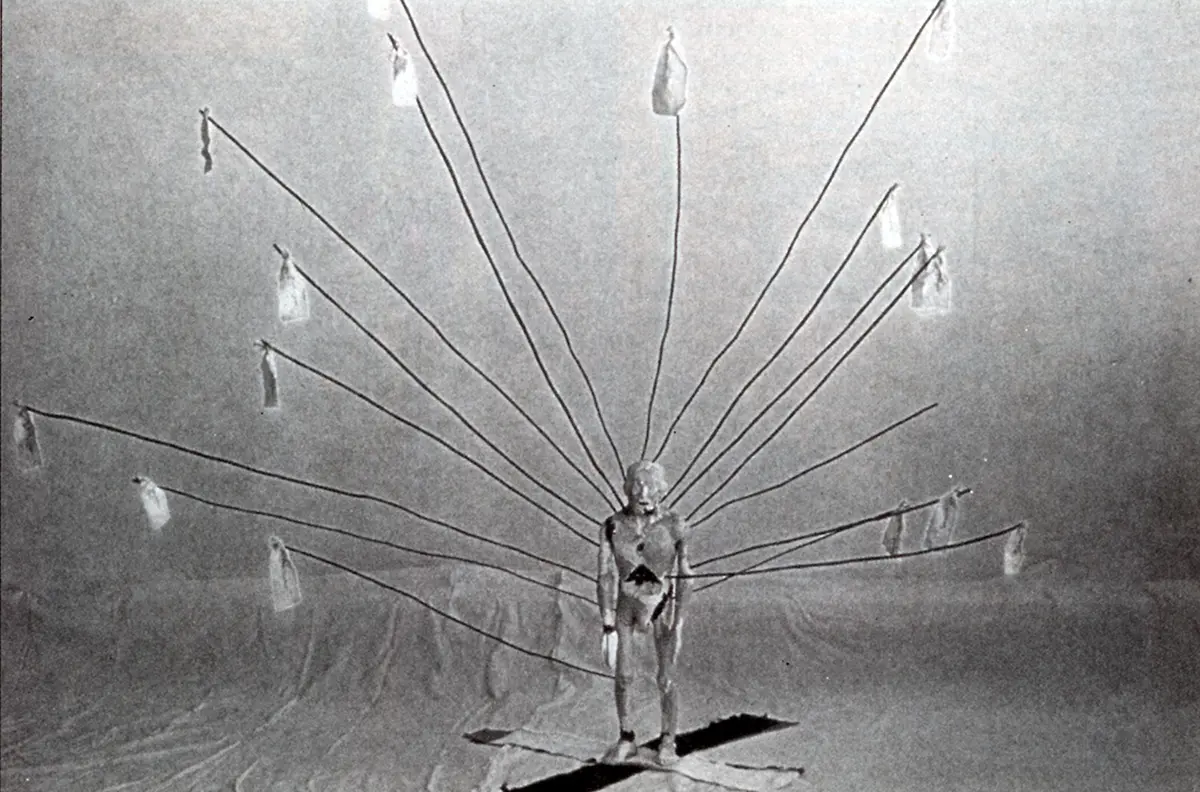
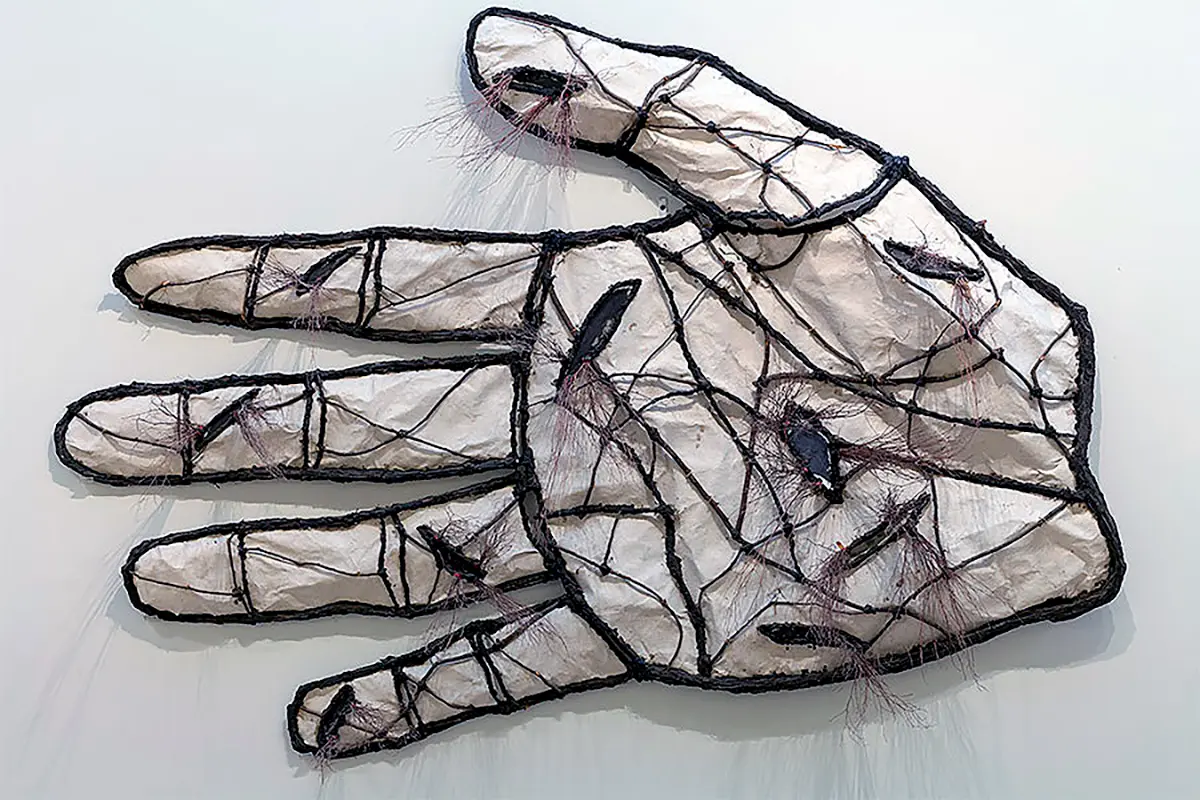
During his final year, Elso worked on a new project. While he was temporarily living in Mexico to prepare a show at the Carrillo Gil Museum, he began his Heart-Face, based on the educational teachings of the Náhuatl. The work, which was part of a more ambitious project entitled The transparency of God, comprised three parts: a human skull two meters high made of cloth and branches, a heart of the same size made of woven branches and a hand more than two meters long which is playing with the skull. The work, at least in its present state, appears less complex than For America, although there is no doubt that it was visually his most impressive piece during his short career. It is also the work that came closest to his idea of Latin American spirituality. It was to be the platform that would have enabled Elso to move on to the next level: a work dealing with Simon Bolivar which would be a continuation of what he had proposed in For America.
Elso died on 27 November 1988. He always thought of himself as a fighter and he wanted to die fighting. He never thought that his battlefield would be his own body. He himself had diagnosed leukemia weeks before his doctors confirmed what he had suspected. He considered that his certainty was consonant with the use of his own blood in his art. The hand of The transparency of God had been done by reproducing his own hand. It had cuts in it from which bunches of dried grass emerged, symbols of the spurting blood which interrupted the drawing of the lifeline. When Magali returned to Mexico after Elso’s death, she found that the arrows in For America had worked loose from the body and fallen to the floor.
NOTES
1. In spite of his illness, Elso had decided to apply for a Guggenheim scholarship. The quotation is taken from his application form.
2. The Carrillo Gil Museum in Mexico City is now working on the organization of an exhibition of all of Elso’s work.
3. Application for a Guggenheim scholarship.
4. The show also included José Bedia, José Manuel Fors, Gustavo Pérez Monzon, Ricardo Rodríguez Brey, and Rubén Torres-Llorca.
5. Interview with the author in January 1988.
6. Interview with the author.