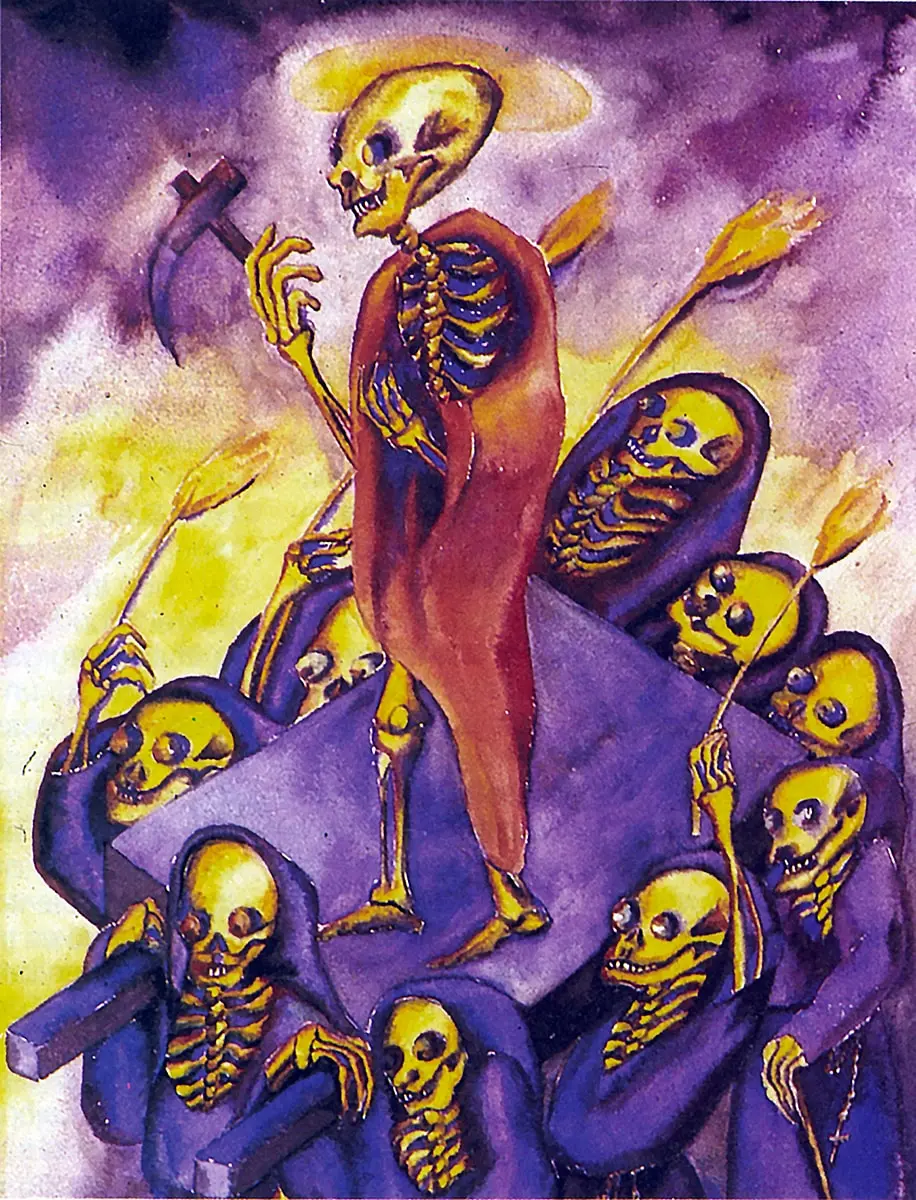
The easiest thing in the case of Débora Arango is to resort to the apparently obvious in her work: "realism," and "expressionism." The mental laziness of a certain criticism thereby eludes what in this work really speaks, arranges, asks: expressionist for the dull, stormy world that she draws with the utmost harshness? Realistic because it bears witness to a difficult social, and political reality? The signs in use forget what the artist's soul accuses in the face of the elements of the facts, in the face of the flurry of history: painting is not a testimony here —as writing is not only communicating— but personal affirmation, a haughty gesture against the arguments of that reality for which obviously "art is superfluous."
To avoid “superfluous art" is then to affirm what ideology does not want: personal ethics. Since ideology wants from art only the "artistic," an idea of "beauty," of "plasticity," and not hesitation, the impurity of every day in its metaphysical dimension. In Groz, Beckman, and Nolde, the expressive is taken as the liberation of that which was constrained by the norm, by the taboo, the fear: the color that bursts seeking the connotation that the yearning for freedom confers, thus, what is free, then, is color, so color, as Rimbaud wanted, recovers its existential resonance, that echo of ancient responses, of ancient and frustrating adventures. However, this attitude is also born of a suspicion, that of Morgenstern: "Often a violent surprise seizes you concerning a word. With the speed of lightning, the complete arbitrariness of the language in which our world is understood is clarified, and therefore the arbitrariness of our concept of the world in general."
This liberation of color is, therefore, what becomes annoying insofar as the “chromatic scale”—like the musical “harmony”— suppose the ruling of the norm, the submission to a rule that in the "nuance" goes underground imposing the gesture, the urbanity of the "artistic." Because in fact, it is good to clarify it at the outset —the so-called regional schools turn into more stereotypical academies, more oppressive styles, where a fixed image of the provincial is imposed as a fetishized symbol. The gesture places us in this case in the space that precedes norms and codes, in the virgin land where another alphabet of art and of what living entails begins: "The deformations of images thus reveal the ontological condition of things or people because being aesthetically unrealized is equivalent to discovering their deepest reality” (Theory of Expression, F. Schwartzmann, p. 326). The expressive in Latin America was always given by the profile of social reality, by the pathos, the echo of the telluric: a metaphor for a nature that was unattainable and today degrades itself reduced to "natural resource," a cry of the old myths that resist disappearing, the brutal presence of history as a mere abstract fact. Nevertheless, in Débora, the telluric is not the allegory that results from "americanisms" or “indigenisms,” but the field that never entered within the recognized codes of the West. That which is on the sidelines and defies the project of the established culture and therefore refuses to accept a conventional face, giving itself the task of continuing to be governed by its own codes.
Isn't this what is in Tamayo, in a peasant from Rivera, in a character from Forner, in a line by De Szyszlo? Only here does it fall into the stereotype: the American not as a question that deepens but as a formula that preserves rethinking in the face of the facts that are changing from within those cultures, the space of the attacked cities. This is the origin of that fatality of an empty Americanism that, as in the case of Guayasamín, is only a commercial art. Débora supposes the process instead of that from those first notions of identity leads the individual-lucidly present in Fernando González and his anti-philosophy, the individual who fully faces the tear of living a dispersed, broken social reality, in front of which the elements of ancient art are useless. National styles also avoid this certainty, believing that a theme —and not a new language— was enough to create "the American" per se.
Débora then faces her task leaving towards the nudity that comes from assuming, just as Fernando González dismantles an academic idea, professorial of philosophy, and philosophizing, the provincial attitude of "writing well" since he knows that the connotations of a new word are beyond the grammar of academics. That is what separates Débora from other Colombian painters and what gives her importance within what we can call our true modernity. It is "modern" because she simply embraces the latest style? The metaphysical is understood here not only in the sense of the individual gaze that questions being —that American being stereotyped by Americanisms— in the nakedness of liberation against tradition but fundamentally as the appearance of that personal will to face which means the art that has been given to it as "inheritance," that mixture of chauvinistic claims, professional rules, and provincial conventions.
In this measure, when dismantling the "art," she is proposing another grammar of the visual. The presence of a metalanguage —that which Beatriz González was not able to carry out— then points out in this ethical unveiling the path to an origin; that origin that others saw simplistically in indigenous ruins, in the local color. However, what in Van Gogh and Munch necessarily becomes rooted in the tragic by the unrelenting tension between the self and reality, in Débora —as in Groz and Otto Dix— manifests itself in the discovery of a reality marginalized by the codes of that western culture and to which it is accepted. The critical element —which, I repeat, is not "testimony" or "denunciation"— is thus conferred by the presence of something —a color, a word, a space— that would never take place in the space of so-called art and so-called culture.
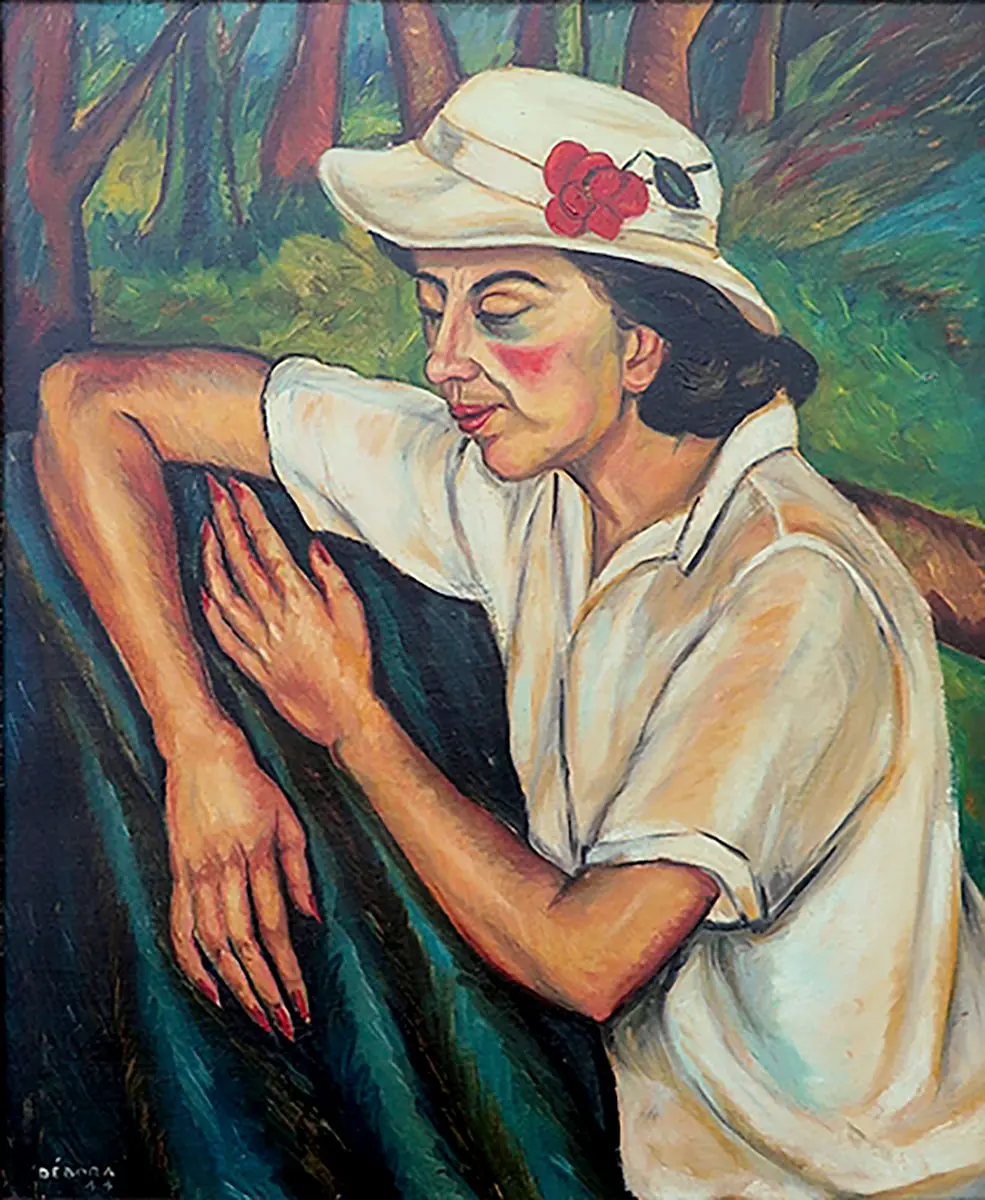
It is the implicit violence that exists in those characters to which Alfred Doblin gives life in Berlin Alexanderplatz or Tomás Carrasquilla, writing, you speak, areas that challenge from their context —and not only from their content— the bourgeois idea of what is the novel, the character, the plot, etc. Which separates it from the easy scheme of the so-called "social art." Deciding on reality is already an ethical decision where, in its case, the conventional term of the feminine is reduced, moreover, to a few themes, to a "sensitivity."
It is still curious, I think, the absence of the urban —so often brought to mind for no reason— in Colombian culture, both in literature, art, and cinema. Isn’t the city the scene of contradictions, where the field stops being a feeling to become a reflection? It is from the city, from where Débora locates what we call her vision of life; the moral weight of the world assumed as the only reality, hence the prophylaxis of irony, of sarcasm that are the privileges of the lonely since impugnment comes, like all choices, from an authentic act of solitude.
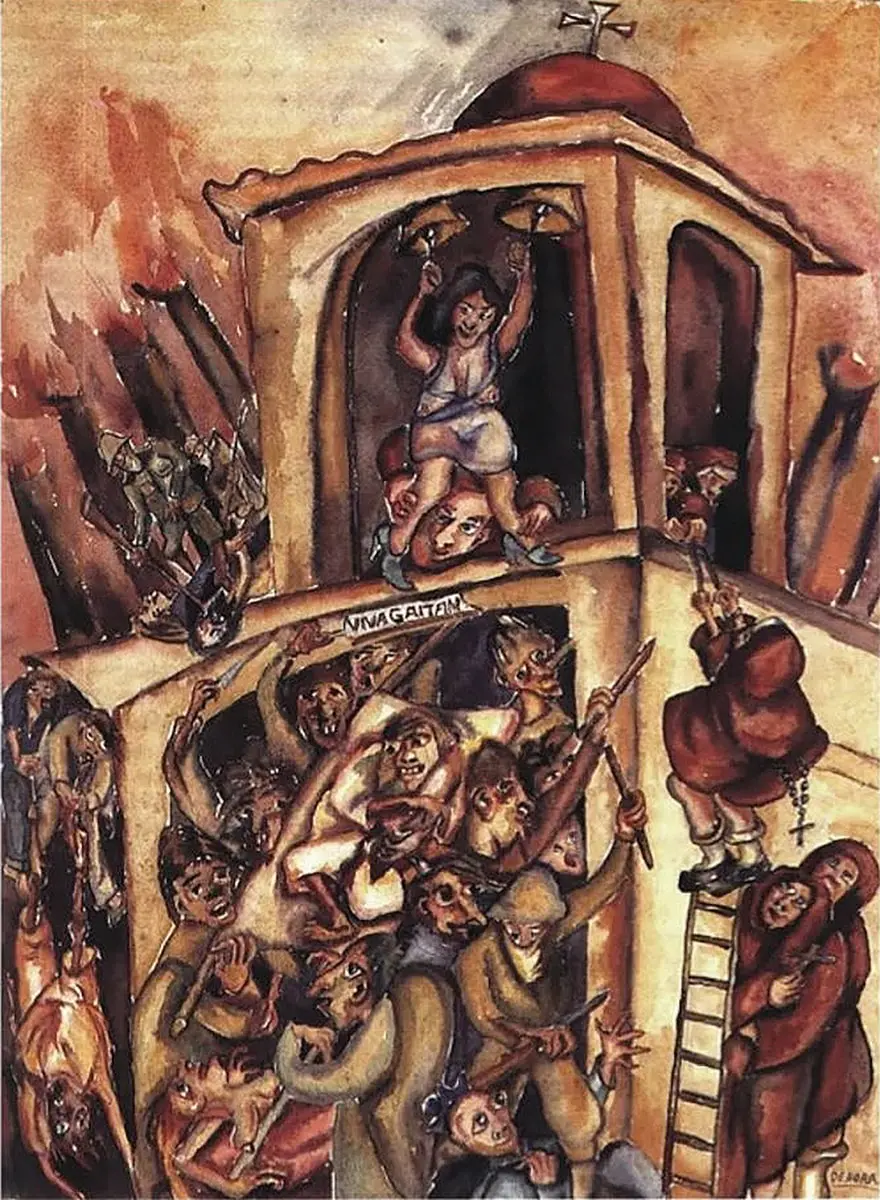
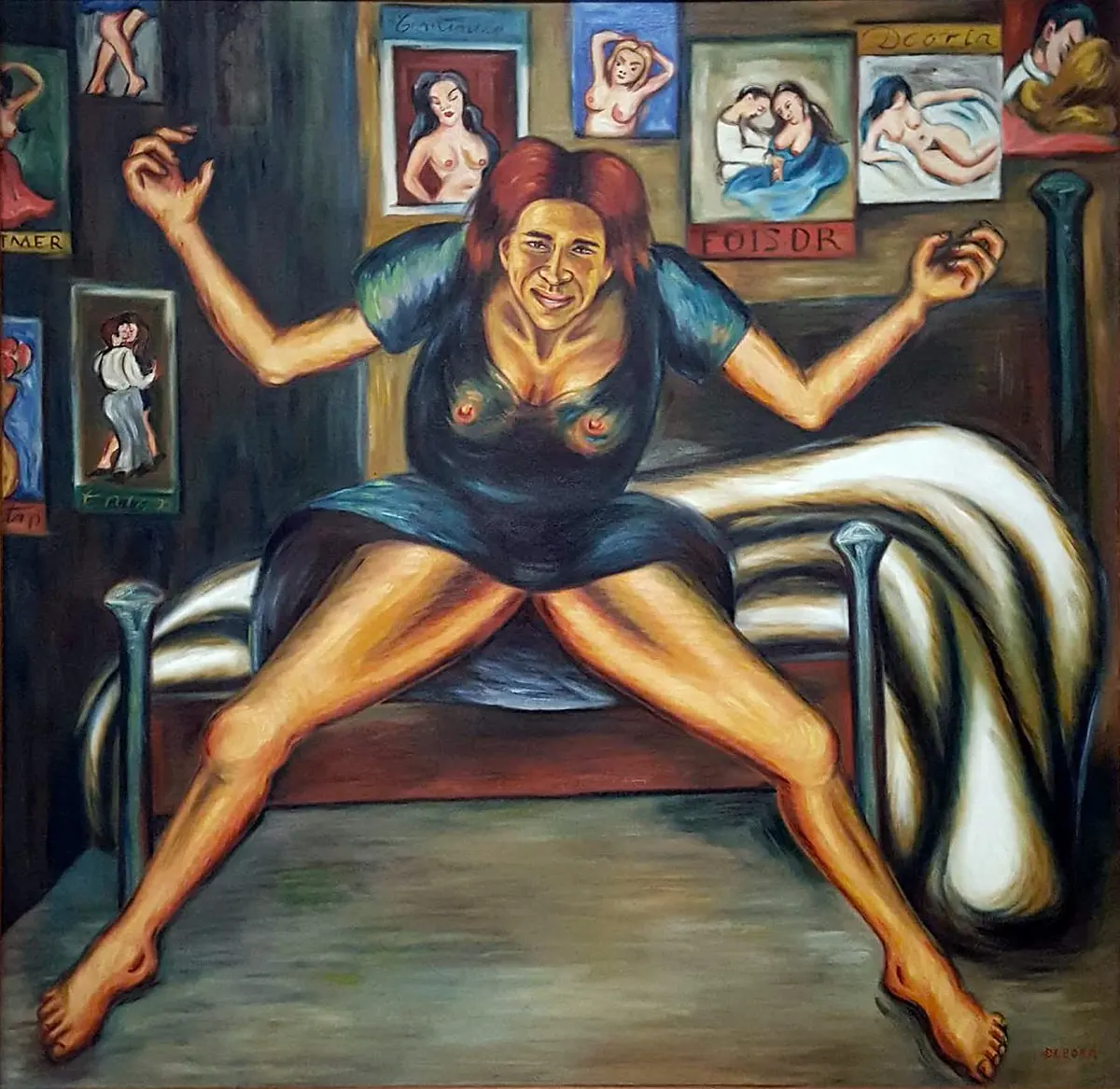
The city is not, therefore, a "motive" or a different landscape, but that scattered, confused fact before which a choice is made: the color of the real that hypostasizes the "artistic" is carried here to its ultimate anthropological consequences. The woman who opens her legs in her sordid room is, above all, that system of objects that characterizes a way of life, and that way of life —which has defied custom— is both a geography that affirms itself, a language that comes from the suburbs like an irrepressible mist. Apart from the codes that identify the established society —uniform, without fissures— these languages speak of the diverse, of the uncontrollable of life. This is what separates it from the costumbrismo, of the so-called regional art detained in its vision of life, unable to open itself to the internal processes that history marks.
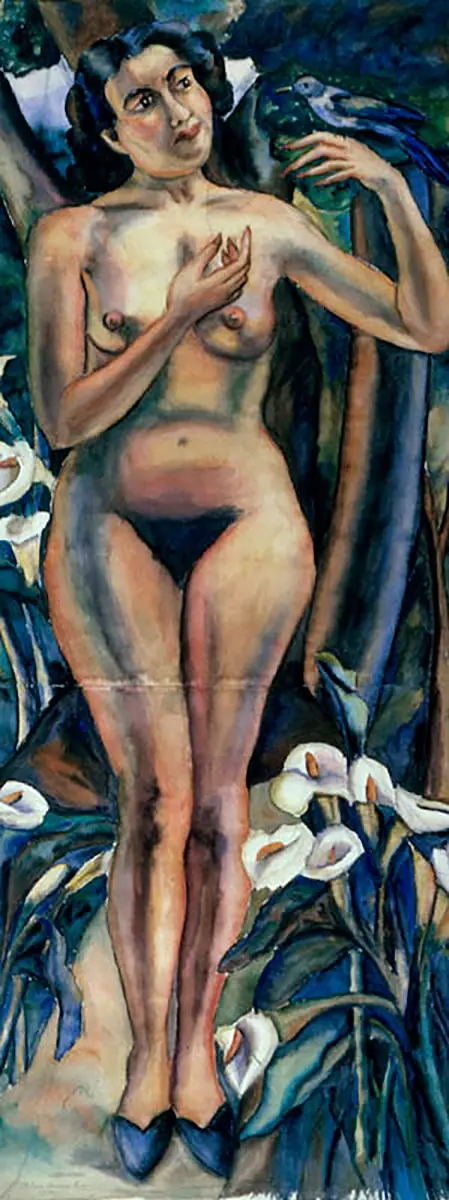
The scandal that accompanies her work is not so much due to the "ugliness" of her subject matter, to its deformations, but to this violence that is implicit in the color released, in the way that it comes to confer an iconographic character to that world that the institution wants to forget. For this very reason, in the sense that Kayser gives to the grotesque, she energizes everything he creates, breaks symmetries, fosters imbalances cancels proportions, and mixes opposites, but singularly at the same time gives a plastic dimension to that world in which she morally recognizes herself: the brothel, the canteen, the sinful hallway, and at the same time the nude of the woman but seen with the eyes of eroticism, introducing ambiguity: a carnal gaze that verifies the body, which she recovers by making undressing an act of affirmation as it happens with a 1944 watercolor where a woman undresses, discovers her breasts, her clamorous pubis to escape the convent. Or, like that painting where some nuns play with the bird called "cardinal."
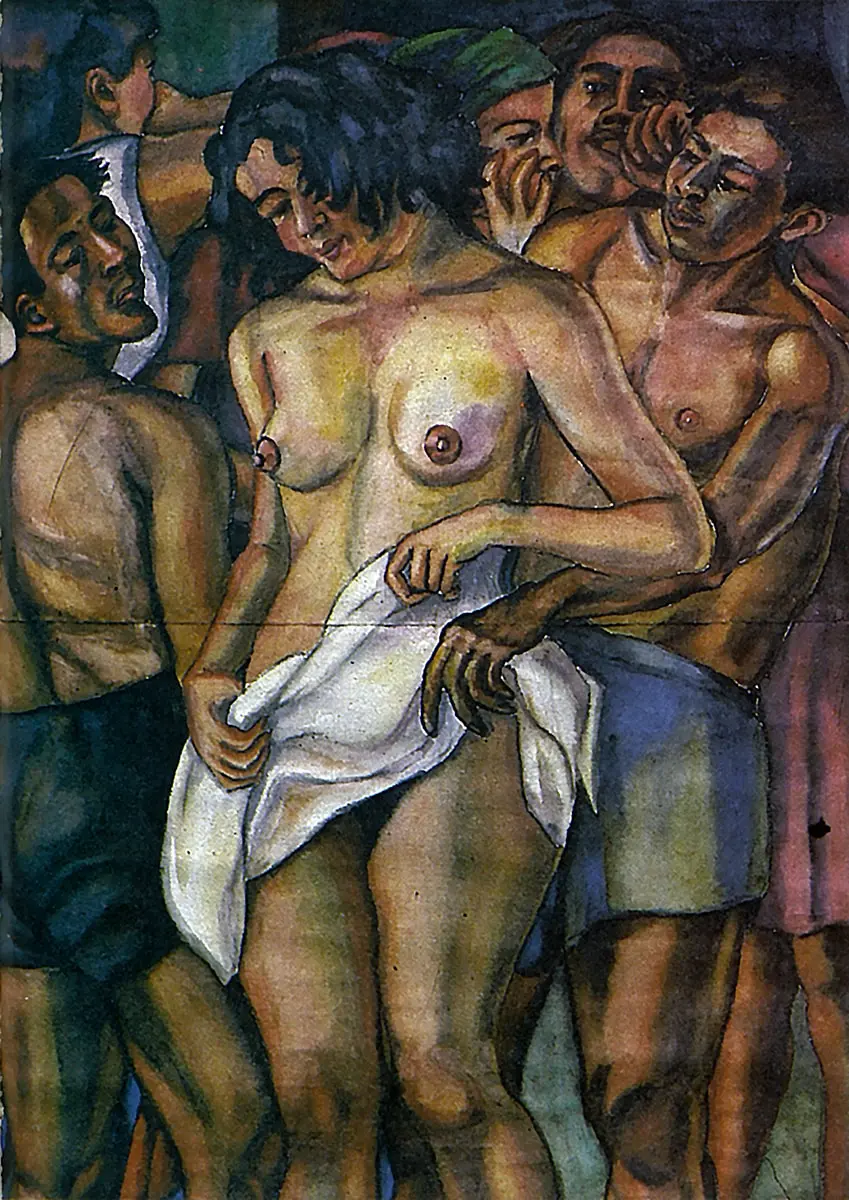
Insolence renews the terms of the topic. This area, therefore, is their particular territory —which should not be confused with the attachment that some artists have to a subject that they repeat and repeat without any imagination. In overcoming the sublimation that the “artistic” makes of this reality —because the artistic nude is "decent"— the process is marked towards what we can really qualify as a new figuration: her watercolors from 1939 to 1944 are proposed in the clear sense of transgressing the regional academy —the landscape painting, the typical scene, the “Antioquia brushstroke”— to highlight the face of this reality that is revealed, until making the face of this reality a differentiated icon: as Hopper does by bringing the figurative to the semantic extreme that both cinema and photography have given to the image. The local then refers to the relationship that a color has with respect to a reality that it characterizes, that which in Hopper becomes the color of helplessness here is the fullness of a world that is before history, I repeat, alive in its gland, in its dimension of the bestial, hair, vulva, esophagus. In this way, this figuration fixes instants of a world that will continue walking towards other forms of marginality, in order to continue in freedom.
Now, in this case, the marginal does not mean the residual but, I repeat what by option remains outside the institutionalized: the canteen, and the brothel, have created their own visual image, a particular area characteristic of a micro-society that from within has set its own codes. As Pop will later do, Débora uses this uncontaminated iconography where the figurative already contains the symbolic element, that which, beyond simple communication, is simply recognizable language, a color that speaks, when in the other city, that of order, that of decency, in the city of "art," depersonalization, the death of meanings is already the state of affairs and when night comes, and in this geography, the color begins its party; there, there is no possibility of anything.
In this way, her wisdom leads her to understand how reality fixes its contents —which, like the party, lack limits— leaves its contents, abandons them, while the Philistine sleeps: was it, not this laxity that threw Pop in the hands of commerce, the one that half-did its task of going beyond primary images? The siren song that Débora never heard. It is the icon of the marginal that Burroughs gives, Genet, different from Bacon's homunculus, Katz's illustrations, Cuevas' literature, that other beauty of the beast that haunts us and to which we would like to return to redeem ourselves, to find the cry of the first intercourse before religions, theories. The icon is marginal, and it is because it is seen from within and not from the accommodative point of view of "testimony." Reality shows once again that it cannot be reduced to realism.
Just as the cartoonish is not caricature by reduction. This is entirely given in the sour, accurate stroke of the pen, of the pencil in the snapshot of the daily event, in the biting that comes from challenging the attacked truth. Débora does not make the caricature of a certain character but instead brings to mind the grotesqueness of history, and the ruthless violence of ideologies: in this attitude, she runs away from the immediacy and, to make her rejection more forceful, leads the disfigurement to the zoological metamorphosis, to the delirious image, empowering from within through color, never forgetting the validity of the pictorial support until reaching it with that intensity —within that aesthetic category that Valle Inclán gives to the grotesque— the dimension of a reverse metaphor, not as idealization but as an abyss. So that the color comes to take the strength of an argument, and the character becomes an ethical archetype.
The catharsis that, in many cases, leads her to use a carefree attitude —which will only be taken later by Fernando Botero, who starts from here— unknown in our art, so incapable of posing a risk, of getting out of the corsets where it sleeps. Rooted humor that comes, yes, from a popular tradition: the picaresque. She is present in the irreverence that inscribes her within a culture to which she renews the power of the present that the past is not empty data, that tradition is, above all, something that works with images, that renews the daily project.
This will, which impacts when seeing the totality of his work gathered for the first time at the MAMM, springs from the verification that in her career she never faints, nor do those dead periods so common to certain artists exist —which does not mean that she eludes the deep contradictions that animate her, nor that by peering into what we call a finding, she was content to turn it into a way. Much less did she want to grow old living in the worn-out terms of a national style, easy refuge, easy and recurring recipe to fulfill patriotic duties and, at the same time, find assured commercial success. To say that she has always been buried with the truth and the commitment to art is not to put one example in that pitiful sense with which society "recognizes" old age, as a virtue, but to talk about a task whose essential meaning we have long forgotten.
**Luz Stella Castro and Gilberto Montoya took the photos that accompany this article and those that illustrated the material on Débora Arango in Arte en Colombia No. 25. They were kindly loaned to us by the Museo de Arte Moderno de Medellín, where the important retrospective exhibition took place.
DARÍO RUIZ GÓMEZ