In April 1949, at the Bogotá Art Galleries, Alejandro Obregón exhibited 34 oils, 4 temperas, and 9 drawings. He sold 15 canvases in less than two weeks for a total value of 4,000 pesos, less than 30% charged by the owner of the gallery. At that time Obregón was head of the Official School of Fine Arts, where he earned 400 pesos a month. The artist was married and had a 4-year-old son, Diego. One year earlier Obregón had exhibited individually in Bogotá but had not sold a single work. Among his defenders were Marco Ospina, as well as Gonzalo Ariza and Luis Alberto Acuña,1 whose works were only timid attempts at the renovation Obregón incarnated in decisive terms.
The works shown on that occasion surprise us today for their tight elementality. They don't tell us much. Some of the works contain a bit of surrealist lyricism, like that of Dalí. The most noteworthy in those years was the artist’s firm and solid frontality and a trace of hieratic sculpturism influenced by the indigeneity of Rufino Tamayo.
The self-portrait of 1949, Astigmatism, shows the treatment of the material that reveals an interest in pictorial questioning, and nascent expressionism. There is an enigmatic equilibrium between the cloud and the figure that reveals the power of the artist in order his personal world. Perhaps this is why we are so moved by the fish of Symbols (1949), a sober equilibrium of forces. The dark mass on a dear surface: one of his key elements. Yet what a long and danger-filled path this fish would follow until it would die again in Barracuda in 1966.
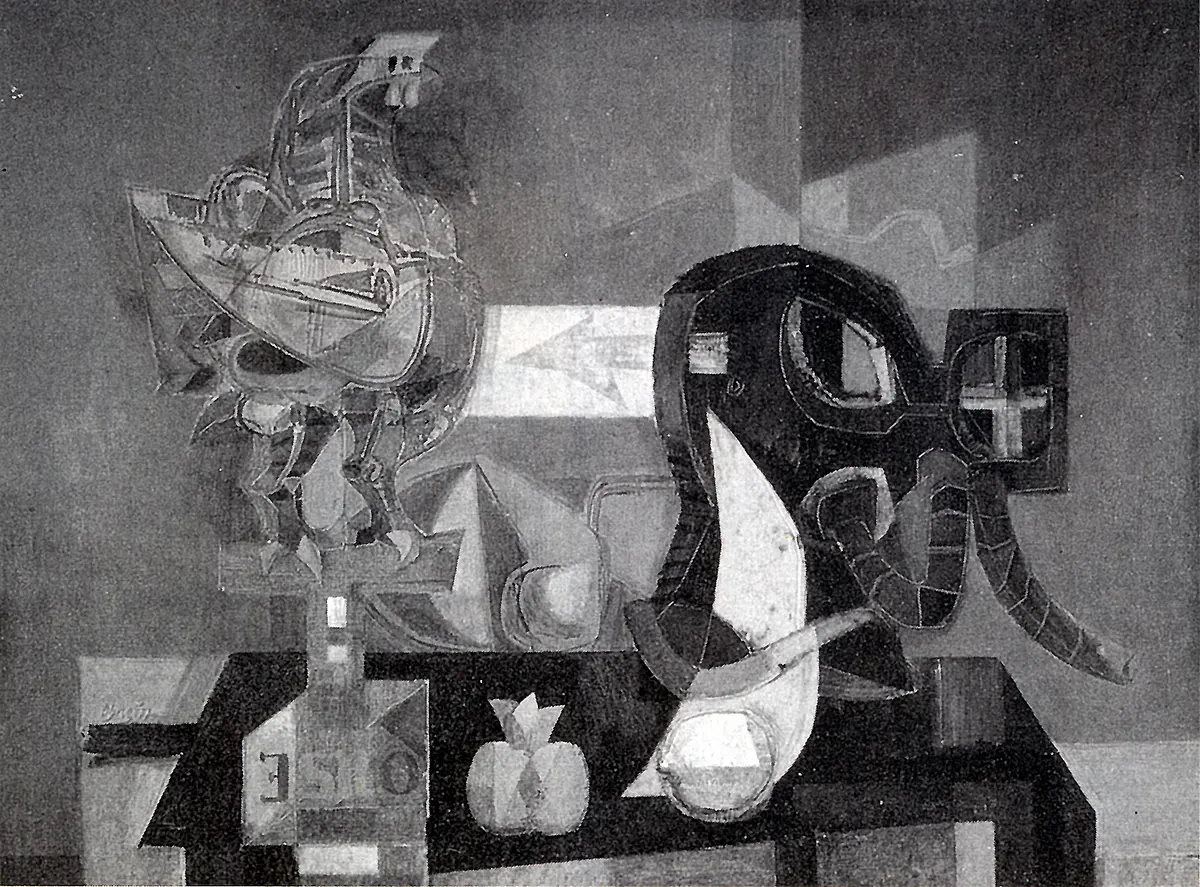
Waiter Engel wrote of Symbols: “What almost mystical accord in the profound blue, white, and green!” Years later Obregón made explicit his use of condors, barracudas, fish, and bulls, responding, “There are no symbols. Simply for their plasticity, the beauty of their forms, I explore them, / invade them, and / kill them.”
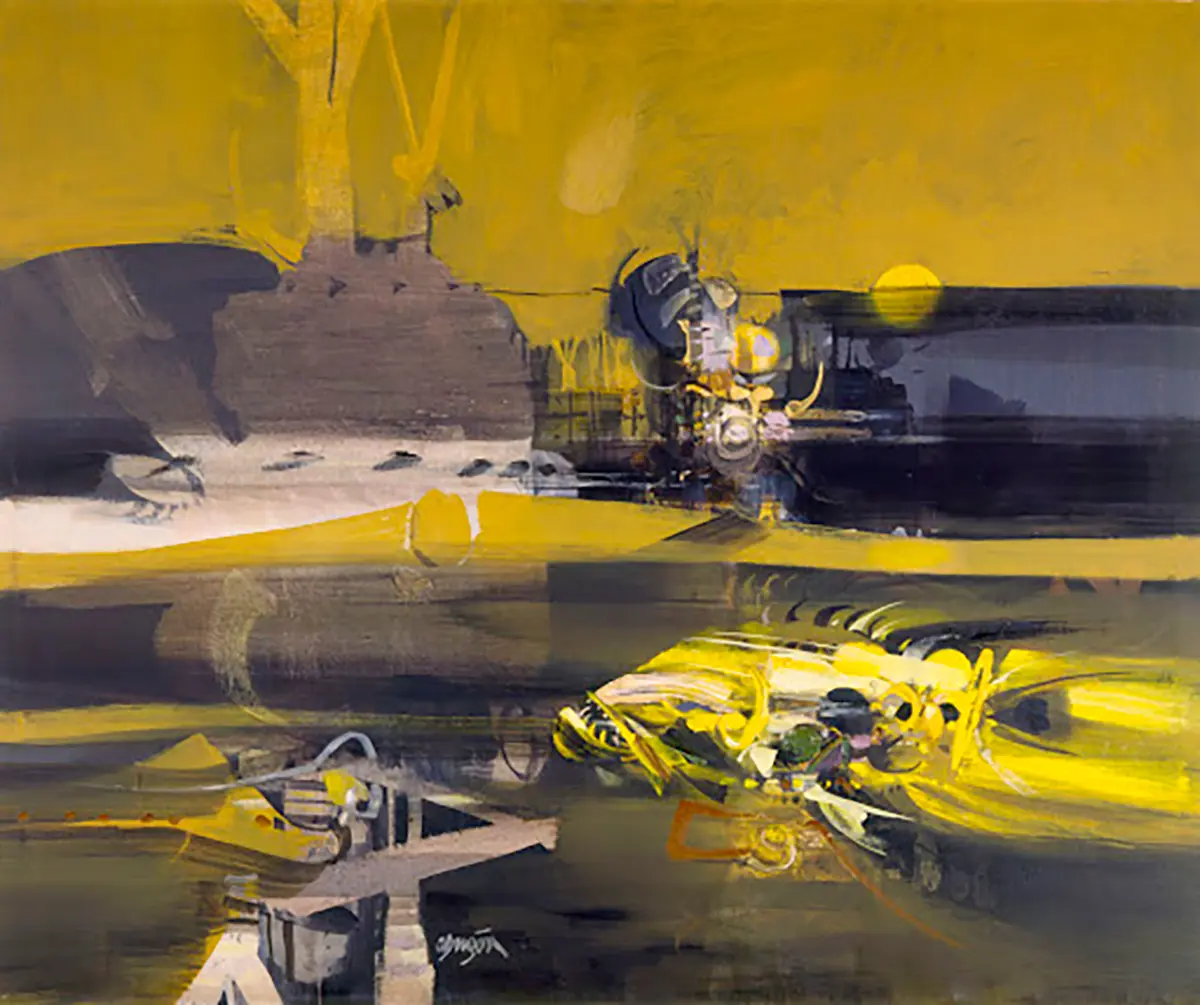
A geometrical and rational Obregón with constructivist tendencies developed between 1947 and 1959 when another more expressionistic and irrational Obregón evolved. With undoubted daring, the artist has since combined emotion with dynamic equilibrium in his figures, radically changing the habitual Colombian colors of blacks and greys to his vivid tones.
The Obregón who lived from 1940 to 1944 in Spain and from 1949 to 1955 in southern France became our most famous painter upon his return to Colombia. His creative maturity was synthesized in an exhibit at the National Library in Bogotá in 1959. The 27 works included Condors. Chimborazo, and the famous Dawn in the Andes (1957). The exhibit included all of the Andean latitude and the tropics with A Touch of Cartagena, as was titled one work.
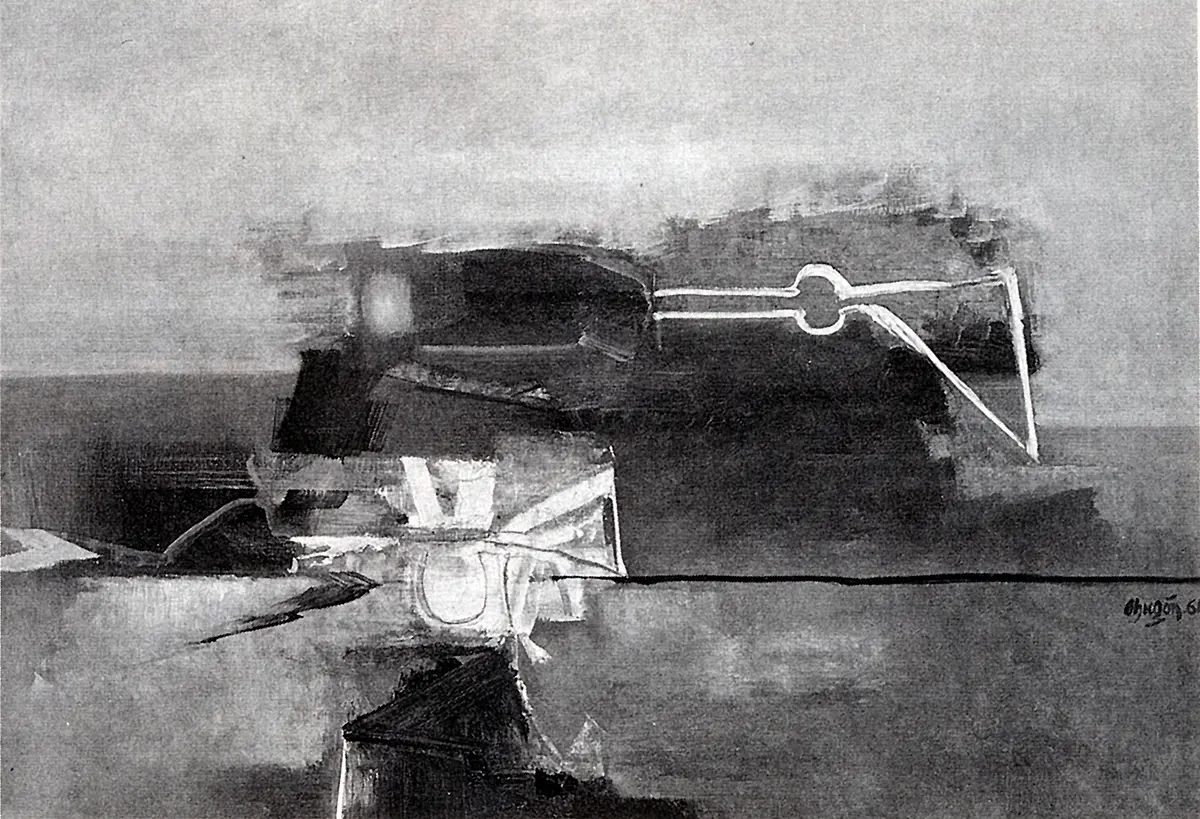
The showing at the Panamerican Union in Washington, in 1955, marks two precise periods in Obregón’s career. Nelson A. Rockefeller bought a painting, as did Alfred H. Barr, the latter for the New York Museum of Modern Art. The Phillips Gallery of Washington acquired another. Obregón won the Biennial of the Caribbean and the Guggenheim prize with Velorio, where vegetable forms serve as a framework for the absorbing drama of the dead man.
But it was the condors and the bull-condors, like that of 1961, which would doubtlessly reign over the artist’s new universe. Obregón had seen his first condor in a cage at the National University. “He looked like a Jesuit priest, all covered with brilliant black and with a white collar.” He patted the bird’s head and then pulled out a tail feather, receiving several pecks that left a scar Obregón still has. At least 40 condors have been painted by the artist, and they placed Obregón at the head of Colombian art, making the 60s his decade.
Obregón won two National Salons, 1962 and 1956, with Violence and Icarus and the Wasps, and two international prizes: the 2nd Americana Biennial of Cordoba, Argentina, in 1964, and the Latin American Francisco Matarazzo Prize at the 9th Biennial of São Paulo, 1967. The Masks of 1952 have been left behind, today at the National Museum of Bogotá in the permanent salon dedicated to the artist. The blind eyes of the tall woman in that work are overcome by the magic and mystery of reality which invades the condors.
“When instinct is sharpened it is called intelligence,” he said, and Obregón’s became more acute through painting 15 hours a day, through life in Barranquilla, and through association with the Barranquilla Group. This conjunction of writers, architects, and artists renovated Colombian culture and the autochtonous, giving it vitality and goals.