The comprehensive approach to contemporary art admits the use of many categories of analysis. This diversified possibility is determined by an indisputable fact: each discourse is rooted in particular models of inquiry and singular teleological projections. Thus, the categories of analysis are not valid in the absolute sense, but rather acquire their relevance according to the nature found in a work.
This premise is reactivated when we try to read Santiago Cárdenas’ approach since his wealth refers us to multiple paths. Specifically, we wish to view this attempt through the nominative, denotative, and connotative categories suggested by his proposal. By nominative category, we understand the effort to place a work in the dimension of existing aesthetic currents to favor a preliminary step of interpretation. In this sequence, we admit that the description of the characteristic features that make up the perceptual areas of the visible results is denotative. Finally, understand by connotative the indication of the concepts within which the ontological status and the legitimate content of a work are inscribed.
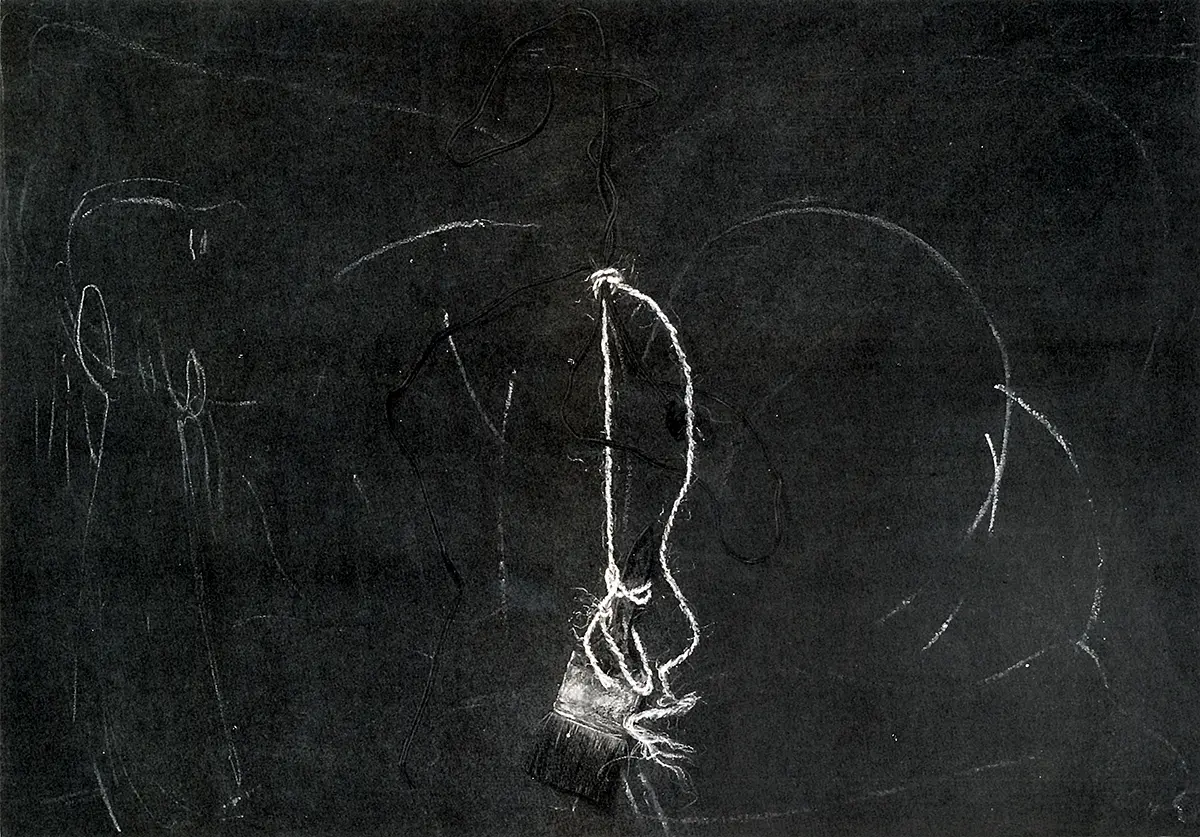
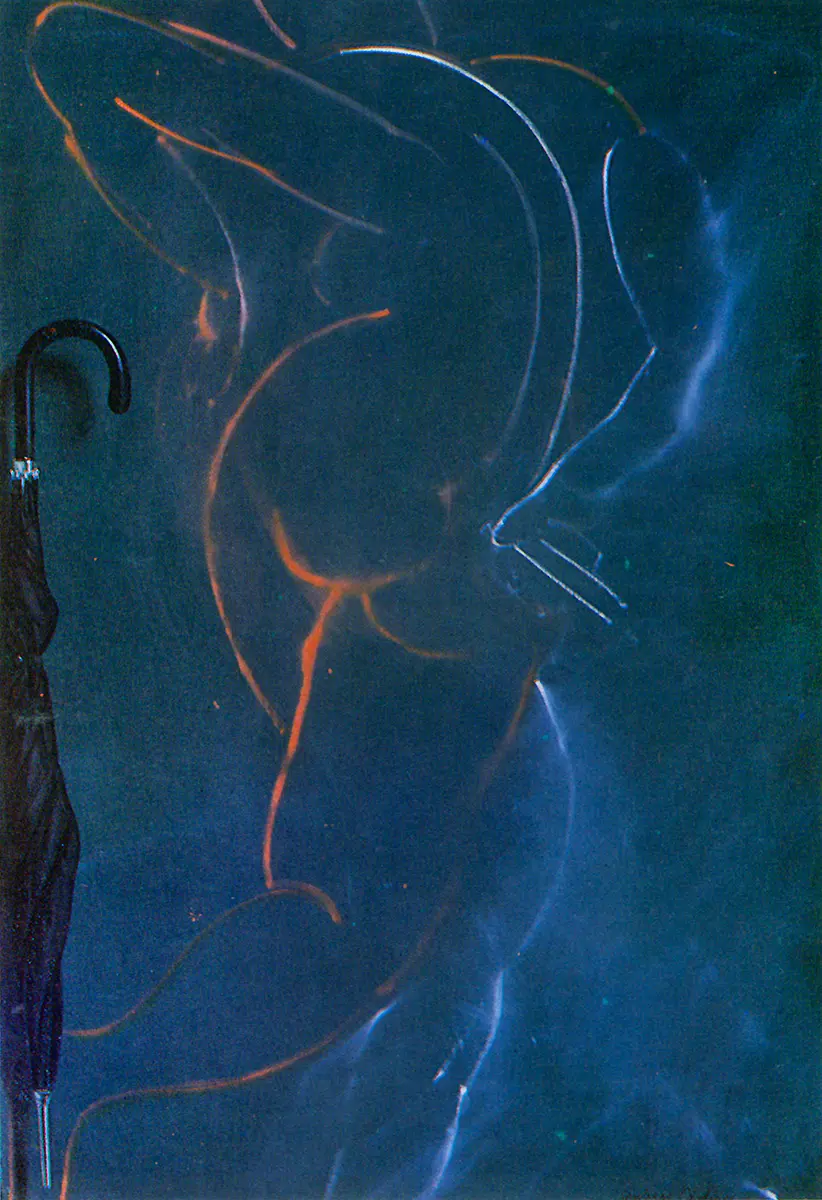
To figure out the path that we intend to follow, another essential caveat is imposed: Santiago Cárdenas' work is concretized in a multidimensionality. It is made up of a totality that arises from the combination of different exhibition spheres. Indeed, in his recent production, some areas combine, in a single box, the space of a board, the calligraphy of figurative expression, and the focal detail of an everyday reference. These three dimensions obey an intrinsic logic and, at the same time, merge to make way for the sense of something encompassing. For this reason, it is necessary to develop our explanation based on a methodological separation of these three fields to approach them with the stated categories and combine them in a corollary that puts us in contact with a set that encompasses its unitary structure.
The Textured Blackboard’s Background
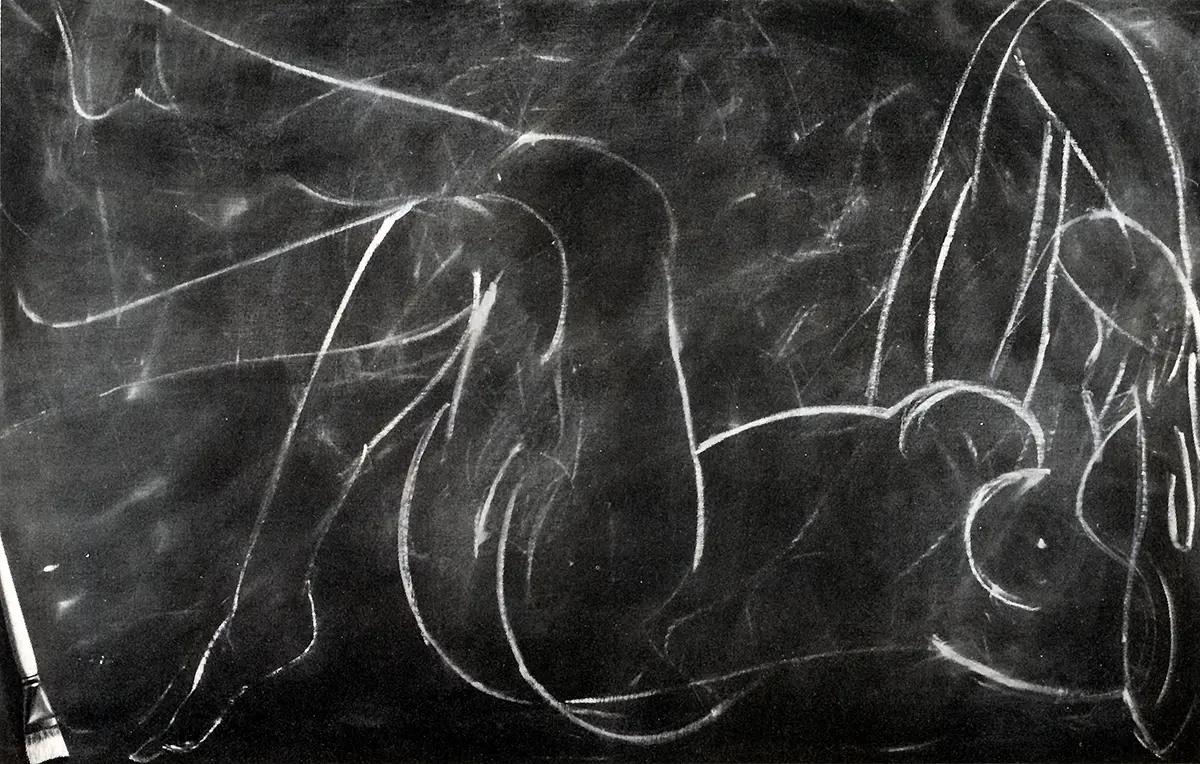
The first aspect that is imposed by its visual strength is the one that is related to the elaboration of a background that generally occupies the entire frame of the support. The shocking suggestions of the black color assume an expressive strength that surrounds the viewer from the relationship's incipient moment. The real and the virtual cease to be the irreducible poles to merge into a tune of equivalence that multiplies into demands of curiosity and wonder. Then, the impact of a blackboard appears and constitutes a stage capable of supporting plural representations.
From the nominal perspective, this topological territory can be associated with superverist, informalist, and symbolist leads. There is a superverist result because there is evidence of an explicit attempt to repeat a reality that is tangible in the world of the empirical and that, when transcribed into a visual language, reproduces a new reality that highlights the accidents of the copied element but also overflows them by the impact of virtuosity. There is also a certain informal air because the chromatic matter claims its leading legitimacy and makes one feel the sensuality of a texture. The visual element is equated with the existence of the sense of the act as a counterpart of equal rights. Likewise, symbolic effects emerge because the meaning or continent element is not an end in itself, but a means that refers to meanings and content that open up to various associations and multiple questions. In this context, the substantive is not so much the emergent form but also the matter that is stimulated through its intrinsic and original qualities.
Moving on to the denotative dimension, we find a saturated field where the "real space" ceases to be itself to become a "fictitious space." Indeed, an interesting mutation is seen that causes the empirical surface of the support to be altered in favor of a virtual surface where the non-existent attribute of being is given. In this way, the black background is not a simple chromatic event, but it acquires a descriptive scope that denotes the concrete image of something. To achieve the appearance of this surface object, Santiago Cárdenas emphasizes the appearance features of traditional boards using a rigorous pigmentation that responds to the interweaving of brushstrokes that make the artisan traces analogous to those of the rustic manufacture of these instruments. Still, above these results, the plastic effects that are claimed arise because the board that appears represents a support that makes the pristine support vanish, pa to assume its distinct peculiarity that accentuates the eventuality of a shot and the strength of a framed monochrome.
Thus, we arrive at the connotative dimension that refers us to the underlying meanings. The blackboards are not epidermal or finalist results, but resources that are supported by diverse conceptual meanings. Let us begin by noting that the blackboard suggested in terms of "fictional space" performs the same role as the actual blackboard. It constitutes a medium that accepts illustrations, diagrams, designs, projects, and silhouettes. All these graphic representations acquire a meaning that correlates with a kind of memory of the ephemeral because each element that is pointed out is an element for a circumstantial moment and an image for a casuistic time that lacks an enduring vocation. Thus, there is an underlying notion of time understood as a specific point, as a sectoral juncture, and as an instant in a sequence that precedes and is preceded by other representations. To this idea of time, a representation of space is added because the blackboards are always the extension of limited territory, the scope of a field that is identified with a portion of the chronological, and the perception of a scenario that is treated according to a purpose. Within this itinerary of insinuations, it is also worth noting the presence of an idea ofthe intuitive because the blackboard is generally a resource for writing quick, unfinished, and complimentary sketches where the glimpsed gesture matters more than a complete resolution. All this makes the blackboard a topological space, in limited time, an illustrative proscenium, and an environment for the expression of circumstantial, where the repeated use of lines generates juxtapositions between what is partially erased and what appears with explicit definition, between the images that still leave the memory of their survival and what makes declared hatching. The blackboard symbolizes, then, memory understood as a container that enlivens all the intellectual, affective, and volitional potential of man.
The Automatic and Emotional Sketch
The monochromatic uniformity in which the blackboard is circumscribed serves as a basis for the writing of a discourse that is enriched by plethoric images. They share the responsibility of exposing a repertoire of visual information required as a derivation of the calligraphic and graphological exercise. The calligraphic response to the clarification of a diversity of morphological characters summarized in a figurative alphabet. For its part, the graphological makes feel the incorporation of the psychological temperament that guides the constructive definition of the strokes. In this way, the informative, the calligraphic, and the graphological acclimatize the cold nature of the black and textured support that serves as the background.
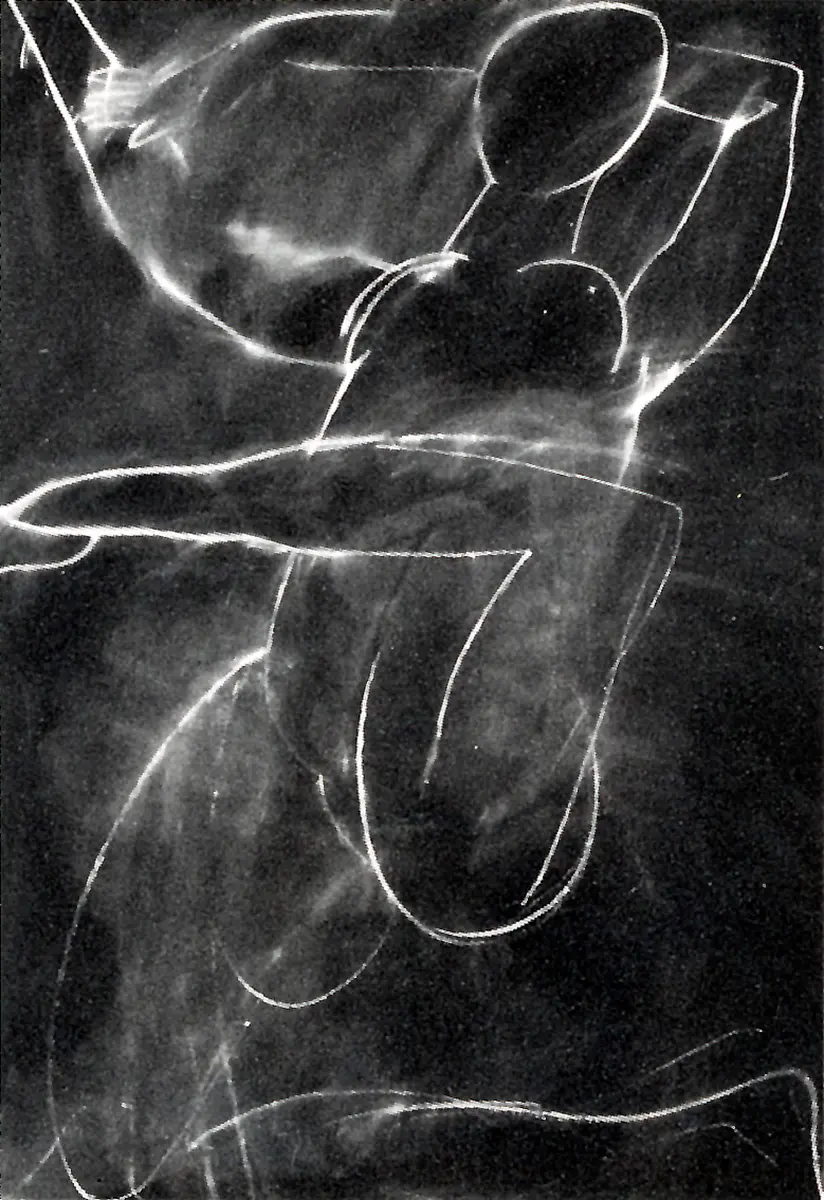
The statement mentioned above refers us to a new expressive plane in Santiago Cárdenas' work that also requires its particular criteria of a comprehensive approach. To be consistent with the foreseen methodology, we must point out that, from the nominative approach, this field responds to an expressive intention because it has its origin in a subjectivation of reality and is projected towards an emphasis on the emotional. The displayed product is isomorphic to the object's interior schematic and not a copy of the object itself. Therefore the image appears strengthened by a wealth that is added in terms of suggested perception and in a schematic way. In this sense, Cárdenas brings up an interior image that replaces the real to search —in Bachelard's phrase— for a "seeing the absent in the present." This subjective and subjectivation force takes root with the emotional to make way for a record of data and sensitive features that are woven and corrected according to an operative and instinctive scheme that is decisive in fixing the parts, sizes, proportions, and expressiveness of the whole. The final result is a drawing of an almost automatic nature and syncretic globality because the resolved physiognomies and the breakdown of the details do not interest but the suggestive and suggestive totality of the expressive.
In this order of ideas, it is now necessary to highlight the denotative approach of this plane. From this perspective, we appreciate that Santiago Cárdenas assumes a drawing composition elaborated through nervous lines that move with deliberate hesitation, and with exciting lines that break and interrupt in sequential gestures. Initially, the constructions are inscribed in the intuitive, but they end in a final harmony that closes in a gestalt form. In this context, the emotion raises its protagonist essence because the forms are quickly attacked to avoid the censorship of a rational rigor and to allow a free flight that marginalizes any inhibition filter. The presence of an energetic charge and the intuitive potentiality are embedded in the blackboard to give meaning to globality. It is important to note that the declared image is set in the previous images that, despite having been erased, leave the silhouette of a permanence that does not hide its sensitivity. All this enhances the original texture of the support through sensual features that multiply the optical effects of the visual-tactile space.
The explanations detached from the nominative and denotative angles favor a move toward the properly connotative. From this perspective, it should be noted that, on this level, Santiago Cárdenas does not pursue the point of the syntactic data embodied in the figures, but instead seeks to emphasize the fidelity of symbolic content. What is important here is not the graphic lines that stumble over each other, but the expression of an introspective vision that makes explicit the sentence of the affective. With this, he seems to want to vindicate Klee's sentence when he states that "art does not reproduce what we see. It makes us see.” Indeed, Cárdenas intends to make us see things that we do not appreciate through a simple relationship with the world, and he achieves this "wanting to be seen" through the series of questions that emerge from being in contact with his work. In this encounter, there is no place for trivial and conventional ideas of beauty but openness toward emotional value. The call to the affective is activated by a global result that mixes human figures with handwritten characters that find their discharge in the looseness, tensions, and weights of the lines that are renewed with anxiety and that point towards a vital conformation.
Underlined and Objective Realism
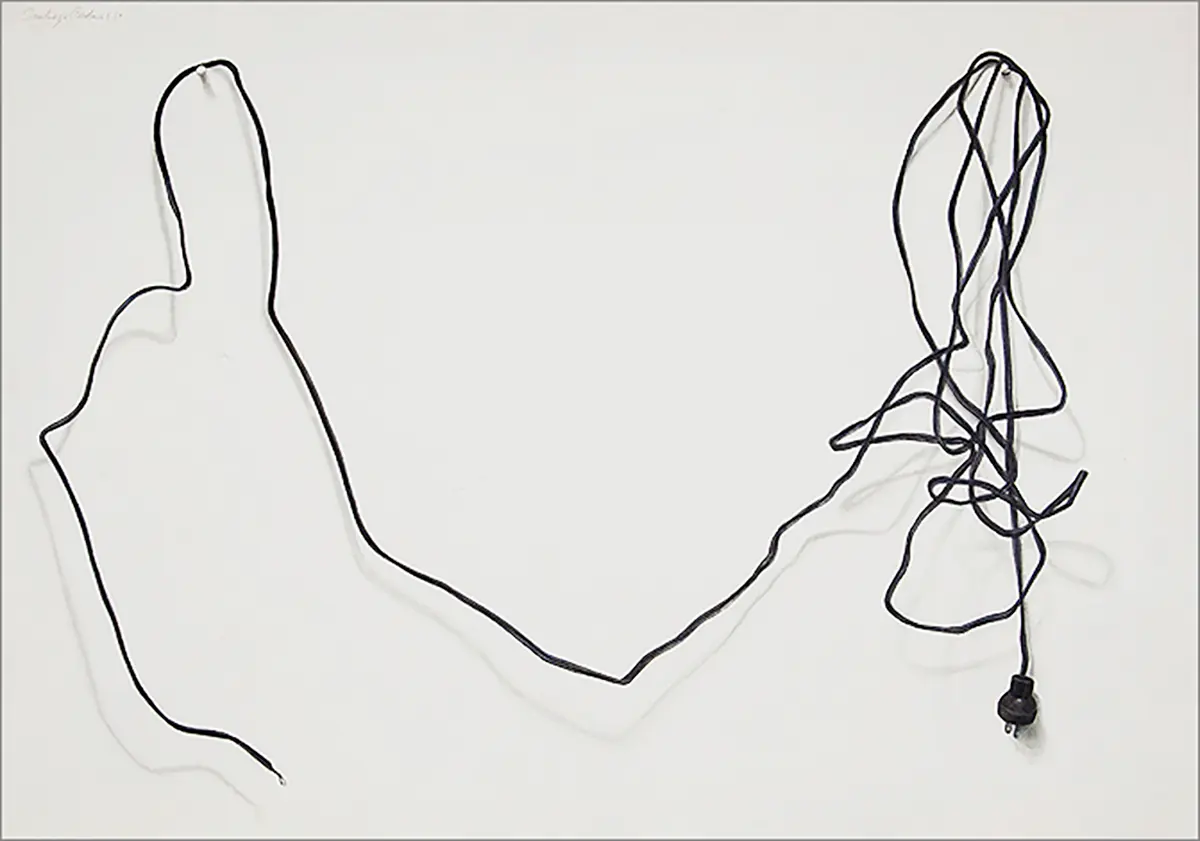
To the hatched blackboards and the drawing's graphic gestures, he adds a third plane of a predominant feature: an empirical reference that emerges, floats, or rests, at any point in space, and accentuates its objective morphology. Indeed, the conjugation of this focus in the planes already described constitutes an unavoidable characteristic in Santiago Cárdenas’ recent creations. This conjugation increases the problematizing and enigmatic sense of the whole as it provokes curiosity and restates unknowns implicitly as a result of a hybrid nature.
By placing ourselves in the nominative perspective in front of this new visual fact, we perceive a correspondence between the hyperrealist aspect and the one that comes from pop art. There is a hyperrealistic intention because this focus is undertaken to highlight the reality of reality, that is, not so much to reproduce or repeat it but to point out the superlative degree of its tangible objectivity and its measurable density. Cárdenas' proposition goes beyond the meaning of the exact copy to achieve the appropriation of the phenomenology of the referent itself. However, some glimpses are associated with pop art because there is an underlying disposition to elevate everyday objects to an aesthetic category. Both senses are correlated in the same continent and have an identical signifier.
To obtain the strength of this presence, Cárdenas proceeds with a rigorous explanation that expands strongly on rationalized elaboration. In this way, the definition of the object emerges as a consequence of its objectification, that is, of a visual conformation that adheres to the laws that narrate the peculiarities of reality. Every detail is solved with mathematical precision and phenomenal fidelity to promote the emergence of a carefully reproduced goal and transcribed with meditation. He manages to promote an amazing link between the knowing ability and the knowable element since an indissoluble point of union arises that leaves no room for doubt about the existence of a tangible matter. The viewer has no contingency alternative since he is forced to accept the presence of a visual-tactile illusion that responds to the embodiment of an object that, at the same time, is and is not. In this context, it is not possible to avoid the virtuous capacity and the mastery of a profession compacted with the heuristic capacity displayed in the previously interpreted planes.
The objective definition of the empirical referent does not exhaust the finalist's sense in Cárdenas' work but instead constitutes a simple resource that also condenses its connotative meanings. In this dimension, the possible interpretations are plural. In this aspect, it becomes pertinent to note that Cárdenas seeks to promote knowledge through recognition, production through reproduction, and creation through imitation. This is understood by accepting that these referents are not out of context, nor are they absorbed in their morphological resolution. In addition to self-describing, they contain meanings that go beyond their materiality to indicate the solemnity of the hieratic, the essence of the empirical, the purity of the objective, and the suggestion of the tactile. In this way, the supposed copy of the object vanishes to acquire a different pose that appears as a problematization of reality itself. Thus, a set of metaphorical impressions is produced, making its optical acuity feel to project itself towards the suggestive. In this sense, Cárdenas makes the perception of the trivial, the vulgarized, and the known serve as a trigger to experience the feeling of the unusual, the wonderful, and the upstart.
The Dialectical Scope of the Overall Result
The three areas exposed do not constitute pages that can be unbundled, but organized planes that are reconciled and harmonized in the same coherent discourse. Based on this premise, we maintain that, in Cárdenas’ work, the subject ceases to be a purpose in itself because the "represented" aspects are guidelines that bring out the "presentation" of a theoretical platform that is charged with conceptual intention, as well as aesthetic and technical content. Within this sense of unity, the parts acquire meaning in the compendium of the total result that ignores any aseptic sense. We perceive that in Santiago Cárdenas' work, there is an underlying idea that tries to make a transition from plurality to pluralism. This can be demonstrated by several fundamental explanations.
On the one hand, between the planes that make up their approach, there is a more formal than real differentiation. They enrich each other by accentuating their existence according to the simultaneity of contrasts. There arises, then, a tolerance of coexistence where each area claims its own rights within a globality that relates them in a climate that marginalizes the monologue in favor of dialogue and competition in favor of confrontation. This dialogue and this confrontation come to clarify an ability to accept otherness and to seek the adjustment between the visual components and their corresponding significant contents.
In this framework, we appreciate an explicit rejection of all kinds of dogmatism. In Cárdenas, there is no attachment to a singular aesthetic current, but rather an opening that allows different orientations to be legitimized and claim their respective ontological statutes. Precisely towards the demonstration of this thesis, we have directed our interpretive journey, declaring the association of each aspect of his work with the pre-existing elements of contemporary art. The conclusions in the work of Cárdenas are not affiliated with or subject to any of them in exclusive and excluding terms. On the contrary —and in some way— wants to overcome them by writing an approach that synthesizes them dialectically through a different product.