Besides developing in his themes the participation of the viewer and the introduction of motion, the superposition of planes of several vibrations is a characteristic of Jesús Rafael Soto’s work. Since 1950 to today, he has posited an expressive revolution that tends towards the de-materialization of the work of art. In a metaphorical way, Soto’s subtle and vibratile elements come close to a representation of waves and of phenomena of spatial continuity, both in his Extensiones and in his Penetrables. Soto reduces and lightens terms such as mass, weight, gravitation, transforming the notions of figure/ground, presentation/non-presentation, as a function of a new achievement of pictorial space-time.
In order to re-structure his message sunder new parameters, Soto has taken every existing historical element. He defines himself as a non-objectual artist; concerned above all with the concepts of anti-matter and energy, he moves beyond Op Art. His fertile creativity was able to give abstraction a monumental character.
To expand his exploration of a universalistic aesthetics, Soto had to abandon the restricted parameters of a national culture. Since 1950, the artist resides in France and diversifies his activities between Europe and Venezuela. As a symbol of this exchange, the Museum of the Jesús Soto Foundation was built in his hometown of Ciudad Bolívar.
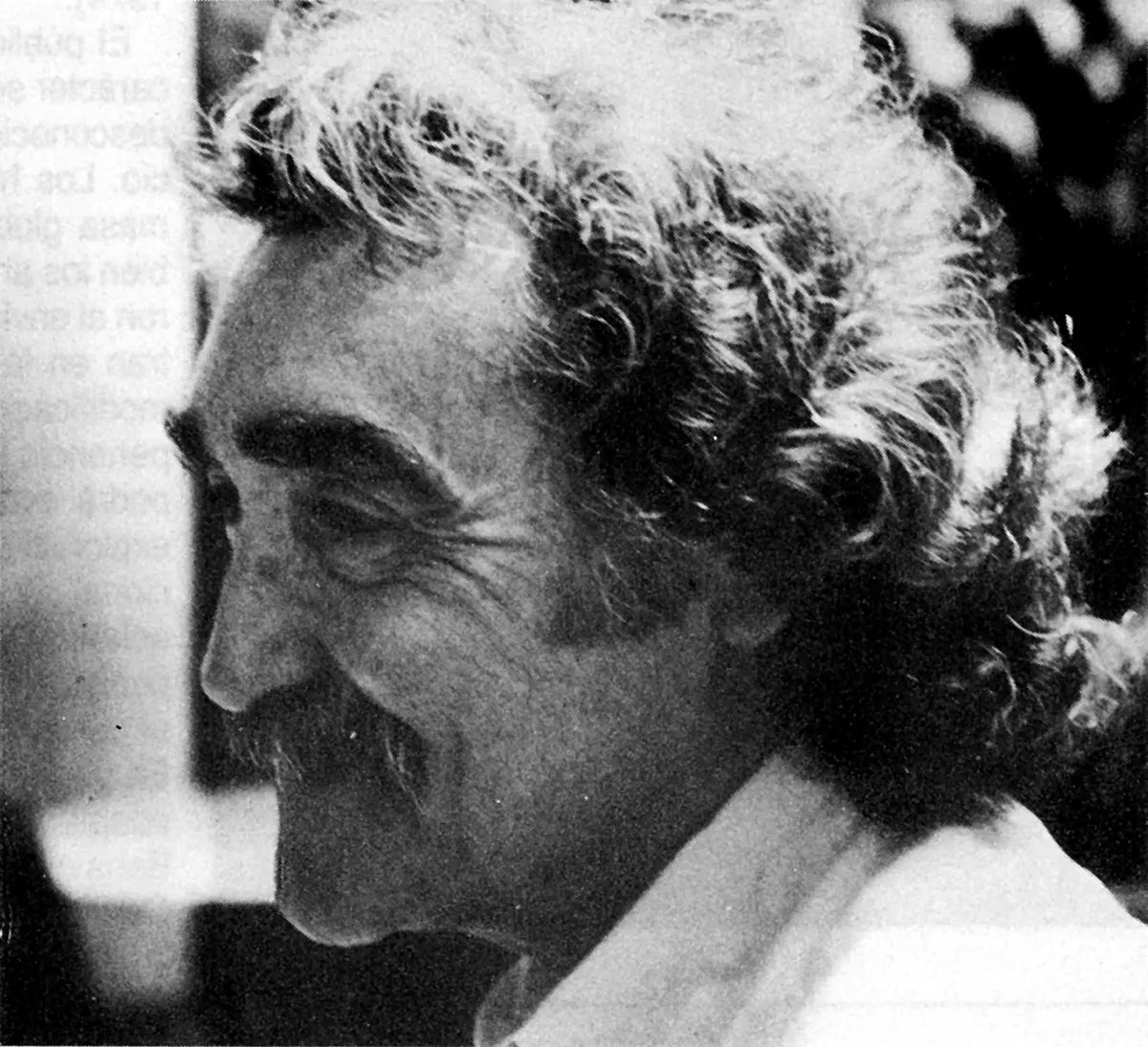
Since the museum’s opening in 1973, it has held an exceedingly important collection of Soto’s own works as well as works by some of his contemporaries. Landscape and milieu influence creativity, but, against the background of the dense vegetation of the Guayana region of Venezuela, the museum’s complex possesses—like creativity itself—the value of an anomaly.
After his beginnings as an advertising illustrator, between 1942 and 1947 Soto frequented, thanks to a scholarship, Caracas’ Escuela de Bellas Artes, and since the end of his studies until his departure for France, he helmed a small art school in Maracaibo. In his personal history, Soto speaks of Cézanne, Mondrian, and the influence of the former on the entirety of art since the turn of the century.
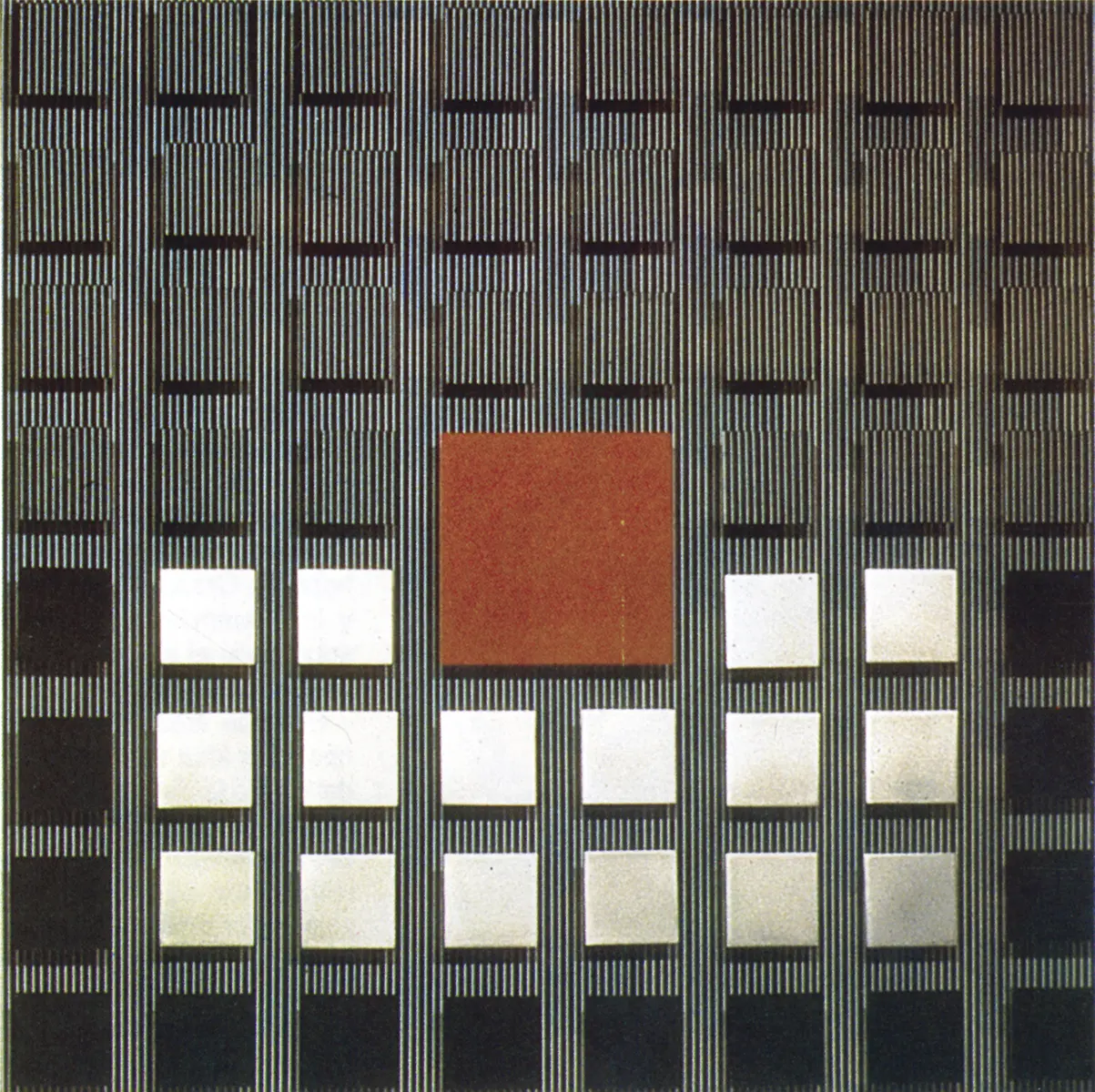
Yet of all the lessons learned, what became an important factor in Soto’s thematic content was the notion of a multi-vision of the object. The elaboration of a rationalistic understanding of the construction of a painting prodded him, above all, to abandon appearance and anecdote. After a trip to The Netherlands Soto discovered that Mondrian, had he lived longer, would have evolved towards kinetic art, as can be seen in his last works, Broadway Boogie-Woogie, of 1940-43, where Mondrian’s dynamic primary-color squares become even smaller and generate en essential element: vibration in relation to space.
Nevertheless, and regardless of personal choices, it was in the historical climate of Paris that these issues in art unfolded. Under the direction of Michael Seuphor and the spiritual guidance of Torres García—and despite its short official existence—the Cercle et Carré group, founded in 1930, promoted a debate of constructive abstraction. The writings of Klee and Kandinsky gave way to reflections about the relevance of Bauhaus. Lyrical abstraction gave way to a precise elaboration of forms. Hungarian artist Vasarely assumed aesthetic leadership in the postwar period and found material support with the establishment of the Denise René Gallery in 1944 and the opening of the Salon des Réalités Nouvelles in 1946.
Also to be noted are the precedents that developed in Latin America and the precursor work of such artists as Verdánega, Kosice, Fontana, Arden Quin, and the Concrete groups in Brazil. Many of them opted also for a voluntary exile, seeking the appropriate conditions for the creation and diffusion of their ideas.
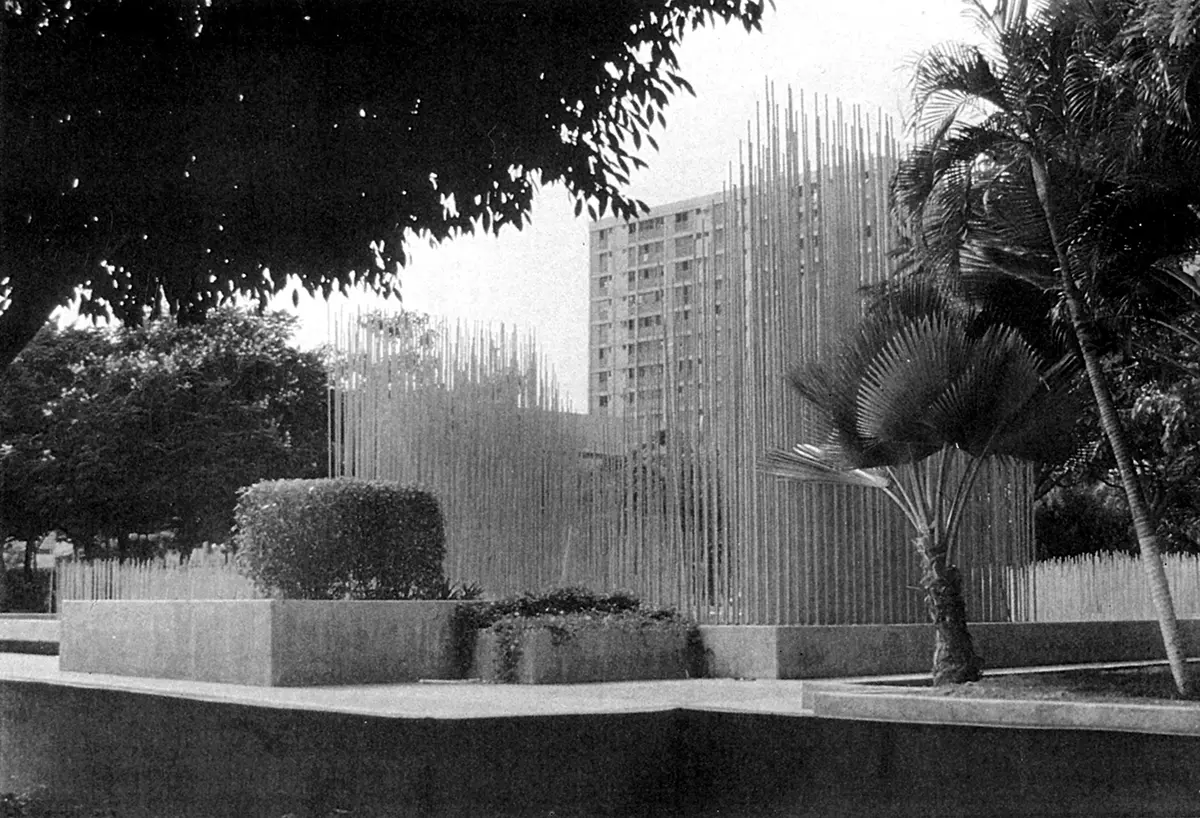
An exhaustive study of Soto’s oeuvre makes it almost impossible to describe every one of its variations and possibilities: reliefs, installations, sculptures, and even their combination, as well as sound environments (Penetrable from 1970) and ballets (Violostries, 1971, Paris).
Soto’s earliest “dynamic compositions” are from 1950-51. Based on an interplay of lines and on the three basic colors, he recreates Mondrian while giving dynamism to the form through the introduction of diagonals and curves, also present in his later Escrituras. Simple geometric elements are at the base of his Repeticiones, from 1951, and the progressively growing dynamism of the frame takes him to the serialized paintings of 1952. But these constructions move beyond organic abstract growth and find support on a solid mathematical foundation. “Dodecaphonic music and its immediate consequence, serialization, allowed me to move from music-science to painting-science,” Soto explains.
“I wanted to give dynamism to the lines in my Permutaciones. The solution I found was to superimpose two surfaces, one opaque, the other transparent, leaving several centimeters between them. In this way I incorporated the space that is manifested between two separate planes.” (Desplazamiento de un cuadrado transparente, 1953-54).
The intersection of points and lines is what suggests in these works a third dimension. It is thanks to the viewer’s own motion that the optical effect of motion actually emerges. Artwork and viewer execute in unison a scientific principle: “The explicit function of the work of art is to provoke thought: its interest is eminently conceptual, even as the artist deploys sensorial means to put across his thoughts.”
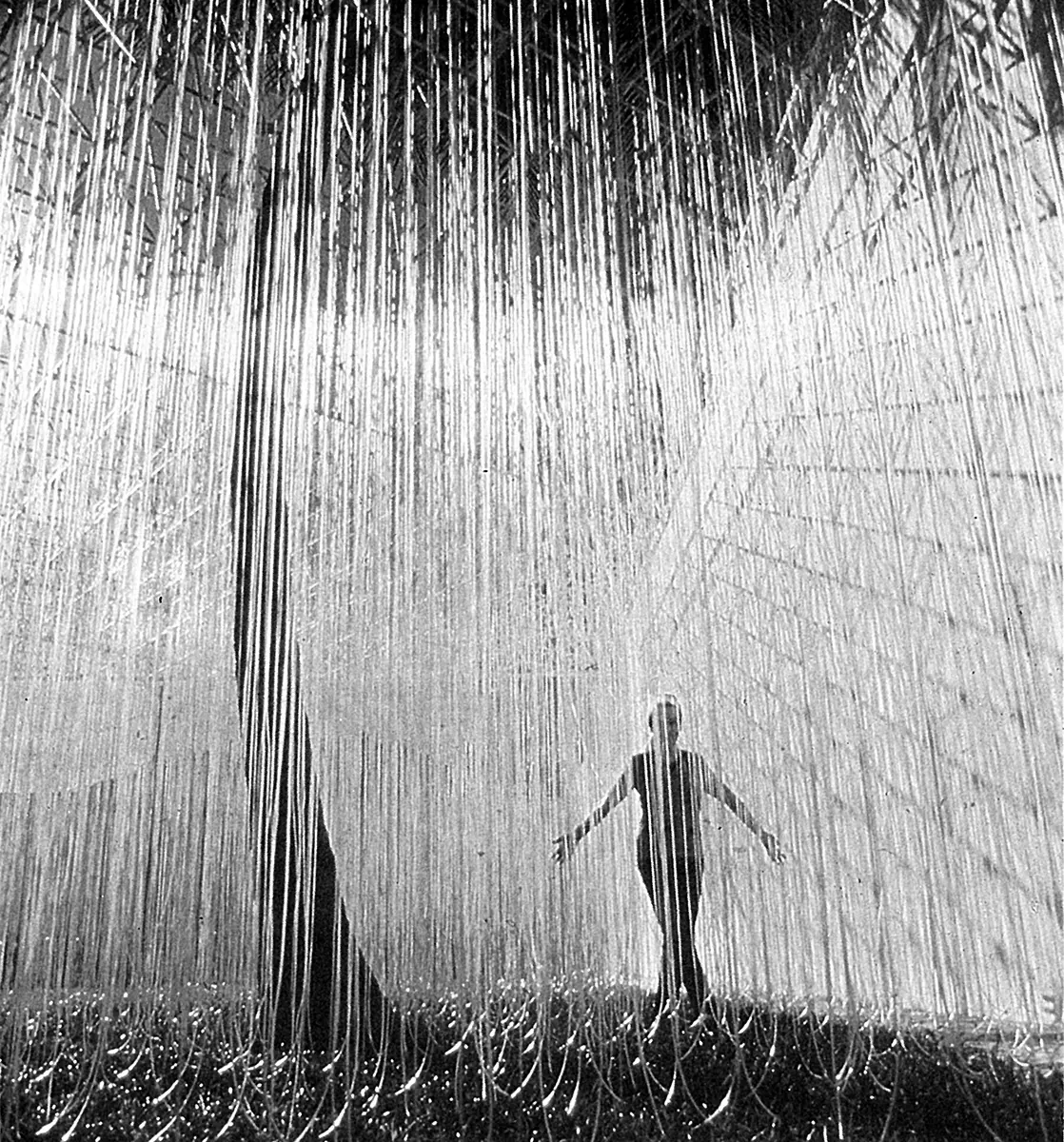
La Espiral, 1955, is a synthesis of these arguments where Soto, using minimal elements, resolves this curve into positive and negative: one in white and the other one in black, in a translucent space. But all these creations follow logical coordinates and—from the beginning to the Progresiones and Penetrables, with their innumerable strung threads, bodies, and lines—become virtual volumes. The analogy in relation to the theory of dematerialization and the rupture of the Euclidean precept is clearly noticeable in Soto’s acrylic polygons , such as Cubo de Roma, from 1969. “Space, energy, time, and motion are universal entities of which we are tributaries. They are inseparable, and, contained in the idea of relationship, can be summarized in a kind of elasticity into infinity.” This unveiling of the sensible world using the purest structural values constitutes the essence of the penetrable (Pampatar, 1971; Washington, 1975, or Guggenheim Museum, 1974).
The audience encountering artworks of these nature feels transported into an unknown environment: it lives in symbiosis with space. The plastic threads reach all the way to the ground and the global mass is nothing but vibration. While conceptual artists devoted themselves to environments, all focus on the occupation of a given site and not in its modification based on a principle. “The experience of a different space-time will evolve more freely with an advanced exploration of the non-gravitational medium.” And with regards to the execution of the work, Soto notes: “The Penetrable can be built without my help: that is the true meaning of conceptual art.” In general, his suspended volumes adapt subtly to their location (Centro Benaven, Caracas, 1979, or Royal Bank of Canada, Toronto, 1977).
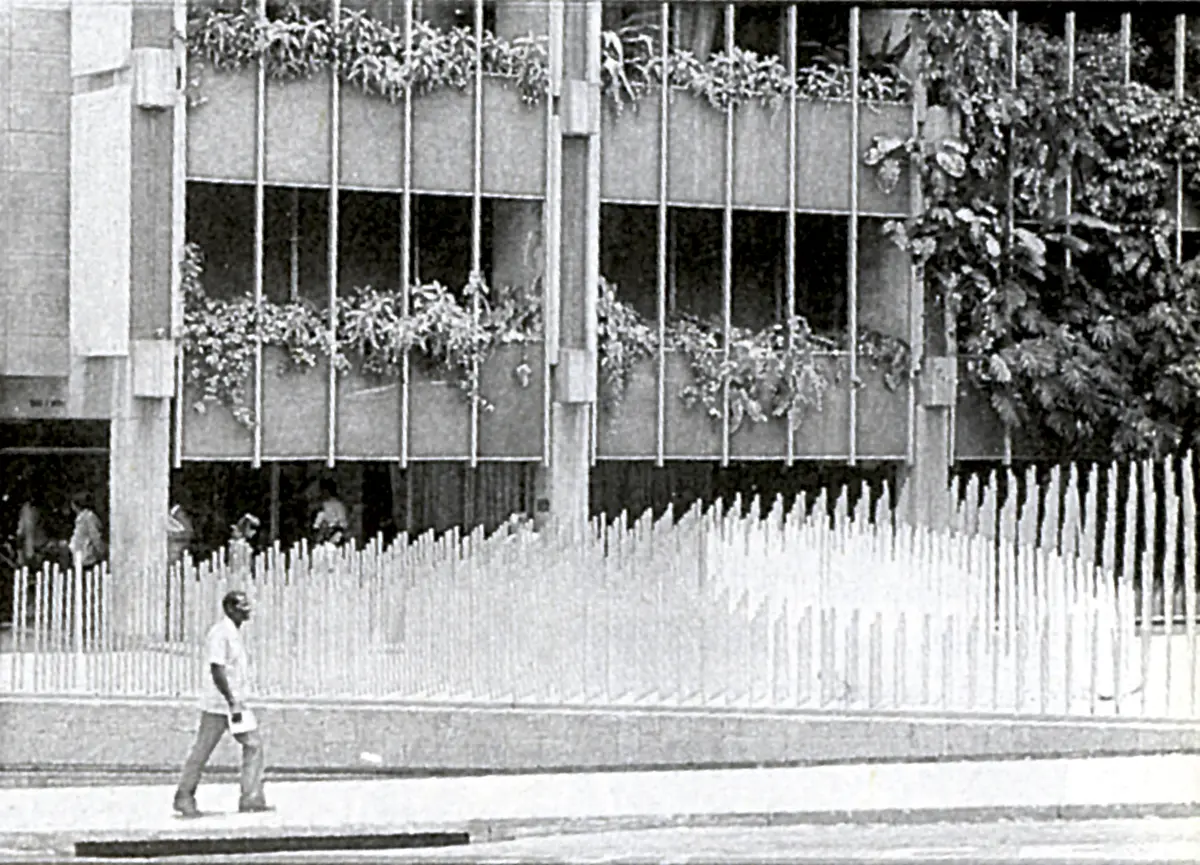
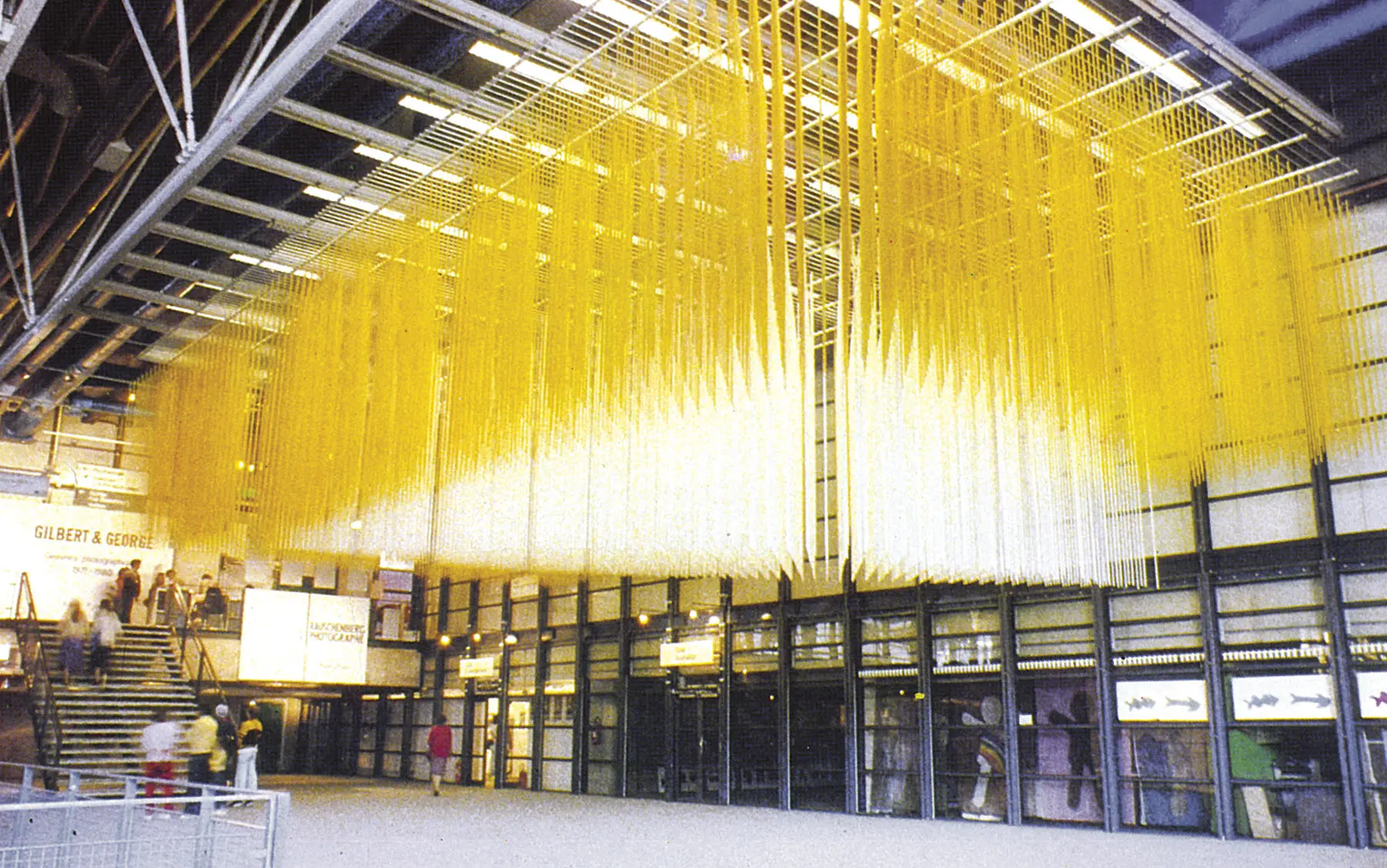
On a surface 14-meters in length, hundreds of narrow white and yellow rods, set out in the open, comprise Progresión de Caracas, 1969. In works like Extensión, 1979, at Centre Pompidou, equal-size bars set below eye-level from the viewer’s perspective and placed on the ground on a surface of approximately 30 meters, suggest that the air is not a vacuum, but that it is, rather, loaded with elements.
The entrance to the Renault facilities in Boulogne de Billancourt, 1975, summarizes Soto’s various monumental-scale works: Doble Cubo Cinético forming the entryway, walls animated into Cuadrados Vibrantes, an Escritura over a 30-meter area, and a giant Progresión formed by 250,000 segments attached to the ceiling. In 1977, the same company unveiled Soto á Sénanque. Hung from the walls of the austere abbey were large-format works of art, especially Soto’s Escrituras: at a distance of approximately twenty centimeters in front of a grid of parallel vertical lines in black and white, invisible threads support curved or straight vibratile rods that break the previous parallelism and produce, with their motion, an “atomization.”
In artists like Paul Klee we find a concern for a search for the invisible; Soto, in turn, prefers to find support in the methodical conclusions contemporary physics.
To explore in greater depth his particular ideas, we will synthesize this interview, in which Soto explains his points of view.
In today’s art, there is a tendency to ascribe greater importance to the object than to the metaphysical or transcendental idea of what is being shown. Mondrian, by reformulating the interplay of vertical and horizontal lines, presented not only a problem of composition but a cosmological idea; when you speak of an art-science, what is your position on that regard?
The very history of painting is, in essence, based on totalizing principles. The construction of space, in Eastern art, for instance, is inextricably connected to the philosophy of those cultures. Until the Renaissance, artists represented a space that was external to them. But, starting with Las Meninas, Velásquez not only entered the stage as an observer, but even represented the characters who are outside the composition. This work is a revolution, a kind of pre-Cubism. It would seem that the artist is gyrating, offering a multiple vision. Here we see clearly how great artists have always mastered the conceptual question. True art begins with a “cerebral” attitude.
That predominance of the idea brought with it another element, which is its execution.
The impressionists already reformulated the value of technique. Monet, for example, leaves behind the “finish” of the work and opts for the “capture of the moment.” When he paints his cathedrals at different times of day or his Water Lilies, in the latter he was creating an “environment”: the proof that the viewer is at the center of a spectacle that unfolds around him or her. In Cézanne, distant and close elements have the same density. Picasso and the cubists didn’t insist on “mannerisms” either: they considered a painting finished when they had said everything they had to say. Kandinsky, in my way, was very clear in his ideas, but from the pictorial point of view he had difficulties in communicating his thoughts. Mondrian and Malevich, on the other hand, started from Cubism and arrived at an essential distillation. This is why abstract art was able to acquire significance. It is not that geometry didn’t exist before; in the Renaissance, for example, geometry was the support of the painting, but it was subordinated to a monocular figure.
What is, in your understanding, the difference between abstract and concrete art?
Do you remember, in Argentina in the mid 1940s, the groups Arte Concreto and Arte Concreto-Invención? These creators confused both terms. They started to construct artistic objects and reliefs and emphasized the value of their constructions to such a degree that the conceptual issue was left behind.
What is the difference between conceptual and abstract, according to your conclusion?
In abstraction, geometry, or better yet, the invisible aspect of the painting, is more important than the result. The pictorial event is a function of a construction.
Where would you situate your own creations?
My paintings and reliefs are only intended to show the abstract value of the pure structure. I believe that Mondrian thought about this. And if mankind arrived at a higher culture, we would probably no longer need the object to understand the beauty of art. This almost incomprehensible aspect of the de-materialization of the work of art is a normal thing in the field of music. The great orchestra conductors marvel while just reading a score, without the need for any instruments.
You are talking about conceptual art. What is your experience of the most recent contemporary tendencies?
I do not understand today’s art as such, in my view a title has been given on loan to something that doesn’t deserve it. Contrary to what it appears to show, so-called “Conceptual Art” places great emphasis on the object. Even arte povera indirectly highlights the effect of the materials with which it works. I think that we can talk about conceptual art in Malevich or Mondrian, because of the value they gave to pure structure.
Can you expand on your idea of space-time?
This is a kind of leitmotiv in my work. Space-time precedes form and with that we can say with a degree of propriety that form is nothing more than a space.
Mondrian said: “Form is limited space.”
Exactly. This is a concern of the arts since the time of cave paintings. And if one wants to achieve mastery of pure structure, one must break with the premises of traditional painting.
Some critics have made reference to nature when commenting your work, but you reject that idea fervently.
Absolutely; for me, artistic talent is independent of this aspect.
Nevertheless, the Penetrable’s transparency effect presents a similitude with rain or with the dense atmosphere of the tropics. Why reject this?
People always seek references to immediate reality. But the intent of the Penetrable is to show that space is a dense entity. It itself doesn’t build a vacuum; on the contrary, it is as dense as water. Were I to search for a different element to express the same sensation, the reference to vines would disappear.
I think of it as I observe the landscape of Venezuela and the possible repercussions of early infancy.
There might have been an influence in me, but that does not imply a generalization in terms of a country or region.
In his proposals, an intention is signaled to go beyond reality, in search for a certain metaphysics.
The function of the artist, like that of the philosopher, is to arrive at understanding. Metaphysics for me doesn’t have a religious meaning; it is a physics that is yet to be discovered.
You have a work by Lucio Fontana in your studio. Do you think of him as a Latin American artist?
I disagree with separating Latin American phenomena from global cultural processes. Fortunately, extraordinary foundations have been laid in our continent, thanks to its ample contact with the West and to the splendid art that was created in the pre-Columbian period. But if artists from our region are not willing to understand the interaction between those two cultures, they will not be able to produce elements that are authentic.
I mentioned Fontana because he was also one of the first to mention conceptualism, and especially spatial art.
He was one of the rare artists, along with Yves Klein, who found a different solution. Cutting up the canvas, Fontana creates “real space,” not an imitation. Secondly, in the search for the absolute he also makes an interesting discovery. When Gabo established “virtual volume,” he switched the term “sculpture-mass” to “virtual volume”; he intuited that it was volume that revealed space.
Which do you think is the most important step taken by your work?
I see my work as a concatenation. When I tried to go into Mondrian’s work in greater depth, it was because I was very close to that conception of rhythm. And if an Extensión is produced it is because there has been a whole series of prior elements: the Repeticiones, the Espiral en transparencia and, within them, a kind of virtual motion. After studying history’s most important creations up, first, to the Cubists and, second, to the abstracts, I realized that they all were in search of movement; this fascinated me, because they had been unable to make that concrete in the end, because they had not had the opportunity.
In what ways do the work of the scientist and the work of the artist differ?
Experimental science engages in the scientific study of reality, but there is a part of this reality that is the sensible space, which can only be expressed through artistic creations. On the other hand, scientists have great admiration for artists, because artists present a deep vision of the world using elements as simple as those found in a studio. For me, the universe is a sensible whole. The scientist must also be a hypersensitive individual in order to understand those values and communicate them. It is possible that in the future it will be possible to convince people about the sensible state of the universe. I have felt with great satisfaction how visitors of a Penetrable lose their bearings, the sensation of verticality and isolation, and the distinction between walls and floor. If you take away the sensation of depth from a person looking at a landscape, they will also question the other space: the space of the “cube” or room. I believe that our society is not yet prepared to receive artists as someone who invites them to knowledge, but as someone who offers a gratuitous satisfaction. The artist is like the scientist, someone who is striving for mankind’s intellectual development.
SUSANA SULIC
Art writer, Professor in Fine Arts(ENPP).