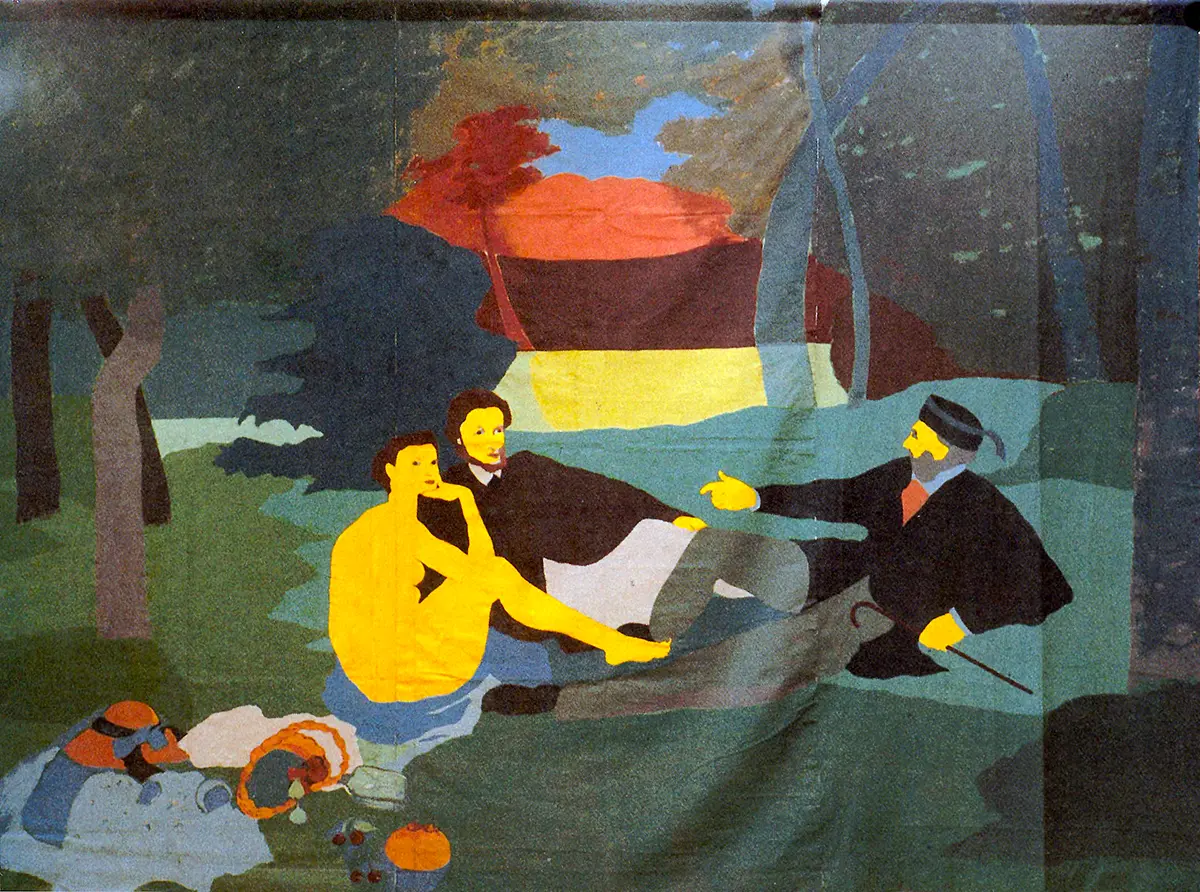
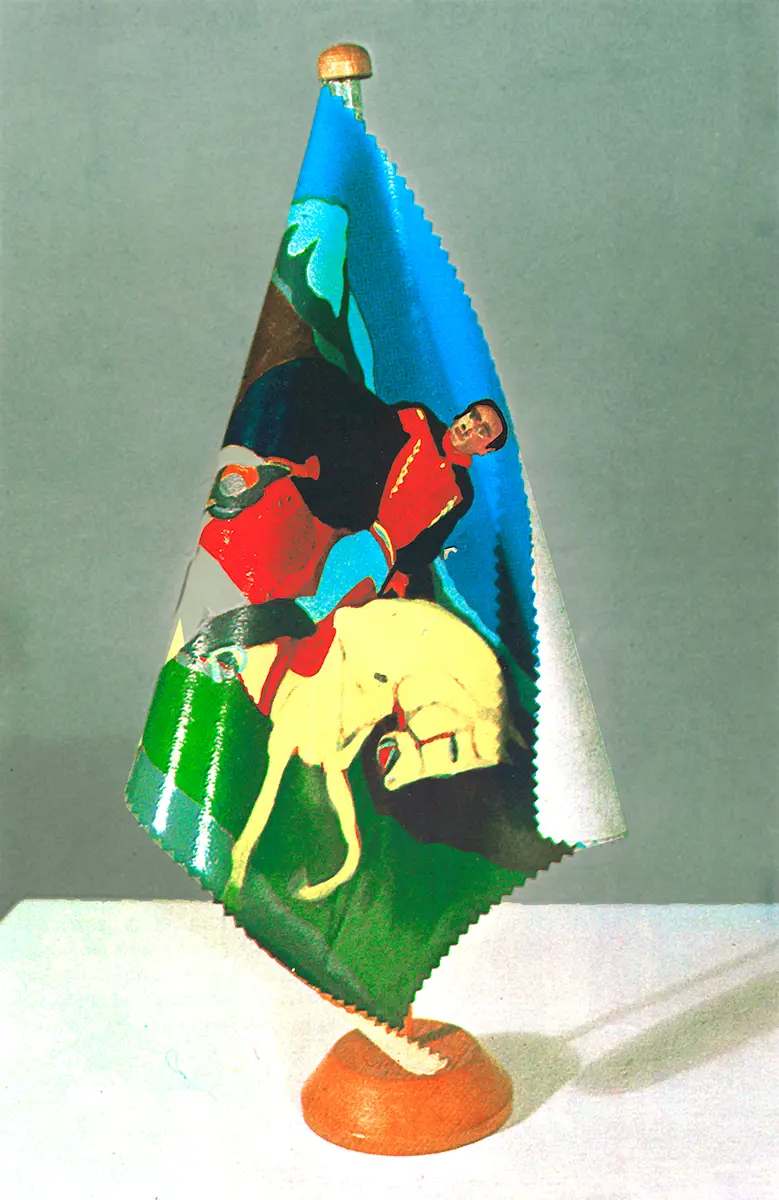
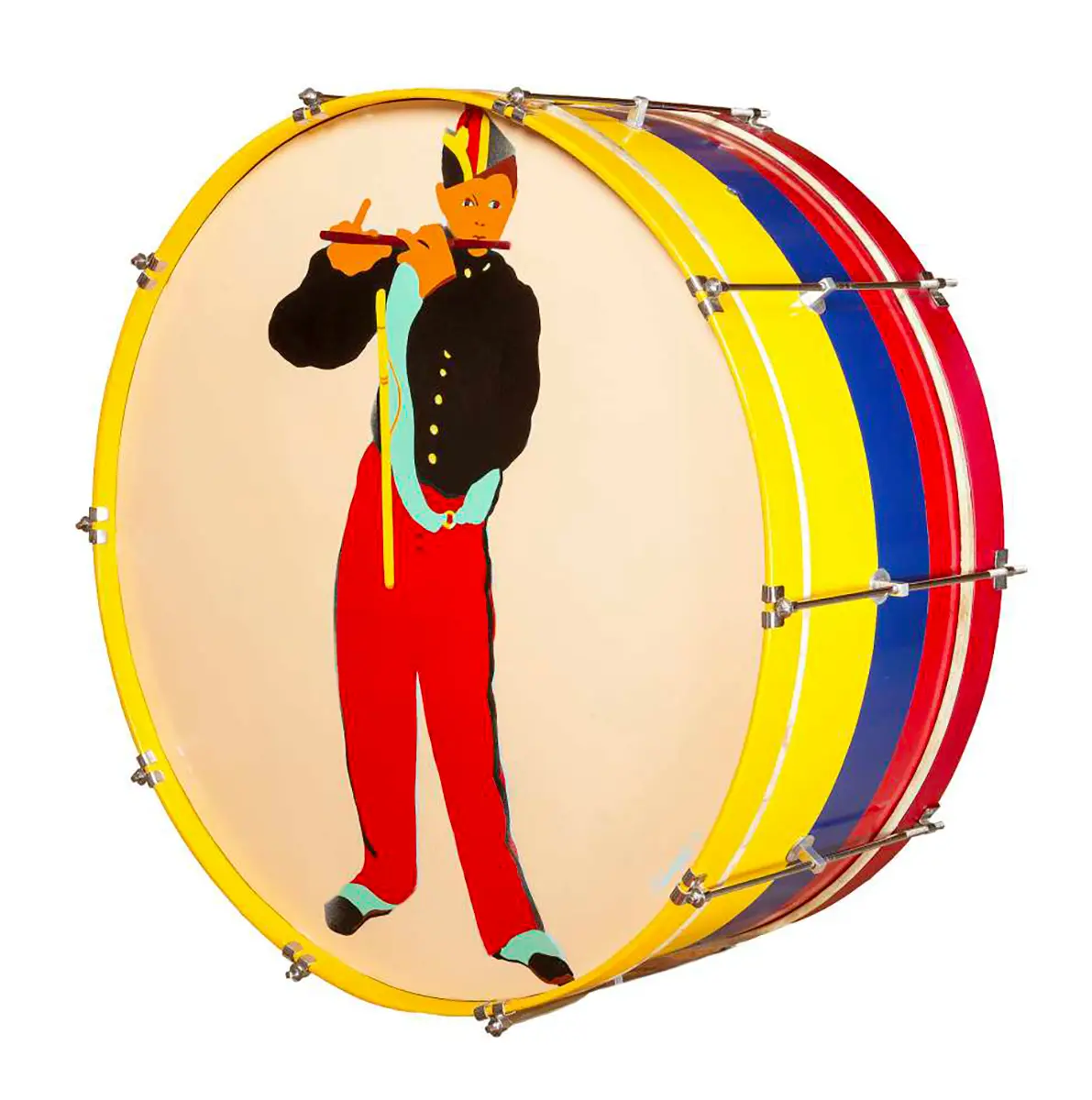
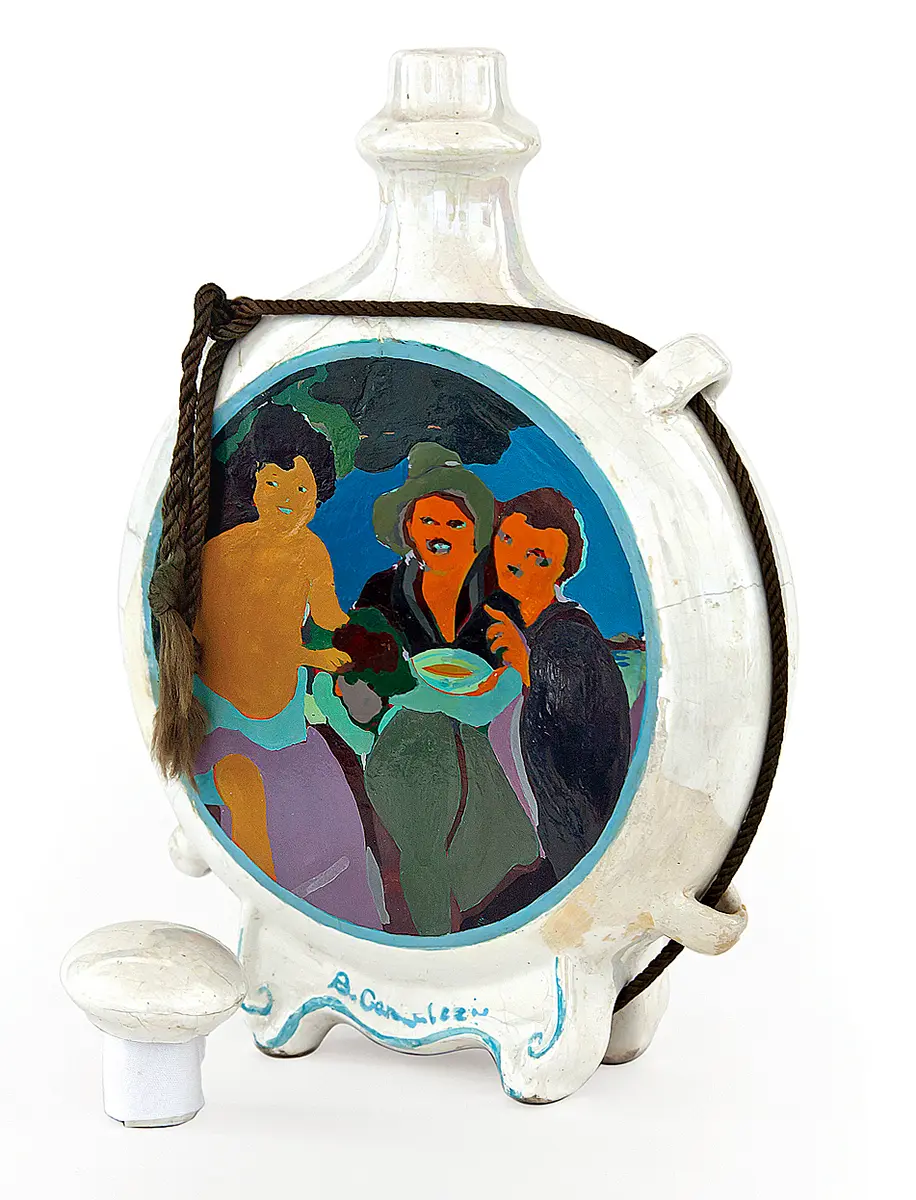
Recently, the Museo de Arte Moderno de Bogotá presented the latest works by Beatriz González: three huge curtains, three towels, a bed cover, and five objects (pennant, drum, table, sewing kit, and wine pot). On such utensils of very different materials, the artist painted with enamels or acrylics. Except for Un Bolívar (One Bolivar) —a small rubber flag— all works were inspired by famous works of universal art: Botticelli's The Birth of Venus, Velázquez's The Drunken, Fragonard's The Swing, —the oldest references— The Fife and The Luncheon on the Grass by Manet, Portrait of the Artist's Mother by Whistler, Women in the Garden by Monet, Where Do We Come From? What Are We? Where Are We Going? by Gauguin, and Still Life by Braque.
Since the beginning of her career, Beatriz González has based a good part of her work on the history of art. The artist's first paintings, fifteen years ago, were versions of Velázquez's painting The Surrender of Breda. Shortly afterward, the variations on Vermeer's The Lacemaker would come, with which she would make her first individual exhibition in 1964 and, later, versions of Rembrandt, Rafael, Leonardo, Ingres, Millet, Cézanne, Degas, Renoir, etc. Two reasons have led Beatriz González to work with famous works from the history of painting: her inability to compose, to distribute forms on the canvas, and her admiration for artistic works. This admiration dates back to her childhood when the artist enjoyed looking at the framed reproductions that abounded in the corridors of her house, or the plates of the art books that were in her parents' library in Bucaramanga.
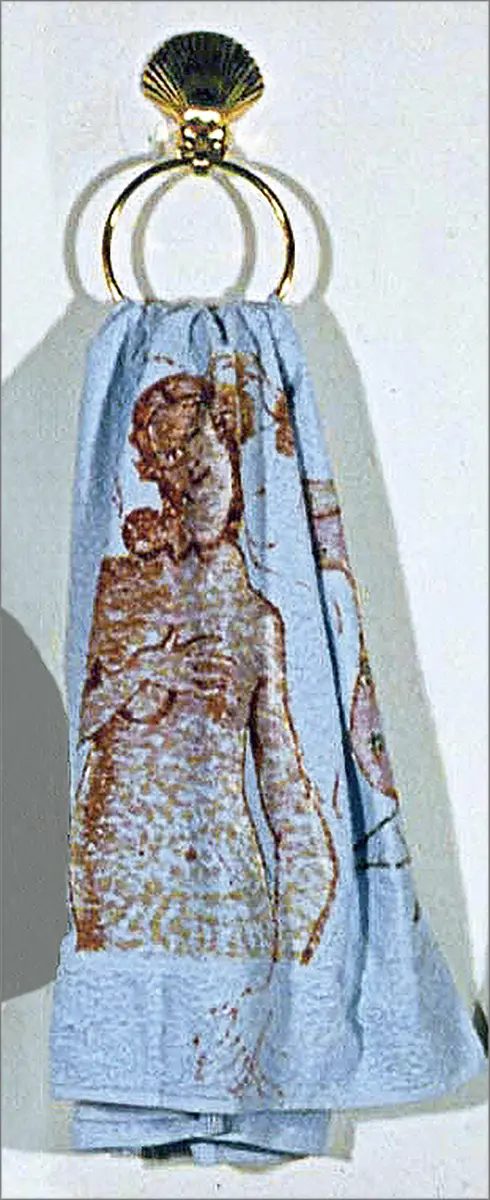
Beatriz González confesses having a prejudiced vision of art history. At all times, everywhere, the artist associates her visual experiences with famous paintings. From any object, from the texture of wood or the shape of a piece of furniture, the aesthetic association arises. Thus, for example, from some shell-shaped towel rails came the image from Botticelli's oil painting The Birth of Venus; from a striated Madeflex sheet, a still life by Braque; from a seamstress, the portrait of Whistler's mother; from a comb with a circular mirror, a tondo by Rafael; from an umbrella stand, Leonardo's Mona Lisa, etc. Other times, the procedure is the opposite: a painting inspires the idea of the object where its composition should be. That is how the curtains inspired by Manet, Monet, and Gauguin came about. Isn’t Manet's The Luncheon on the Grass an actual "curtain"?
As the artist works on surfaces of different materials and textures (metal sheets, various woods, towels, rubber, bed covers, etc.), she must continuously invent new finishes. With oils, enamels, or acrylics, Beatriz González masters each of the techniques and works with a very varied range of colors. From her oil paintings on canvas from her early works to acrylic painted curtains, through her numerous enamels on the tin, the artist has had the luxury of mastering the procedures and, above all, talentedly transferring the paintings that inspire her. Because if it is true that Beatriz González copies the composition of the works of the past in the aspect of the distribution of forms in space, there is no doubt that she always invents a new color relationship and, often, also a new technique. Venus Coppertone and In fraganti (Red-Handed), for example, follow the designs of Botticelli and Fragonard's works. Still, they are authentic creations from the point of view of color and finishing.
In this sense, a parallel could be established between Fernando Botero and Beatriz González. The history of art frequently inspires both artists. The first one tries to copy or learn —to the best of his ability— the techniques of many artists from the past to reproduce their characteristic figures and compositions. The second openly copies the distribution of the traditional shapes of the paintings traditional to invents a new color composition and investigates new materials and procedures. Botero works on the observation of the originals. Beatriz González prefers reproductions. The first has a direct and unchangeable relationship with classical painting. The second has a relaxed reference—in size, in color—that allows her to act with the greatest of liberties. That is why, while Botero's paintings —oils, pastels, watercolors— are heirs to the best pictorial tradition, Beatriz González's paintings are closely linked to contemporary art, both for their support in the reproduced images and for their flat colors and violent reminiscent of Fauvism or current advertising design.
Furthermore, when Beatriz González interprets a famous work from art history, she intends to recreate it in a sui generis context. She wants her version to reflect a sensitivity not sufficiently cultivated. She wants her piece to be deficient and poor. She aspires to create a new work full of freshness and spontaneity, "as if a choir accompanied by a Sesquilé guitar interpreted Beethoven's Ode to Joy of the Ninth Symphony.” Hence, many people do not understand the artist's painting, and consider it disrespectful of the originals, and ruthless criticism of popular appreciation and assimilation. Nothing is more wrong. Beatriz González has achieved an unmistakable style making excellent interpretations —not without humor— in which the masterpieces of painting lose their false sacralization of immovable and invaluable pieces and become festive and simple decorations of everyday objects, and the originals of the museums are only ideal archetypes of new aesthetic realities irrigated with other sensibilities and other intelligence.
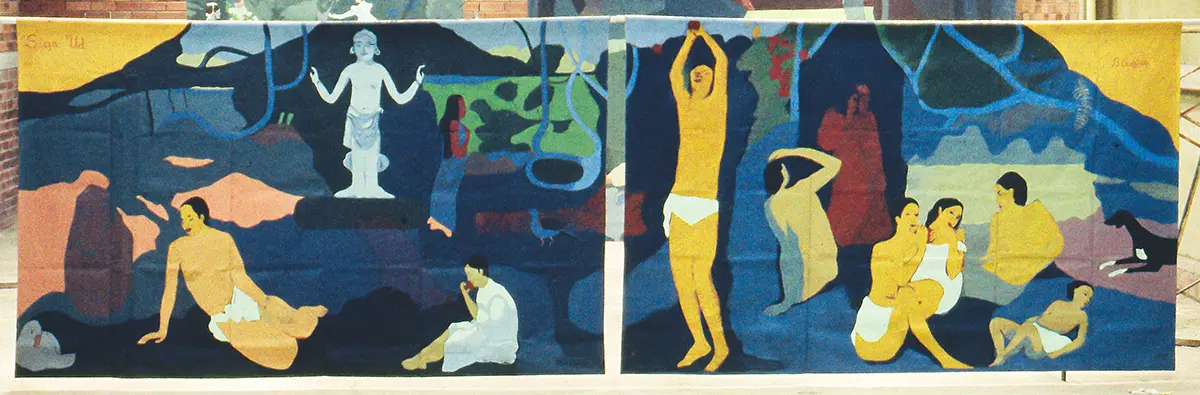
Beatriz González is convinced that her work can easily reach all kinds of audiences. People who know where their works come from —what are their artistic sources— can appreciate and enjoy them in a certain way. The one who does not know that there are famous paintings as antecedents or points of support for her creations may have another approach to her objects-paintings. Indeed, a work like Siga Ud. (Go Ahead), based on Gauguin's 1897 canvas Where Do We Come From? What Are We? Where Are We Going?, a jewel of the Museum of Fine Arts in Boston, amazes the connoisseur of art history for the quality of recreation, in which the colors applied following those of the original have gained a liveliness and freshness that reinforce the exoticism and magic of Gauguin's painting which, well regarded as the artist made, it is a true symbolist theater curtain. Don't you think of Maeterlinck or Verlaine when facing it? However, for a person who does not know the origin of Siga Ud., this gigantic curtain is no less striking. The presentation of the half-naked figures, the luxuriant landscape, and the entire tropical environment that the fabric radiates can produce various associations. Ultimately, it could be taken as a tarp abandoned by a decaying circus.
Of course, to understand Beatriz González's painting in one way or another, you need a good dose of humor, the same, at least, that the artist has to carry out her pulsating, joking, and innovative work.