Seen from a Latin American perspective, the spatial shifts in Alfredo Jaar's work appear to be absolutely extraordinary. A Chilean artist, who is barely thirty years old, has exhibited with notable success in international exhibitions —Documenta 8 (Kassel, 1987), XLII Venice Biennale (1986), Nineteenth Biennial of São Paulo (1987), Magiciens de la Terre (Paris, 1989). He is named by international art critics in the company of artists such as Hans Haacke, Barbara Kruger, and Jenny Holzer. In Brazil, he has made trips to Sierra Pelada, and the toxic waste dumps in Africa as part of the many observations and findings that have a fundamental place in his work. He has lived the last seven years in New York, where he has just finished presenting a spectacular project in the Grand Lobby of the Brooklyn Museum, after having made numerous exhibitions in various places in the United States. A work of his welcomes visitors to the International Foundation for Human Rights, at the recently inaugurated Arc de la Défense, in Paris. He will soon move to Federal Germany for a year, with a scholarship that allows him to freely develop his artistic work.
The enumeration is necessary not only to account for an exceptional and still little-known career in the Latin American spheres. It also serves to introduce a reflection on the work itself. Its development, over time, points to an artistic task of a critical and exploratory nature. Themes focus on the relationships between human groups —fundamentally those of power— and are linked to the geographical and cultural spaces in which we all live, and among which Alfredo Jaar constantly moves, looking, and then showing.
Interconnection Spaces
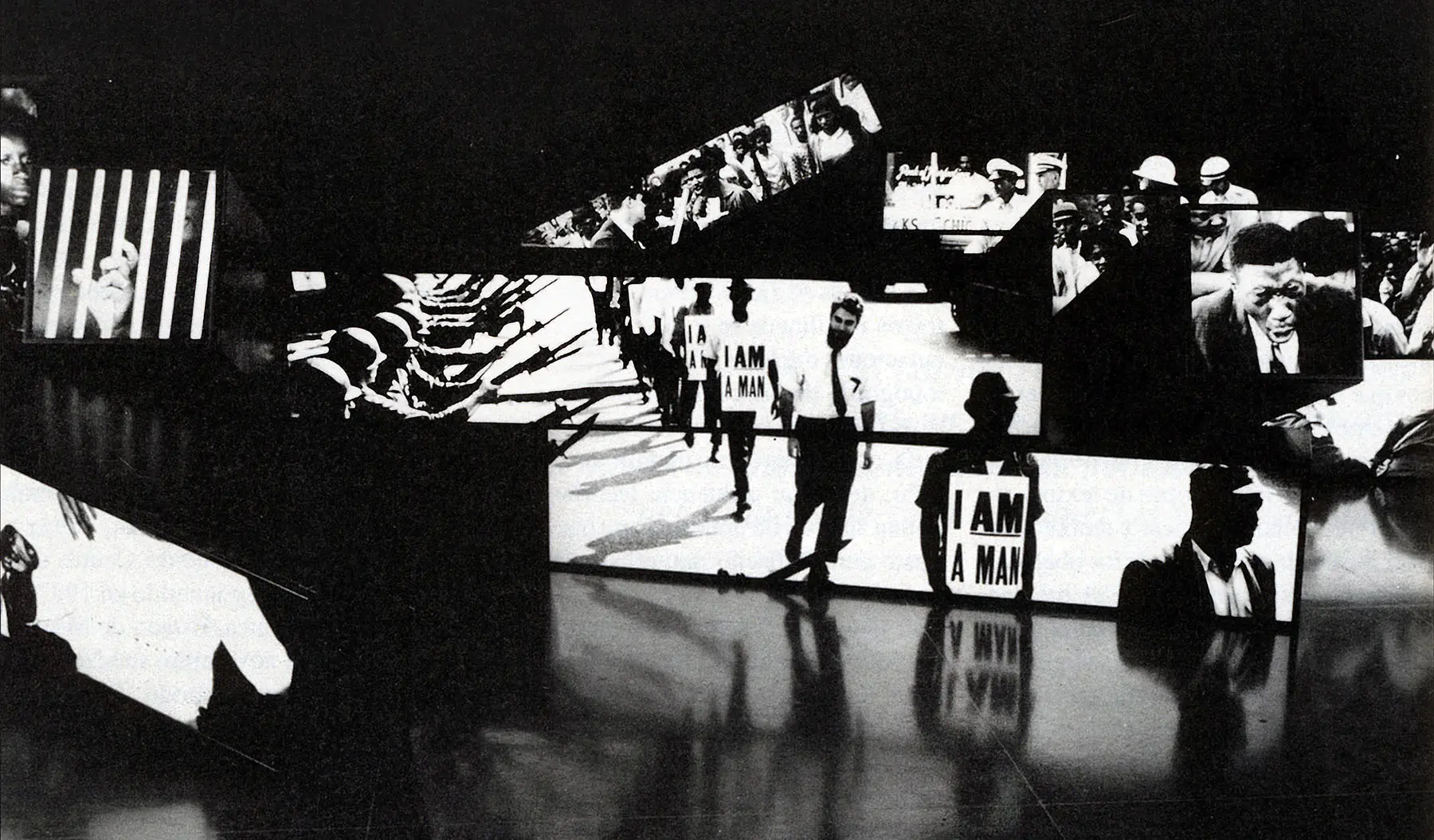
Mobility is a feature, almost a precondition of Jaar's gaze. It allows the creation of interconnection spaces in his works: producing a look from the intersection of different perspectives. An example, his latest work, The Fire Next Time, presented until September four at the Brooklyn Museum interconnects beginning with the title. The phrase is from James Baldwin, who, in turn, quotes a black slave: "God gave Noah the rainbow sign, no more water, the fire next time!" The photograph announcing the project is that of black protesters, in a single file; each one carries on his chest a sign that says: "I am a man." The fire, which is announced, is also present in the photograph: the row of protesters passes by another row, of military, which confronts them with open bayonets. The interconnection between the biblical context, the context of racial struggle that James Baldwin embedded, the context of the military threat, the —artistic— setting of the museum in which these photographs from the sixties are presented, and the —social— context from the neighborhood of that museum, within the framework of New York City today... The word "fire" is found at the intersection of all those contexts and is charged with the senses of all of them: it is transformed into a space in which all those senses come into a relationship.
Ezra Pound said that poetry is nothing more than a word charged with meaning to the maximum of its possibilities. Alfredo Jaar's installations remind us of that literary observation. Each visual element charges and recharges those around it summons associations of ideas, and makes the senses play. And it maintains its ambiguity: ''art makes sense but has not one meaning."
Transcultural Subject
In Alfredo Jaar, as a creative subject, it can also be said that, as in the word "fire," in the example —multiple contexts intersect. Their place is not within any particular culture, but in the interstices between them, in transit. His identity is "mixed, relational, inventive."1 Transcultural subject, in the sense that there is a transitive process, passing between cultures.2 Alfredo Jaar is located in a very peculiar relationship with Latin America.
a. The Framework
It is worth starting with his career. After presenting his Obra abierta y de registro continuo (Open and Continuously Registered Work), in Chile, in 1981, he moved to New York. There, he says, he avoided limiting himself to the circuits of Latin American artists. The vast city has many circuits, many. Some of them are the circuits of the subordinates in Gayatri Spivak's words. They survive, enter into controversy and reciprocal opposition, circulate in particular galleries, among their peers, appear in exhibitions whose title mentions that they are subordinates, and are seen as such by the public. The reference to these subaltern circuits gives the public and critics of the enormous city —and the enormous world— an easy key to reducing the reading of the works to a limited and exclusive frame of reference. It is not by chance that Jaar's work has had an obsession with frames, which have appeared on the ground, empty, filled with golden nails, enclosing a mirror, filled with other smaller and smaller frames, bare or in the air, hanging, raped by a cannon. (One of his recent works is called Frame of Mind).
Jaar has tried to remove his works from the frames of reference reserved for subordinates: frames imposed on them by external perception and imposing, within their limits, their own rules.
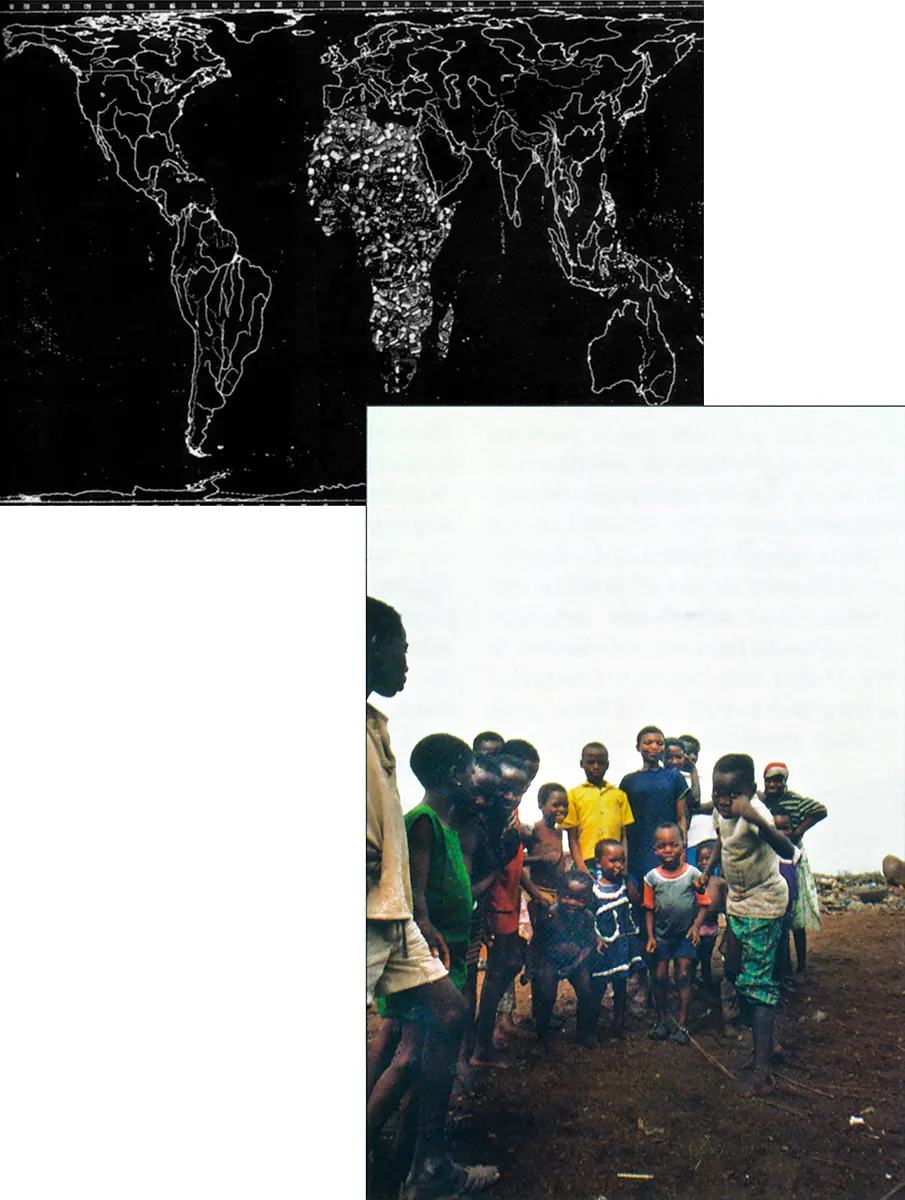
The difficult interaction with frames of reference and the work as a proposal that seeks to exceed such frames can be exemplified by some elements of the work that Jaar presented in Magiciens de la Terre (Paris, 1989), an exhibition that intended to bring together "in a plane of absolute equality" works by artists from the peripheries with those by artists "from our centers."3 La géographie, ça sert d'abord à faire la guerre (Geography is first used to wage war), was the title of the work. It began by challenging the notion of "center" —equivalent to the "centers" of the northern hemisphere— using as an introduction to the installation space a world map in Peters projection, which restores to the southern hemisphere its equality in terms of geographic area. Then, in an exhibition in which the artists from the peripheries were mainly represented by Africans, or by Latin American cultures with African roots, he made Africa his thematic reference (specifically, through the photographs he took of poor children and young people digging the deadly dumps of toxic waste in Nigeria). It is interesting to note that, while many African artists exhibited works produced within subordinate cultures that corresponded to their internal parameters, Jaar's reference to Africa placed it in the framework of the world, interacting with it in its entirety. From this perspective, he incorporated it into the work as one more element in a reflective concentration space created by the installation. As a critic said about his presentation in another great exhibition, Documenta 8, the close link created between the political perspective of the work and the place in which it is presented is key for the work to achieve its objective.4
b. Learning to Play
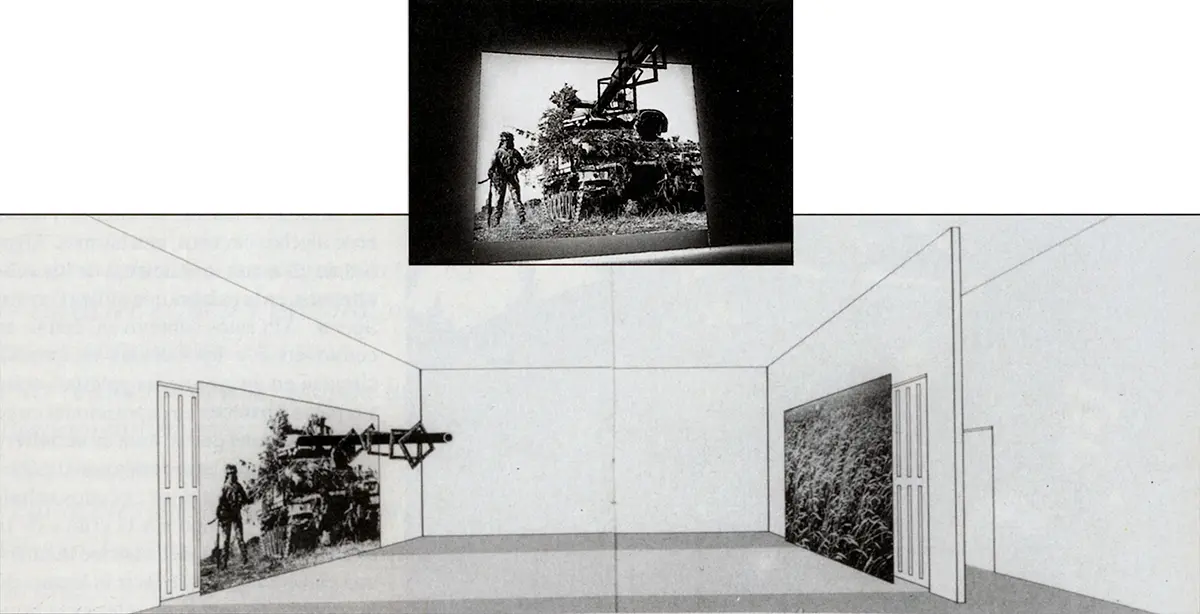
Another work —the one presented at the São Paulo Biennial, 1987— is called Aprendiendo a jugar (Learning to Play). The awareness of the framework of power in which all social life moves, and to which artistic production certainly cannot be alien, imposes a knowledge of the power game and the possibilities of intervention in that game. The thematic reference of this work is Brazil, a great producer, and exporter of tanks and armored vehicles. Brazil, learning to play like the great powers of the centers. As it happens with the thematic references of his other works, Jaar proposes a space in which the elements and the operations of meaning play against an open question, in this case, what game?
Transferring this question from that particular work to the set of Jaar's works and the role they play in the art circuits, it is worth asking what the game is. By the way, this one has its dangers, like other artists with similar concerns and attitudes: the danger that the critical attitude adopted fits too well with the logic of exhibitions and museums, the often-pointed danger of co-optation. The artist moves in a precarious balance of which he is fully aware: "We live in an imperfect world where we are all guilty of many things. But we are also victims because we find ourselves in a situation that we have not created. The only thing that can be done then (...) is to choose certain errors. The important thing is not to marginalize me and not let others marginalize me. From within the system, I must learn to say what I want to say and to do what I want to do... "5 There are two key ideas in this statement: one, "learn to do what I want to do," and the other, ''not marginalize myself.'' The choice is clear: that's the game. To lose it would be to assimilate completely into the system. Losing it would also mean staying out of it, condemning itself to the more than one hundred years of loneliness falling on Latin America everywhere.
The chosen course requires agility typical of the picaresque novel and the skill of a tightrope walker. It also requires an exceptional insight regarding its location within the power game, and its own ability to influence, to stretch the limits of the possible action to the maximum. All of this places Jaar's work in the crosshairs of what in the United States is called cultural politics, a field of studies of culture about social power.
This insight regarding one's own —poor— power situation and its consequences for possibilities and modes of action, represents an attitude that contrasts with many commonly accepted ideas about the artist's attitude towards the power relationship, and, above all, it departs from the possibility of "an artist-hero, who will provide the image of cultural identity and who will form a new audience for art."6 Many times, this last notion has not been alien to Latin American culture and its many redemptive and messianic instances. The heroic figure encapsulates without question history and the nation.7 A work by Alfredo Jaar would ask, at this point, "What history? What nation?"
c. The Mismatch = Mismatch
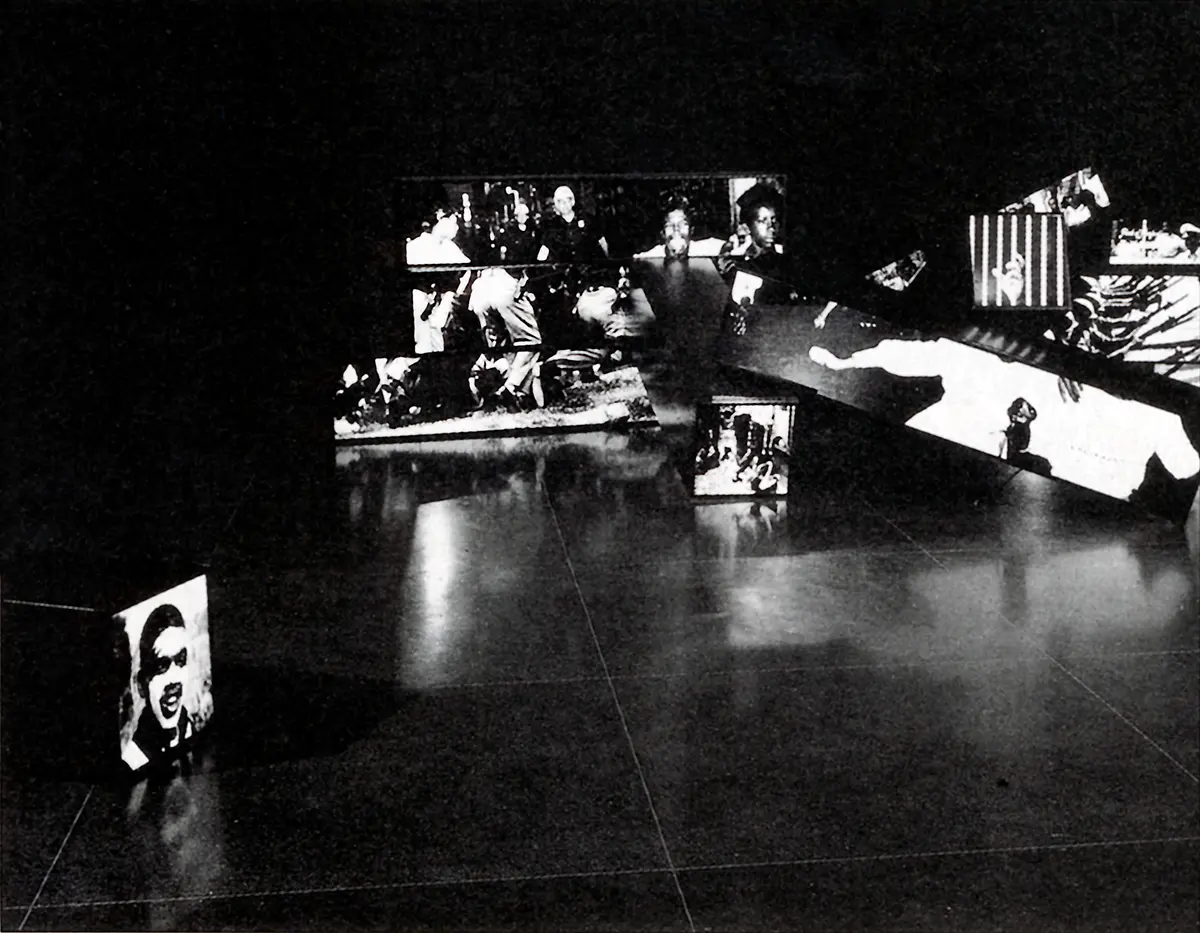
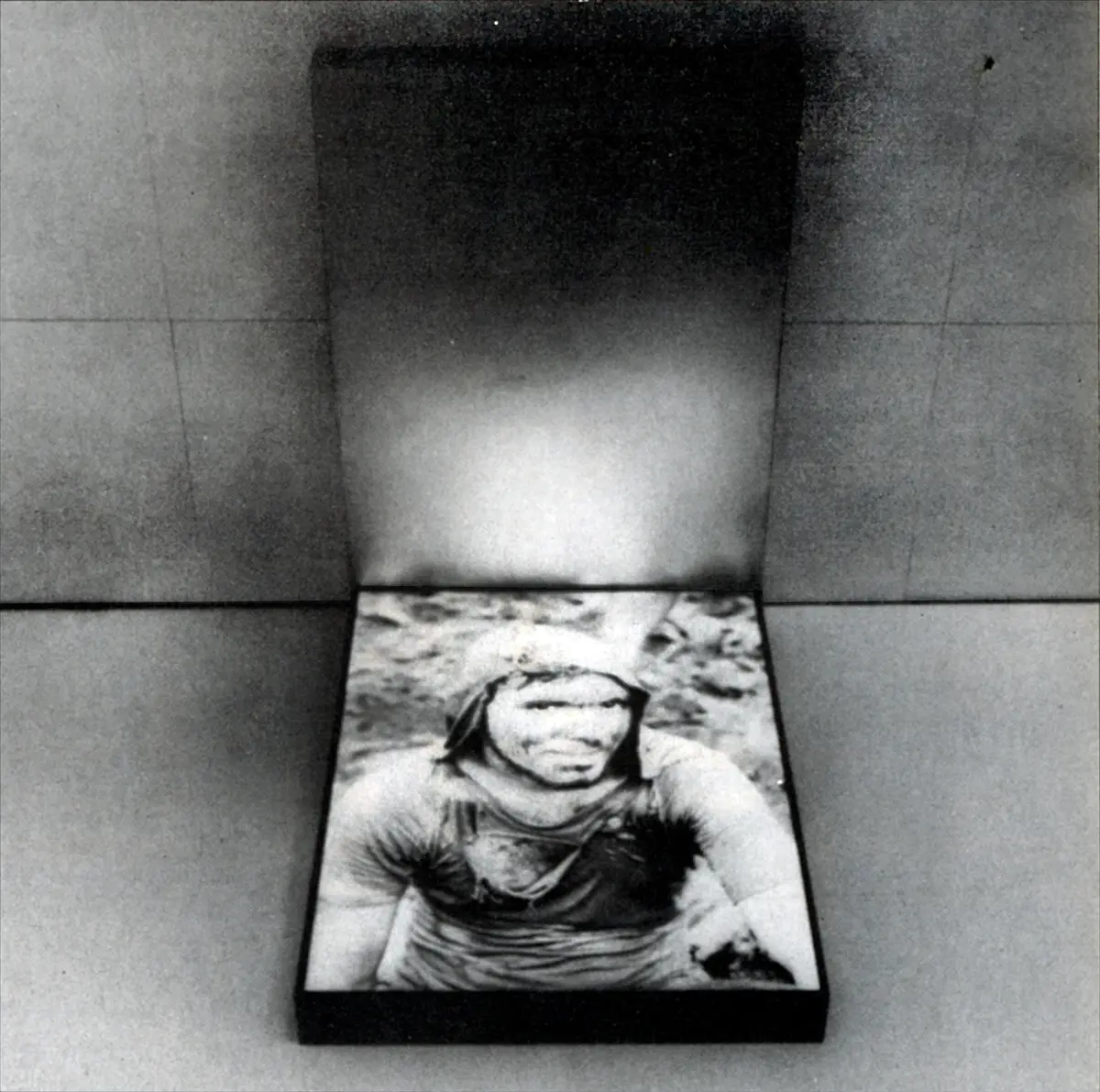
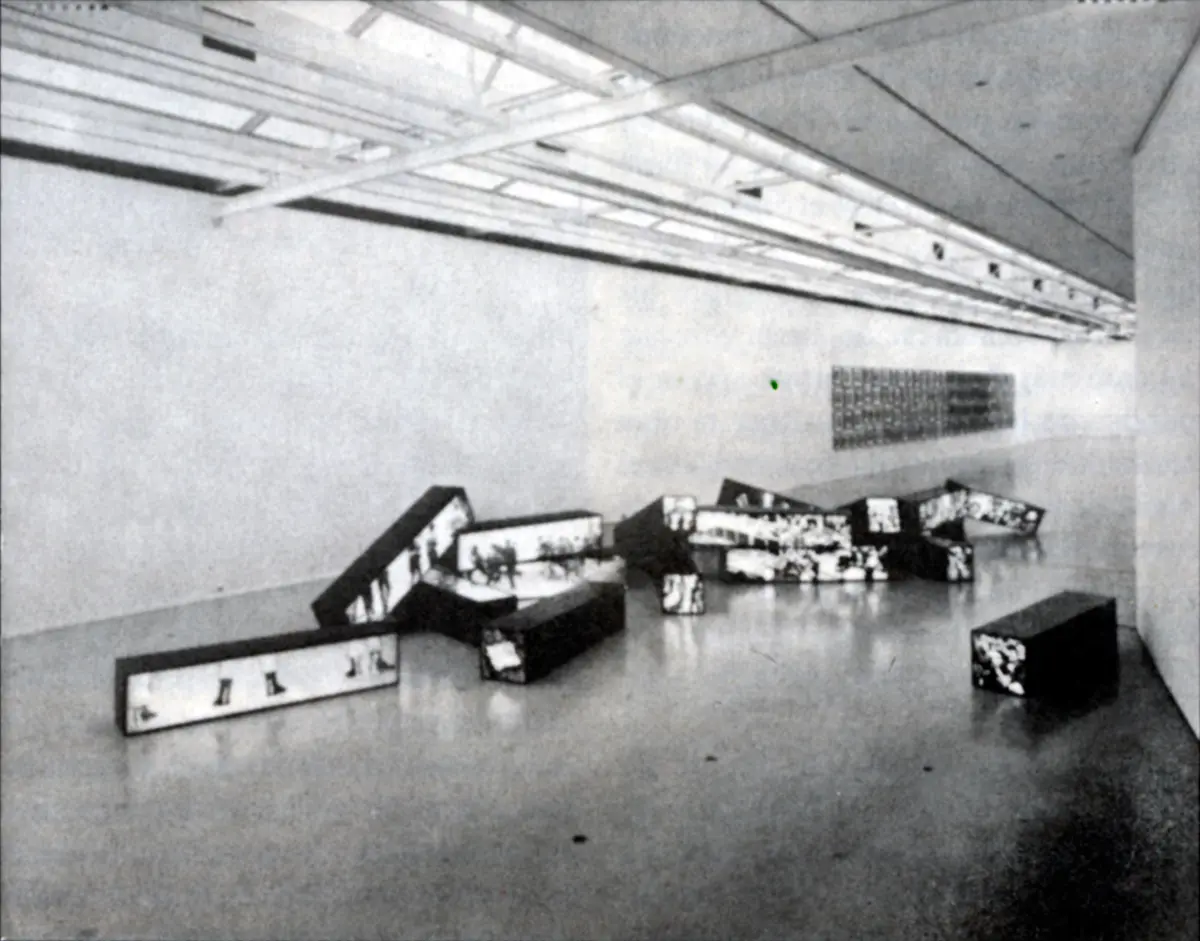
Some commentators on Jaar's work have noted the mismatch that characterizes much of the images present in his installations. The images are located at any level, except the level of the spectator's sight. In Gold in the Morning, the work presented at the Venice Biennale; Ils l'ont tant aimée, la révolution (They Loved Her So Much, the Revolution), an installation featured at the Museum of Modern Art in the city of Paris (1989); The Fire Next Time, in Brooklyn (1989); or in Out of Balance (1988), the lightboxes are scattered on the ground and demand to surround them, lower and raise the situation of mismatch of their perspective. They refuse, then, the possibility of a correct position,8 which implies a single point of view. On the contrary, the movement of the gaze —and with it, the spectator's body— implies an indispensable uncertainty for the reading of the work. In Out of Balance, moreover, the images give the center of the lightboxes to unoccupied spaces, creating again, through the displacement, the effect of suggesting the impossibility or difficulty of an interpretation of what is presented.
These observations of mismatch may appear to be merely formal. However, when relating them to the previous topic —power, the point of view— a reflection arises that again refers to the possibility of postulating structured points of view around a center, a clear and formulable personal or collective identity. The mismatch of figures and frames in Alfredo Jaar's work perhaps refers to a gaze whose subject is off-center concerning structured systems of meaning characterized by "perpetual displacement, by attention to a specific place and situation, but in a broadly comparative relationship, in a kind of living and traveling at the same time, in a world in which both experiences are less and less different."9
The Image: Reflections, Fugacities
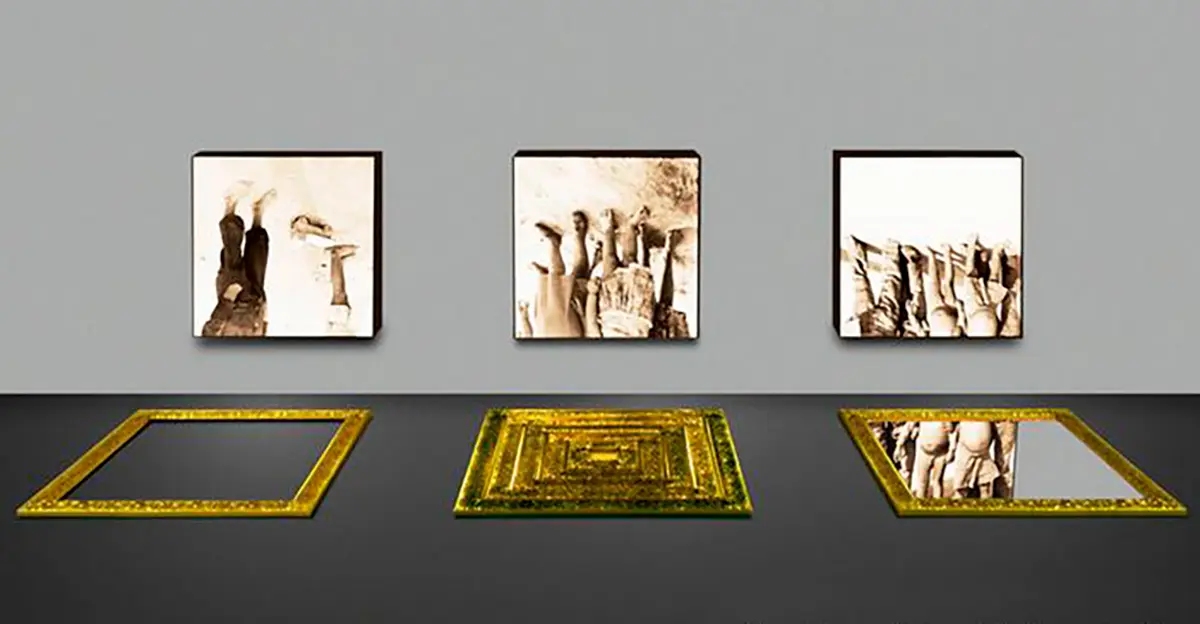
The work 1 + 1 + 1 (Documenta 8, Kassel, 1987) works mainly with three photographs —placed on the wall— and three frames on the floor, and the relationship of fit and mismatch between them. The framework said Tzvetan Todorov, about this work,10 represents an interpretation contract established between those who show and those who watch. But here the photographic images are and are not in those frames; they accept and avoid the interpretation contract. They do this by introducing the notion of reflection. Two of the frames contain mirrors. In the middle one, the mirror is conspicuous by its absence. The photographic images are inverted, and the possible mirror could make them appear, to the viewer's eye, in the "correct" position. However, images, frames, and mirrors dodge each other, dodge their possible interpretation contract. To see or not to see. An image + a mirror + a frame. In this mathematical operation, the = sign is missing. The result of the sum is dodged. The place that the performance could have is left in suspense.
Furthermore, the place of interpretation —the fixation of a place from which to look— is avoided by the necessity of the spectator's movement. It sees where it stands, and its vision changes as it moves. The spaces of Jaar's work are built to involve the spectator's movement, and thereby avoid the stability that seems inseparable from the photographic image. The image is something that is seen and not seen; that is visible and therefore sought. The hurried spectator will only see. Whoever stops will see that this form of a glimpse —this glimpse— is part of the work, part of the opposition between stability and movement, part of a concept that makes the gaze not a fixed moment, but necessarily a course, with its illuminations. The gaze looks, fleetingly, a reflection of the image on a surface. This reflection differs, intervenes, relativizes the image, and puts it at a juncture: a juncture of which the viewer's own gaze is a part.
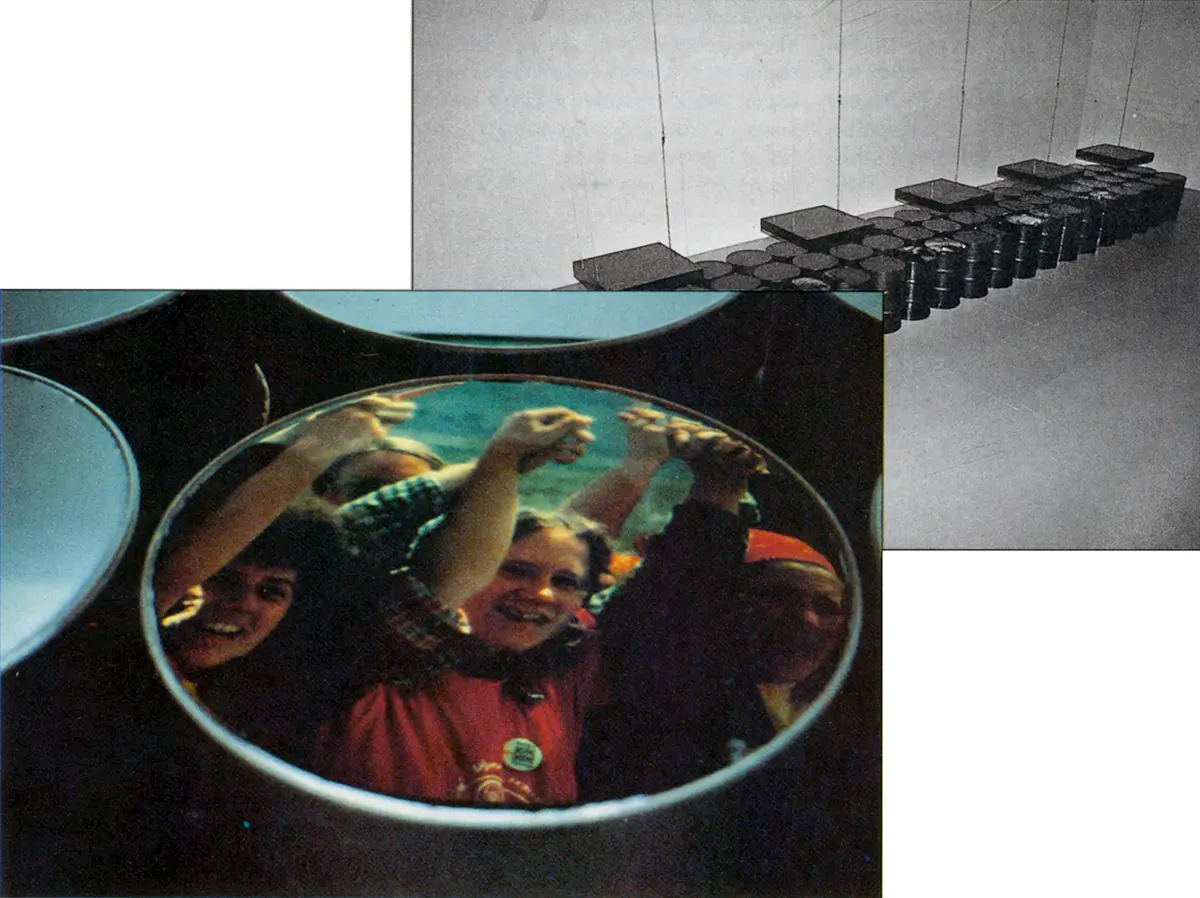
In Falling Rocks (Colorado, 1988), the theme of reflection goes further. First, the images reflected may be those of potential viewers: they are taken from photographs of people from the same town where the exhibition was held, and they are women protesting in front of a nuclear power plant. The theme of the work is the same as that of that protest. The work involves the gaze of a female viewer who may be looking at herself. "See you see me see you see me," said the artist. Second, images are only seen as they are reflected, not in a mirror, but on the surface of the water contained in barrels. The oscillation of the gaze no longer depends only on the viewer's movement but also offers another element of hesitation and fluctuation. Keats wrote the following words for his epitaph: "Here lies one whose name was written in water."
Elusive Image Aesthetics
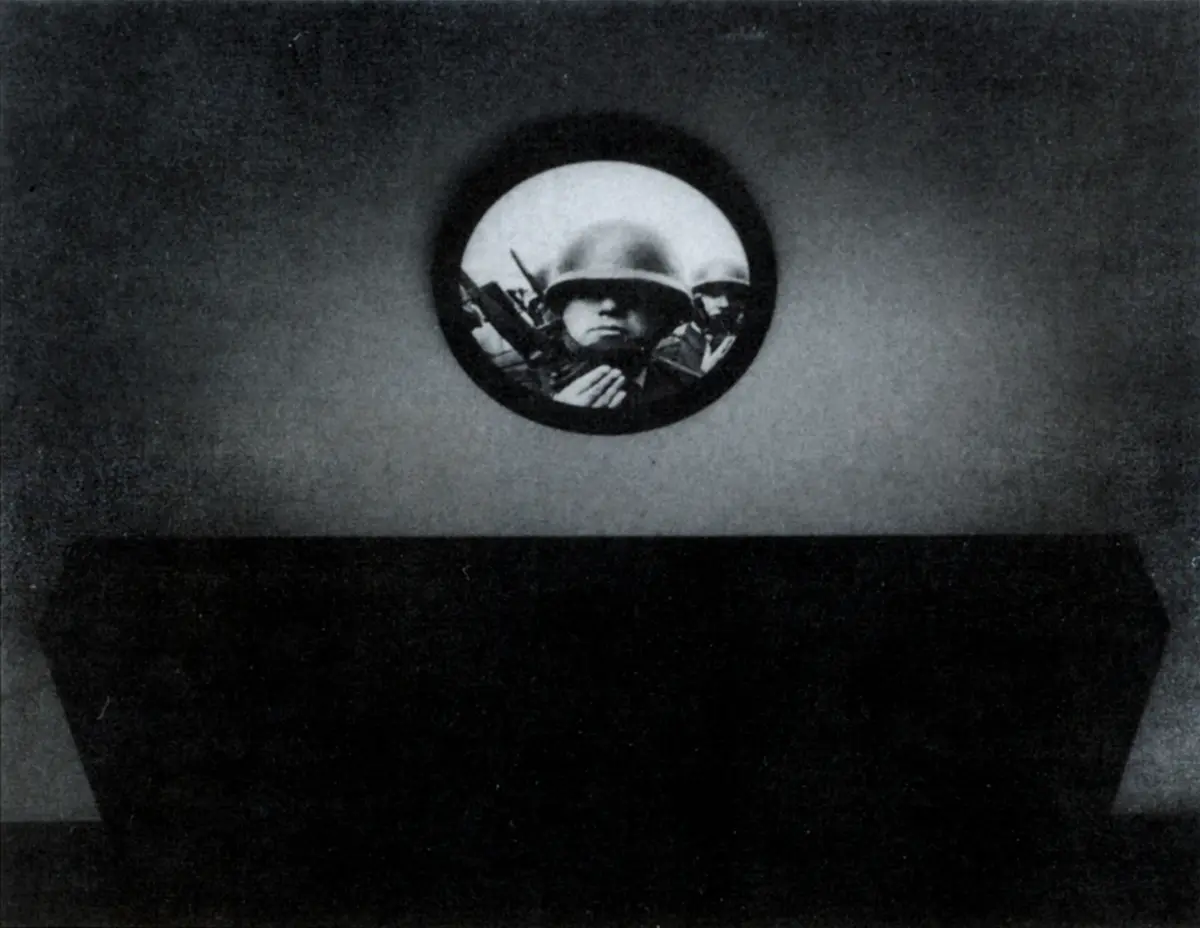
Looking and looking at each other are dangerous activities. The water was a mirror and death for Narciso. The shield mirror was the salvation of Perseus and the downfall of Medusa; the Gorgon saw her reflection and became petrified. A large photograph, in Alfredo Jaar's studio in New York, shows unarmed protesters. They hide, like Perseus, with large mirrors, where helmets, weapons, and the terrifying presence of a group of police officers are reflected. Protesters force them to look in the mirrors. The mirror and the water, the game of the reflections, has the fascination of that lethal power, present from remote times in people's imagination.
In the context of the transcultural subject, his movements and mobility, play on the edges of power, and his frames of reference, the current danger of fixing one's gaze can perhaps be understood. (Current, because the history of the danger of the gaze, of its relationship with maternal power, with women's sex, with the artist's activity, is very long, fascinating, part of the curiosity that drags "an anthropology of the visual arts."11 If the complex problems of the gaze could refer only to the relationship of this transcultural subject to power, with his situation before the gaze of the other, perhaps it could be said that the work of Alfredo Jaar has undertaken an imaginary task: avoiding the fixity of the gaze, to escape the petrification that implies the fixed gaze of an observer who feels like a bearer of power.12 The images are mediated, reflected, sighted, intervened, the impaired vision, can be perceived as a defensive maneuver. If the gaze of the infinitely powerful —wherever it is— only petrifies the other (petrified me), that gaze would have to be hindered. That perception would have to be de-automated, that gaze would have to be returned, to the very edge of precariousness and danger. Because the transcultural subject is on that Rimbaudian border: he is me, and he is the other. It's one, it's the other.
Identities in Conjuncture
"Either being Argentine is a fatality, and in that case, we will be in any case, or being Argentine... is a mask."13 Borges' phrase is almost half a century old. Incidentally, it does not apply only to Argentines, nor does it apply only to Latin Americans. The mask's theme is not far from that of Medusa's gaze if it is connected with the fixation of the physiognomies. Nor is it far from the issue of power, which is the agent of that fixation.
In a situation of a significant difference in power and symbolic prestige, between those who look and those who are looked at, the gaze of the other can be transformed into the gaze of Medusa. The desire to give to the powerful what is believed that he wishes to rise to a petrified experience, a mask, placed at the service of the desire of the other, and the irony is that this desire is, in turn, largely an imaginary construction. From this perspective, Latin America would have been an ideal patient for Lacan, avant la lettre, of course, since the beginning of his miscegenation history, five hundred years ago. The schemes of the other's desire are many. Among the most recent, Latin America as a surreal continent: surrealism was, in Latin America, the marvelous real, always present. The desire for the wonderful, magical, and exotic has an exchange value for Latin American productions. Also, the epic's desire, for the idealistic and bloody struggle, is located, by the way, at a prudent distance from the metropolises. Last but not least, those who have discovered that postmodernism has always characterized Latin America have not been lacking. Each of these possibilities of interpretation is petrified in its corresponding mask, created from what was perceived as the suggestion or desire of the other, the metropolitan "other," the gaze that is perceived as carrying power.
The transcultural subject has to avoid a gaze that transforms him into a mask, on the one hand. Then, he offers himself to the gaze and withdraws it at the same time. Starting with Keats' epitaph, Falling Rocks can be read by saying, "Here lies one whose face is seen in the water."
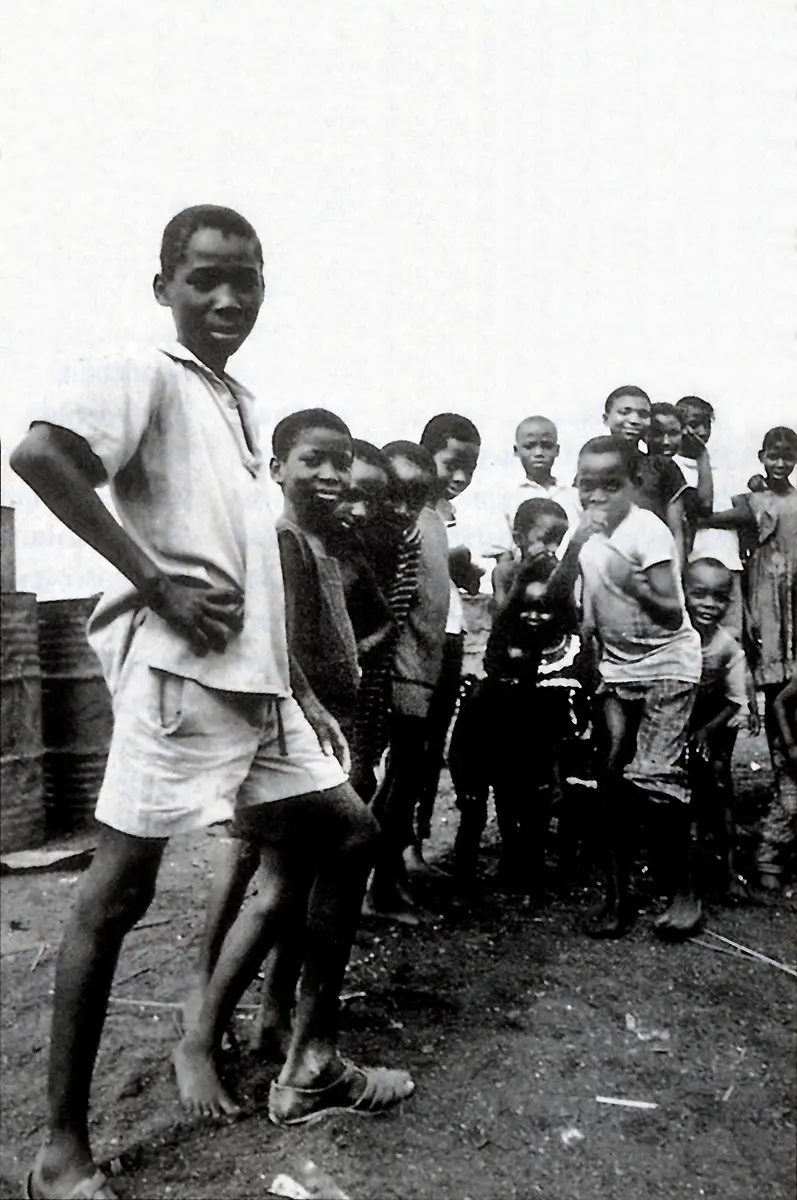
On the other hand, cross-cultural subjects can also be watched. In La géographie, ça sert d'abord à faire la guerre, Jaar's first photographs, are those of teenagers and children who stare. ("The eye you see is not an eye because you see it; it is an eye because it sees you," said Antonio Machado). It can establish the space of discomfort so well described by Sartre: that of perceiving another center, another point of view in volume to which space could be organized. The images of the "other," the "peripheral," have been trivialized a thousand times by the media, until they become one more piece of news seen by the public in the metropolises. Here the work gives them another presence: it highlights them to the point of making them capable of returning their gaze, creating the unknown on the load that that look contains, to make that look a factor that misaligns the observer's perspective of the spectator of the centers.
However, that is only one of the moments of the work. At the end of the path that it proposes, Jaar reintroduces the ambiguity of the gaze. The last photograph cannot be seen from the front. By showing his back to the viewer behind an opaque wall, it goes almost unnoticed. Only the spectator's movement allows one to see the image of the face of one of the children previously seen in a mirror that has the shape of Africa. This last photograph, with its device that requires a journey, with its programmed difficulties, suggests that apprehending those "others," which the spectator "I" has believed to see, could not be equivalent to "fixing" them. The work presents a tension between the direct and elusive images: between the presentation of a direct gaze, illuminated to hyperreality in the light boxes, and the presentation of a gaze that can barely be seen, a glimpse into a reflection.
It seems evident that this whole game can be read from the perspective of peripheral identities and their relationship with centers. The aesthetics of the elusive image have to do with displacement, preventing appropriation, fragmentation, and totalization, and identity in conjuncture but not with an essential identity. It could be read as a tactic of the "others," the "peripherals," to avoid the Medusa's gaze. It could also be read as the staging of a mixed, relational, inventive notion of identity, as mentioned when speaking of the transcultural subject. It is a dynamic vision, in which the gaze cannot fix another since it always escapes. It can only be glimpsed because it is fleeting. Neither the position of the observer nor the position of the observed, remain fixed. There is an experience of constant movement between one and the other, a rubbing, a contagion, an incessant production of the hybrid, in terms of Homi Bhabha.14 The cultural space is then seen as a space of interrelation and constant renegotiation and repositioning. The issue of identities and differences, in turn, can be viewed in terms of processes. The gaze on the others is thus transformed into a discontinuous series of glimpses, glimpses, fleeting moments that apprehend the instants of these processes, without intending to totalize them.
In short, one possibility of reading Alfredo Jaar's work would be to locate it at a point where various themes intersect: that of cultural identities and the process of transculturation, that of frames of reference, that of "centers" and the "peripheries," the "other." The successive reading of all the works presented has allowed us to think about the development of a process of reflection around these recurring themes. Each work is part of this process, but, at the same time, an exercise in which reflection is resituated. Each work arises from the "here" from the "now" of its exhibition. The vertiginous mobility of the crosshairs expires the worn-out opposition between "local" and "world" perspectives. It locates the cross-cultural subject, not in a space, but a movement, a move.
This work's path is that of its successive gaze operations and the elements that the various situations incorporate into that gaze. The frames, the gold, the mirrors, the reflection, the sighted and elusive image, the mismatches appear successively. All of them, and the game between them, in each installation and successive installations, configure the reflection process. From it, many concerns about Latin America, which is the focus of this text, can be reconsidered. Among them, their elusive identities can be mentioned first, in "a world in which the very concept of identity is challenged, where all common ground has become suspicious, and in which subordinates also find that their own stories are the object of appropriation..."15 Jaar's work is not mourning for lost identities, nor is it the postulation of founding utopias: his space is not the past, which founds mourning, nor the future, which utopia proposes. Its space is a critical intervention that has its place in the instantaneous presence of each installation. From there, he questions the viewer's place in that present. In his installations are the characteristics of the present: the elusive image, the multiplicity of possible options, and the privilege of perplexity.
NOTES
1. James Clifford, The Predicament of Culture, Harvard University Press, Cambridge, Mass., 1988, p. 10
2. According to Femando Ortiz's term, cited by Ángel Rama, "Los procesos de transculturación en la narrativa latinoamericana," in La novela latinoamericana 1920-1980, Instituto Colombiano de Cultura, Bogotá, 1982
3. The expressions are from Jean-Hubert Martin, in the preface of the exhibition's catalog, p. 9.
4. William Wood, "A Circular Insanity-Documenta 8," Vanguard, September/October,1987.
5. Alfredo Jaar, in "The peripatetic artist: 14 statements," Art in America, July 1989.
6. Benjamin Buchloh, cited by William Wood, op. cit.
7. On the hero's myth in Latin America and the assumption of his role by the writer and the artist, see Jean Franco, Plotting Women Gender and Representation in Mexico, Columbia University Press, New York, 1989, particularly the chapters "Body and Soul: Women and Postrevolutionary Messianism," and "On the Impossibility of Antigone and the Inevitability of La Malinche: Rewriting the National Allegory."
8. Eleanor Hartney, "Mirror Vision," Contemporánea, International Art Magazine, June 1989, pp. 50-55
9. James Clifford, op. cit.
10. Tzvetan Todorov, "Trois, deux un," in the catalog.
11. See Jean Clair, Médusa, Contribution a une anthropologie des arts du visuel, Gallimard, Paris, 1989
12. See Adriana Valdés, "Les 'centres', les 'peripheries' et le regard de l'autre," text of the lecture presented at a colloquium organized at the Centre Pompidou, Paris, on the occasion of the exhibition Magiciens de la Terre (June 3-4,1989)
13. Jorge Luis Borges, "El escritor argentino y la tradición. Discusión” (1932), in Obras Completas (1923-1972), Emecé Editores, Buenos Aires, 1974
14. Homi Bhabha, “Hybridité, héterogéneité et culture contemporaine,” catalog of the exhibition Magiciens de la Terre, op. cit., p. 24
15. Jean Franco, op. cit., p. 186