From as far back as the painting titled El Dorado (1957) to several constructions from the 1980s, the work of Eduardo Ramírez Villamizar recalls the world of pre-Colombian art. Although several sculptors from other Latin American countries have created works inspired by the pre-Hispanic world (Marta Calvin, Gonzalo Fonseca, Lika Mutal, amongst others), it is Ramírez Villamizar who has most often and most successfully explored the rich formal universe of pre-Colombian culture.
Although after the above-mentioned picture, Ramírez Villamizar did a number of reliefs with pre-Hispanic references, in the 1980s he has consistently produced constructions in oxidized iron which are related to pre-Colombian art. It is a relationship that has never been simply nominal, although it has not involved any essentially direct transcriptions. Ramírez Villamizar is sufficiently creative as an artist and too much an admirer of pre-Colombian art to try and “imitate” it. He has visited —particularly in recent years— the main archeological sites of Latin America and these experiences have helped him strengthen his concept of form and encouraged him to develop a very varied range of constructions inspired by the pre-Colombian world.
It is undeniable that whereas the reliefs from the 1960s and early 1970s showed the sculptor particularly interested in gold and silver work, his interests in the 1980s have been essentially oriented towards architecture. His trip to Machu Picchu at the end of 1983 had a decisive influence on the production which he started at the beginning of the following year consisting of large constructions full of sobriety and power. To the series entitled Memories of Machu Picchu, which gave rise to other sculptures related to the 1984 work which referred to the walls, terraces, paths, and irrigation channels of Inca architecture, Ramírez Villamizar has added such works as the Tired Stones of 1986, the Ceremonial Robes of the same year, the Ritual Masks of 1987 and the Temples of 1988.
For just over ten years Ramírez Villamizar has been doing sculptures in oxidized iron. At first, he alternated these with painted works such as The Polychromed Cathedral (1979), Flowers for Feliza (1981-1982), River in the Jungle (1982), and Anniversary (1983), amongst others. Since 1984, he has worked exclusively in unpainted iron. Ramírez Villamizar has said that these constructions belong to his “Romantic period,” a description that concerns only the finish, which is different from the impeccable coloring of his previous production. Apart from that, the sculptures continue to be strictly rationalist.
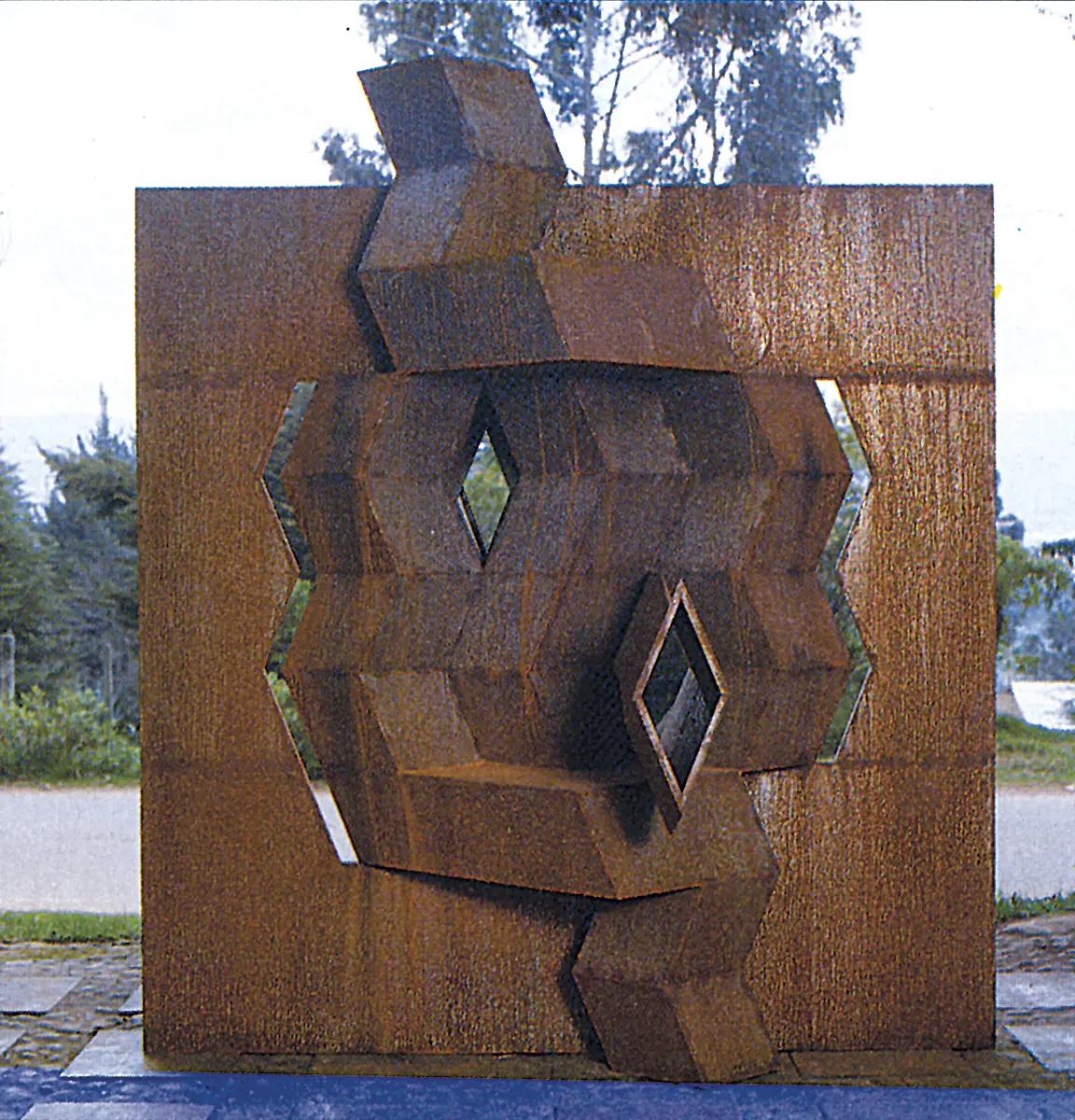
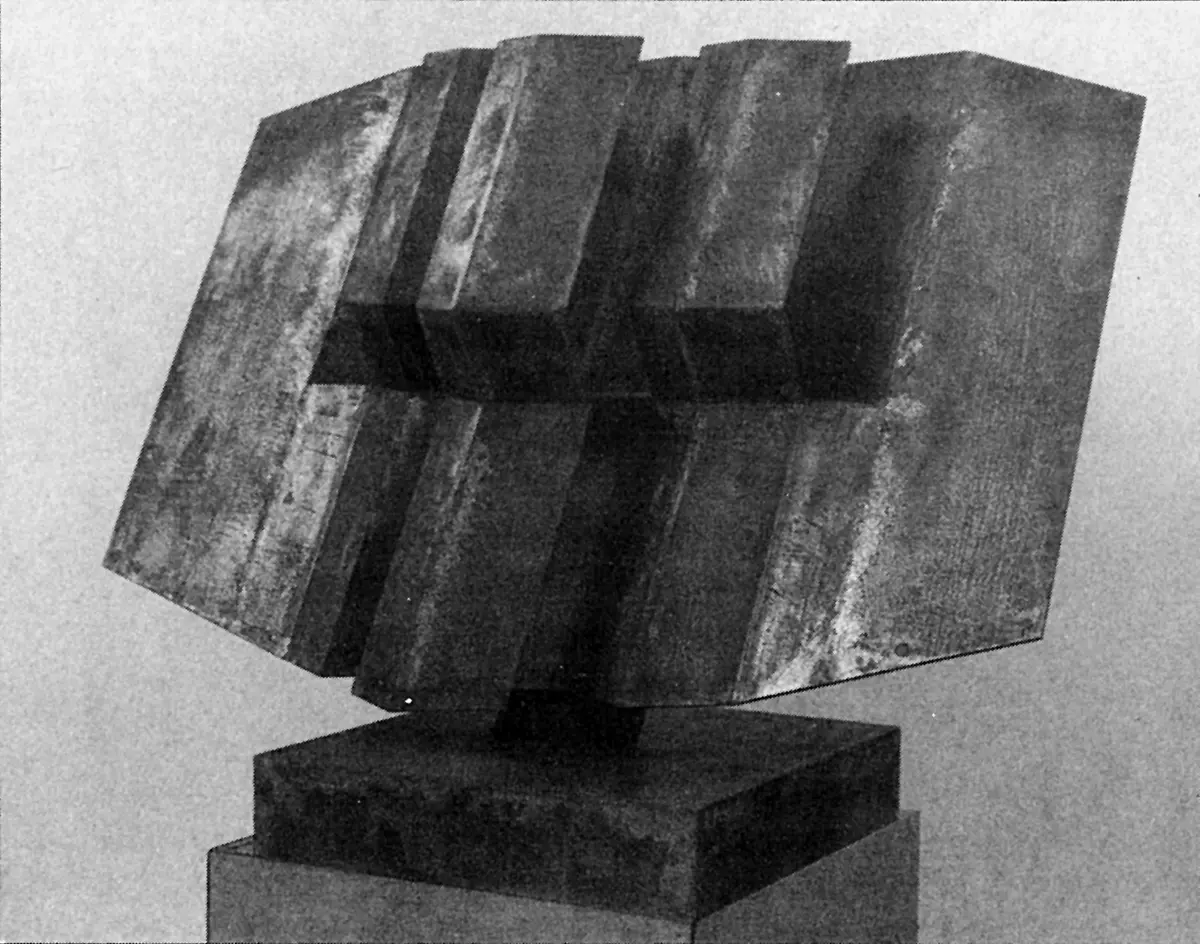
The constructions of Ramírez Villamizar are closely related to the two-dimensional or flat component sculptures that have been done since the beginning of the century. The Memories of Machu Picchu series was characterized by the presence of large articulated surfaces that were reminiscent of the polygonal ashlar stones of the majestic Inca architecture. It was furthermore a series of constructions that were frontally arranged to face the spectator and thus had only a front and back. However, Ramírez Villamizar has continued to work with volumes —made up strictly of surfaces— and with spaces placed between them. Some of the volumes are evident, that is to say, they are not completely closed but are made up of only some of their sides, although others do indeed have three dimensions on all their sides. Examples of the latter are the Masks, the Robes, and Temples. And so the constructions of Ramírez Villamizar are sometimes works raised up on the basis of surfaces which constitute a kind of thin wall and sometimes sculptures in which volumes play a predominant role. However, in both cases, the sheets of iron are used to retain their character of being flat surfaces.
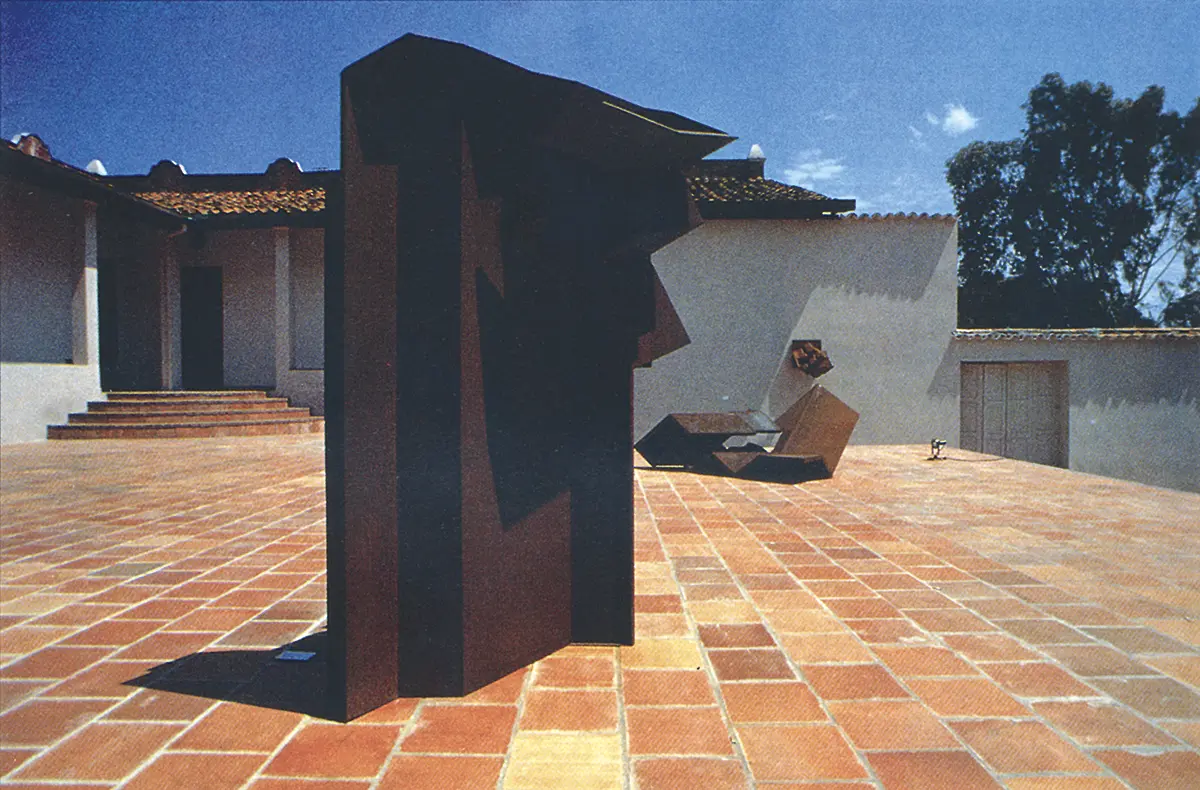
Despite their evident volumetry, the above-mentioned works continue to be essentially frontal. The Masks look out at us with pride and arrogance and their symmetrical presence is as powerful as that of some pre-Colombian idol. The Robes, like full tunics, open in the middle, where the rigorous verticality of the construction also contrasts with two fringes made up of diamond-shaped surfaces that descend in zigzags. The Temples are distributed into two sectors which slope in a parallel fashion from a salient angle stressing the front side.
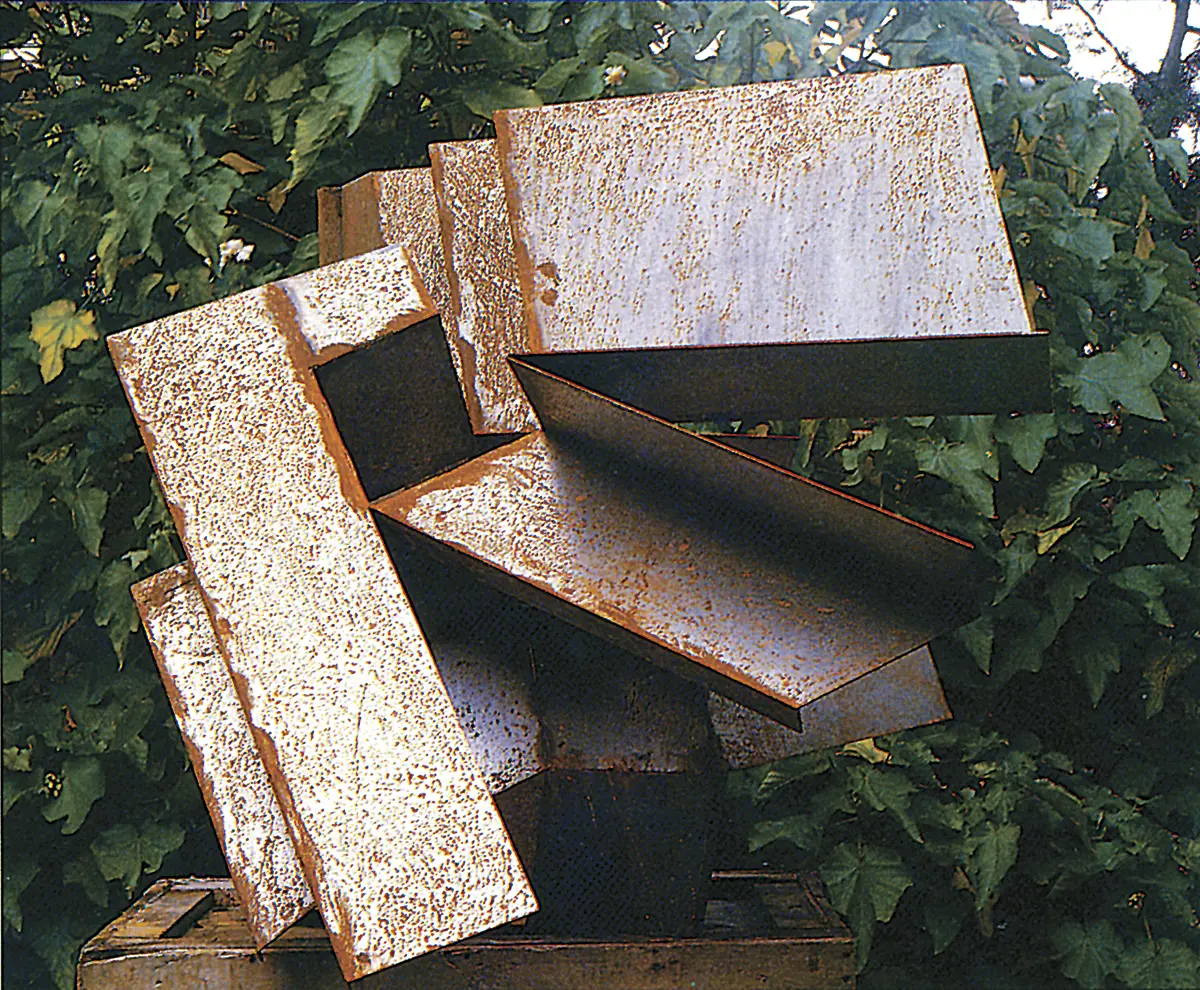
If these constructions make us think of architecture, as so often happens in the work of Ramírez Villamizar, the artist himself has emphasized his attachment to nature, as can be seen in the Shells of 1986. According to Ramírez Villamizar, the secret geometry of the natural world is at the heart of all his work: “The whole of geometry can be found in nature. Man finds it by carrying nature's forms to their fundamental essence. The moon is a circle. A circle is the moon. I use geometry and it takes me back to nature. I know that when I walk in my garden between the flowers and leaves I am moving between triangles, spirals, and circles.” This latent geometry inspired in nature and which the sculptor includes in all his structures, whether architectural or more or less naturalist, is not only one of the most constant elements in his work but is the basis itself of the conceptual solidity of his art: his artistic work springs from the laws of the world but, in addition, it structures them through forms and patterns governed by intelligence.
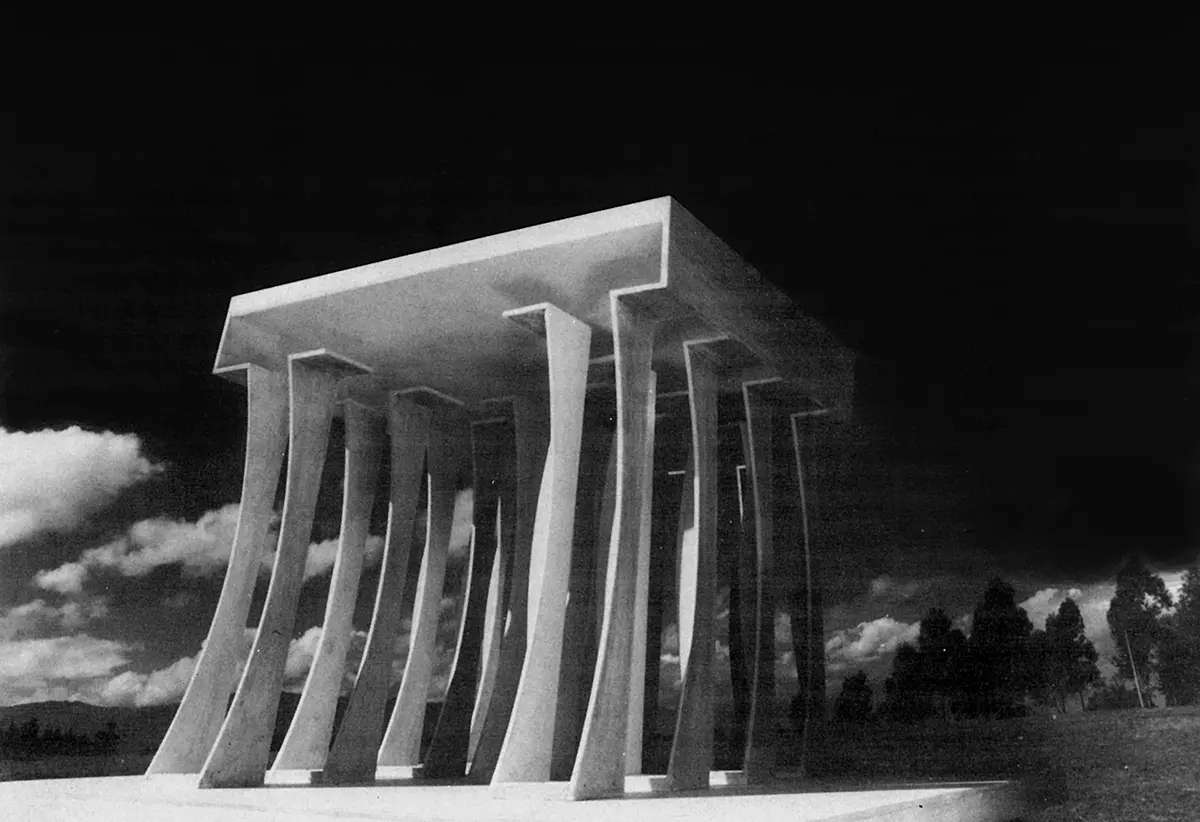
Based as it is in architecture and nature, the work of Ramírez Villamizar seems to be a product of regeneration. In many of his best pieces, there is a desire for abstraction rooted in the natural world, an elaboration of forms controlled by a design that is both precise and refined and a notion of grandeur, power, and mystery which indeed reminds us of the great work of pre-Colombian art. Furthermore, after an artistic career of more than forty years, Ramírez Villamizar often takes up elements from his previous work to enrich his new production —which always appears rejuvenated— to the point where it seems that his style recreates itself without self-repetition. This is the case, for example, with Mirror of the Moon, the new public construction by Ramírez Villamizar outside the World Trade Center, in the Calle lOO in Bogota (see Arte en Colombia, No. 40) and which to some extent is related to the Leaning Construction-Four Parts, from 1976, and the oxidized iron relief en titled Mirror of the Moon, from 1981. Or with the extraordinary maquette for the Temple of Laws, a tribute to General Santander on the forthcoming one hundred and sixtieth anniversary of his death in which there reappears, in the form of columns, a shape which seems to be a geometrized bone, which had already been used in Relic, from the mid-1960s. This new work, if it is ever executed one day, will be one of the most important sculptures of Ramírez Vilamizar. It will be a vast shrine, measuring 15 meters high, which will once again reaffirm the close relationship of form with architectural space.
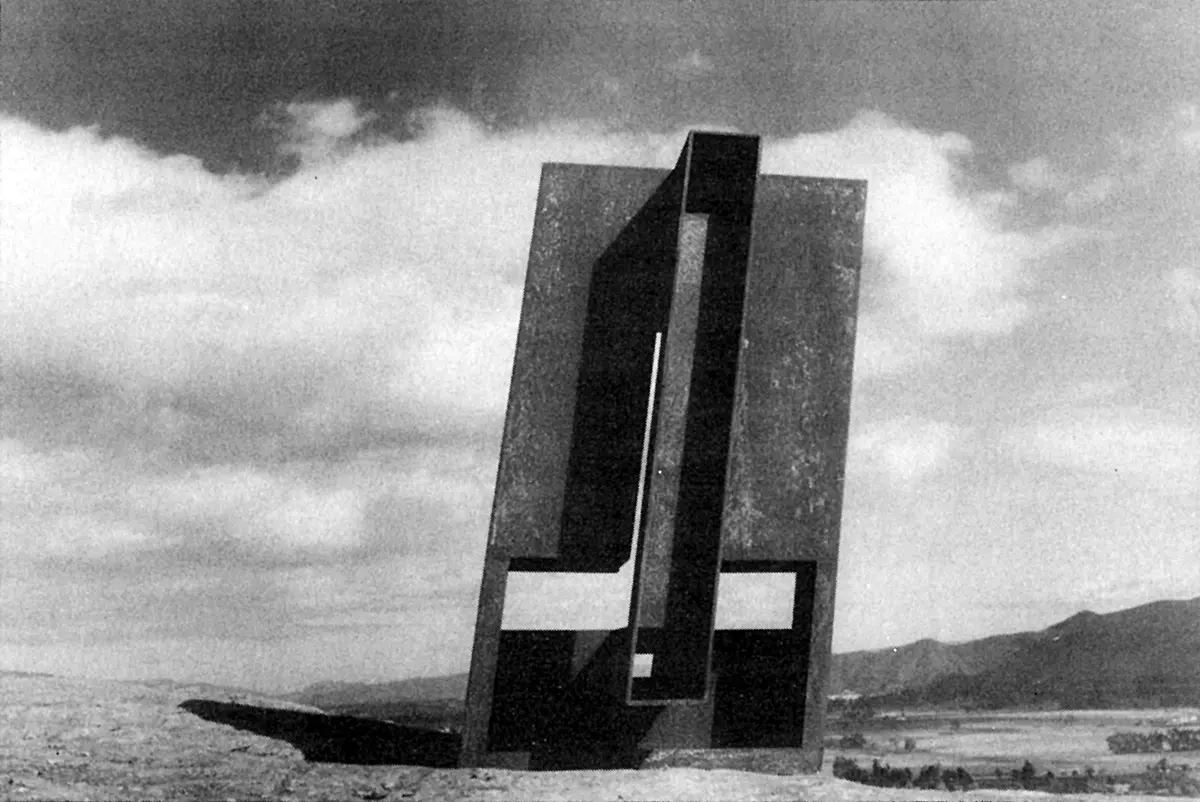
The sculptor feels very satisfied with the large construction that he did in 1987 for the Baconao Park in Santiago de Cuba. This work measuring 6 feet high, 6 feet wide, and 2 feet thick, was executed with sheets of metal as part of the variations of the Aqueducts that resulted from the Machu Picchu series. Various artists of different nationalities were invited to work in Santiago de Cuba, including the Argentinian Enio lommi and the Mexicans Helen Escobedo and Hersúa.
Simultaneously with his prolific sculptural production, Ramírez Villamizar has returned in recent years to painting. As in his sketches for serigraphy, he has used papier collé in these works. The rough finish appeals to the artist and is not unlike the oxidized surfaces of his three-dimensional works. These pictures, which are in the Cubist tradition with their strictly related flat forms, suggest, in the words of Michel Seuphor, that “the spirit of structure is a concept of the world, a form of behavior in life.”
Although he devotes himself entirely to his work as an artist, Ramírez Villamizar has participated generously in exhibitions that have had essentially cultural objectives. Such was the case with the inaugural show at the Museum of Modern Art of Bucaramana, in which Ramírez Villamizar presented sixteen constructions in oxidized sheet iron from his recent work. An excellent record of the installation of the sculptures in the rooms and in the Museum’s fine patio was carried out by Víctor Robledo, a photographer who knows what his art is all about and who, in this case, did not let his own creativity and self-expression prevent him from highlighting the reality of the splendid volumes, spaces and fine details of design and texture which are characteristic of all the constructions of Ramírez Villamizar.
In 1987, Ramírez Villamizar represented Colombia in the São Paulo Biennial. María Elvira Iriarte, the Colombian commissioner at this major international exhibition, wrote in the catalog: “The allusions to the architecture of nature and the architecture of man continue to be present here. These Masks, Robes, and Tired Stones are all monumental constructions in their capacity to communicate meaning, which is the product of diagonal surfaces and space-forming angles, light, and time. Three basic materials and three constant elements in the art of Ramírez Villamizar.”
Shortly before the São Paulo Biennial, the sculptor presented an exhibition in the Durban Gallery in Caracas, which included new variations from 1986 of Machu Picchu, and in particular, the pieces titled Flowers and, above all, Pre-Colombian Serpent. While the former rose up in a complex pattern of diamond-shaped surfaces, soldered in sharp angles, the Serpent crept in the form of an apparently zigzag volume, well out of the rectangular base.
The most recent exhibition of Ramírez Villamizar outside Colombia was his participation in the last Havana Biennial. He was one of five artists who had a special salon at the exhibition. Since the major theme of the show was the relationship between modern art and the cultural and historical roots of the countries of the third world, there was no one better qualified than the Colombian sculptor to participate in the event. Ramírez Villamizar entitled his exhibit Homage to the pre-Colombian Craftsmen, an irrefutable title that reaffirms his admiration for works which although remote in time are still exemplary in the austerity of their character, the rationality of their style and the spirit of transcendence which they embody.
GERMAN RUBIANO
Art historian.