Rodolfo Morales's work has a popular freshness and imagery. In it, the sacred festivals and those of the town have much more preponderance than the civic ones, customs that are, ultimately, those that make up the history and community events.
SANTIAGO ESPINOSA DE LOS MONTEROS
“The town was very lonely; there was absolutely nothing, people only dedicated themselves to work, to religion, to go to mass, and the rosary. That was it, but very often, almost twice a week, there was a murder in the town, and then it came to life because everyone went out to see the body. As a child, one was generally the first to arrive and see that corpse lying there, the blood on the ground. After that, the town commented on the life of the murdered, his entire family, and the person who murdered him. Chocolate was given in the wake, and praises were sung all night. All of that stayed with me.” (1)
This is a memory from Rodolfo Morales’ childhood in his native Ocotlán, Oaxaca, where he was born in 1925. A good part of his current painting is marked by a youth measured by murders twice a week, the corpse’s procession through some sites in town, the municipal palace, and the wealthy community's house being mandatory stopovers.
Likewise, he remembers that “as a child, I had a hard time playing marbles, spinning tops, or ball. I couldn't hit another marble. I could never spin a top. That made me isolate myself and contemplate other things. I would go to see the interior of the churches, the decorations. That's where the taste for colonial architecture came from.” (2)
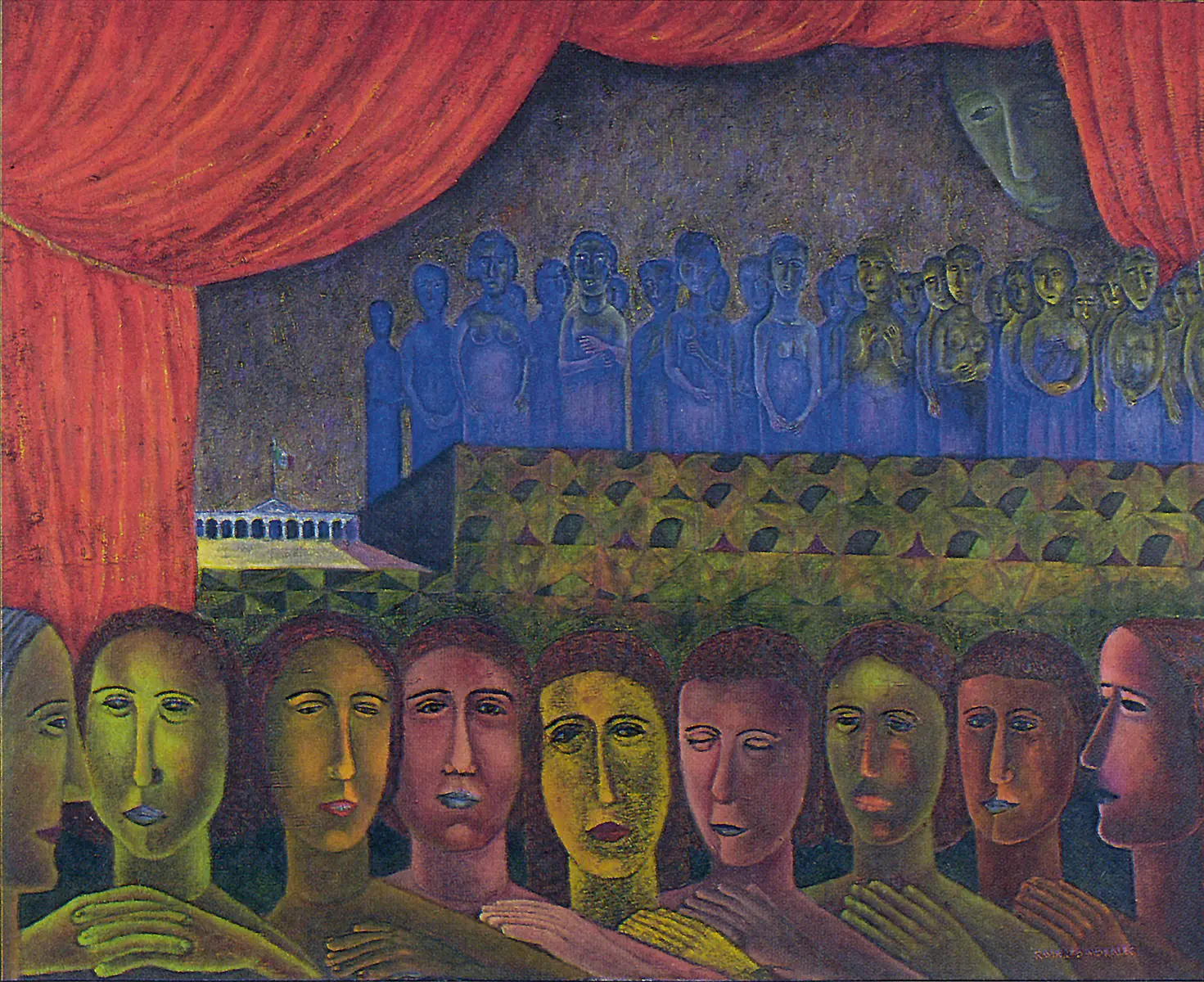
Rodolfo Morales is always careful to include it in his paintings, even if they are small architectural details. In some cases, these do not have a great preponderance within the composition, but they are always present. Sometimes it could almost be said that a dome, a tower, or a set of portal arches are the main characters of the piece.
However, the architecture is not presented in his painting as a faithful copy of the original constructions, much less has the folkloric character that tends to revitalize the ethnic and local spirit. She appears as part of a landscape, as one of the elements that fill the painting and that, given the almost geometric force of this discipline, on many occasions marks the compositional pattern of the painting.
Architecture is "one of the few things I have discovered alone. Since I was a child, churches and vaults attracted me... and later, over time, I knew that this was colonial art.”(3)
Straight or upside down, the buildings that Rodolfo Morales rebuilds in his paintings are not always classic examples of colonial architecture. On many occasions, we come across the classic facades of the town’s houses, the famous arcades, or the grated windows through which so many romantic poets have spilled liters and liters of ink in love. The architectural reconstruction that Morales carries out in his paintings is totally attached to that of his town, to that of so many towns that, without being visually memorable, have a more or less determined a style that differentiates them, at least, from the neighboring village.
Another recurring theme of this Oaxacan painter is women. In many cases, only their feet appear in a crowd, almost running over. He says that, when he was very young, he could only attend town or family parties as a simple observer. Thus, confined to one of the corners of the patio or the hall where the dance was performed, he threw himself on the ground with his belly down and observed only what entered "the box," that is, feet, shoes, ankles and, occasionally calves, and legs of chairs and tables. During his early childhood, he thought that the same way that he could see the birth of the men’s thighs at the bottom of their pants, women had very short legs that went from the ankle to the knee where the skirt’s hem would be, and that from there on their legs would be made of meat. It was as if a long and endless trunk began there, and that the generally vast skirts of the Oaxacan women hid it due to its ugliness and disproportion.
His mother had a sewing workshop attended by numerous women from the village. They all talked, told stories, gossiped, and dressed. Rodolfo, a boy, shared those afternoons attentive and observant, perhaps learning by heart the woman who, in his adult years, paints almost always in profile. Could it be that they seldom spoke to him and observed them their bodies facing another interlocutor? The reason does not matter now. They appear with such recurrence that it is impossible to detach them from his pictorial trajectory.
Like brides dressed in white, they are always waiting; dressed in everyday and street clothes, they still look at each other, standing, or playing a musical instrument. They seldom speak; in their mouths, as in Rodolfo's paintings, the anecdotes are already far away: moments remain; they are made, there are stories of dreams that dream at the time he paints.
Spirits abound here. The popular belief that souls that leave the body—once it is dead—have the exact configuration of the being that contained them, and that he has already begun another stage in his existence (or in its ceasing to exist?).
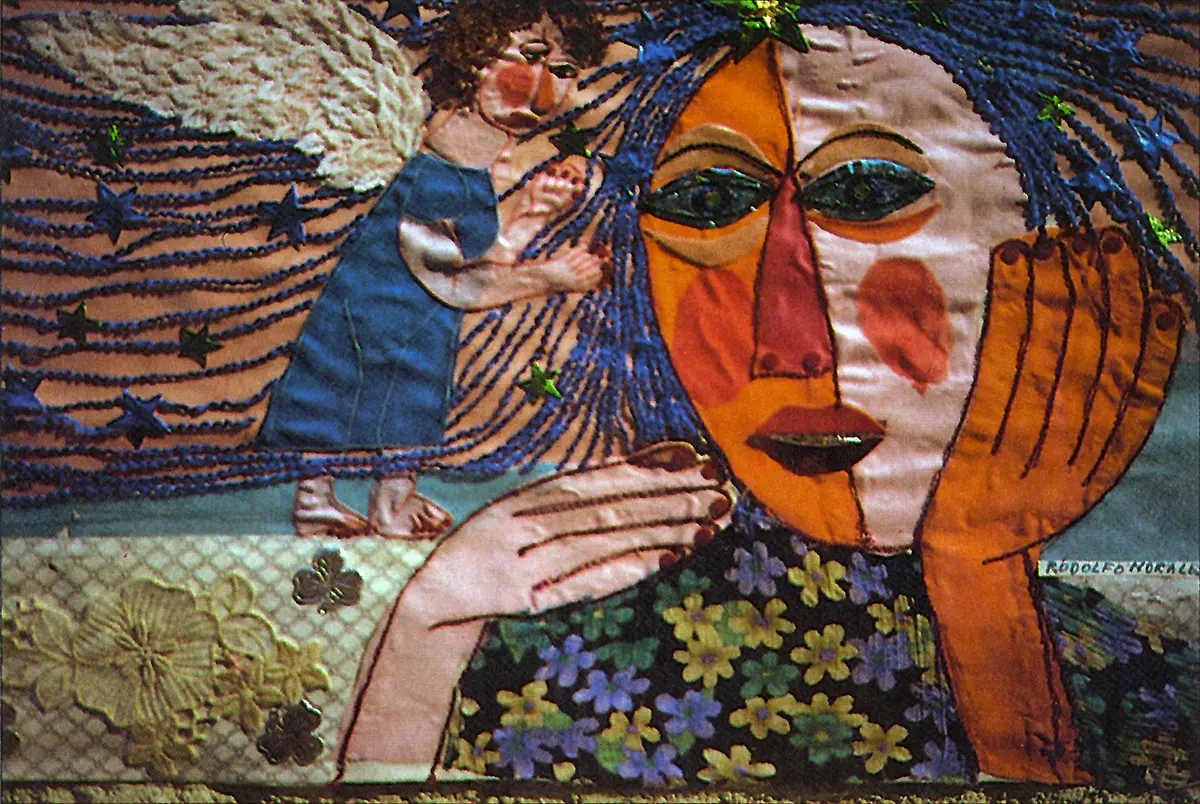
Transparent women move from one side of the sky to the other, from wall to wall, being shadows of nothing, silhouettes, presences: almost all fly, the corporeal, and those that are not. Rodolfo is convinced that the human being should fly, that the man should transport himself from one place to another, but not on the trains that appear so often in his painting and seem more like they have been there forever and not going anywhere. Men should no longer hang on airplanes suspended by a strange force that keeps them off the ground, no longer in the clouds that sometimes are simply the tail of a bride's dress that the couple never came to. Man must fly, thus nothing else. Fly together with the wind that moves the school's flags or the municipal palace, fly that easily, without flapping, with no other impulse than the desire to do so, with no other destination than the eyes of Rodolfo Morales to verify that it can be done.
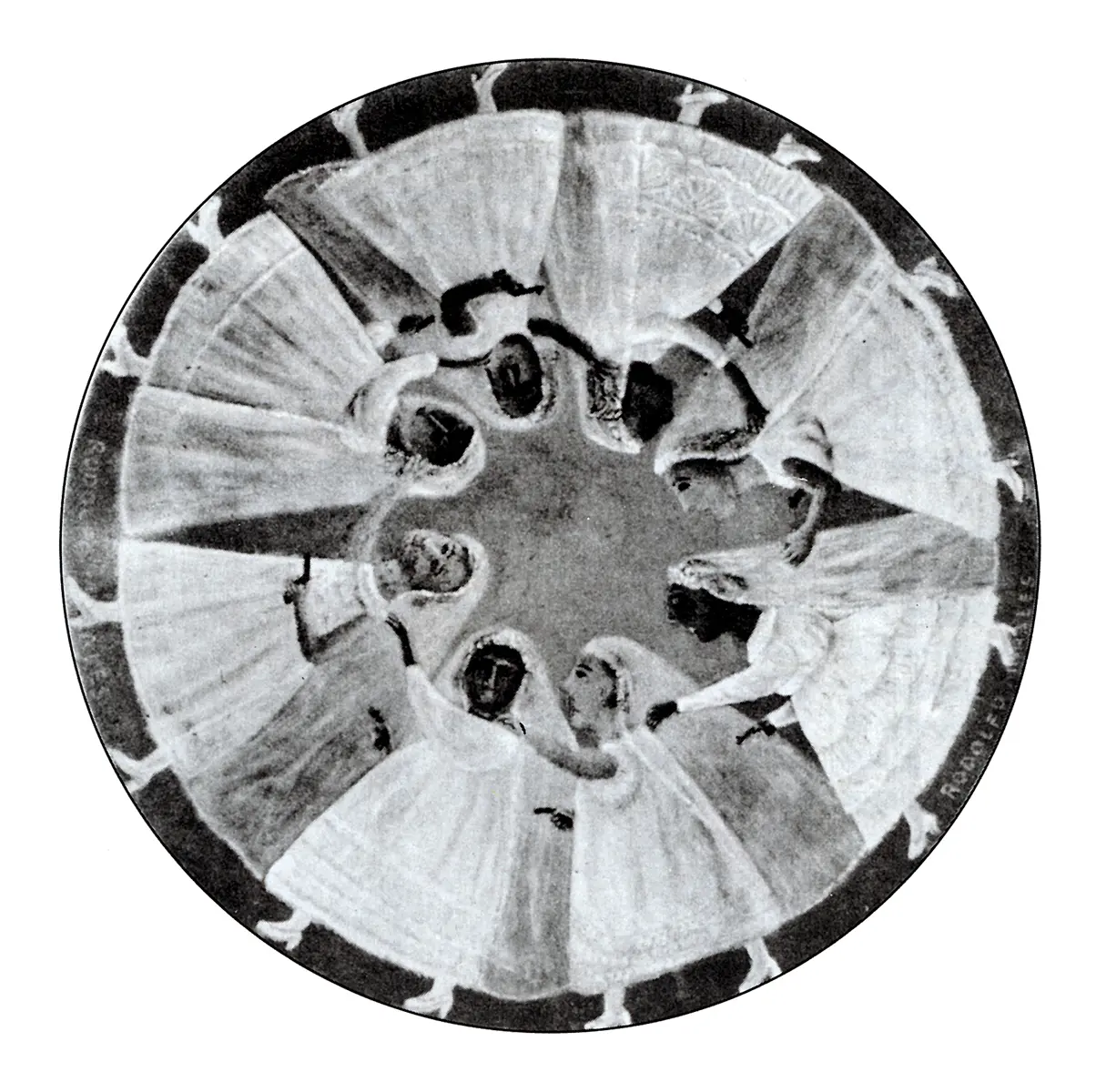
The women in his painting also suffer. In one of the compositions that can be seen inverted (Rodolfo has intentionally signed the painting in both directions to accentuate this visual game that was already given in itself in the structure of the piece), they carry their own heads as if they were their son or the lump that is carried through life without remedy. At their feet, Creole dogs that accompany the national event, the solidarity of women who take their thoughts as the witnesses to the murders that occurred four to a month in the children's Ocotlán of Rodolfo Morales.
Luis Carlos Emerich has written that "Morales has not 'adopted' modes of popular plastic expression since they are his in their own right. Morales is a people, but a people overwhelmed. He simply says such complex things through recognizable images that excite other levels of perception. Everyday life goes beyond life, to the reason of the spirit and its destiny; its expiration, and its eternity; the death of the dream of life and the dream of life and death. The final destination as an uncertain trance and I walk towards him as the only certainty; it does not matter if Glory or Hell is augured or a family meal.” (4)
Crowds gather in his paintings. Sometimes we see them behind the portals, and even in the windows of the same building, their heads only, the bodies no longer fit. To the question of this challenge, the quick and simple answer: "What, have you not noticed when it rains how all the people take refuge?" (5)
The color in Rodolfo Morales' painting is of rather "serious" tones. Antonio Rodríguez has described it as “so apparently festive,” so epidermally “Mexican.” It carries in its bowels, which is where the authentic color is born, a serious and austere harmony as if it were a night color that deceives itself with promises of the sun.” (6)
The composition in the work of this painter is far from what could be called orthodox. He assembles his pictures without any previous outline. The perspective is sometimes circular. It is somewhat reminiscent of M.C. Escher, especially when the subject of the painting is the buildings of his town. It is also the case, but maybe a little less, although within this category as well, the women. They seem to have inhabited a dome and walked in it for centuries, dressed as brides, chasing each other always in the same direction, touching their shoulders as if they were "lining up" in elementary school, taking the exact distance between the classmate in front and the one in the back (that exact distance is the one measured by the outstretched arm that places the hand on the shoulder of the opposite one and thus separates it a prudent space).
"I never understood that from the gold section. I went to Diego Rivera's talks, and I listened to everything, but I never understood him. I think I compose my paintings like this because, as a child, I used to put up many altars, buy Chinese papers of many colors and make them decorate them. I don't compose. There are no composition lines in my paintings. I wanted to do that, but I never could.” (7)
Rodolfo Morales's work has a popular freshness and imagery. In it, the sacred festivals and those of the town have much more preponderance than the civic ones. When a bust of a hero appears in his painting, he looks almost ironically. It's not the same with the church, not with the customs of the townspeople, customs that are, ultimately, those that shape the history and events of a community.
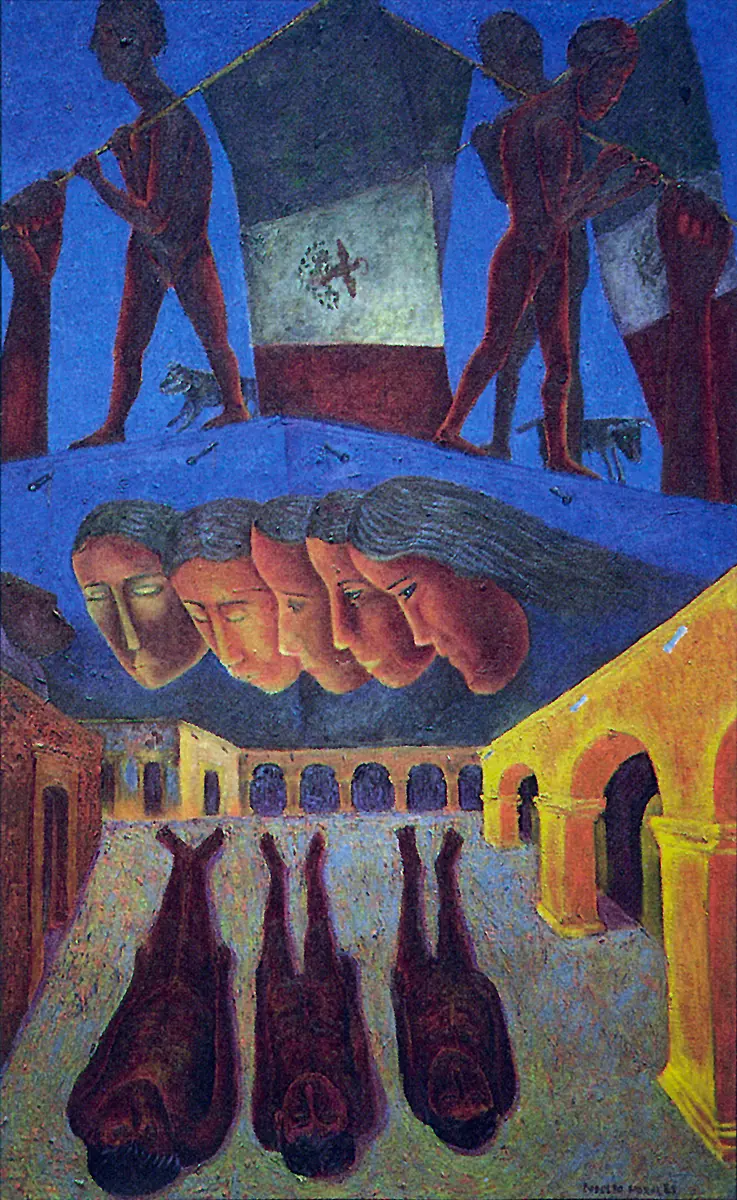
Like his paintings, these customs do not have names. Each one gives it the one that most reminds him of a particular situation. Meanwhile, the funeral processions continue touring the town.
The corpse in front, making way with his death for the living who come behind. The memory of Rodolfo Morales, a child who insistently looked at the shoes of the women who attended funerals, walking slowly, crawling gently; the dogs that were behind closing the parade of tears and music; and later, at dawn, a couple of drunkards who sang nine days then "the praised," filling with their uneven and sad voices, affected by mezcal and exhaustion, and a town with a light that was just beginning to reach it, which was still dim, doubtful, always an omen of the sun that everything flattens, everything shines, everything paints.
NOTES
1. Shapiro, Estela y Ríos, Juan Francisco. Imagen y presencia.
Chapater on Rodolfo Morales, p. 80 Editad by Galería Estela Shapiro, December 1985, Mexico.
2. Sesín, Saide. “El oaxaqueño Rodolfo pinta una realidad entre los sueños y la vigilia.” (primera de dos partes) [Oaxacan Rodolfo paints a reality between dreams and wakefulness. First of two parts]. Diario Unomásuno, February 13 1989, p. 23. Mexico
3. Unpublished interview with Rodolfo Morales, February 14 1989, Mexico City, by Santiago Espinosa de los Monteros.
4. Emerich, Luis Carlos. “Rodolfo Morales: La provincia infinita.” (Rodolfo Morales: The infinite province). Diario Novedades, January 2 1987, p. C-3, Mexico.
5. Unpublished interview. Op. Cit.
6. Rodríguez, Antonio. La nostálgica compañía de la soledad (The nostalgic company of loneliness). Edited by the Instituto Politécnico Nacional. Mexico, 1981
7. Unpublished interview. Op. Cit.
SANTIAGO ESPINOSA DE LOS MONTEROS