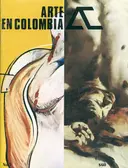
INTERVIEW BY DAVID NOHORA ROMERO
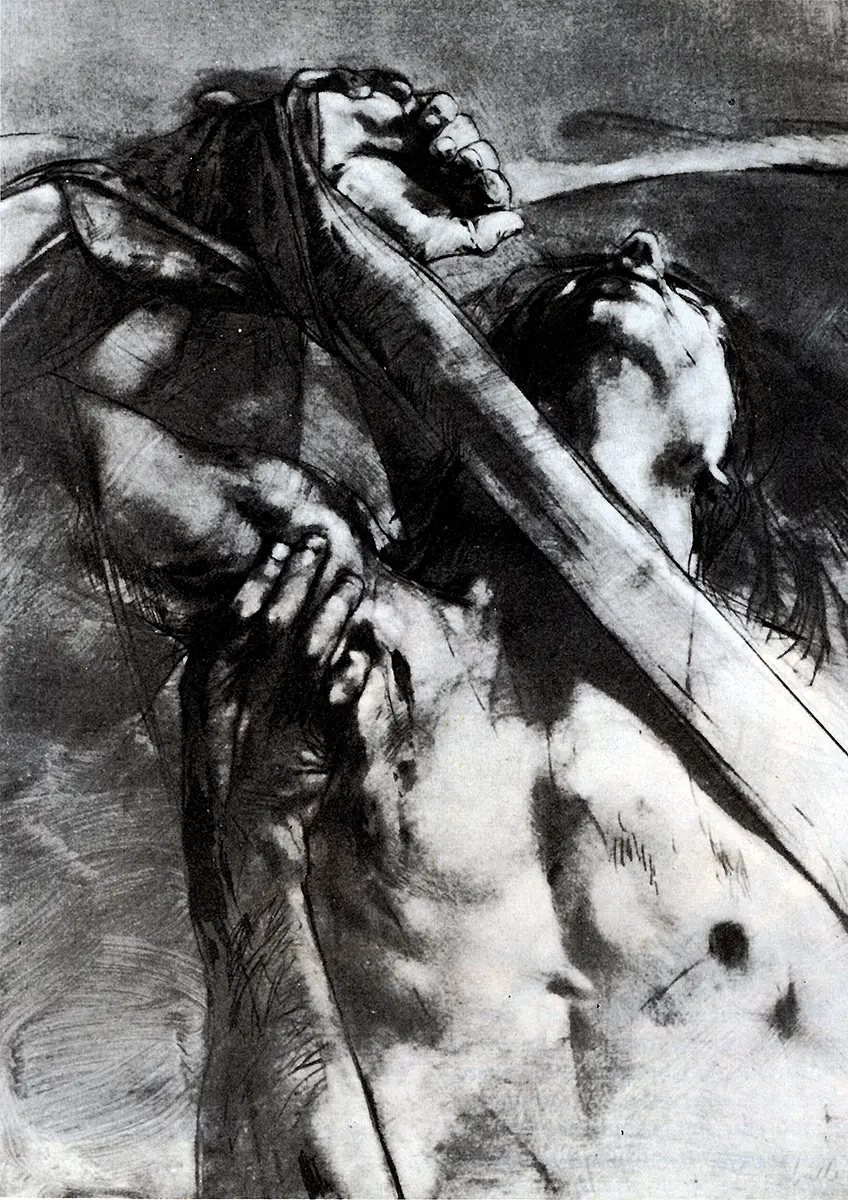
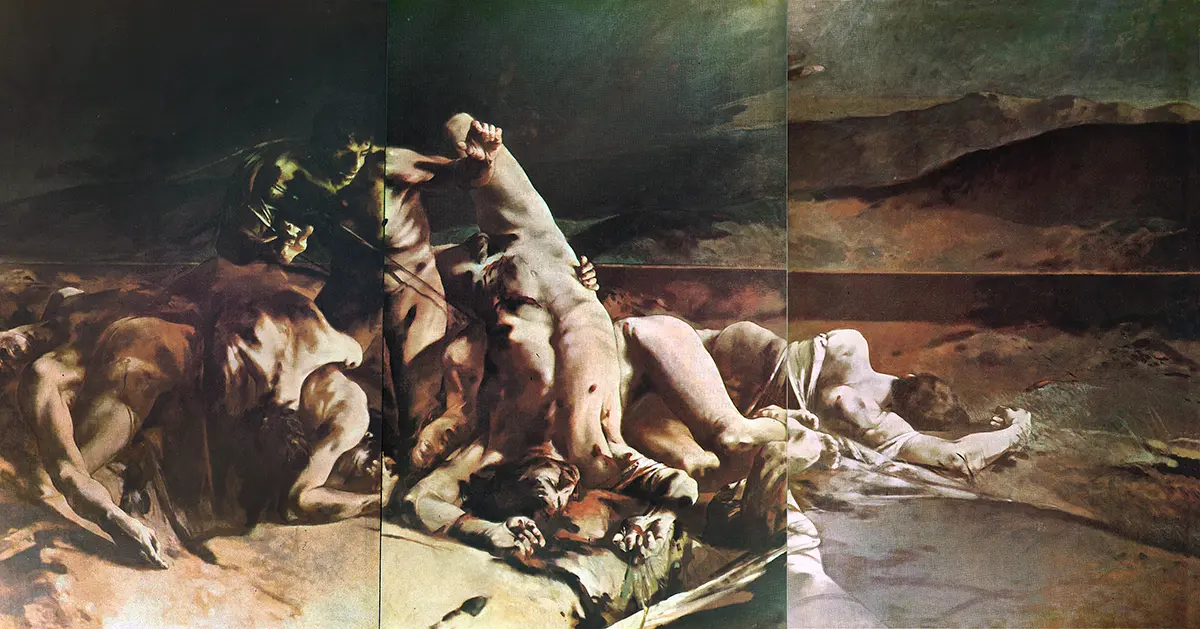
Luis, you are exhibiting a great triptych and a series of anatomical drawings that are studies for the great painting at Albert Loeb Gallery. I would like to ask you, first of all, why do you show these drawings since they are, as you say, only studies.
Yes, they are studies from drawings made from life and from which I have developed the triptych. If I show them, it is because I believe that in reality, they are the fundamental base of my work, and although many times they are only notes, I think that there is already the germ of all the ideas that I will develop later in the painting. Drawing is a way of thinking for me, and my painting is only the elaboration of that thought.
I would understand it that way if they were imaginary drawings, you, the paper, and your ideas. But in this case, we have the model involved, and it seems to me that there is a danger of silly reproduction, a school exercise, or the study of anatomy. Neither the reproduction, nor the exercise, nor the study, are sufficient for the creation of a work of art.
Agree. Art is much more or much less. There may be art without study, but there can also be art within the study, and this in a way that can be conscious or unconscious. I explain how I see the two cases. I may be foolishly drawing a leg as you say, and the drawing is almost always bad. Agree. But sometimes that leg, for me looking at it, becomes much more than a silly excuse. I can suddenly see something in that leg that moves me profoundly and try to reproduce the leg plus the emotion. And the drawing of a leg that transmits a feeling may already be a work of art, don't you think? That as far as conscious creation is concerned. The other, the unconscious creation, is much more difficult to analyze. But let's go back to the leg: I can foolishly draw that leg without getting excited, but it can happen that this emotion that does not come from the leg suddenly appears in the drawing. How? I do not know. It is what I would call unconscious creation. It may be a chance; I don't know. Anyway, I suddenly realize that there is something in the drawing that creates a visual emotion, and that is enough. All these drawings are then sensations, sought or found, do you understand? And it is through those drawings and those sensations that I later make my paintings.
You then paint through feelings rather than reason. But it seems to me, hearing you speak, that you reason too much to be an emotional painter.
You're right. Maybe it's the French influence. And surely, if I analyzed less what I do, I would do it better. My best paintings are always the most spontaneous, and the big problem in my painting is keeping those feelings instead of slowly destroying them as I work on them.
But when working on them, what do you pretend? And why do them if they are already there?
Yes, they are there, but only potentially. If I keep working on them, it is to give them more evidence, to make them more visible, to communicate.
So, art is communication more than expression?
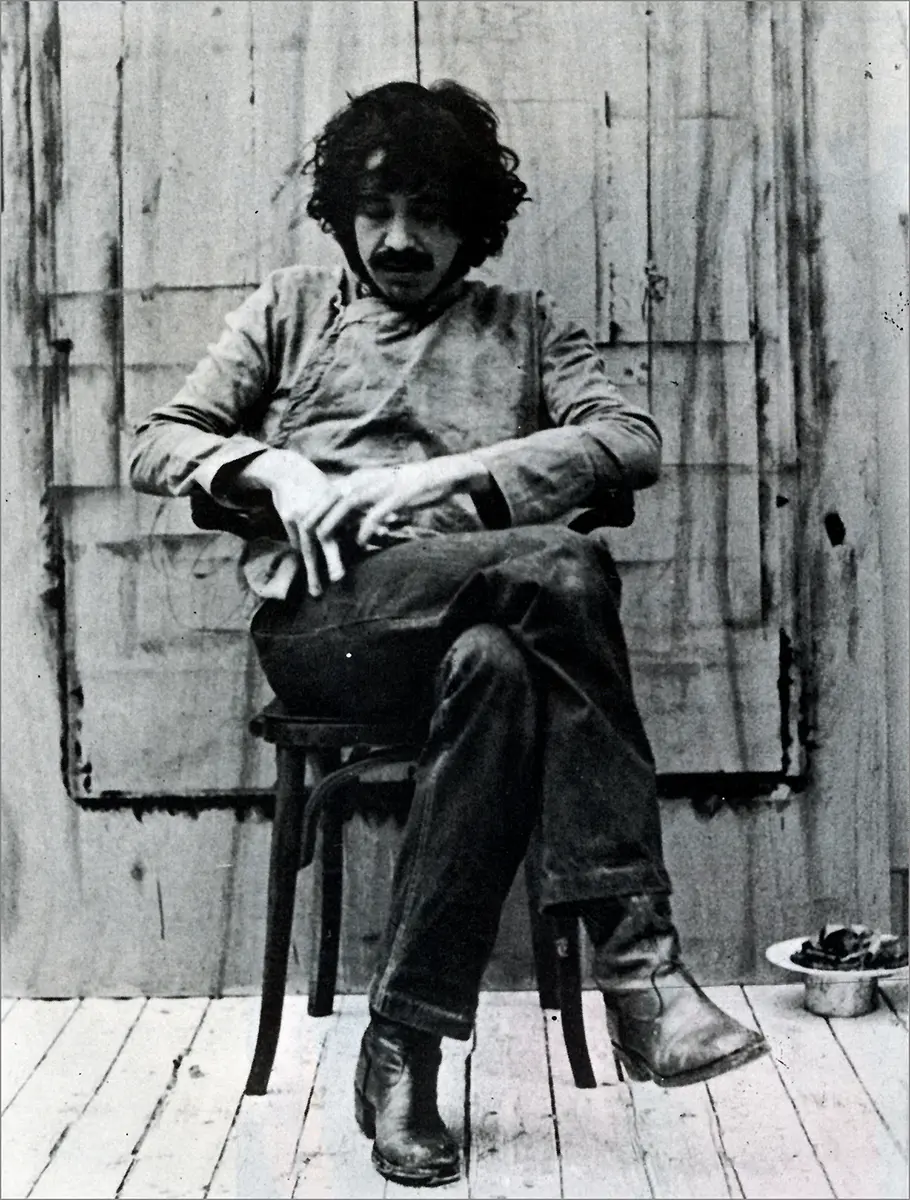
Both are essential. If the work does not communicate the expression it contains, I do not see its value; on the other hand, that value primarily depends on the expression.
The emotion of a leg, for example...
Do not make fun of it, that, drawing legs, Michelangelo was able to create and transmit a whole humanistic vision of the world.
In the sixteenth century, I agree. At that time, it was precisely about the creation of humanism after the Middle Ages. But now, do you honestly think that you are going to say something new with your leg drawings?
I don’t know, but it is not a problem that concerns me, especially. I only try to recreate and transmit my emotions that are produced by a leg, by a sunset, or by a philosophy book...
We were talking about legs.
Legs or theology! I talk about my feelings. And those feelings are surely conditioned by the society in which I live. And I don't think it is necessary to paint machines or make cyber art to be current. Current is a leg the same as a machine, and I get more excited with the first one than with the second one. I would actually tell you that this machine can produce all the emotions and feelings I would like to transmit by drawing a knee. And also, that that knee, that leg, that body, are more directly emotional than any rocket around the moon; and that with a body and nothing else, you can express everything and say everything. From Byzantium's religiosity to Michelangelo's humanism, from Rubens's satisfied bourgeoisie to El Greco's sickly spiritualism, from David's political civility to Klimt's perverse eroticism or Grünewald's human pain. Everything can be said with a body, or with a leg, or with a knee.
Yes. Precisely everything has been said with a human body...
And something new will always be said as long as there are men who get excited with a body.
Do not interrupt me. I agree that the human body will always be a motive for emotions. What I don't see clearly is how can you still be able to convey emotions?
In the same way that a beautiful body will always tell you much more than a whole treatise on beauty, or that the image of a tortured man will impress you more than all the literature on the subject.
The vision of a tortured man, yes. I doubt the emotion that the painted image of that man can transmit. A photo would surely be more moving. And this is what I wanted to say: that painting, perhaps because it is such a widely used language, has lost its potential for expression and communication.
On the contrary, it seems to me that a photo will never be as expressive as a painting. I speak of the photograph as a document and not as a work of art. The photograph is exciting precisely because of its documentary value, but the painting can sharpen and concentrate that documentary value. A good painting has always been that: a concentration or a reflection on the document, and it is that capacity for expression through a document that differentiates the good from the bad painters. For example, Velázquez, who is one of the most documentary painters there has ever been, might seem at first glance, merely the photographer of the Spanish court. But by comparing him to other "photographers" of the same court (Mazo or Carreño, for example), we see that in Velázquez, there is something else. A Reflection on that document. The ability to turn it into something magical and poetic and moving. All this to tell you that painting is a means of expression as current as ever, and that, although it has largely lost its document value, the emotional and expressive value will always exist and that is what is important.
But the same can be achieved with a photo, in the cinema, or theater, creating expressive visual images. Why keep using brushes?
Well, because the brush actually represents two irreplaceable instruments: the hand and the eye. The hand that can be the unpredictable instrument of the unconscious that we were talking about at the beginning, and especially the human eye that sees differently from the camera's photographic eye. The eye sees sentimentally and qualitatively. The eye chooses what it sees, while the camera coldly sees everything. Perhaps the painting is merely knowing how to choose. Choose the lines and colors that will form the painting. Know how to select the elements that will produce the desired effect. I don’t know. This is all very vague, but what I am sure of is that all these processes, which are very subtle and in which the concern and the unconscious are mixed, can only be carried out through the eye and the hand.
This is all too technical. Let’s talk about something else. Do you think the artist's life should be reflected in his work?
Not necessarily, but I believe that the artist's life always influences the work and that the work probably conditions the artist's life. But that does not matter. Perhaps El Greco did not believe in God. Maybe he wanted to believe in God. Maybe he was a believer and a mystic. I don't know. What is certain is that his works are eminently religious.
But to transmit that religiosity, it must have been of great sincerity!
Sincere at the time of completion, but that does not mean that he went to mass every Sunday.
And you think that your painting is religious?
I wish it were. You can see that more clearly than me since you see it from the outside. I see my works through my intentions, and you see only the work.
Do you doubt the result?
Of course, I doubt. I always doubt, and I will never be able to know for sure because, as I say, I know my intentions.
And what are your intentions in painting?
I am not going to tell you. It would be silly. I would not want to influence your judgment. As I was saying, I think painting is a language, and if that language does not communicate, it is not worthwhile to continue talking.
But maybe it communicates something other than what you wanted to say. Would that bother you?
Yes. Deeply and out of pure vanity. Although I have doubts, I prefer to think that the artist is aware of his work and not merely a "medium." That is why I dislike the vast majority of abstract art. Because it does not pretend to say anything or because it can mean anything to the viewer's liking. Art to dream, sweet music, and comfortable armchairs!
But you say you have doubts...
Yes. I said that I had doubts about the work's emotional content, which may have been unconsciously achieved by the artist. But let's say, to simplify, that work can be read at many different levels, and that this reading can be either formal, or literary, or psychological, or social or economic, that the same work can be interpreted in different ways different times. After all, what bothers me is that after so many analyses, something remains to be analyzed and that something is what really matters!
But let’s go back to religiosity. I would not want to offend you, but it seems that perhaps you have religious intentions, but the result is not religious but erotic.
Other people have told me precisely the opposite, which confirms the idea that religion and eroticism are, at least for me, linked in some way. You may have noticed from everything we have said that I try to understand art and that I despair that I cannot understand it. The same thing happens to me with religion and eroticism. The three activities go together. There are three ways to get to something I do not know. To go further, I do not know how to explain it to you. I know that the end is the same and that they all have the same origin. The difference is on the roads—the smells of incense, turpentine, and semen mix in my head. When I paint, I make love, and when I make love, I pray. And although I don't pray, my memories of the church are constant but purely aesthetic. To paint is to confess, and to make love is communion. This all seems ridiculous, and I don't know how to explain it to you, but maybe you will see it in my paintings?
Never mind. Maybe one day. And if, as you say, if something else is seen, that may be better!
I see blood.
Does it bother you?
No, but I don't understand, and I don't understand the relationship with erotism and religion we mentioned.
But I don’t ask the viewer to understand but to feel! The pleasure-pain relationship seems entirely evident, and if I insist on it, it’s because I am passionate about the ambiguity of the gesture. The visual images of pain or pleasure are very similar to the point of confusion. And since I work precisely with images... As far as religion is concerned, it seems that you are not Catholic! The adoration of a suffering man, of a bleeding man, of a dead man, doesn't tell you anything? The pain transformed into love? "This is my blood," and you drink it. “This is my body," and you eat it. Blessed are those who suffer, those who weep, and those who bleed! All that with clouds of incense and golden chasubles. Mass is a sacrifice and a bloody sacrifice from a purely visual point of view. I am left with the image of a dead and bleeding man supported by two beautiful women who cry, a virgin, and a prostitute.
I thought that there was also a political intention in your painting. Do all those bleeding bodies have no intention of protest? Are they just the image of your little erotic-religious ghosts?
Look, I paint what moves me, whether it's the image of a man bleeding two thousand years ago in Palestine or the Palestinian who was murdered yesterday. It may be the memory of a dead friend, or the death and torture of thousands of men I do not know. If there were merely horror in my painting, I would tell you that it has a social and political intention, since social and political reasons generally cause pain. But as I have been telling you for more than an hour, the basis of my painting is not only pain but also pleasure, and I would be ashamed to mention that my ''little pleasures," as you say, can lead to work with political intentions.
But do you think the artist should commit himself politically?
As everyone. But that does not mean that his work must have a political message. No one has ever asked a shoemaker to make political shoes, or a musician to compose symphonies on the left or the right. Why would the painter have to do political painting? What he has to do is a good painting, which, if it is good and therefore sincere, will thus necessarily reflect the problems of his time, of his society, and his country. The painter may decide that politics is more important than art, but, in that case, he leaves art to do politics. You cannot do both at the same time. For my part, I don't see the solution.
Don’t you think Picasso’s “Guernica” is a political work?
Not in the sense that political art is spoken of today, that is to say, as an art of propaganda.
And yet it was created for political reasons.
Yes, but that does not mean that it had political consequences. It seems to me that in politics, what counts are the consequences. "Guernica" is a moving image that shows the horror of war, but it would be pretentious to believe that a painting could prevent a war. What may have significant political value are Picasso’s political views.
And why not his works?
Because the language of these works is extremely sophisticated and difficult to understand, and I believe that politics requires a much simpler and more direct language.
So the language of painting can never be revolutionary?
Revolutionary yes. What I don't think is that it has political efficacy. A painting must be revolutionary in the sense of creating revolutionary images. Images that make us see; that make us feel; that we are profoundly moving. Those images can gradually create a new vision of the world, a new way of seeing and feeling. That is the revolutionary value of art, and that is its political value. As for Latin America, I tell you the same. Latin American artists must create a new vision based on new images. If the artists are sincere, I believe that they will necessarily make Latin American images even unconsciously. Still, for this new vision to be born, artists must try to look for it in themselves and not outside of them, no matter how exciting the artistic movement that occurs elsewhere. I believe that the political duty of the Latin American artist should be, simply, to be sincere in his Latin American condition. That sincerity will produce images with a different sensitivity that will eventually lead to a new way of seeing, typical of Latin America.