Those who have written about the work of Liliana Porter often forget that the initial and recurrent driving force of her work has been printmaking, a craft which, in its most elementary form is a matter of incision, of making marks, where everything has to be thought out in advance and in reverse. Hence her affinity with Borges and Lewis Carroll, masters of the dialectic of the mirror. These same writers end up seeing Porter's work as a kind of literature —misled perhaps by its narrative, sequential structure— and fall into the same trap as those writers who have said that Borges's literature is essentially metaphysical, whereas Borges himself once wrote that metaphysics is merely a branch of fantastic literature. Other commentators have been beguiled by the apparent tender touches in Porter's art —the little figures from the family album, the horses, the piece of chalk resting on the mantelpiece— and reduce the poetry of her work to the ingenuity of a young girl strolling through the world and opening up the sewing basket for her grandmother.
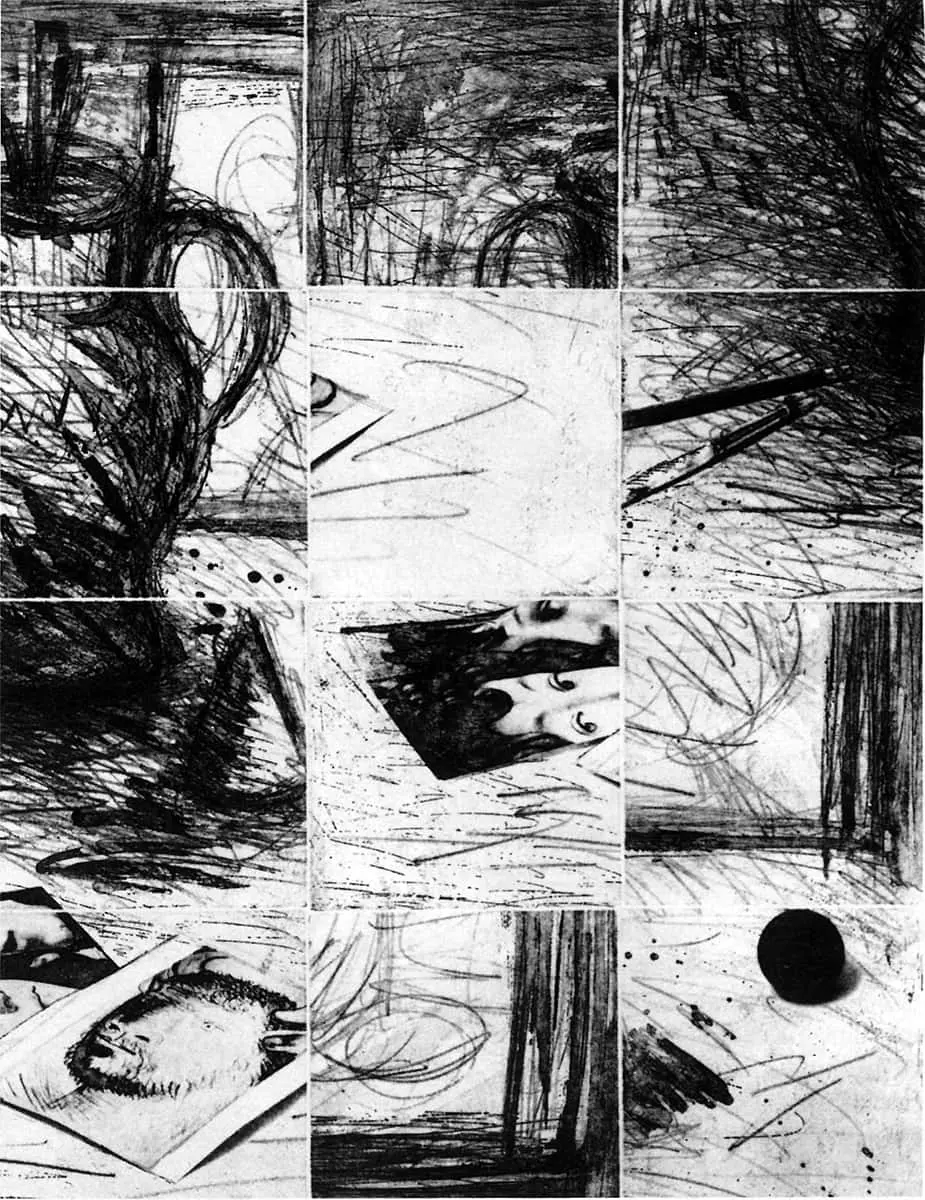
In point of fact, Porter’s work is not only disturbing, it is actually perverse. She perverts, from the beginning, the actual and dramatic concept of print-making itself, taking it to its final consequences: she unravels the lie about depicting things in reverse and in the best Duchamp's spirit demystifies things, but in her own way. For a work to be what we call a work of art, Porter once said, it must generate an idea, perhaps another work. This is not a throwaway remark. It explains the incision —in the spectator— of inertia that will lead to a movement of the imagination, an association of ideas that will not stop until some stronger force appears: the street, routine, the crudeness of a world bereft of miracles, the lamentably real world of which Borges also writes. Meanwhile, the spectator too has done his work. He has seen how Liliana Porter, with sengraphed images on the walls —images which will be rubbed away, fleeting images which are out of reach and which will not recur in the same place— denies the idea of ownership of the work, appropriating without hesitation the images of Magritte which she found in some book, until the image, the book, the object resting on it, the mark of the press on the paper make clear that everything can change ad infinitum, that there is no such thing as an original or definitive print, that the accepted rule of the repetition of the print is not an ironclad principle. Even though each moment in this process can be repeated The idea is indeed perverse.
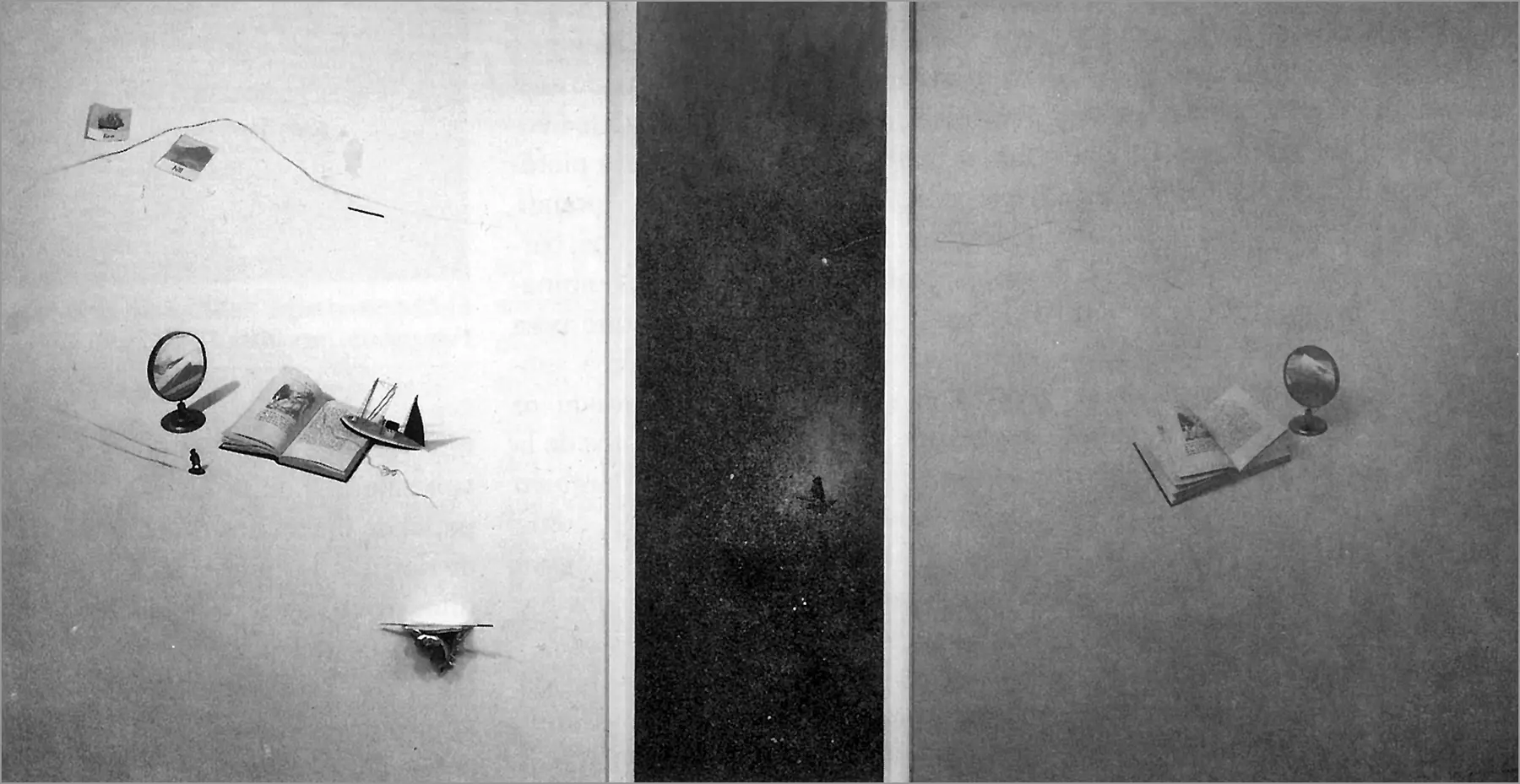
And then Porter attacks another convention: that of collage. A little real ship will form the center. There will be little pieces of paper with drawings, shadows, bits of books with fragments from Borges, little cut-up photos of another boat, or the same boat, all cascading together, an intimate, absolutely chaotic aleph. Or there might be a single book, nailed —through sehgraphy— in a corner of a piece of white material protected by two other pieces of material of deep blue color, broken only by the shadows of some minimal geometrical work. Everything is silent, as if the book, which is so real, were on the point of being swept away by these pieces of material floating on the limits of the painting and the succeeding void.
MIGUEL BRIANTE
Artistic advisor. Recoleta Cultural Center.Buenos Aires.