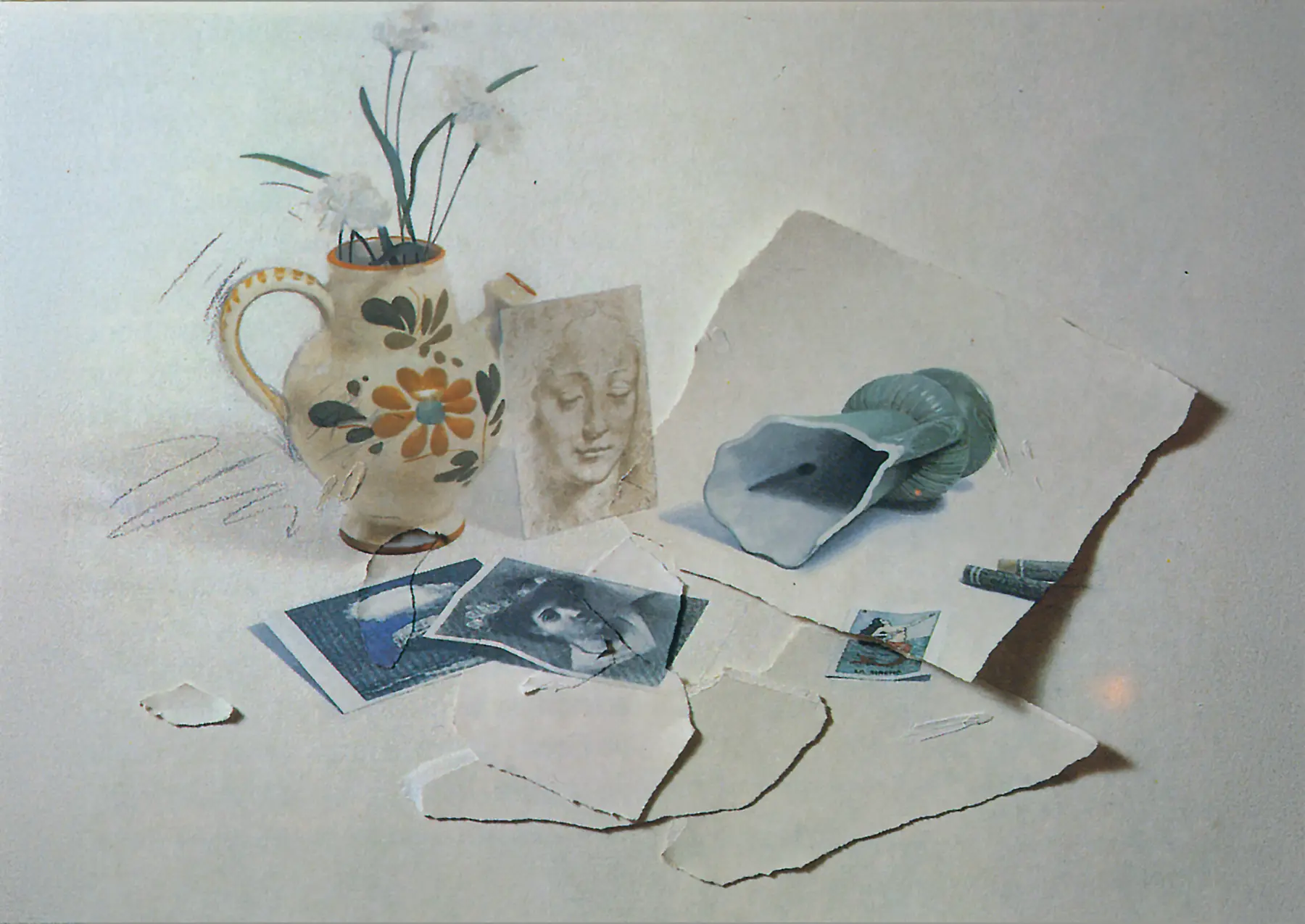
The work of Liliana Porter can be compared to the art of the magician, the conjuring up and conjuring away of the things that make up reality. Around 1969, she progressively moved away from that reality. It was in that year that she presented at the Di Telia Institute, in Buenos Aires, a series of prints on postcards, suitable for sending through the mail, the subjects of which were absent figures (a vase, an olive) only the shadow of which remained, an imperfect simulation of objection, trompe I'oeil.
Porter endeavors to grasp what is beyond our reach and to do so exploits the subjective complicity of the observer; she shows that she is capable of going beyond what is objectual by making it of only indirect significance: she records only the trace left behind by objects.
It has been said that desire does not refer to some real object, but only to an imaginary object (absent, lost, imagined), so that the real object is but an intermediary, an illusion, a substitute for something that in the end is out of reach. Porter deals with the corporality of her objects in the same way as with her prints: just as she is not interested in the plate, the block of wood (which no one has yet said is a sculpture), but rather in the mark which it leaves on the paper. She is therefore more interested in the trace left by the presence of objects than in the presence of the objects themselves.
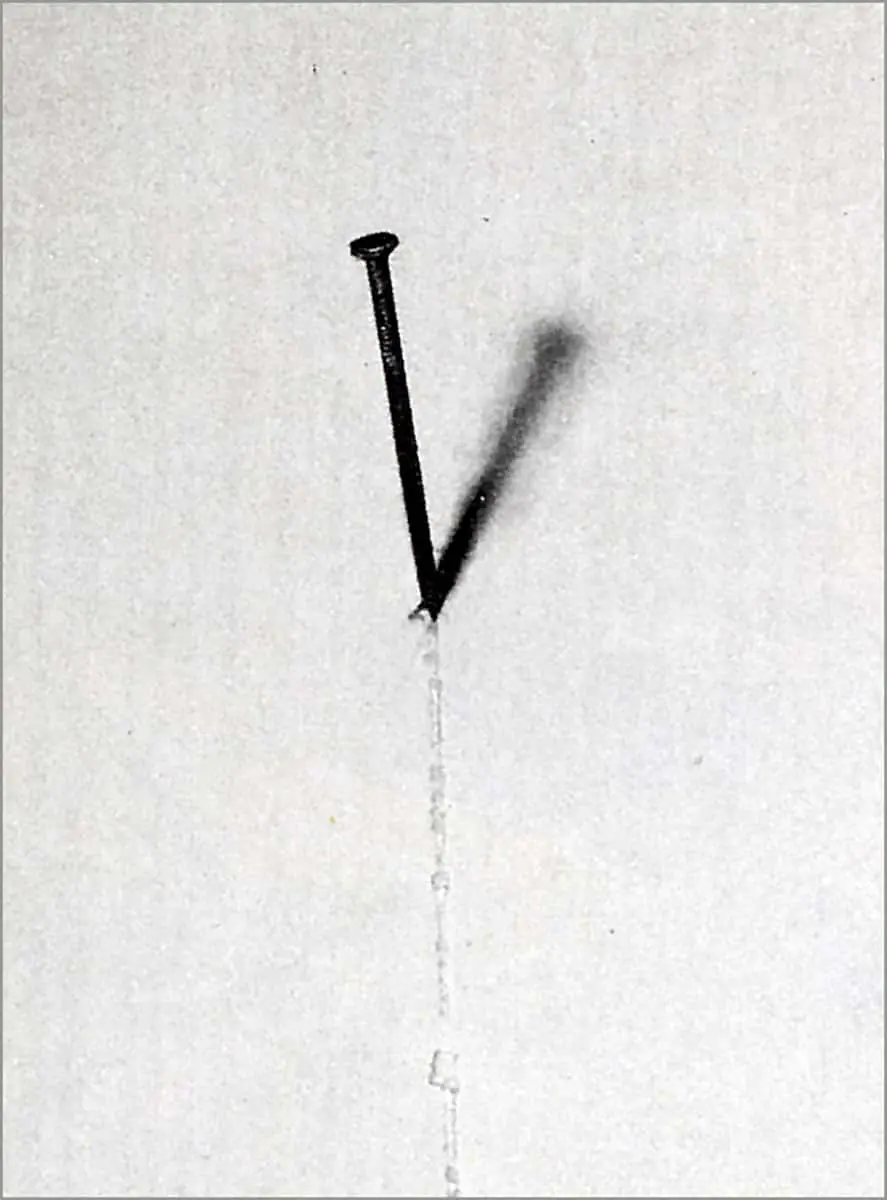
Later she would begin a process of partial recuperation of reality, which would become more emphatic. In Another Reality (1977), she links the virtual nature of the surface of her prints with real objects: a real cord is tied to an imaginary screw in the support, and a real screw on the floor; an imaginary nail will emerge from a real tear. Where does reality end and the imaginary begin? The dichotomy of reality/illusion which Porter proposes continues, but the force of reality is overwhelming. Porter is now moving toward a recuperation of this reality. Whereas before the eyewitness was a mere shadow, in some of her recent canvases the eyewitness is now a mirror. Why a mirror? The reflection of Narcissus? Perhaps not. Rather than Lewis Carroll's Looking Glass, Alice enters Wonderland.
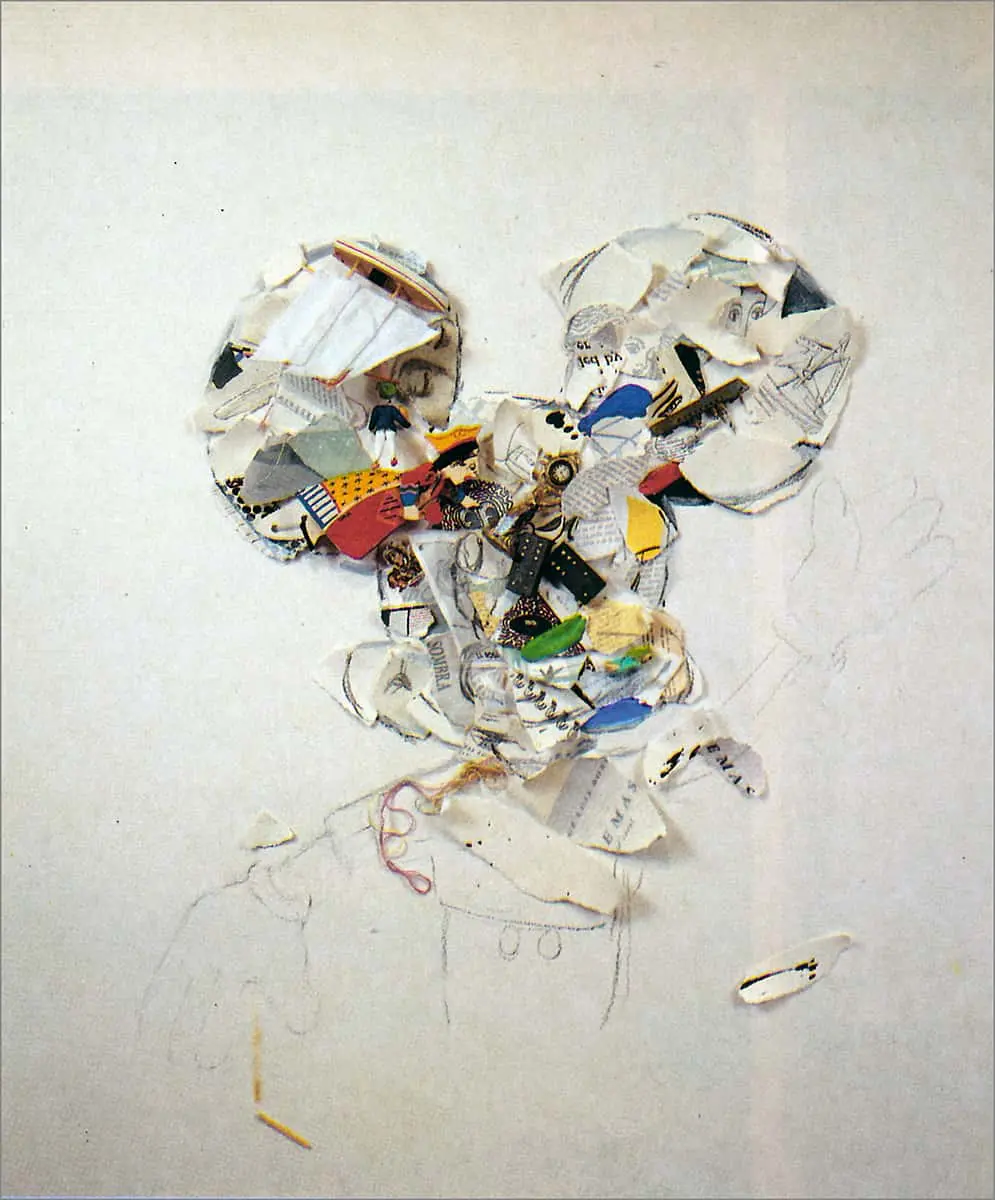
In Reconstruction with Mirror (1988) there is a photograph of a copy of Carroll's book, with its page torn and ripped out, pieces of scattered leaves, and a circular and convex mirror (a homage to the Self-Portrait of II Parmigianino? or Van Eyck's The Marriage of the Amolfini?). Here we see the paradox: real reality is shattered to pieces, but the illusory reality of the mirror is recomposed. And this recomposed reality is nothing less than that of Alice in Wonderland, the fantasy that lies beyond the looking glass. In this case, the mirror is more real than the world.
But why a mirror? The mirror, like the print, shows the world in reverse. And Porter is a printmaker. Furthermore, since time immemorial art has striven to be the mirror of reality. At the same time, the mirror fuses reality and illusion and this is the area of confrontation that Porter proposes. An area overflowing with unanswered questions. The Conundrum (1987), an oil and assemblage work on canvas, is a special variation of collage; above the support, the artist has installed three-dimensional objects. On the other hand, a virtual world is spread out over the support. The canvas is conceived as an enigmatic virtuality. What happens between the reality that is above and the lines that are on the canvas? This is a different dimension, going beyond both the third dimension and virtuality; it is a fractal dimension. It belongs to the same species as that proposed by Duchamp in the catalog to the Mina Loy exhibition in New York in 1959, which presented the poems of Mina in two and a half dimensions. If it is possible to conceive infinite fractal dimensions in mathematics, why not in art?
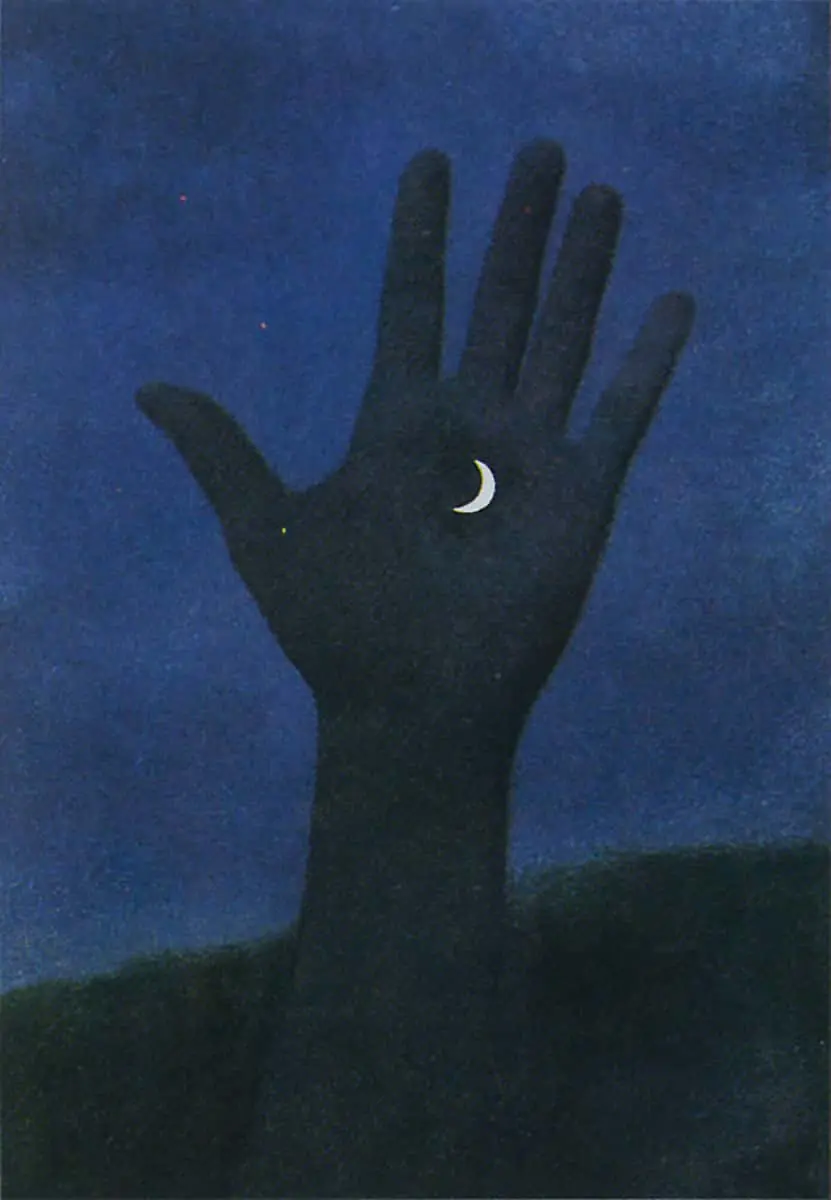
From the beginning of her career up to the Wrinkles series in 1968, Liliana Porter broke with reality, like Alice, but since then she has begun a slow process of reconstruction. Does this signal a nostalgia for lost time? But the objects are recuperated only fragmentarily. Does this have something to do with memory, the past, with affectivity?
These fragments come from a dispersed and decomposed world; texts written and then re-written backward (mirror-like); the word GAME, i.e. the ludic; photographs, recent or from the distant past, intact or in pieces, coupled with the techniques of photomontage; volumetric objects; stains of pictorial material; quotations from Picasso, Morandi, Lichtenstein; geometric drawings, little boats; dancers; little horses.
They are combined with the theme of the pitcher which in some doctrines (not only mystical) symbolizes the female breast, enclosing the secrets of metamorphosis. And they are combined with the theme of the bibelot (which, like all miniatures, fascinates children) —“real" bibelots which are sometimes photographed.
The confusion between reality and illusion is always present. As well as all the paraphernalia associated with childhood, decalcomanias and transfers (those of a serial kind), enormous trays, like those used in birthday parties; and reels of colored thread. All these elements testify to the artist's collector spirit. Umberto Eco has written that "ours is an art of additives and compositions like that of the Middle Ages... and the apparent Byzantine character of our civilization, our passion for collecting things, catalogs, assemblage, the accumulation of different things are due to the need to take things apart and once again judge the remnants of an earlier world which was perhaps more harmonious but which is now out of date".
All these heterogeneous elements result in a kind of informal collage, for Porter has a somewhat lax sense of form which encourages the participation of the observer. This is why the figures which appear fully incorporated are those which lack any strong Gestalt. And so the eye of Greta Garbo, the Divine, is cut out of the portrait: if just the face were included, it would undoubtedly gobble up the whole work. I would say that Porter's attitude is closer to Dadaism than to any other aesthetic tendency. She pays attention to something that the Cubists neglected: she is more interested in the content than the final form. Most of the objects come as pieces of paper or through the print support. For Porter, the world is Alice's Wonderland. And Porter herself is Alice.
ANGEL KALENBERG
Director of Museo Nactonal de Artes Plasticas, Montevideo, Uruguay.