
Most works by Adriana Lestido (Argentina, 1955) invite poetic reflection and political preoccupation because of their remarkable conceptual depth and formal expertise. Her lyrical gaze impregnates her unforgettable portraits, overwhelming landscapes, and even the photographs charged with feelings, absences, and sorrows. With her most recent exhibition titled Mexico, the photographer closed a year (2015) in which she showed her work in New York and also developed curatorships. As usual, she also offered workshops for artists in which her mastery of the photographic medium was shared with a passion that reaches for transcendence.
Taught in the mountains and by the sea, Lestido’s workshops represent a fundamental experience for artists. She is greatly respected as a teacher and her approach to teaching is designed to guide her students to learn how to see both the internal and external. Not publicly advertised, her workshops are only imparted to those who show a real interest in participating. And after every call, there are always those (usually more than 20) who do not make the cut.
Presented at Rolf Art—a gallery specializing in works that explore the boundaries of video, installation, and photography—the exhibition Mexico consists of two impressive photographic essays completed in Mexico during a period of over five years. The two series were conceived as a result of an invitation from Mexican curator Patricia Mendoza to photographically elevate forest areas on the occasion of the International Year of Forests. One of the series became Mexico and the other, Hierve el Agua (The Water Boils); named after an eponymous site—an incredible place in the state of Oaxaca that was probably sacred to the ancient Zapotecs—full of millenary, petrified, naturally formed cascades in which water indeed boils.
Curated by Adriana Lauria, the selection of small works presented at the gallery in Recoleta conveys the aesthetic value of Lestido’s work and the frequently critical sharpness of her gaze. This is particularly true for the series Mexico, which was captured in Durango, Ixtlán de Juárez, Oaxaca, Quintana Roo, and San Juan Nuevo de Michoacán. In it, Lestido celebrates the cycle, organized by the United Nations in 2011, to raise awareness about deforestation and the need to conserve forests. Since ancient times, forests and their trees have been the source of the resin used to make chewing gum.
Lestido captures light and air in a singular and surprising manner, as the two elements appear to envelop the people and vegetation that from time to time clearly appear from under the foggy, almost alien, environment. The fiber-based paper that she uses for her prints contributes to the soft and terse expression of the landscapes visited and the actions of mankind. The natural vapors of certain regions are intercalated with the smoke from coal ovens (where the resin is baked) and the sweat of tired workers. The presence of the workers is rare, and most times only their silhouettes or the consequences of their actions are shown.
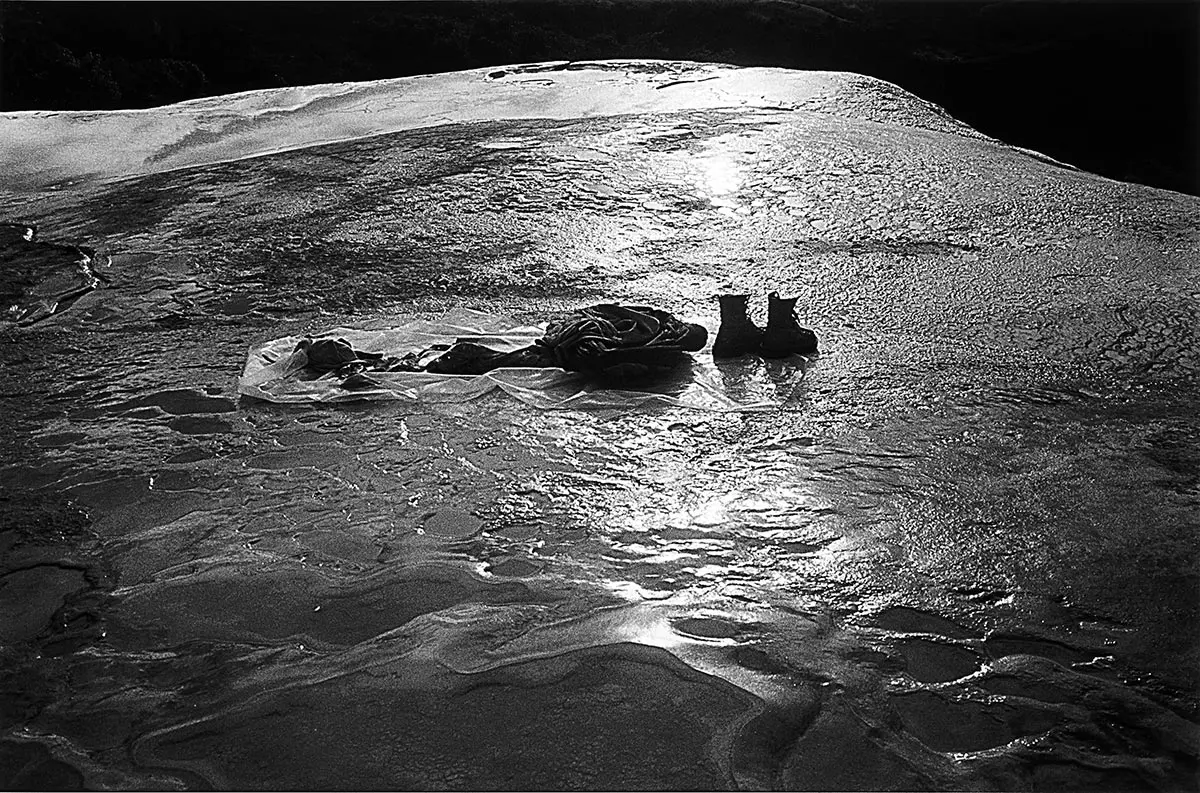
Also out of this world are the amazing landscapes of Hierve el Agua. The splendid images achieved in this remote area were captured by Lestido during a stop on her trip through Mexico. The views of this archeological and touristic region full of precipices, natural bodies of water, and a few brushstrokes of desert vegetation exude a metaphysical air. They are images that invite viewers to dream and unleash their imagination. According to curator Adriana Lauria “The pleasure of her gaze is reflected in the sensuality conveyed in the rock formations.” Lauria also stresses the presence of Lestido in “the subtle composition of a bundle of cloths beside a pair of boots that occupy the center of an undefinable frozen surface with undulating reflections.”
The group of images—black and white film photographs—appeals to the viewer’s gaze because of their beauty and contrast, for offering compelling evidence of nature and its devastation. In all the images, even the pictures with people, solitude appears to prevail.
The melancholy that they arouse could perhaps be influenced by knowing the trajectory of images—imprisoned women, teenage mothers, mothers and daughters, unpopulated landscapes, and mystic interiors—in which the absence of men is predominant. In fact, the photograph that gave Lestido recognition as a photojournalist was Madre e Hija de Plaza de Mayo (Mother and Daughter of Plaza de Mayo, 1982), which depicts a mother and daughter passionately demonstrating against the disappearance of a loved one. Lestido affirms that her work tells “a single story.” Her photographs narrate absences but also hopes, communicate changes and permanence, delve into separations and reconciliations; they are a beautiful glimpse of life itself.
VICTORIA VERLICHAK