
Alberto José Sánchez (Caracas, 1979) presented seven medium-format works in an exhibition titled Estructuras ilusorias (Illusory Structures), at Caracas’ Graphicart Gallery, specialized in geometric abstract art.
Sánchez’s works are characterized by their construction of symmetrical structures, supported on straight, precise lines. Their lively colors are also distinguishing features. Sánchez’s paintings are directly influenced by the tenets of optical art and, in that sense, they are based on the perceptual interplay between shapes presented on a plane and the viewer’s cognitive response, as we tend to see the paintings as a three-dimensional figure.
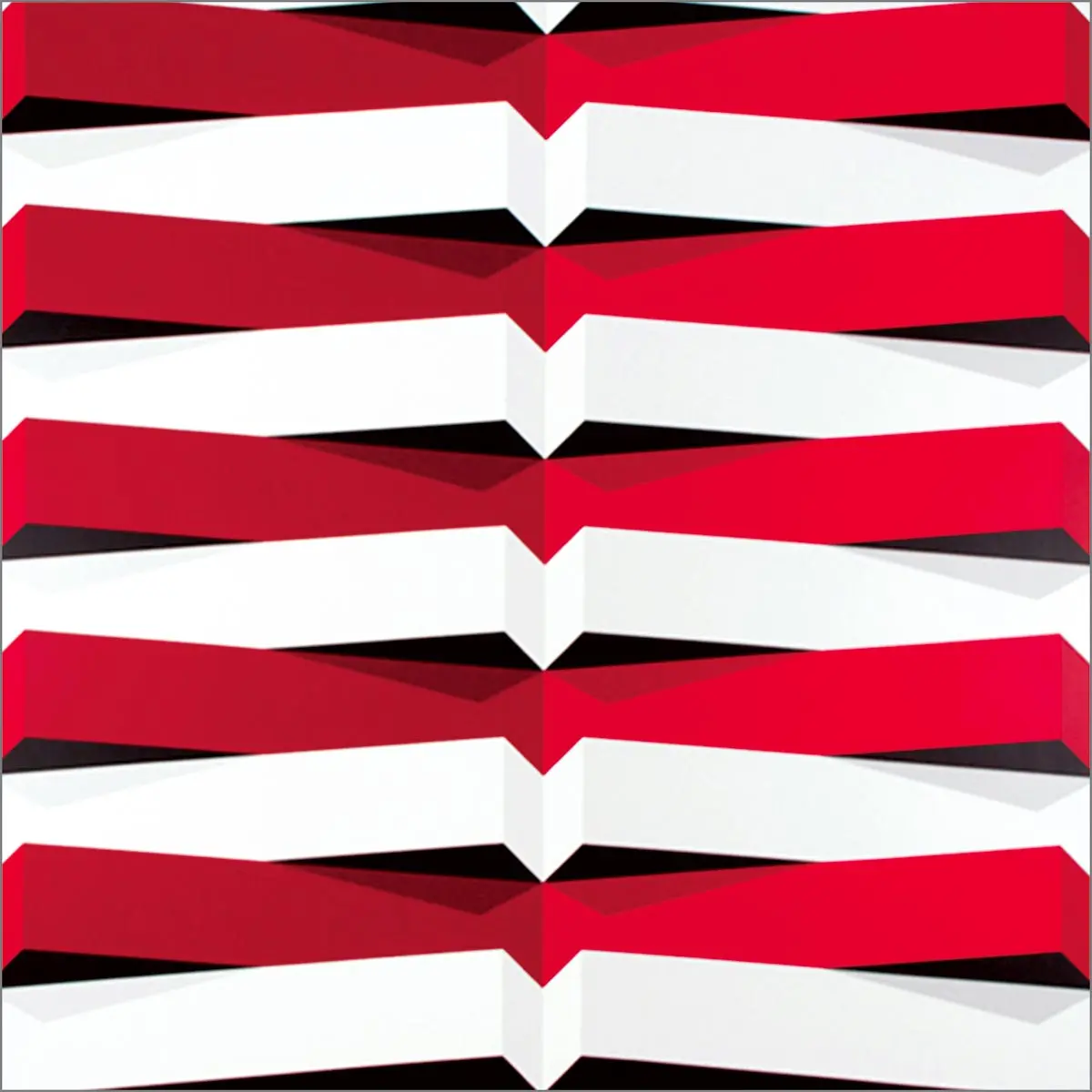
The artist has said that these visual stratagems are intended to produce pleasure in the viewer, who, as is often the case with this kind of art, is “captured” by the optical illusion, as well as by the concatenation of shapes and rhythms the illusions provoke and the hyperrealist chromatism that underscores the perceptual ruse.
The Venezuelan critic Susana Benko, author of the catalog essay for the exhibition, writes that “Our visual system is trained to identify shapes on the basis of our perception and location in the world. And we tend to adapt ourselves to it. In this case, however, the artist creates intentional misunderstandings—fictitious volumes, nonexistent spaces, visual artifices—using, paradoxically, elements from the immediate reality such as the incidence of light on the shapes and their consequent color shifts.” Our adaptation to it leaves us suspended in contemplation, pleasurably immersed in the dichotomy between what we see and the fiction that struggles to impose itself. A number of questions arise immediately, and our mind is activated, laboring to resist the illusion; this makes us more aware of our own perception and the mind’s ability to deceive itself. “Confronted with one of Sánchez’s paintings,” writes Benko, “viewers can’t avoid wondering whether what they see is real or fictional, and they experience the bewildering realization that their supposedly robust rational logic is really no such thing. This bewilderment causes viewers to look at the painting in a much more active way, much more thoughtfully and intensely than in mere contemplation.”
The exhibition featured three different types of works. One group evokes a kind of spatial fabric where parallel lines represent a counterpoint of incoming and outgoing angles. One of these works is Estructura paralela (Parallel Structure), based on an alternation of gray and red lines against a black ground. The artist skillfully uses the varied hues and shades of each color to simulate the incidence of light and the projection of shadows, in that way producing a dynamic play of interweaving angles. Entrelazado cromático (Chromatic Interlacement) is another painting in this group, which also included works similar to these in different chromatic combinations (blue/yellow; orange/gray; aquamarine/gray).
A second group emphasizes the creation of illusory volumes that emerge from a plane, producing, for example, visual “columns” or concatenations of triangular volumes and hollows.
The third group is composed of works that appear as floating sheets or layers, lines that simulate anglings but never come to intertwine; they just remain there, floating in a neutral space.
In the creation of such perfect illusions, the artist uses a computer to produce the initial models of his designs, trying colors and formats until finding the representation he is after. He then transfers it to the canvas, careful to produce a flat, not textured, finish in the application of color.
Like all Venezuelan artists who follow paths derived from geometric abstraction, Sánchez assumes the inevitable influence of Carlos Cruz-Diez and Jesús Soto, as well as Víctor Vasarely or Bridget Riley. Sánchez has followed this line of work for more than twenty years.
José “Nanín” García was the museographer for this exhibition. Germán Roig was in charge of photography and María Elena Ayala took care of graphic design.
KATHERINE CHACÓN