
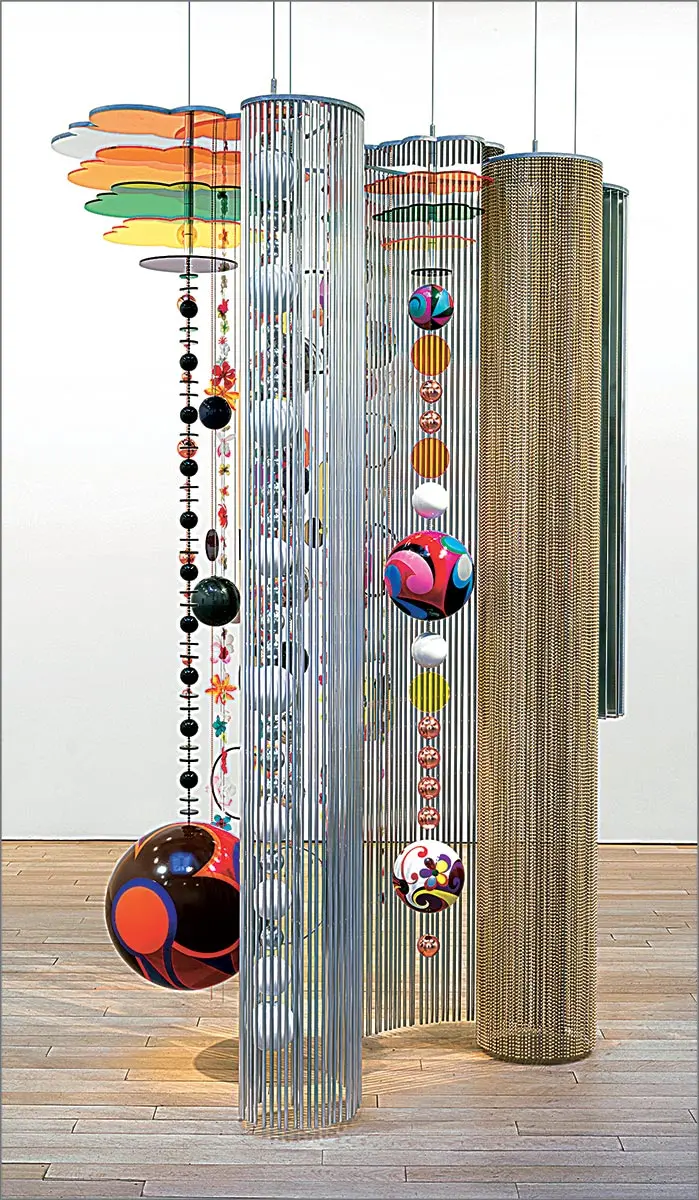
Beatriz Milhazes peculiar new work can be seen from the street outside the gallery. It is three-dimensional and hangs from the ceiling as though one of her paintings were attached up there and its many rings, fringes, circles, squares, showers of metallic threads, and strips of alternative colors were gradually dislodged and slipping to build a sculpture in circular zigzag, grazing the ground. Viewers have had a chance to read the name “Milhazes” on the wall; now they can also read “Milhazes” in space, in a somewhat reflective, transparent three-dimensionality, with undulations, spheres, and lines in different materials. The work of this Brazilian artist, well established in the international scene, is highly personal. It brings together mono-transfer techniques, a collage of decal media she has invented. These self-generated technical features—which are essential for Milhazes—connect painting, printmaking, and collage in unique originals. In the same vein, Milhazes’ art is inhabited by elements of popular speech, carnival, and Brazilian music; she treasures her country’s natural riches, as well as concepts and developments derived from the landscape architecture of Roberto Burle Marx, an artist yet to be fully appreciated. Both Milhazes and Burle Marx, although belonging to different generations and following disparate professional paths, revel in the magnificence of nature in Brazil. In its unending variety, they find myriad seeds, leaves, and in towns and villages, people make necklaces, objects, and textiles with fibers that science has not yet cataloged. Meanwhile, these elements flow together into harmonies and disharmonies in Milhazes’ studio, situated right next to the Rio de Janeiro Botanical Gardens. There can be no doubt that this is a powerful natural motivation that keeps her at a distance from neo-constructivism and conceptual art, the two movements that have cemented Brazil’s prestige in the international art map of the Twentieth and Twenty-First Centuries.
Two decades ago, Beatriz Milhazes began to exhibit in New York her baroque, colorful, lively paintings and prints. New York City, intensely urban and intellectual, was familiar with aspects of cultural exoticism coming from the Caribbean, Asia, and Africa. Beatriz Milhazes opened a different path, more authentic, not commercial or tourism-oriented. Her works were serious and playful, in the beginning, focused on flowers and later including lines and geometry, all of which prompt us to characterize her as an intellectual carioca. From the start of her career, Beatriz Milhazes has primarily produced paintings, collages, and prints. On the other hand, she has also created stage designs for her sister Marcia, a dancer. Given that the latter works are not conceived to last in time, they are not exhibited or sold like her authorial production. This dichotomy has fueled even more powerfully Milhazes’ interest in space, and from that standpoint, she created Gambo, a commission from Cartier using precious stones, and her project of a ceramic floor for the Beyeler Foundation in Switzerland, while continuing to nurse her desire to work in sculpture. The experience of many years working with Durham Press and the fact that this is a highly professionalized workshop made it possible for Milhazes to respond to the physical requirements of her projects. She has worked with them for more than five years, especially with Jean-Paul Russell, Ann Marshall, and the Durham team. They have produced Marola (Seawave), Mariola (Seandwave), and a third work not yet exhibited to the public (each is produced in three serial-numbered originals). The artist knew she did not want to produce mobiles, or stereotypes of beauty, and was open to diverse materials that she and her team tried until she found what she needed.
The somewhat rough-hewn appearance of her paintings, due to the monotype process, is not present in her sculptures, and she doesn’t work with decals here. The titles announce this situation. Marola refers to the waves left behind by the water as it recedes from the shore; it can also refer to the treasures that blink from the sand. Emphasizing the multiplication of forms, she creates sets of sculptures that eschew stoutness and expand into territories that differ from the paths so far followed by sculpture in the Twentieth and the Twenty-First Centuries. In her work, detail and rhythm are synonymous, and they are expressed as graphic details. A reader who hasn’t seen these nine paintings and two sculptures may imagine a relationship of “detachments” with her works in acrylic and stretcher frames. There are overlappings and transparencies of different forms and materials that do not cancel each other but act in synergy. Metal dominates Milhazes’ three-dimensional works; in her acrylic paintings, there are few filled-in figures and many contours, grids, contortions, and many graphic sections of stipplings, showers, waves, and flowers. The playfulness and the rigidity of Marola produce a symbolic vision of contemporary trans-global society that is attractive, integrative, and somewhat superficial.
GRACIELA KARTOFEL