
Beth Moysés’ work is unimaginable without the issue of gender violence it invokes and exorcizes with great public resonance. But it is equally unimaginable without the figure of the bride, which has made it possible for the artist to counter in her work the sublimation of the female condition with its somber underside of humiliation and sorrow. This figure is so powerful that one could be forgiven for believing that it was the bride who imposed herself on this outstanding Brazilian artist, rather than the other way around. Moysés suggested as much in the correspondence we maintained as the writing of this essay progressed. “The figure of the bride appeared in my work before I even recognized it,” she acknowledged. “I started making a number of very loaded paintings that incorporated such everyday objects as bathroom sponges, silk stockings, pieces of tulle… I would, for example, attach a pair of transparent stockings to the canvas, and when the paint dried, I’d rip them up in sections to reveal what was underneath. The stockings and the canvases I used were white, and one day I decided to create paintings with no color. To it, I attached the clasps of an old dress and sewed some silk stockings, and the whole support became a woman’s body, all white and immaculate: it was the first time I saw the bride. Her figure made it possible for me to evoke my parent’s marriage and it was the object that triggered repressed memories from my childhood. All the injustices I experienced or witnessed bubbled up to the surface, and from that moment on new works started to take shape compulsively.”
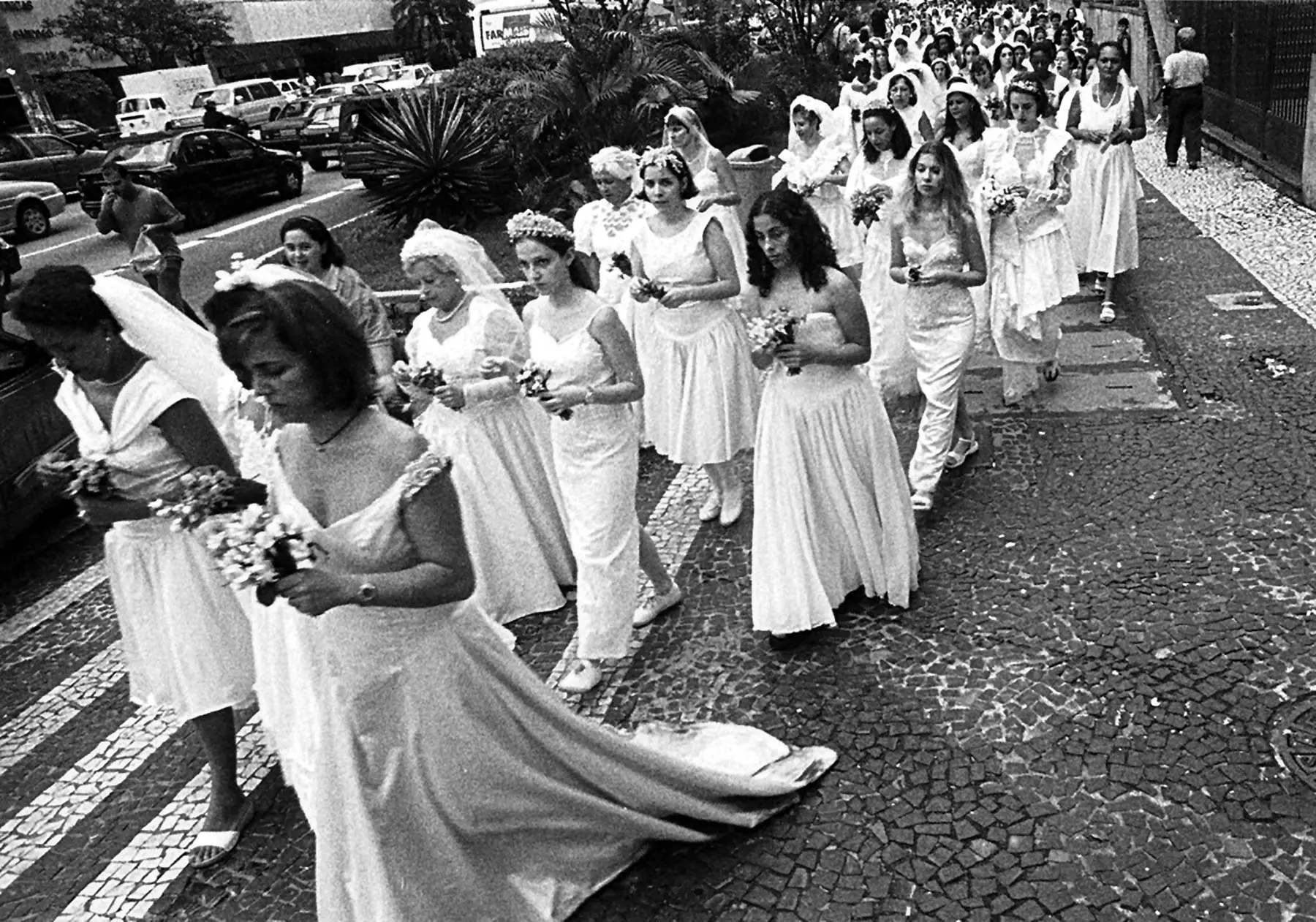
The symbolic potency of the bride figure is certainly responsible for the impact of the street actions designed by Beth Moysés and executed, over many years and in several cities and countries, by bridal gown-clad women of all ages and social conditions. One highlight among these actions, for its premonitory and exemplary character, was Memoria do afecto (Memory of Affection), performed in São Paulo on November 25, 2000, the date of the UN-sponsored International Day For the Elimination of Violence Against Women.
That day, pedestrians and passers-by in some of the Brazilian megacity’s most central and congested streets were surprised to find 150 women in wedding gowns, parading in complete silence and leaving behind a trail of petals torn from the rose bouquets they carried. The audience’s shock and astonishment were understandable. Who had ever seen so many brides in one place? Were they going as a group to an unprecedented mass wedding? And in that improbable event, why were they so unsentimentally pulling off petals from their bouquets? Why were they walking alone, exposed to traffic and smog, against the tradition that requires brides to travel well protected inside an automobile to the very steps of the church or City Hall facility where their marriage is to be performed? Their march through the streets seemed more a peregrination or a protest rally than the classic, intensely anticipated bridal walk. What were they protesting? Moreover, who protests in a wedding dress? Isn’t a woman’s wedding day supposed to be the happiest of her life?
The incidental audience’s discomfort hinged on such questions and others like them; the unexpected event they had run into critiqued the sublimation of the female condition, which finds its clearest expression in the figure of the bride (with many more layers of meaning attaching themselves, palimpsest-like, to the whiteness of her appearance). After it was adopted by Queen Victoria for her wedding to Albert of Saxe-Coburg, the color white acquired the status of an unequivocal marker of social distinction: its impeccability and its dazzling pulchritude were not within the reach of lower-class brides, especially since the gown, exquisitely cut and richly ornamented, was tailed by a long train that dragged over fine carpets and marble floors, and needed to be held up by a squadron of servants. The whiteness of Victoria’s paradigmatic wedding dress also became an emblem of purity, i.e., chastity, for women who, having been previously freed from the stain of original sin by the sacrament of baptism, were now, on their own volition, to be also liberated from the dishonor of sexual enjoyment, then—and until very recently, in fact—the exclusive preserve of the harlot and the mistress, never the wife. The color white was a passageway between the bride’s unblemished virginity and the wife’s obligation to submit to her husband solely for reproductive purposes, as demanded by Victorian moral standards.

Superimposed on the repression/sublimation of female sexuality represented by the white of the wedding dress, was the sublimation of women’s social condition, as the use of this color extended first to middle-class and then to working-class brides. They all adopted the custom in a process that can be described as “social mimicry,” the obliteration or denial of one’s own class identity and the adoption of the external signs of a different group, set up as a model to be imitated. Lower-class brides wanted—and still want—to “feel like a queen” on the day of their wedding, if not of an empire, at least of a beauty pageant.
Like other performances in which Beth Moysés has interpreted this model, Memoria do afecto brought the many layers of meaning that attach to the figure of the bride out of the shadows in which they often reside. And it did more: it exposed the contrast between the sublimation of the female condition implicit in the figure of the bride and the more humiliating everyday realities of married life. These were not brought forth in an overly explicit way but evoked through the action of pulling off petals from the bridal bouquets, which, as is well known, play a significant role in the construction of such sublimation. The seductive beauty of the flowers is taken for granted, and it reflects a desire to attract a male mate for reproduction. However, once the flower has fulfilled its “natural” function in the context of the marriage institution, she who was a bride and became a mother is often left exposed to mistreatments and humiliations that, inevitably, damage the “floral moment” of her relationship. This is why the São Paulo women who marched on that International Day For the Elimination of Violence Against Women kept pulling at their bouquets until nothing was left but naked, thorn-covered stalks.
The next step in Memoria do afecto, the action that brought the performance to an end, underscored, from among its many goals, what was most important for the participants: the promise of healing from the injuries they had endured up until that point. The women ended their march in an empty city lot, where they excavated a deep hole in the black dirt to bury what was left of their flowers. In the iconographic tradition of Counter-Reformation Catholicism (so lastingly influential on popular culture across Latin America), the thorns are the allegory or symbol of grief that instead of healing, takes hold and fester.
The thorn symbol is, however, not Beth Moysés’ only debt to that tradition. By all rights, she is a contemporary artist, the author of performances, installations, objects, and videos, but also one who has craftily appropriated and reinterpreted not only the symbols and allegories but also the myths and legends that are the legacy of Baroque culture in response to wholly contemporary expressive and representational demands. Today, a wedding dress appears as just another legacy of Victorian culture, but the sublimation par excellence of the female condition also hovers over its immaculate whiteness: the Virgin Mary, who gave birth to Jesus of Nazareth without losing the integrity of her hymen and was herself “conceived without sin”. The bridal walks organized by Beth Moysés in São Paulo and across the world have been protest rallies, but also ceremonial parades that, in their fashion, evoked a bride’s solemn procession down the aisle. Carefully considered, the brides in Beth Moysés’ performances compose an untimely version of the figure of the mother/virgin; being married or divorced women, they put themselves in public display in the same dress as a bride who is presumed virginal (or is intended to represent that role).
Moreover, Beth Moysés has not restricted her allegorical, symbolic, and ritualistic use of the color white to bridal gowns. In fact, the women participating in her performances of recent years parade through streets and public squares or intervene in institutional art spaces, clad in wholly unadorned white tunics or costumes that cover them from head to toe, like a novitiate’s habit.

To this issue of the color white that recurs in the dresses worn by the women Beth Moysés sets on the march, we must add, also, the equally significant ritualistic aspect of these performances. As I said, the last act of Memoria do afecto is a good example of this, but by no means the only one. In practically all of her interventions, this extraordinary Brazilian artist has promoted rituals that are evident versions of ceremonies rooted in multi-secular cultural and religious traditions, including Christianity. Although innovative and impressive, these versions retain an umbilical connection with the traditional domains of confession, offering, sacrifice, and healing.
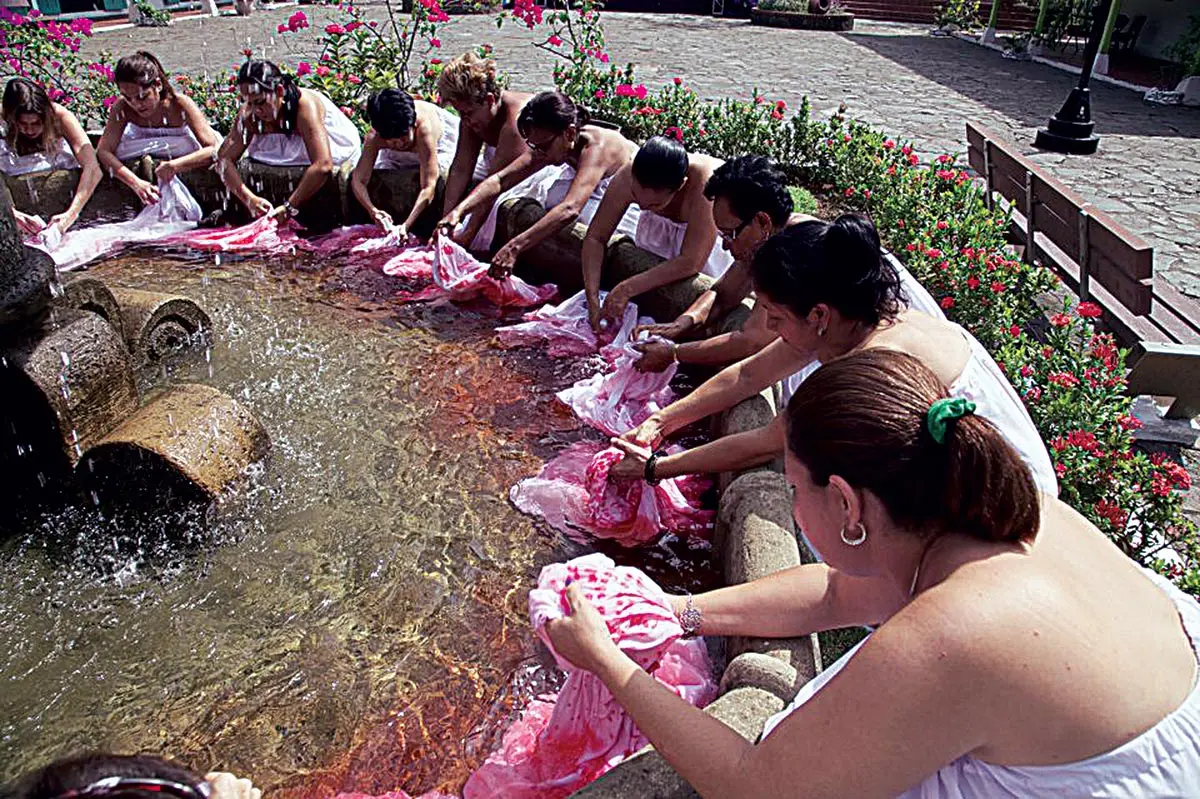
Moysés’ 2011 performance Diluidas em Água (Diluted in Water), at the Pinacoteca do Estado de São Paulo, is exemplary in that sense. The protagonists were women with whom Moysés had already worked in a shelter for abused women and who participated actively in the design of the public action. They were dressed not in wedding gowns, but in plain white tunics that brought to mind both a novitiate’s habit and a housemaid’s work uniform. They walked barefoot in the streets, and each carried in her hands a bar of white soap. Waiting for them in the gallery, arranged in a circle, were a series of washbowls filled with very clean water. Each woman stood in front of one of the bowls and took off her outer tunic, on the reverse side of which, traced in red crayon, were texts and drawings the women had created at the shelter to narrate the injuries and offenses suffered in their marriages—the reason for them to have fled their homes and sought refuge there in the first place. Then, they kneeled, soaked the tunics—a testament to their sorrows and suffering—and hand-washed them thoroughly with water and soap, using the same technique still commonly used by poor women across the world. At the end, when the tunics were clean and the water was red, the women stood up and marched off the same way they came.

This performance involved, in the first place, the consecration—or, if you prefer, the ritual exaltation—of a household task that is still regarded as exclusively female, as necessary as it is belittled. Beth Moysés has carried out the same dignifying operation with regard to the delicate craft of knitting in such memorable performances as Goteando (Dripping) and Transbordando (Transferring), to mention just two outstanding examples. Her sui-generis procedure is at once a ritual of exorcism and expiation: the suffering endured is invoked and exposed in order to make them vanish, just as the texts and drawings imprinted on the tunics vanished to leave the women dressed entirely in a clean, white robe (the one they wore underneath the first one) as they abandoned the scene, as so many women have done in the several restagings of this performance Beth Moysés has organized in other occasions, locations, and contexts.
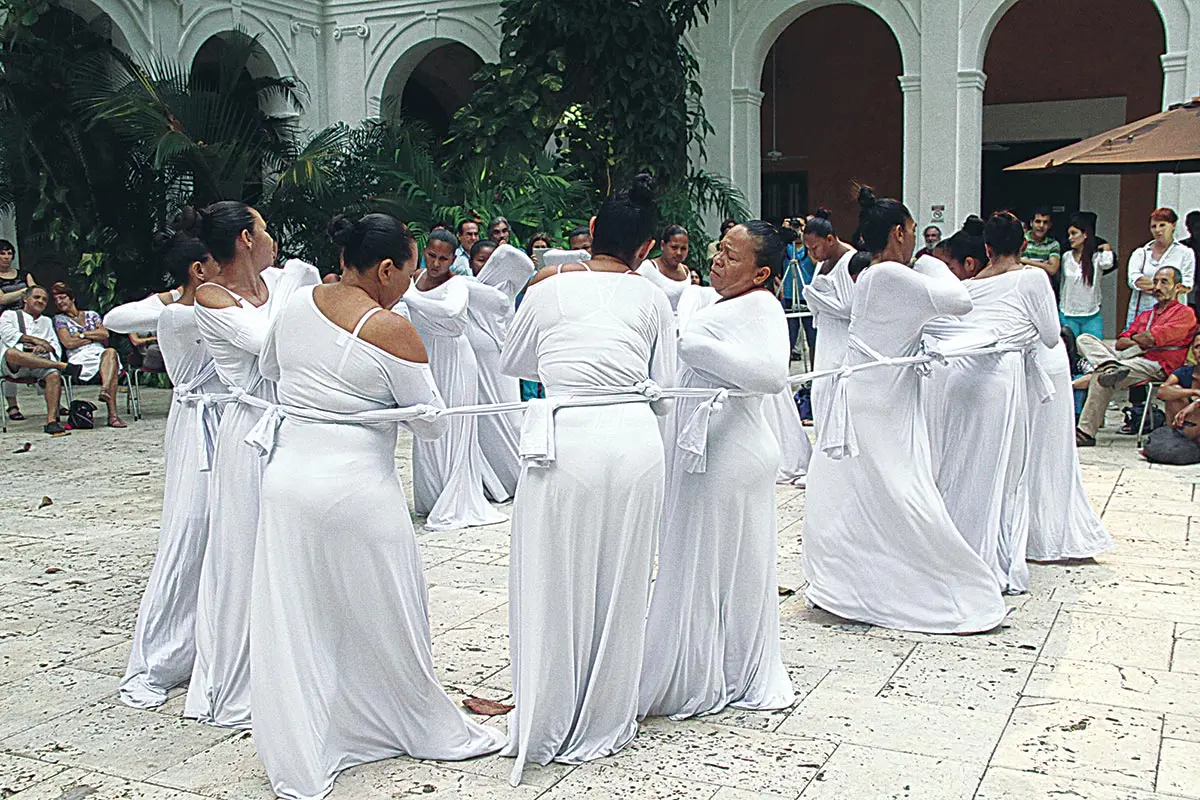
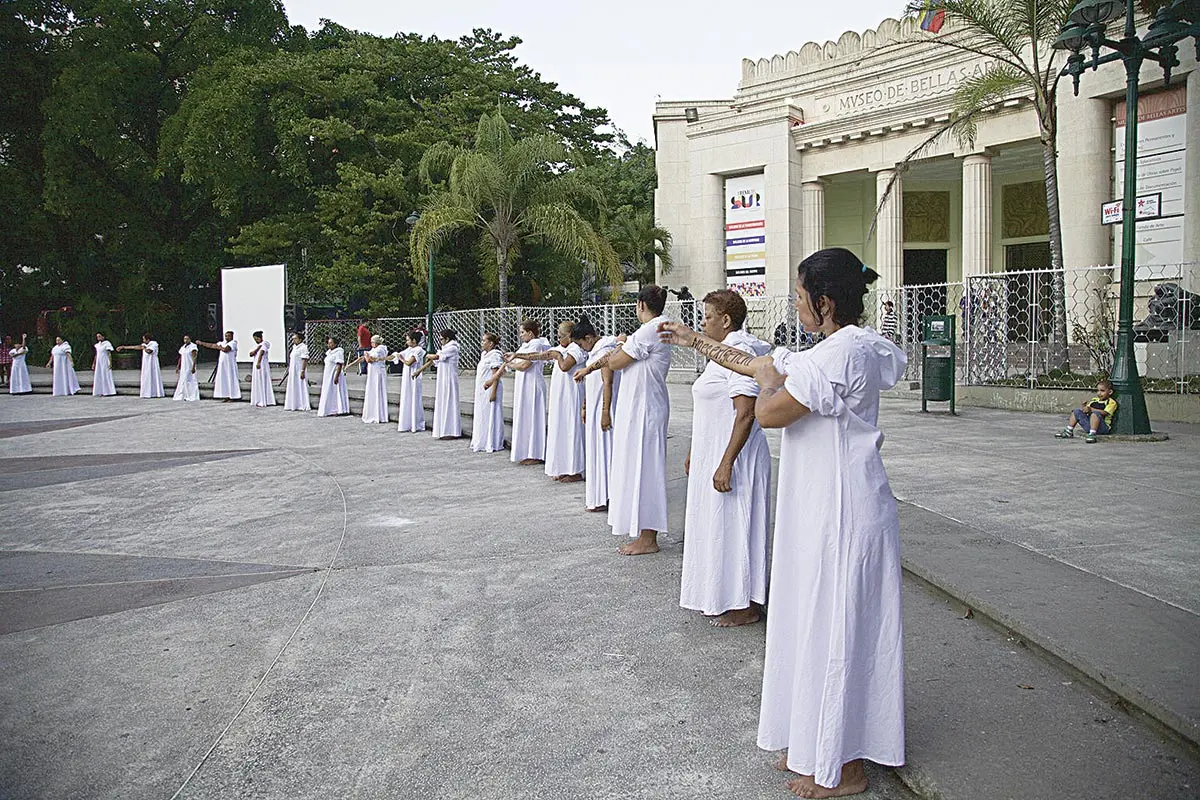
It must also be noted that this purification ritual involved a sacrifice: the sacrifice of the modesty with which the women in the shelter hid away from prying eyes, even from family members and close friends, the abuse they suffered at the hands of their partners. A bloodless sacrifice, but nonetheless a sacrifice of something that was entirely their own; it has been reenacted by the protagonists of performances like Desatar tiempos (Untie Times), at the 1st Cartagena Biennial of Contemporary Art, and Palabras anónimas (Anonymous Words), at the 1st Biennial of the South in Caracas, Venezuela. In the former, women paraded in public wearing white tunics with very long sleeves that rolled around their torsos like a straitjacket’s straps. The ritual consisted in breaking free from those bounds as a way of exorcising the bonds that kept them joined to their abusive partners. In Palabras anónimas, the women marched into the site to form a silent, gesturing chorus, rolled up their sleeves, and revealed phrases and slogans written on their arms that combined tales of their suffering with proclamations of their freedom.
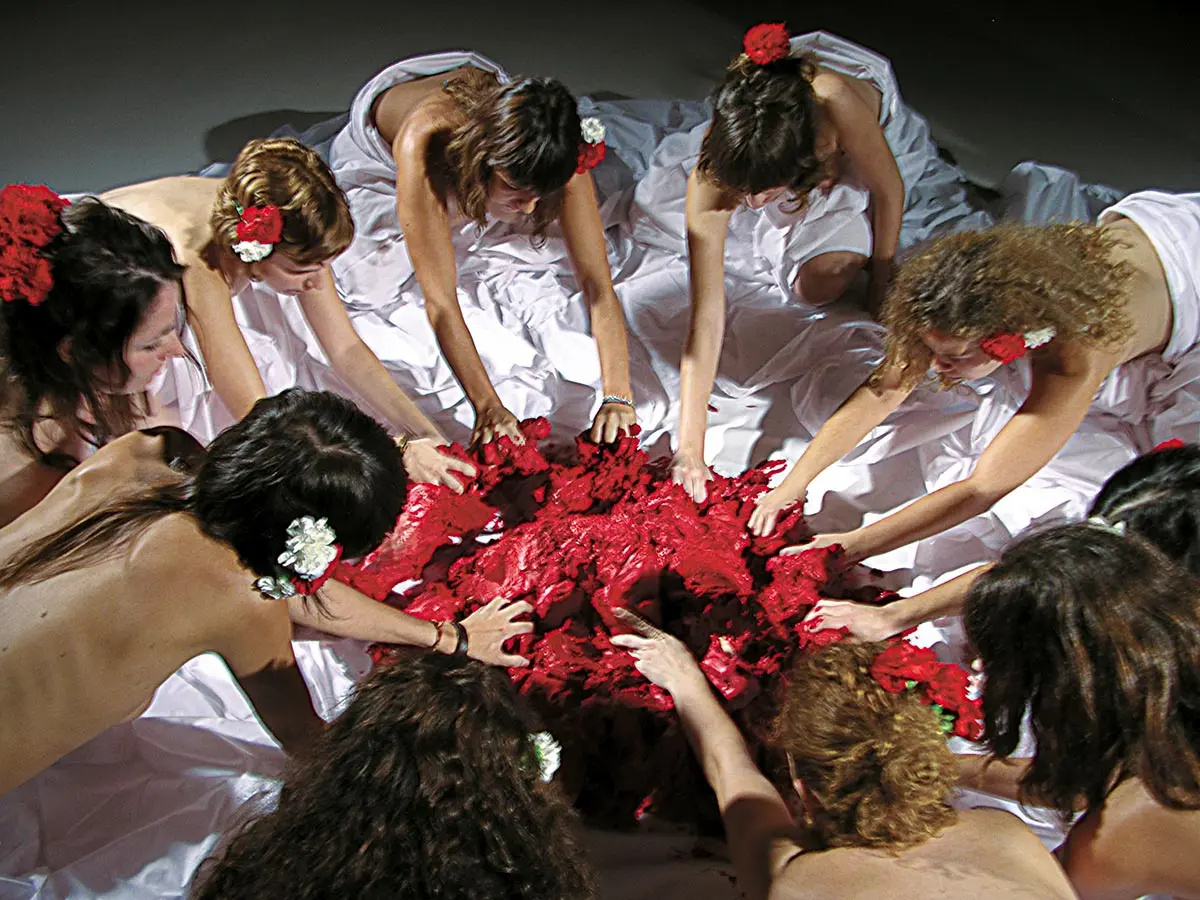
Finally, it should not go unmentioned that Beth Moysés has also critiqued the supposedly ungovernable passion invoked by the figure of the bride: love, another form of the sublime. Love’s incorporation into Christianity as a cult object was announced in the Middle Ages by Saint Mechtilde of Hackeborn and Gertrude the Great, and converted into an ethical and iconographic program by the Jesuits in the Seventeenth Century with the purpose of “enthroning the Sacred Heart in every household.” The Romantic Movement, however, transformed what for centuries had been a symbol of divine love into a symbol of worldly love—one that carries within the contradiction of simultaneously exalting and sublimating the physical. Beth Moysés has targeted precisely this contradiction in works that enact a bleeding heart or a heart modeled by women’s hands in blood-red clay, such as her admirable videos Corazón tejido (Knit Heart) and Lecho rojo (Red Bed).
CARLOS JIMÉNEZ
Art Historian and critic.