
The work by artist Carla Chaim (São Paulo, 1983) perfectly adheres to the maxim that form and meaning are inseparable. She tried this theorem in the exhibition titled Wave Collapse, a large installation specially created for the CCBB-RJ exhibition space, and in an intimist artist’s book. The exhibition is the result of Chaim’s participation in the last edition of the CCBB-JR and CCBB Contemporáneo Award.
Chaim relied on raw graphite powder to reaffirm the interrelation between form and content in the various facets of her artistic trajectory. Titled Colapso de Onda (Wave Collapse) like the exhibition, the installation was constructed with graphite powder. She used half of the exhibition room to “draw” a rectangle on the floor which turned 5 degrees on its axis and became a partial projection of its image onto the wall. With the help of a domestic strainer, Chaim dusted by hand 50 kilograms of graphite powder on a demarcated area. To apply the material to the wall, she invented a technique using a compressor to pulverize and attach the graphite.
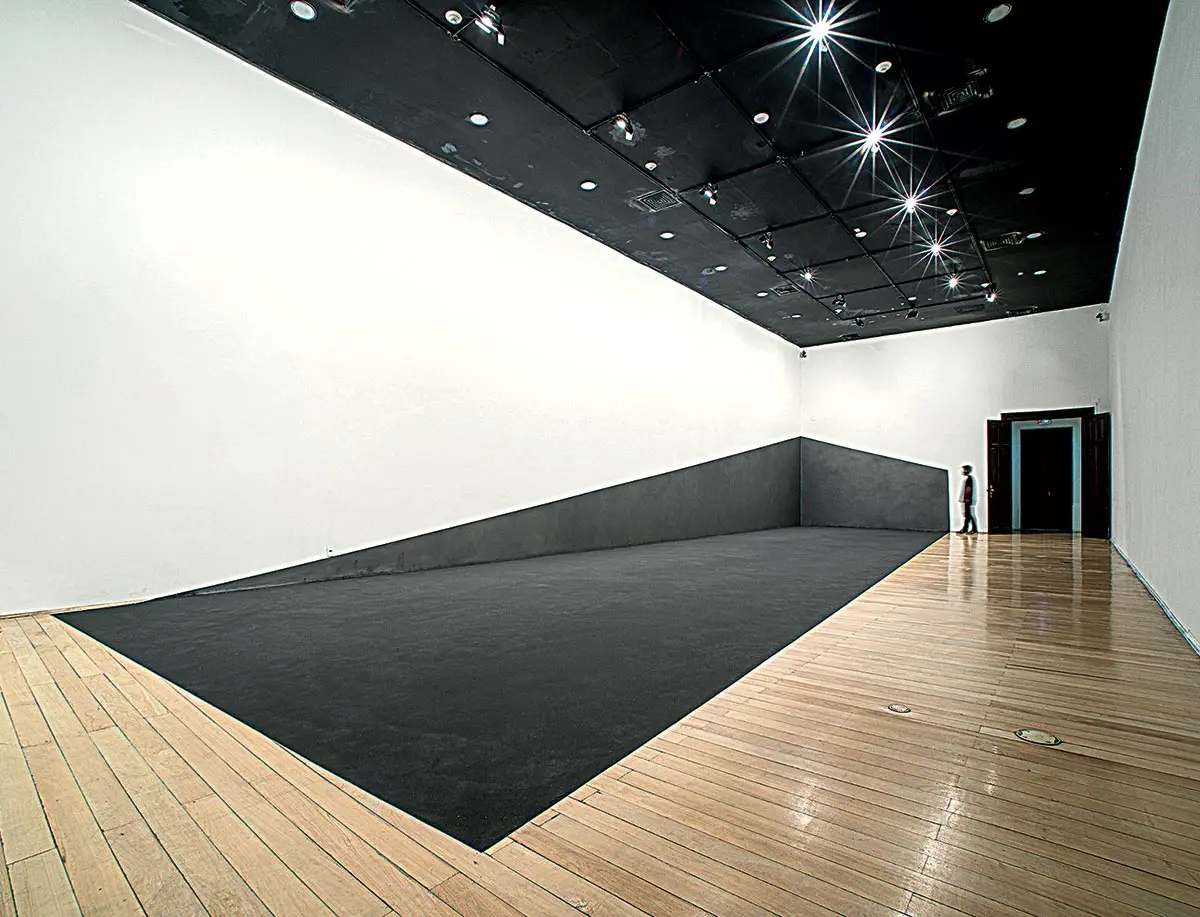
The work generated great impact because of the generous dimensions of the image, the dislocated effect caused by its form, and, above all, as a result of the dense texture rendered with the graphite. The artist added a contrasting element with the addition of a work-book titled Multiuniverso (Multiuniverse). Graphite powder was applied with cotton on its sixty pages. Then the pages were randomly folded to achieve different looking creases. When opened, the pages revealed different compositions. Five hundred copies of the original were scanned and then printed in an offset to be distributed to the public.
It could be said that graphite became an obsession in Carla Chaim’s work. It is an element that she has used throughout her career in different moments and applications: drawings, sculptural objects, and even on areas covered by powder, like in this exhibition. Above all, it reveals proposals that allude to meta-referential themes: the act of drawing, the relationship of action with the body and space, for instance. The choice of material is also intentionally in line with the chromatic spectrum of her entire oeuvre, in which predominant scales of black, white, and gray are revealing of this artist’s introspective and self-reflective nature.
Chaim’s choice not to use other colors was conscious and intentional. With a degree in Visual Arts from the Fundación Armando Álvares Penteado (FAAP), she has always drawn and painted in a systematic manner and explored different artistic languages. After many chromatic and figurative explorations, Chaim understood that her proposals needed other approaches—mainly influenced by her studies of Art History in a postgraduate course also at the FAAP.
Her work gained a deeper profile through the influence of conceptual art and minimalism. Aside from expanding the field of drawing beyond traces on paper, she also incorporated the body of the work itself, like in the video recordings in which she is shown drawing continuously, or in the photographs where she dialogs with geometric forms. Some of her series include drawings with grease bars on graph papers. To create the work, Chaim instinctively placed the bars on the elbow to draw shapes without using her hands, relying on the limited movements of her arms and torso. The result was a new type of mechanism for drawing that was transferred to a larger scale.
Speaking of geometric forms, they are always present in the work of Chaim, revealing dialogue with the constructivist currents in art. On the other hand, she actually proposes a new expansion of the aesthetic experience. It is as if she were in a constant state of derridean deconstruction, mainly by questioning the traditional way of drawing, considered—from the materials used to their dissection in the space—as an instrument to explore and reflect on the world. Despite the purist and non-figurative nature of her work, Chaim incorporates strong elements from the real world, like in the series titled Wet Nature (2009). To create this series, she dipped large sheets of paper in water and ink to obtain almost abstract landscapes in scales of gray.
The work Laboratorio de Dibujo/Experiencias Extra-Sensoriales Específicas (Drawing Laboratory/Specific Extra-Sensorial Experiences, 2009) was conceived during a medical consultation in which Chaim underwent a heart exam. During the ergonometric test, she was inspired by the machine producing a drawing from her heart palpitations. Later she produced a series of drawings based on electrocardiograms taken in different situations, like when running or walking. She also recorded these actions and edited the material to create non-figurative videos. The material was presented in an enclosed environment and with headphones, which gave spectators the feeling of being inside the artist’s body as they listened to her heart rate.
Despite all subtleties, the work of Carla Chaim, in the end, converges in common themes, sustained by a well-structured and coherent core. Her works irradiate a meaningful conceptual complexity: They convey a poetic that always turns in on itself in a constant state of self-analysis. Most of all, she speaks about the aesthetic-existential possibilities in the contemporary world.
ALESSANDRA SIMÕES