
Synesthesia is one of the fundamental resources of art. Opening a door and leaving through a window, or digging a tunnel between two rooms; the combination of two feelings that come from different senses.
Artist Cecilia Paredes (Lima, 1950) works largely from synesthesia. She combines formats and constructs a universe of her own making in which life experiences, historical memory, and subjectivity merge. The very title of the exhibition Listening with the Eyes at Tabacalera Promoción de Arte, clearly alludes to her intention to combine sensory perceptions. Running concurrently at Galería Blanca Berlín, the exhibition I Prefer a Hundred Flying than One in the Hand, also by Paredes, underscores the increasing presence of Peruvian artists in today’s art circuits.
The two exhibitions proved to be complementary. While the smaller gallery, Tabacalera Promoción de Arte, shows her smaller works, Galería Blanca Berlín, on the other hand, accommodates her larger proposals in its more generous space. Curators Alejandro Castellote and Blanca Berlín have done an excellent job at seamlessly integrating Paredes’s ethereal works into the industrial space.
In this sense, Manto (Mantle), the first work in the exhibition located in the nave by the entrance, is compelling: an installation made from coral fragments tied with wax wire. Scarce lighting gives the piece the appearance of a floating marine animal. Nearby, there is a table where the art and education group Pedagogías Invisibles invites visitors to deposit an object as part of an intervention within the exhibition. It is a ready-made that, by relying on autobiographical memories, is closely connected to the proposal by the Peruvian artist.
Three-dimensional works clearly represent one of the greatest successes of the curatorial proposal. Ucayalí alludes to the river in the Peruvian Amazon and consists of fourteen rainsticks activated by rotary engines. The rotation allows the sound of the internal percussion of the rainsticks to be heard without interruption. In fact, their sound is constant throughout the exhibition. In this manner, the proposal creates an enveloping, vegetal, and dense atmosphere that is set in contrast to the cold temperature and vast industrial architecture of Tabacalera. Incidentally, visiting the exhibition during the late afternoon and in the middle of winter in Madrid adds corporal qualities that are pertinent precisely because of their contrasting qualities.
Something more evident but extremely visual is the piece titled Migración (Migration). It consists of seven ships made with wire that hang from the ceiling. Their shadows are projected onto the floor and, here too, there is an effect of estrangement, of a half-told story, of perception from the depths of the sea.
The photo-performances En Tus Alas (In Your Wings), Paisaje Azul (Blue Landscape), or Ruta del Bambú (Bamboo Route), among others, introduced a different format: photography applied to bodypainting actions in which the artist is camouflaged with the background. Another fundamental aspect of the exhibition is also present in this series: theatricality, that is to say, the ability to generate representation. As in Armadillo or Papagallo, the artist is the woman portrayed metamorphosing into different figures. It should be noted that in Cecilia Paredes’s work there is something that stands out from the mere subject matter: the strong presence of the aesthetic material. There is something pictorial, even physical, in her works.
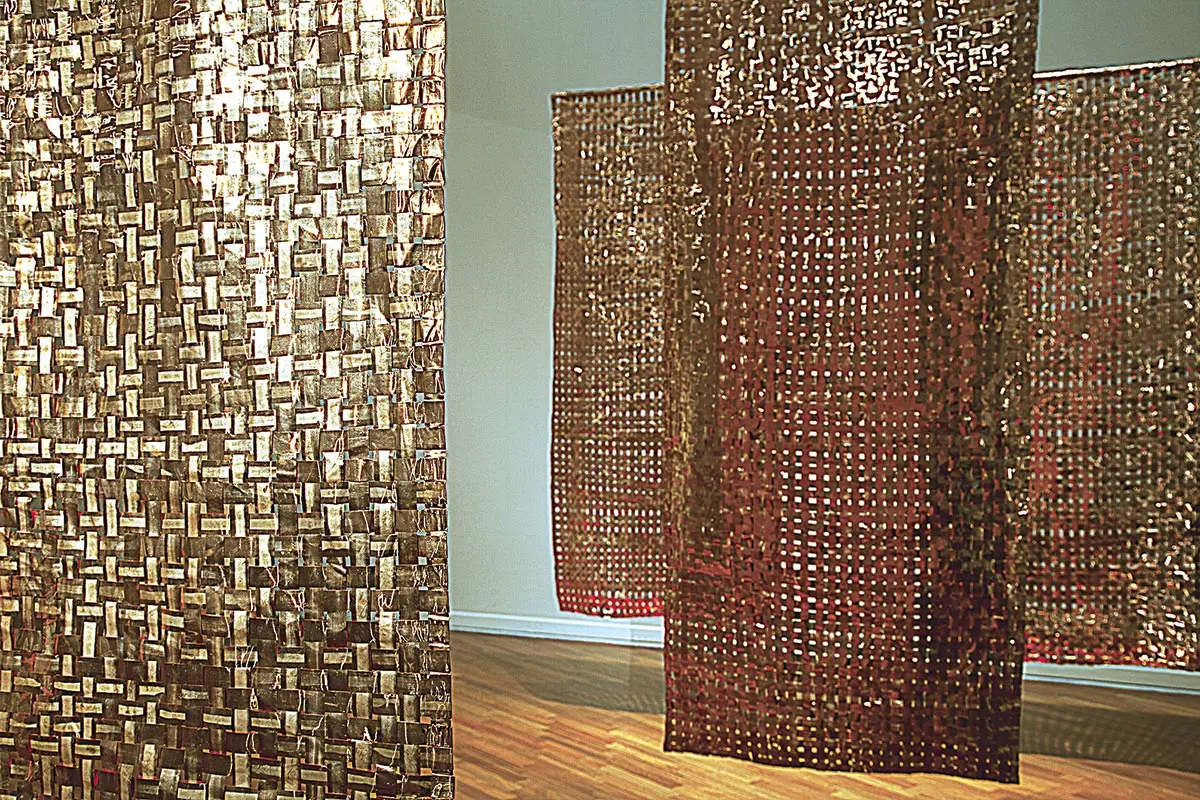
From a more emotional perspective, the works Plegaria (Prayer), El Deseo (Desire), and La Culpa (Guilt) are constructed like large scenic installations in which viewers become part of the suspended alienation. The piece titled Habitación (Room) features large copper panels that reference, on the one hand, the fourth Inca emperor Atahualpa and, on the other, the main material exported from Peru. Metaphorically, the work also speaks of the precarious conditions in which the miners are immersed. A topic increasingly addressed by Peruvian artists because of its paradoxical implications.
Unlike the large pieces shown at Tabacalera Promoción de Arte—the more performative and sculptural group of works—the Galería Blanca Berlín presents Paredes’s two-dimensional works of smaller dimensions. Of course, both exhibitions shared some thematic elements: mythology, metamorphosis, ornamentation, and memory. Examples of this can be found in works like All Together Now II, Aracne (Arachne), and Todo Pasó tan Rápidamente (All Happened so Quickly). But at the Galería Blanca Berlín the narrative and fragmentary elements are more present, almost like in Kiki Smith’s work. In this manner, Paredes relies on collage and weaving techniques that confer a more hand-made and intimate feel to her work. Animal iconography, particularly solitary animals, is something that the artist closely identifies with.
Also present at Tabacalera Promoción de Arte are the children’s costumes so characteristic in her work—which speak of the small scale and the family genealogy that interest Paredes: the female world, costumes as a vehicle for intimacy, as “habit.” She combines different materials to render them. In the work Mímesis, for instance, organdy is interwoven with porcupine spines.
The exhibition at Galería Blanca Berlin also includes cartographic themes like the politics of space. The pieces Migración (Migration) and Inmenso Mar (Immense Sea) reveal Paredes’s interest in approaching the notion of the foreign from the perspective of an almost “liquid” and sensorial subjectivity.
The work by Cecilia Paredes is ultimately an attempt to reclaim personal experiences through materials and the perception of the body; volatile synesthesia that nonetheless works.
ANA FOLGUERA