
An exhibition of works by the young Cuban artist Diana Fonseca opens the 2016 calendar at Sean Kelly Gallery, along with another solo show by the prematurely departed Belgian artist Ilse D’Hollander. Both exhibitions coincide in revealing for New York audiences the work of two talented female artists from different geographical and cultural regions, whose respective productions diverge but may also be seen to come together in the way they are marked by subtlety and possess strong suggestive powers.
Diana Fonseca’s exhibition occupies the gallery’s front exhibition space and its lower level. It is a selection of works that illustrate the artist’s explorations in recent years, which have made her into one of the most solid and interesting female voices in Cuba’s contemporary visual arts scene, albeit one whose international recognition is only starting to come now. Indeed, this show at Sean Kelly Gallery is her first solo appearance outside Cuba.
Sculptures, installations, videos, and paintings alternate in the two spaces occupied by Fonseca’s exhibition, allowing viewers to discern the main characteristics of the artist’s poetics. Her videos Pasatiempos (Pastimes, 2004), Caminando por La Habana (Walking in Havana, 2007), Los amantes (The Lovers, 2007), and Ausencia (Absence, 2015) illustrate not only a sustained trajectory in the medium but also the effectiveness and coherence with which Fonseca uses it. In the first two of the works mentioned, based on childhood diversions like sewing on the most superficial layer of skin in the palm of one’s hand, or playing with our index and middle fingers as though they were a human figure walking, Diana Fonseca signals in the directions of topics that impact her own reality: the surrounding environment, the city, the aspirations or dreams of a society immersed for decades in material precariousness. These meditations are also manifest in the paintings on exhibit, all dated in 2015. These are collages where layers of paint taken from Havana walls and façades overlap. The title of the series Degradaciones (Degradations) establishes a semantic ambivalence in reference to both chromatic effects and to the real drama of the decay and blight suffered by architectural spaces in the city (and the country), as well as the material and symbolic structures upon which society functions. Degradation is present, unfortunately, in every realm of life on the island.
One work that synthesizes, in a way, all these explorations is Ausencia (2015), which connects painting and the moving image. It is a video performance in which the artist paints tiny plants in blue; as they are colored, the plants fuse into the sky behind them, leaving behind only a stalk in its original color, contrasting with the background. This is an image of loneliness and the sense of loss caused by absence. And I can’t avoid thinking about the generations of Cuban migrants who dissolve into the sky and disappear from view, leaving those who remain with the feeling of being a minority left behind in the emptiness of physical and emotional space, the profound feeling that gives the video its title.
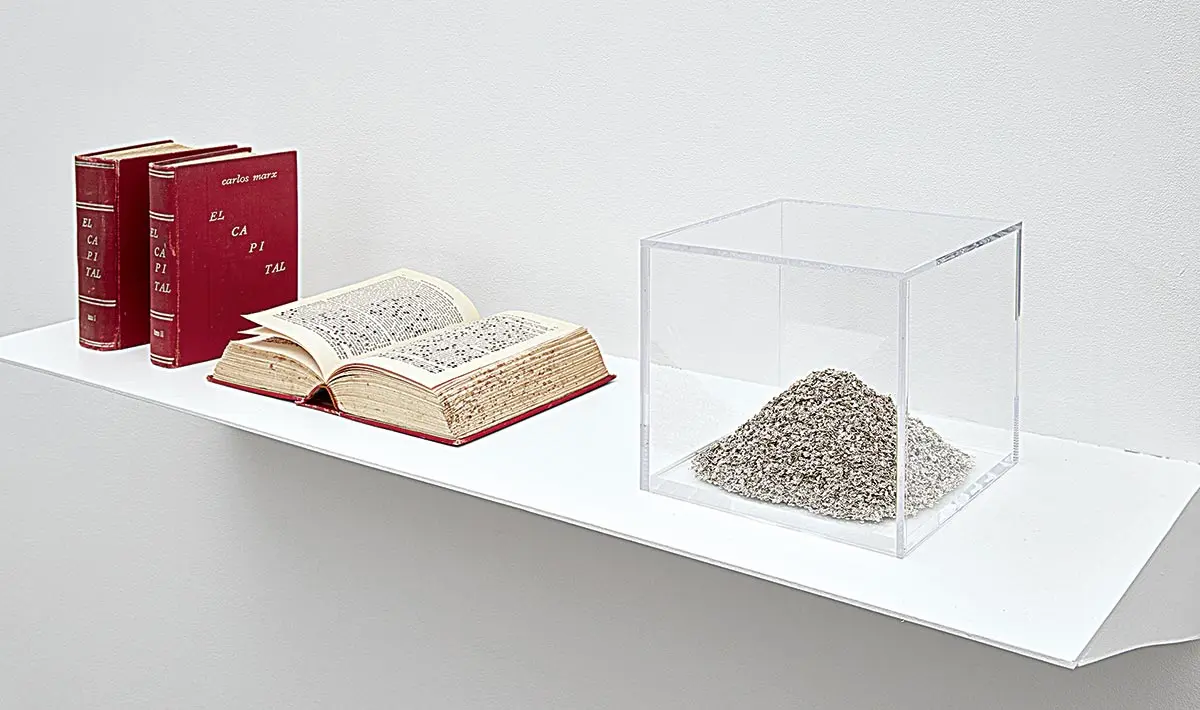
With equal doses of lyricism and sharpness, Fonseca produces commentary on the ideological realm by intervening the three volumes of Das Kapital, the book that is at the core of the Cuban socialist project. Like a mischievous prank, the letter “o” has been taken from every page of the book and piled up like confetti, leaving behind a series of holes, zeros, empty spaces. The result is as unintelligible and disconcerting as the system that the ideas contained in the book helped create.
Literature also serves as a springboard for the representational games established in Simulación y simulacro (Simulation and Simulacrum), a video installation that immediately refers us to Jean Baudrillard’s famous opus Simulacres et Simulation, which develops a theory of contemporary culture and of the postmodern era on the basis of its titular concepts. Fonseca articulates a playful dialog with her source and proposes a delightful landing of the experience of simulation in the realm of the everyday. In this case, a functioning fan blows on the pages of Baudrillard’s book; the interesting thing is that it is not a copy of the book, but its simulacrum, the projection of a pre-recorded video of the pages moving in perfect time with the air coming from the fan. In the end, what does it matter in today’s world whether things are physical or virtual, fictional, or true?
This is how Diana Fonseca reacts to the stimuli of her own reality, which she transforms into poetic images with a minimal, subtle gesture, sometimes in a tone of naiveté, sometimes in a nostalgic vein, but always with the lyricism and the freshness of a seductive game.
MEYKEN BARRETO