
During the second half of the nineteenth-century landscape, painters expressed a great fascination for the symbols of the Industrial Revolution that affected the environment. Artists began to document the battle that man waged against the natural world with the intention of containing, exploiting, dominating, and subduing it to his will. Steel bridges, factory chimneys protruding like new churches, and steaming trains pushing through dense forests, became modern observations of the progress that gradually conquered ancient landscapes. Accelerating time through images that speak of the impact of mankind in nature until today, the exhibition titled The Impossibility of the Landscape counters the idea of that supposed pro-human and anti-natural progress. The series of works by Edwin Monsalve (1984, Medellin) presented in this exhibition speak of the lost battle between progress and nature, which today is referred to as the environment.
As it is usual in his works, the artist from Antioquia places us face to face with extinction and the damage mankind causes to the natural resources. But in other exhibitions such as Rehabilitation Room and Prototypes for a Restored Nature, Monsalve contrasts that death which already occurred, or which is about to occur, with an act of creation, of resurrection that attempts to bring life at all cost; if not as a long-term remedy at least as a poetic and redeeming act that responds to the need to take action. Thus, for example, on other occasions, his work included trees that underwent a process of rehabilitation for the duration of the exhibition. In The Impossibility of the Landscape, however, we are confronted with a series of works that reflect on the impact of continuing to live in an economy dependent on fossil fuel. Graphically, almost schematically, Monsalve renders oil spills at sea as the vehicle to deliver his message.
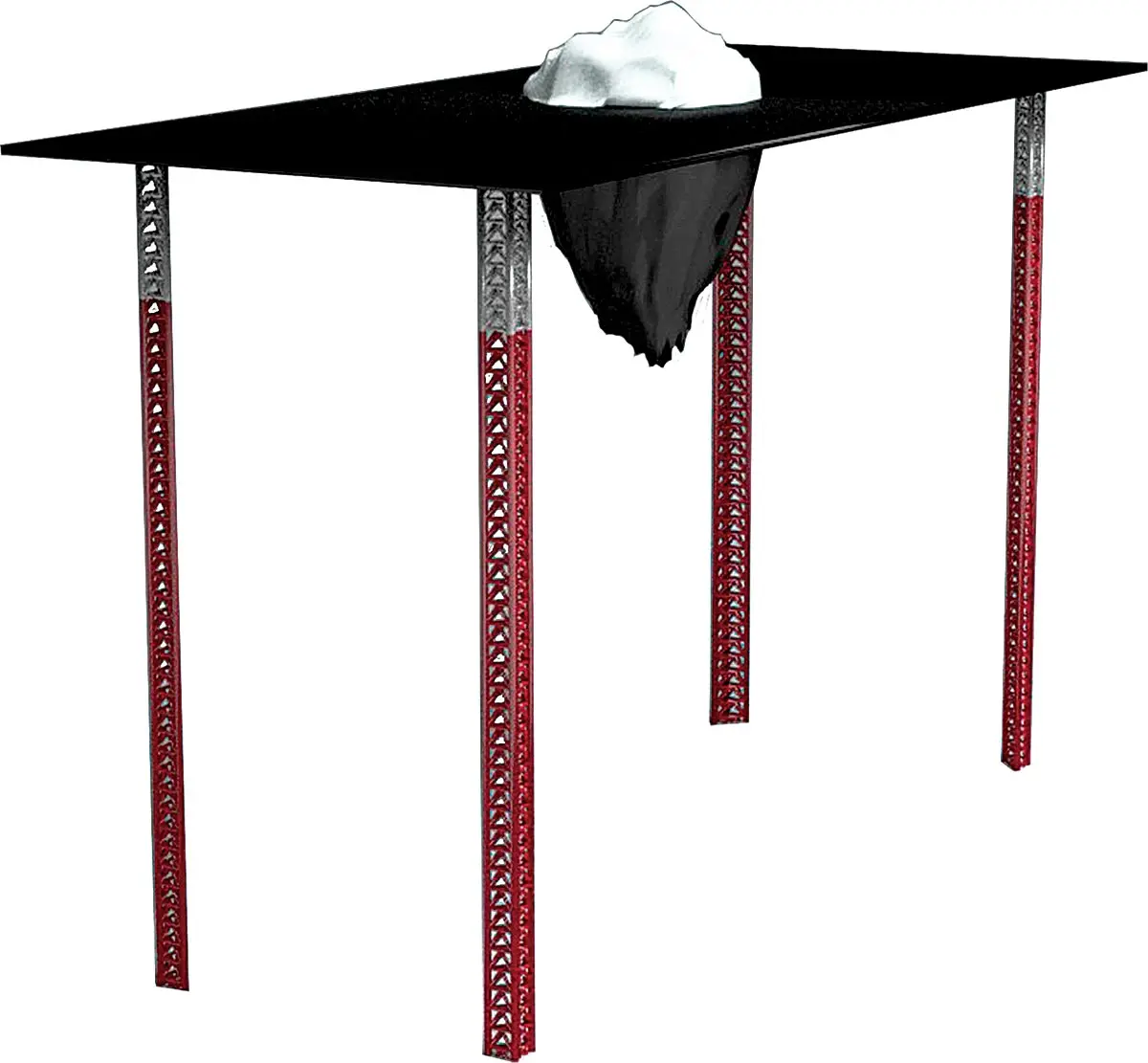
In The Impossibility of the Landscape Monsalve reveals with sharp and objective visual language the crevices of a natural disaster that we are forced to witness from the distance as a result of the works’ scientific-like approach. As if it were the large mockup of a landscape designed a priori, but dystopian in the reality and coldness of its execution, we observe the white tip of an iceberg floating on a sea of reflective oil—inspired by the piece titled 20/50 by British artist Richard Wilson—supported by the structure of an oil drilling platform with the black underlying element beneath. In the polyptych Sin Título (Untitled), the presence of a natural element that watched over the hope of life is replaced by the use of actual oil—extracted from an oil field in Carmen de Bolívar—with the intention of transforming the support into an open and unknown manner. As a metaphor for the impact of oil spills in the environment, and therefore in our lives, Monsalve invites us to witness a process of destruction that leads us to another form of awareness based on a real alert rather than on hope.
An inevitable certainty resulting from mankind’s actions, the drama of the ocean polluted with oil is not overt. Nevertheless, it becomes explicit through the visual reflection of a landscape already intervened and transformed that disintegrates in front of us as if we were witnessing just another statistic. Suffocated by the tone of the exhibition, the real drama resides on three key points found in the two works already mentioned: in the reflection of the oil-covered ocean turned into a mirror, an altermodern vanitas that absorbs our presence; in the black tip of the iceberg hidden under the sea and screaming the reality of the disaster; and finally, in the actual and locally sourced oil, which will gradually transform the original media, making it impossible to return to an origin whose essence can only be recorded in the memory of the photographic record. Elements that once symbolized progress and another battle won against nature are today considered harmful artifacts that are gradually destroying the landscape, denying the very possibility of its existence. In the world created by Monsalve, the consequences of natural disasters are presented as points of departure for the transformation of the landscape. That which we fear is not a future event but something that has already occurred. In this sense, his work reads like a stern wake-up call about the path that we have all decided to take and must confront as we immersed ourselves in the reflection of an ocean of black gold.
CARIDAD BOTELLA