
“Bryce puts history on display; when he copies, he questions,” wrote Andrea Giunta a year ago.1 In the late 1990s, Fernando Bryce (Lima, 1965), then living in Berlin, began to copy historical archives in black-and-white ink drawings; he gathered images from the press, popular propaganda, museums, and libraries, presenting us with a new mode of representing historical memory. Bryce interrogates history, yes, and he does this to the degree that he actively involves the present—the present—in narratives that are held back, denied, or ignored by canonical modernity in the service of its own political, social, and economic motivations. In this way, bringing back into the museum and the gallery, in the shape of hand-made copies, documents from a different era, is not in Bryce’s work an exercise in visual archeology intended to fill in the gaps and to reconcile dominant subjectivities with their blind spots. To put it another way, this is not a literal restoration of the speech of subaltern subjects in the context of the historical narrative of Capitalism, as announced by Gayatri Spivak in her celebrated 1985 essay “Can the Subaltern Speak?” in order to describe contemporary society. On the contrary, Bryce—who moved to New York last year—assumes the standpoint of a decolonial option that investigates the complex histories of domination and subversion (and also of restoration) of the colonial system in Latin America and other so-called Third-World regions in the Twentieth Century, in order to construct a present that exists only inasmuch it interacts dynamically with its past. Thus, the dominant geopolitics’ power to write and disseminate a universal history is placed under siege time and again by an artist who insists, playfully and effectively, on a visual poetics he has dubbed “mimetic analysis.”
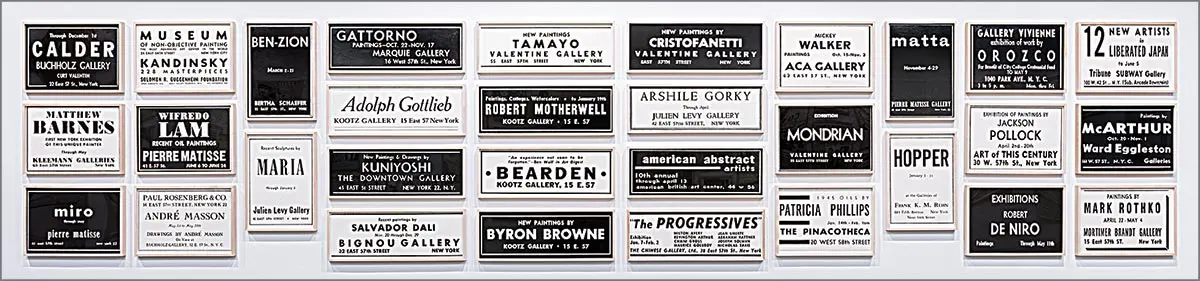
Between November 14th and December 19th, Alexander and Bonin Gallery exhibited three new series by Bryce, all dated 2015. Raising lucid questions around the concepts of abstraction and humanism, Bryce once again questions a number of “universal” historical constructs, based on documents of the immediate postwar years. His series Atlas Perú, created in 2000 and 2001, is well known for revealing, in nearly 500 drawings, the absurd contrasts that traverse Peruvian history between the 1930s and the turn of the Twenty-First Century. In his exhibition at Alexander and Bonin, Bryce focused on a narrower temporal band, the second half of the 1940s and the first half of the 1950s, and a geographic triangle involving Paris, New York, and Buenos Aires (rather than the Lima of Atlas Perú), the Latin American city that already in the 1920s artists and writers like Xul Solar and Jorge Luis Borges had represented as a modern metropolis. So, what are the universal history, the grand narratives, and the modern events that came after WWII? What is to be remembered alongside the Allied victory and the start of the Cold War? The birth of such categories as First and Third World, for example? The triumph of abstract art? Is not the constrained, hierarchical response to these questions that the artist puts in front of our eyes, precisely his “mimetic analysis”? A clue in favor of this last possibility can be found, first of all, in Bryce’s choice of fast-drawing technique to copy the original painstakingly (albeit shakily) and moves away from any painterly intent—or, more precisely, from historical painting, which “proposes a series of rhetorical practices connected to prescriptive functions such as commemoration, virtuous example, and pedagogy.”2 There is no commemoration of universal history in Bryce’s work; there is, rather, a signaling of it as an “impossible genre,” in this case in the postwar context. Thus, in the series The Book of Needs, which comprises 81 drawings of articles published in UNESCO’s Courier magazine between 1948 and 1954, Bryce examines the formation of the independent UN agency that since 1945 has proclaimed universalist and humanistic ideals in connection with culture, education, and science. In turn, the series Arte Nuevo (New Art)—which reproduces in serigraphy 28 photographs from the journals d’Aujourd’hui (Paris), Arte Nuevo (Buenos Aires), and Ver y Estimar (Buenos Aires)—and ARTnews 1944-1947—drawings of advertisements for exhibitions in famous 57th street galleries in galleries—tells the story of the institutionalization of abstract art and its new formal avenues in the postwar period, noting how it was a “universal” response to the trauma of WWII and the start of the Cold War. In sum, this second exhibition of works by Fernando Bryce at Alexander and Bonin (his first was in 2011) was a thoughtful and playful presentation that invited viewers to take their time in reading and analyzing documents, connecting and participating with their copies; it was a moment to reflect on contemporary art’s oft-mentioned archival practices, but one that, being all copy, involved Latin America’s contingent critical discourses.
NOTES
1. Andrea Guinta, ¿Cuándo empieza el arte contemporáneo? (Buenos Aires: arteBA, 2014), p. 31.
2. Fernando Bryce: dibujando la historia moderna = drawing modern history. Tatiana Cuevas y Natalia Majluf, eds. (Lima: Fundación Telefónica: Museo de Arte de Lima - MALI, 2012), p. 230.
FLORENCIA SAN MARTÍN