
The Museo Universitario de Arte Contemporáneo (MUAC) presents for the first time a survey of Grupo Proceso Pentágono approached as a retrospective reinterpretation of the group’s artistic production and their internal work dynamics during different periods.
Active between 1976 and 1985, with some sporadic interventions until 1997, Grupo Proceso Pentágono was formed by Mexican artists who pioneered “Los Grupos,” a movement that emerged in the late seventies and during the eighties, characterized by the collective work of creators who emphasized experimentation and social criticism.
The group was initially formed by Felipe Ehrenberg, Carlos Fink, José Antonio Hernández, and Víctor Muñoz-Amezcua, in response to an invitation by Helen Escobedo to participate in the 1977 10th Biennial of Young Artists in Paris. Serving as the Biennial’s curator for Mexico at the time, Escobedo felt that it would be more representative to invite art groups with a consistent discourse than individual creators without it.
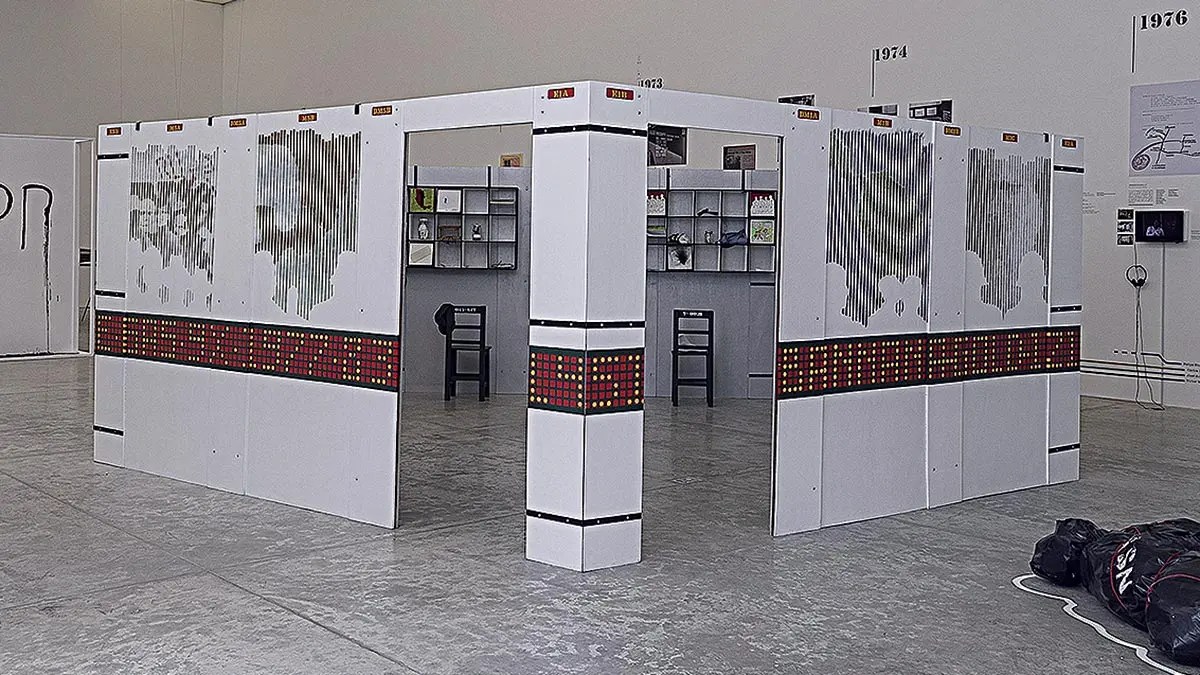
At the Biennial, Grupo Proceso Pentágono exhibited an installation of a critical nature. It consisted of a five wall room with objects that alluded to the political processes and torture that took place during the Dirty War in Latin America. The group participated in the biennial along with some other groups of the time like Suma, TAI, and Tetraedro.
Subsequently, the five founding members were joined by Carlos Aguirre, Miguel Ehrenberg, Lourdes Grobet, Rowena Morales, and Rafael Doniz. Eventually, other national and international artists also joined, strengthening a network of experimental artists who were in contact during a decade marked by strong processes of repression and dictatorship.
Grupo Proceso Pentágono worked on research and experimentation based primarily on action art and non-objectualism as a means to make a critique of the cultural and artistic system in Mexico after the events of the late 1960s. Likewise, their criticism focused on trying to generate an opening for new artistic forms of expression. Thus, the group developed a strategy of resistance through works that addressed social and political issues both in Mexico and Latin America.
Their subversive approach was mainly manifested through the use of materials outside of the traditional medium of painting and the use of public spaces as alternatives to institutional venues. Through environments, installations, and graphics, the work by the Grupo Proceso Pentágono resignified the artistic practice of the time, made collective creation viable and jumpstarted artistic activism conceived as an instrument for denunciation and social transformation.
In this manner, Grupo Proceso Pentágono participated in several institutional and independent events such as the 1979 Annual Experimentation Section of the National Salon of Fine Arts Exhibition organized by the National Institute of Fine Arts, as well as the First Latin American Art Colloquium of Non-objectual and Urban Art, held in Medellin (Colombia) in 1981.
The significance of this exhibition lies in the assessment of a group whose research work and political positions prompted the creation of the Frente Mexicano de Grupos Trabajadores de la Cultura, to which several groups of artists from the 1970s were incorporated. Similarly, the group represented a departure from the status quo of the time because of their criticism of the repressive policies of the state and their oppositional discourse.
This somehow not only had a political impact but also helped lay the groundwork for the emergence of a Latin American brand of conceptual art in which the process and the reflection generated by the work—always in connection to politics—became more important than the work itself. These new strategies led to the incorporation of other artistic approaches like performance and installation.
Curated by Pilar García, the exhibition takes a retrospective look at the creation of the group and charts a chronology of the works that it created--over 32 between 1969 and 2015—as well as the participation of its members. The survey addresses a prolific production in the continuous pursuit of artistic meaning conceived to contribute to the reflection during turbulent political times in the history of Mexico.
The figure of a human body on the ground, tied and laying on top of a black bag outlined in white like in a crime scene, refers viewers to kidnapping and torture. This and other pieces included in the exhibition are a compilation of the works by a group whose discourse, forty years later, continues to be pertinent in the current political context.
This revision also presents documents from the Fondo Proceso Pentágono that are part of the collection of MUAC’s Documentation Center illustrate the aesthetic discourse and activist nature of the group, which emphasizes new forms of presenting the works, their circulation, and interaction with the public.
ISAURA RUIZ