
BREYNER HUERTAS
For Hugo Zapata (La Tebaida, 1945), the stone has many meanings, among them their being the planet’s memory, like the writing of the time. At the time Zapata, who is associated with pure formalism, won First Prize for sculpture at the 32nd National Artists Salon with Geografías (Geographies), audiences and critics saw in his work an allusion to material for its own sake; in other words, that the aesthetic values of slate and iron were “simply” their being slate and iron. For José Hernán Aguilar (El Tiempo, February 18, 1989), Geografías revealed a “cold and depersonalizing formalism.”
Today, looking at the selection of works on exhibit at Museo Rayo, in Roldanillo, what we notice is a contradiction with regards to sculpture; although still connected to formalism, Hugo Zapata alludes in his works to symbologies and allegories. It is as if our contemplation had to move from one extreme to another—from muteness (the rock is the rock) to representation (lutite, the material rock, is a mountain range). Both extremes could mean an impasse or a dead end.
Certain properties of the works, having to do with material conditions, escape the artist’s allegories. For example, the sparkling black color of the inside of a lutite rock, sculpted by Zapata with the purpose of magnifying the hidden side of the stone, is the same black color that allows us to think that his work Cordillera (Mountain Range) looks like mountains in the night in a plane with barely identifiable dark hues. The titles direct our attention to images and concepts the artist considers relevant to his work, even if on occasion these are seemingly simple associations, as is the case with Ciudad (City), a sculpture of small slate blocks that alludes, with its grid structure, to a city’s projection, which seems to betray the stone, since the original shape of the sediment is chaotic. In Ciudad, the entire evolution of the rock has been rationalized into rectangular cuts at different heights, a condition of civilization.
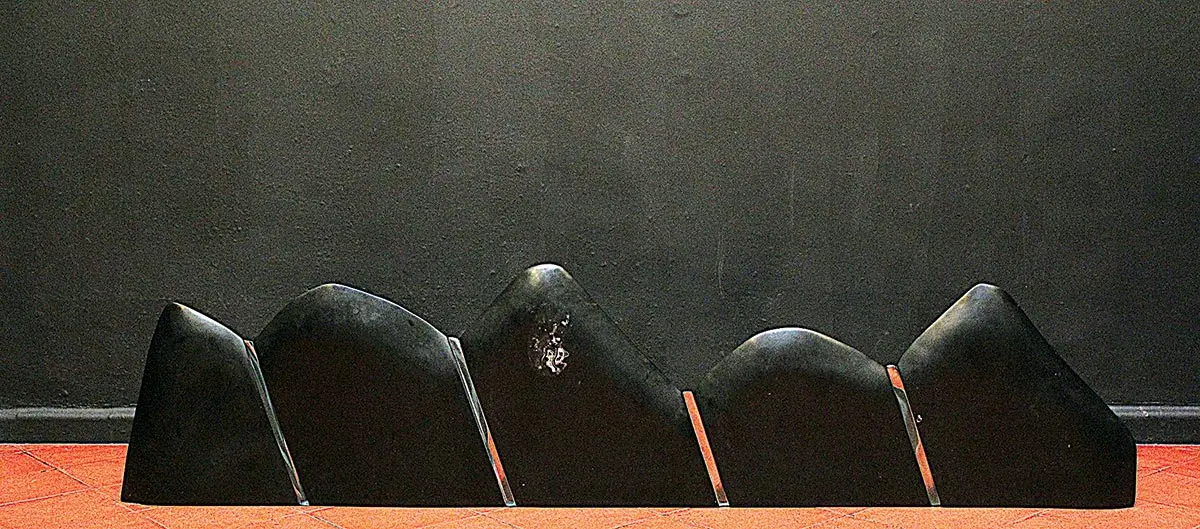
Two states of the rock come into conflict, its natural state, and its artificial state after Zapata’s intervention. The inside of the lutite stone, which is black, comes outside alongside fragments that preserve the original surface. In Afloramientos (Outcrops) and Testigos (Witnesses), the heads of the monoliths are testaments to that. It is important to take into account this clash of presences in Zapata’s oeuvre, as the issue if connected to the swaying view of his work as “formalist” and allegorical. Zapata’s work goes from one posture to the other, since the importance of sculpture encompasses both the origin of matter and the history of its manipulation.
In an interview, Zapata told the story of a physician friend of his who has one of the artist’s sculptures in his office and one day decides to take it home. He immediately notices that his office is no longer the same. I think that the mass of Zapata’s stone is commanding, their black color gives the object great depth and allows it to absorb our gaze as well as our thought. Both in everyday spaces and in exhibitions, Zapata’s sculptures are like black holes that gulp down the obliqueness of our attention and impose their presence with hidden power. This energy has to do with the vibration between natural matter and artificial sculpture (natural and allegorical conditions), where the artist teams up with time in order to sculpt his objects. If rocks are the writing of the time, Zapata’s work is a kind of poetic and human editing of an original text.
Most of the works featured in the Museo Rayo’s exhibition are in lucite, with one exception in slate (Ciudad). Works like Afloramientos, Flores (Flowers), Cascada (Cascade), Cenotafio (Cenotaph), Testigos, and Cuna (Cradle) encompass large volumes and rise like enigmatic monoliths that seem to possess, in their darkness, a yet-to-be-revealed potency. Perhaps this potency has to do with the accidental character of rocks; be it in the act of collecting pebbles (which Zapata does since he started his career as an art student) or picking up a rock from the river to crush bananas, each is a unique and spontaneous natural item, contrasting with their strangeness and indifference with the sites of human habitation. Hugo Zapata’s sculptures, then, transform the strangeness of the rocks and domesticates their indifference. The wild shape is polished to an almost unreal shine, which is precisely what gives it its degree of sophistication (sustained by the artist over time, it is more than a fashion). Perhaps humans have always felt towards the rock the same attraction we feel for things that exceed us with their history. Hugo Zapata says that his sculptures reveal the underlying landscape of the world.