
The title of the recent exhibition One Sentence with Three Sides, presented at the Galería Nara Roesler, proposed a new approach to the trajectory of Marco Maggi, an artist recurrent in his creations and a proposer of perceptive intervals and dissonant expectations for the exhibition space.
Once again, an exhibition by this Uruguayan creator suspended the normal state of time, creating—through the composition of intimist minimal structures—a variety of narratives composed with fragments of papers like reconstructed stories, through silent maneuverings, insinuating a slow visual reading.
The sole representative of the Uruguayan pavilion at the most recent Venice Biennale, Maggi masterfully created a montage of innumerable millimetric figures that were similar to the project exhibited at the gallery.
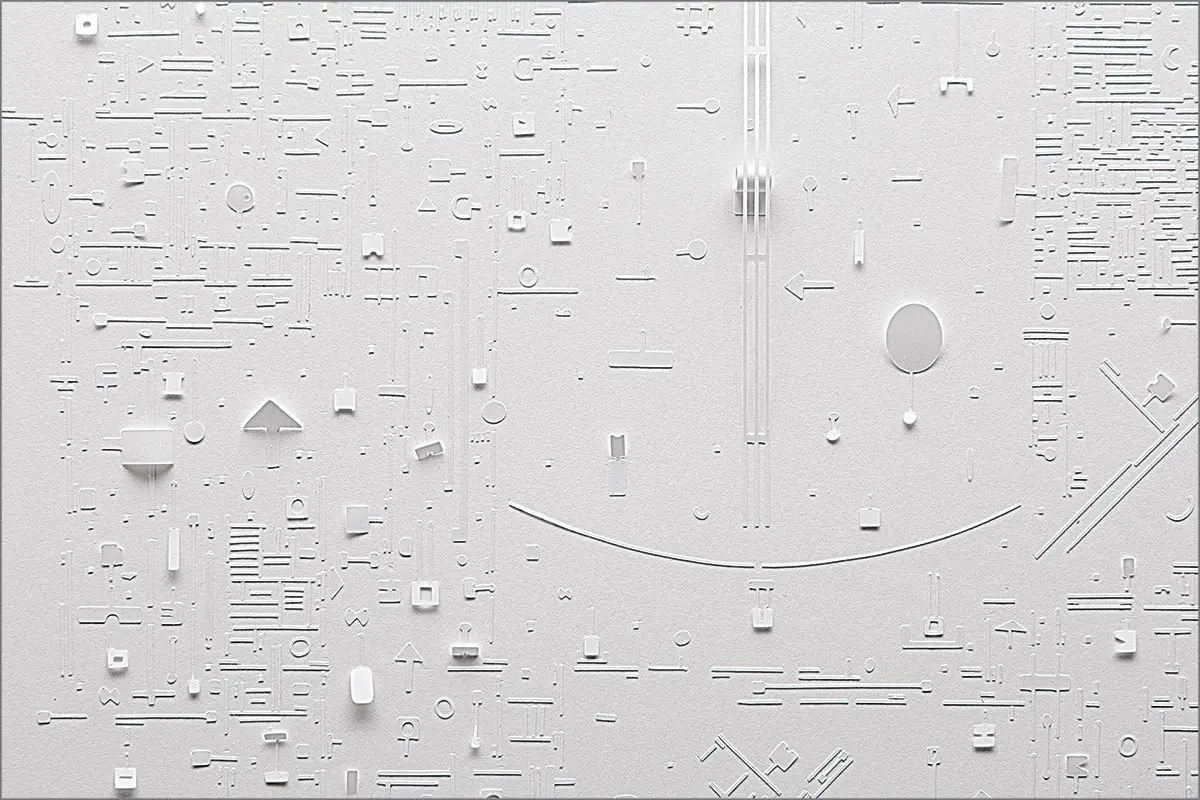
Silencing the scenic space in the exhibition rooms, Maggi mixed hundreds of tiny paper cutouts inside museum labels arranged on the bare white walls, as well as on two-dimensional supports framed with acrylic, to capture the visitors’ gaze and ask them for their undivided attention and patience.
Becoming slower, more acute and wiser, the visitor’s movement through the gallery searched for a level of commitment with the works, away from the transit zone established by the white cube, already consecrated and widely covered since Brian O´Doherty’s Inside the White Cube: The Ideology of the Gallery Space was published in 1976.
As it has occurred throughout his artistic trajectory, Marco Maggi invests in the complex contexts of the relationships generated between the work and the exhibition space that displays his interventions.
Maggi himself affirms that his creation works as an “imperceptible archive,” a singular form of writing, an exercise that delves into other layers or interaction with the exhibition spaces in which his pieces are displayed, as he insists in proposing sensorial dislocations—now provoked by light.
The intervention by Marco Maggi is based on a particular strategy aimed at destabilizing those gazes only accustomed to large objects, paintings of large dimensions, conventional supports and the dynamics of exhibition spaces presented as seductive strongholds. In order to completely redimension that interior, Maggi leads visitors to those details usually hidden in everyday life but showcased in his work like alert signs.
According to Uruguayan art critic and curator, Alicia Haber, who for a long time has been following Maggi’s artistic career, “Maggi focuses on intimism, on an attentive and scrupulous gaze. He is attracted by insignificant objects. He treasures the minuscule, the infinitesimal, and the imperceptible. He is moved by futile, meager, trivial, and modest objects.”
From his simplest of actions with paper and scissors, Maggi generates in viewers a new way of looking at the gallery itself, at the white walls, as he activates a sharper understanding of the plays and interactions that exist between the exhibition space and the work, between color and the lack thereof.
Renewing contact with Maggi’s recent production was a good excuse to revisit debates on the relationships developed between art galleries, exhibition spaces, and works of art.
In his proposal for this exhibition, Marco Maggi established a reflexive bias on the contemporary coexistence with the white cube promoted by modern art galleries. In this manner, he contradicts the end of the mundane—exacerbated today—and the most homogeneous realities.
In fact, Maggi is interested in the possibility of establishing zones for circulation and reflection on the things that are naturally visible but not considered, especially when—through the manipulation of paper, stickers and scissors, to compose a carefully constructed calligraphy—he would recreate contemporary invisibility.
Marco Maggi’s interlocution with the surfaces and supports of his work is intense and prolonged. It promotes a slow and careful adherence to the semi-naked walls of the gallery and places cues of an itinerary created through the incisions in the paper when transiting between two-dimensional and three-dimensional realms.
For Maggi, time is an important part of his creations. He warns viewers about the need to stop and question each proposal by directing our perception towards the compositions materialized through precise cuts in minuscule parts. He requires of us to be attentive to his conceptual charges, to each composition that discovers a series of formal temporalities.
Thousands of minuscule glued structures, very fine cutouts created with white museum labels, disappeared against the white walls of the exhibition room. Some works revisited the proposals presented in Venice, when Maggi represented Uruguay during the 56th edition of the biennale that closed on November 22 of 2015.
Sinuous, tiny, and elaborated with the utmost precision, the paper cutouts presented viewers with very particular writing that, although millimetric and with infinitesimal figures, revealed an eloquent scale through a minimal and precise intervention spread across the walls of the exhibition space.
Upon entering the gallery, the impatient or distracted visitor fell into the trap of an immense and almost empty space by failing to carefully observe the exhibition room.
Among the pieces executed with surgeon-like precision, there were circles, rectangles, and laminated threads on white cardboard that populated the walls with the intention of exploring the concealed nature of a recreated perception.
Maggi composed a visual essay expanded by the minimal scale in works like White Complot (2015), white on a white background, and Black Complot (White) (2015), white on a black background; as well as some brief interventions with red, yellow, and blue as referents of other creations.
On three sides of one of the exhibition rooms, we found a concrete clue about the title for the exhibition in São Paulo: three structures cut into very thin layers and attached to the walls, connected one side of the room with the other—a discrete reference to the historical importance of the “side.”
Undoubtedly, the proposal by Marco Maggi offered visitors an area to pause, time to resist the exaggerated system of urgencies expressed in the routines of urban everyday life and the contemporary chaos.
CLAUDIA FAZZOLARI