
In a conversation several months ago with María José Arjona, she told me about a new project that she was going to develop as part of a residence at FLORA ars+natura. The essence of the work would center on tracking the migration of birds, particularly that of the eagles that migrate from the north of the American continent to the south, passing through parts of Colombia. Arjona’s interest in the project began in New York, and back then she decided to track the birds and shape the project through workshops with seventeen artists that use their bodies as a medium for visual expression. The residence lasted several months and during that time María José Arjona and the other artists performed actions to give form to the theme of the migration of the birds and their meticulous observation.
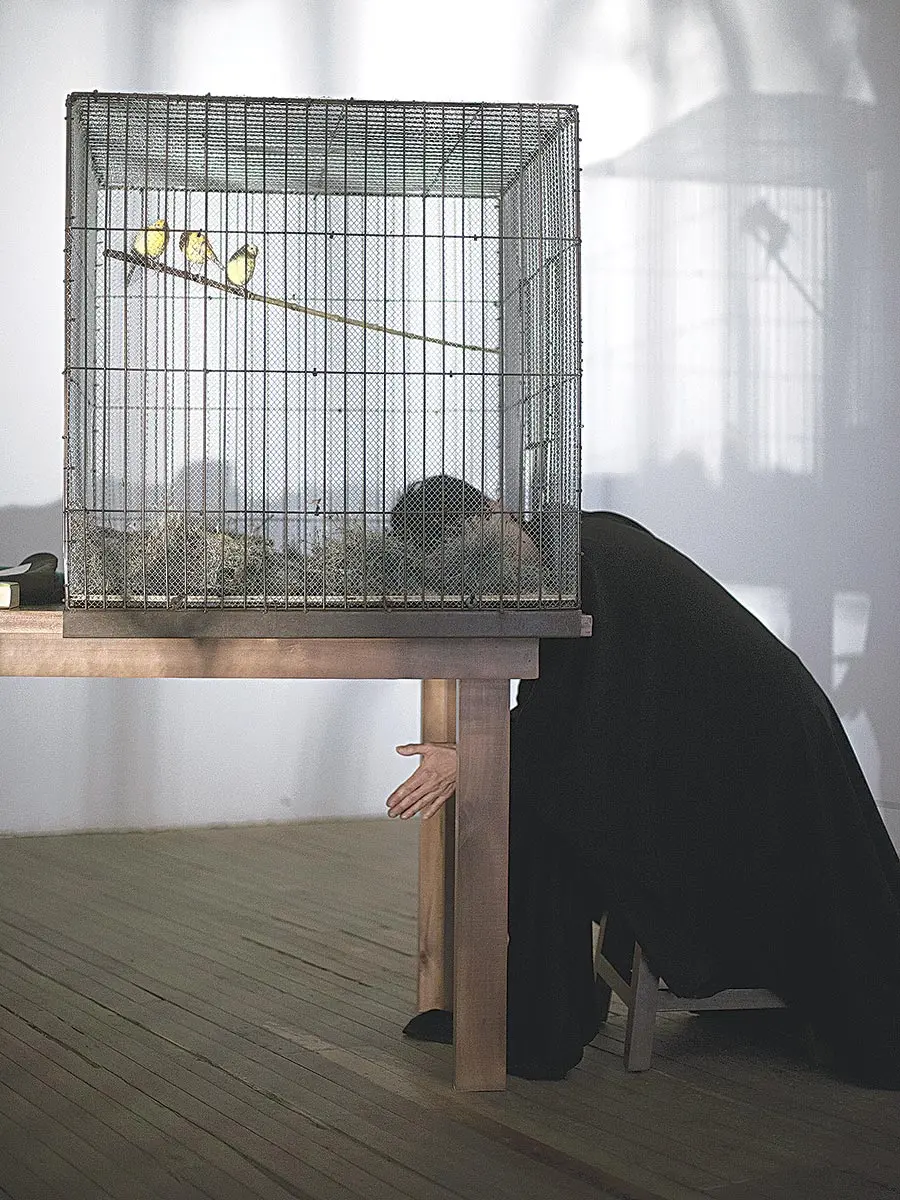
During one of these performances, I got to see the space transformed into a sort of nest, rendered with several cords that wove a structure in the space that began at the staircase to access the place. Upon entering the nest, we found María José Arjona seated on a wooden stool covered with a black dress from which a sort of bird tail appeared to be sticking out: Arjona had transformed into a bird. Her head rested inside a large cage that in turn rested on a large table with several objects on it: drawings, stamps, and, mostly, books about birds.
At the opposite end of the table, there was a manikin head covered with a leather hood reminiscent of those that cover the head of hunting hawks and created to fit the artist’s head. The hood was to be used in a later action in which she stood on the table dressed in an outfit covered in black feathers. A hooded Arjona then proceeded to smoke a cigar and letting out big puffs of smoke.
Something impressed me very much: observing the manner in which Arjona’s eyelids blinked as if they were the delicate flapping of a bird’s wings. No, I was not forcing my gaze to see something that was not there, that was just the impression I got. At the same time, resting under the table, her hands also transformed into wings and simulated the flight of a bird. The shadow projected on the wall accentuated this impression. The action went on for several hours amid a profound silence from which “a composition of songs from eagles, blackbirds, a bird imitator, the Magdalena River and the traffic of Bogota”1 emerged.
About the project Avistamiento (Sighting), Arjona said the following: “This action, in particular, worked as a flight plan. The objects on the table were indications, signals that, if viewers paid attention, allowed them to see what was coming next. The table was mainly an oracle, a map in which to establish physical and conceptual surveys to attempt capturing my own flying and the birds". A delicate gesture, a reference to certain characters that for years have influenced my artistic practice: Deleuze, Žižek, and Alvin Lucier. The objects also had their own resonance; I understand them as sounds that we have yet to hear. Sound is also energetic flat time reintroduced through the body presented by the cage; a free body despite the contingency, the shadow: its liberation becomes the expansion into another dimension where materiality dissolves to better inundate the space with air, with the shadows on the wall that complete the physical drawing. Shadows are also an installation proposed in the beyond of matter; they exist and subsist through the body and because of light. It is an affirmation of the body as a whole, being contemplated as the point of assembly.”2
Worthy of mentioning in Avistamiento, is its transformation into a lengthy piece of process art that makes us reflect on the issue of bird migrations and its disregard for the borders established by mankind. It is an essential lesson that should be taken into account, especially at a time when mental borders are erected between peoples to hinder human movement. While birds come and go as they please, human beings are busy imposing geographical boundaries between them. In this sense, this project encourages deep, poetic, and political reflection on our current state of affairs, exactly at a time when there are plans to raise a wall between the US and the rest of the continent. But the same can be said of Europe and Africa. On the one hand, with this work, María José Arjona succeeds in closely exploring issues about our political contemporaneity, without forgetting that the body continues to be that place or vessel that embodies the tensions and contradictions of our time.
NOTES
1. María José Arjona, purposes behind Avistamiento (Sighting). Correspondence with the author of this text.
2. Ídem.
RICARDO ARCOS-PALMA