
The Peabody Essex Museum (PEM) in Salem, Massachusetts, recently opened Alchemy of the Soul: María Magadalena Campos-Pons, an exhibition of works by the artist born in Matanzas, Cuba. A superb staging for what will surely be among Campos-Pons’ most notable outings in the last two decades. We are talking about a beautiful, potent show set around dialogical principles and structure. It is a speculative essay around the springs and mechanisms of history and their most immediate connections with the most private subjectivity. With great force, it is a constellation of variations and alternations between the spiritual and the concrete, the permanent and the evanescent, the docile and the insubordinate.
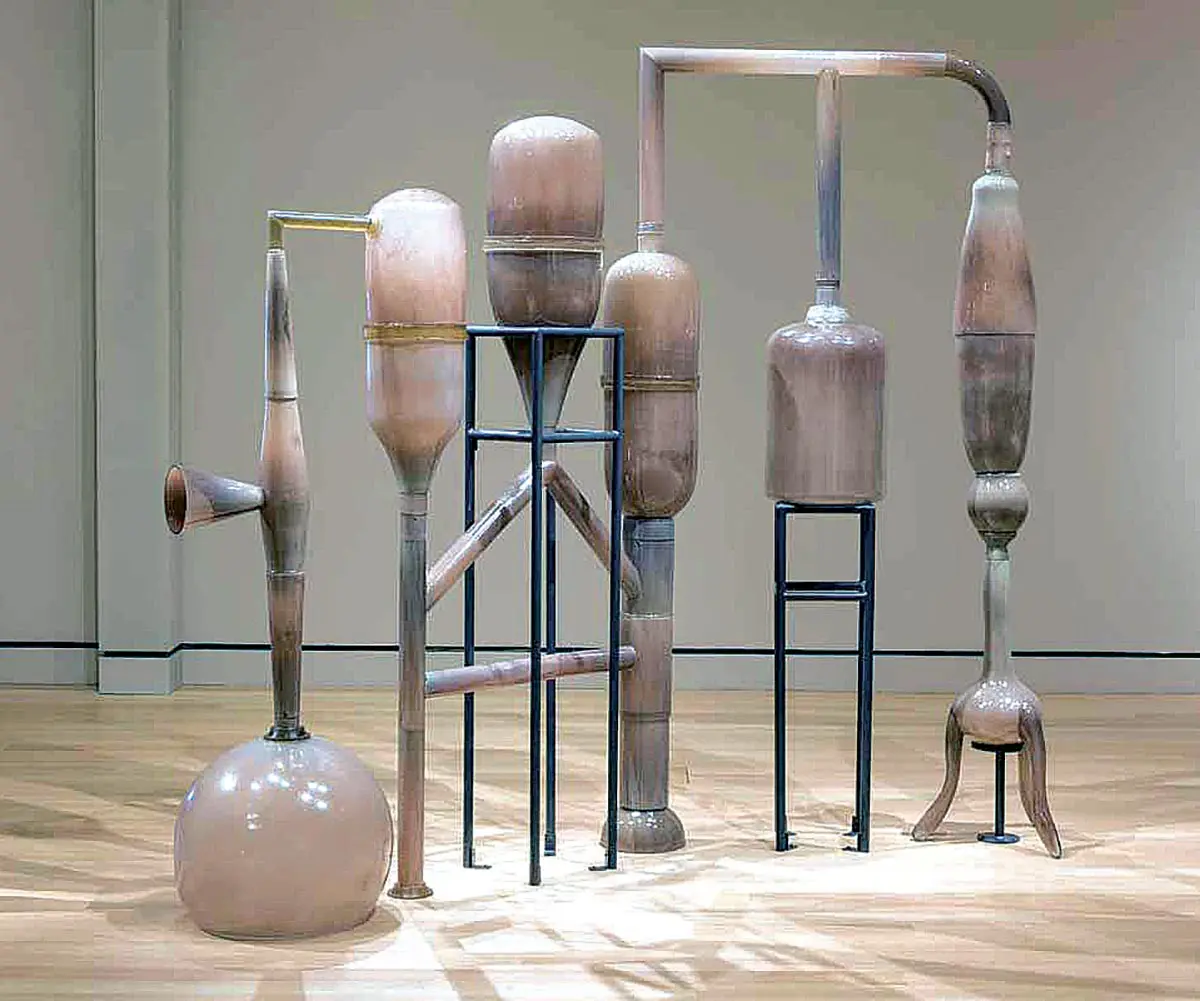
Curated by Joshua Basseches, the museum’s director, in collaboration with the US musician Neil Leonard, who was in charge of designing the sound device for the exhibition, Alchemy of the Soul is revealed, more than the usual exhibit of objects or artworks according to museographic criteria dictated by the curatorial voice, as an aesthetic and emotional experience with deep cultural, human, and anthropological implications. This exhibition—although it’d be more properly called an “essay in reconciliation”—is a robust treatise against amnesia and the anemic meaning of the bastions of oblivion. Everything contained therein becomes a votive offering. It is like a prayer clamoring for the reconstruction, in a single body, of those fragments of existence that are lost in the thicket of Baroque time, in the opaque lettering, under the mantle of petitions, in the allegory of the cave that doesn’t necessarily move us in the direction of light.
It is, then, a sophisticated gesture of restitution of personal, emotional, and cultural memory. A recovery that by far exceeds the position of the first person, i.e. the artist’s self, in order to launch into circulation at the epicenter of her narrative, the sound-based story of the multitude of voices that—in the past and the present—have suffered the bitter pain of exclusion and ignominy.
Each one of the works that comprise the immense glass universe (heavy and light at the same time) arranged in these galleries not only supports in their structures and their strange morphologies—which refer to the cauldrons used in a sugar mill—the history and corporeity of sugar, its distillation into rum, and its natural (and alchemical) transformation into a spiritual matter, but also certifies the ethno-anthropological speculations of Fernando Ortiz and Aregliers León; gives shelter to Wifredo Lam’s androgynous, reverberating foreshadowings and Lygia Clark’s animals; and recovers the imaginaries and the voices of black and cimarrón groups—all the while implying uncomfortable interrogations of Cuba’s history, the same history that must be written a thousand times and from many different standpoints; a history, I insist, that will have to be finally written when the text become the revelation of a truth rather than a response to theses brandished from the realms of power and despotism.
All that aside, however, Alchemy of the Soul ought to be understood not only as a recapitulation and revision of the colonial past, an exercise of reconciliation with history, or the magic act of deciphering a “palimpsest” by separating its many layers of memory and its emphatic writings. This is a living, present, now-centered exhibition: a warning shout, a scream of courage, permanence, and daring. It is, if you will, a way of reinforcing the emancipatory efficacy of utopia to make it resistant to the onslaught of skepticism. As many thinkers have warned about contemporary historical processes: the more one forgets, the closer one is to the pitfalls of repetition. Perhaps it is in this warning that a good portion of the commitment and the effectiveness evinced by the narrative body of Campos-Pons’ proposal resides.
In this way, the exhibition acquires the symbolic dimension of a chorus, a symphony, an orchestra that, wavering between high and low culture, projects the voices of many in a cyclical two-way journey. From there comes its epiphany-like flavor, the recursive interplay of insubordination and the signs of disobedience, which proposes a model for the liberation of that which at a different time—perhaps even in ours—meant a ferocious act of canceling and reducing freedom.
There is, on the other hand, a psychological element that I have not so far seen in other critics’ readings of this show: the centrality of “rage” as a rhetorical figure. On her back flayed by that ancestral whip, María Magdalena Campos-Pons supports the instinct for rage and reactive gestures. The radiograph of a scream is reflected there.
But at the same time this rage, this reaction, has been transformed—thanks to the gift of alchemical processes—into forgiveness, reconciliation, and poetics. That scream—the scream of an irreverent black woman who knows that history is not what was written in the past, but what we write now—is suspended in the spectral domain were the subjects of the past and the present dance together.
A bird flies across one of the museum walls and the artist focuses her gaze on its path, trying to discern on which branch will it come to rest to give us its next squeal.
ANDRÉS ISAAC SANTANA