
AMALIA CAPUTO
Argentinean artist Marta Chilindrón (Buenos Aires, 1951), who has lived in New York since 1969, exhibited at Alejandra Von Hartz Gallery some ten movable works in methacrylate/acrylic built on the basis of unfolding geometric shapes. These sculptural constructions take as their point of departure several tenets from the wide-ranging theory of organizational systems and models, based perhaps on the interdisciplinary investigations carried out by German biologist Ludwig von Bertalanffy between 1950 and 1968, intended to produce conceptual formulations for the application of empirical realities. This theory encompasses, among many other categories, abstract and conceptual systems, closed and open systems, systems cataloged according to their nature, etc. In turn, these may represent exchanges with the environment (allowing or curtailing motion); temporary systems—which involve the passage of time, change, or disappear, and are opposed to permanent systems—are also cataloged. These systems help understand the unifying principles that are transversal to all sciences, philosophies, or sites of thought, and allow us to study the fields of abstract knowledge. Chilindrón’s works in her second solo exhibition at the gallery, made mainly from industrial laminates in acrylic—polycarbonates—that are assembled using multidimensional hinges and vinyl, carry forward her investigation of this idea of open, closed, and temporary systems.
Chilindrón constructs movable assemblages on the basis of geometric shapes that can be manipulated and generate dialogic relationships between bi- and three-dimensionality. In the same vein, she analyzes the potential for motion in the spatial construction of planes. The study and manipulation of geometry have been present in Chilindrón’s oeuvre from the start when she built works and spaces on the basis of fortuitous encounters; her core interest is the spatial study of the works, the space they occupy, and the empty space they generate, and their motion.
Chilindrón started producing this type of modular works in the late 1970s, with objects in wood, and from 2000 on she focused her investigation on her current strategy. The issue of the temporal/spatial in her works also alludes to key art-historical references, as, on the one hand, she is in part inspired by constructivist artists like Malevitch, Gabo, Judd, and Torres García, and on the other has Lygia Clark’s Bichos—a series of sculptures using metal sheets and assembled geometric shapes, produced by the Brazilian artist in the 1960s—as an important referent.
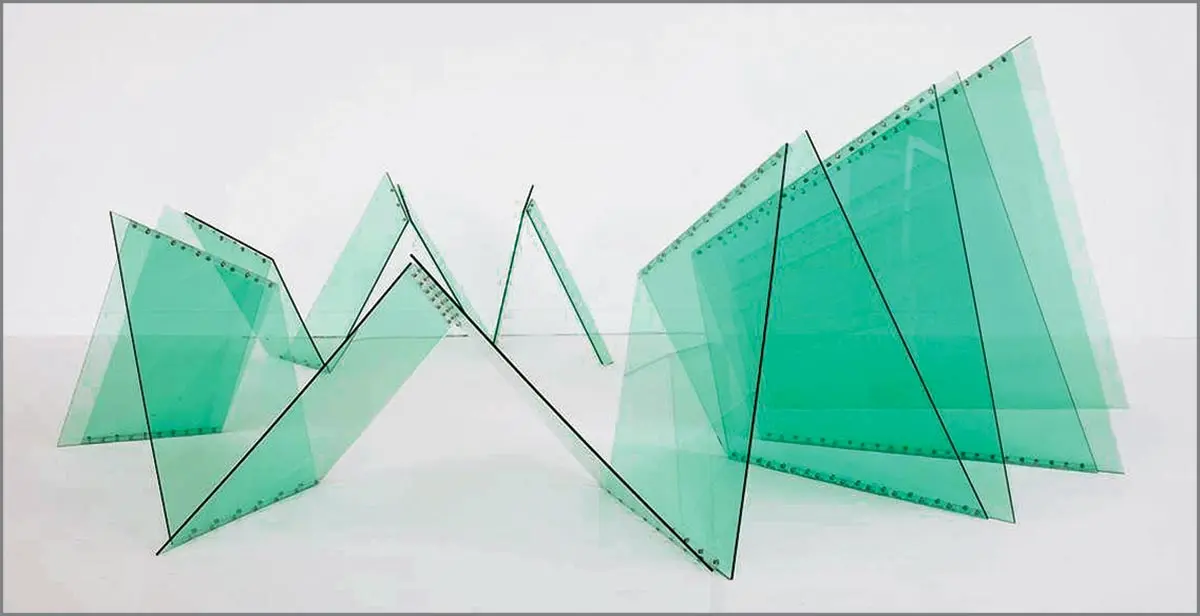
Temporal Systems seems to hinge on the large-scale 16 Trapezoides (16 Trapezoids), from 2015, made in transparent green acrylic; this work comes across as possibly a somewhat monumental architectural model and is accompanied by other works in small and medium formats, some on stands and others on the wall. Pyramid 18, from 2007, is an example of the continuous mutation of forms offered by the artist. Here, we are able to build a pyramid on the basis of a hexagon that rises in a sequence of triangles.
On the pedestals, one standout is Soft Triangles, from 2013, three small-format works made using strips of soft colored vinyl. They are mobile and allow us to rework the circle, the spiral, and the tower; they break the matteric rigidity of the rest of the works on exhibit, some on the floor and some on the wall, that brings into the gallery a refreshing organic element.
Chilindrón’s work does not remain static; rather, it mutates, generates different volumes, and provokes instability. Indeed, via the possibility of change and motion, it attempts to critique the work of art’s aspirations of permanence and the supposed rigidity of volumes in space. Starting with these unstable ideas, merely a pretext for the exploration of change, other aspects of Chilindron’s work deserve highlighting: a playfulness that exalts curiosity, and the desire to have the audience be, in part, also the creator of the work. There is also a message about change, motion, and impermanence, and another about the intrinsic fragility of the work of art, determined by its transparency and by the kinds of materials used by the artist, which are delicate and forceful at the same time.
Chilindrón’s works invite viewers to manipulate them advisedly to generate changes in their flow and motion, starting with a set of shapes and moving towards the new one, with great variability. Delicately, the viewer (wearing cotton gloves) can manipulate the works, alter their shape, and bring it to rest in a different position until the process is restarted. The works on the wall can also be hung in different ways. This manipulation by the audience blurs the lines around the figure of the artist-as-creator and the notion of the passive viewer. The viewer, who acts as a medium to bring into actuality a different possibility, rebuilds the work.
A sculpture that is another, and another, and another, brings to the fore the idea of the object’s permeability. A three-dimensional object becomes bi-dimensional, and vice-versa. Cubes, pyramids, accordions, hexagons, triangles, and other kinetic constructions move to produce other volumes. Geometric shapes that mutate into new ones through repetition and the union of geometries that reflect the continuum transgress our sense of location in space through their manipulation, staking it all on the most unstable thing we know: life.