
Some of the most compelling works by Miguel Angel Ríos have a great deal of human participation. In their execution, Ríos himself plays a role akin to that of a conductor of many musicians. The end product, however, is rewarding to the artist who concocted it, as well as to many others who made it possible in a material sense. For the production of the video Piedras blancas (shown at Sicardi Gallery, Houston), Miguel Angel Ríos and twenty of his assistants manufactured 3,200 balls out of a wire structure and a cement cortex that was later painted white.
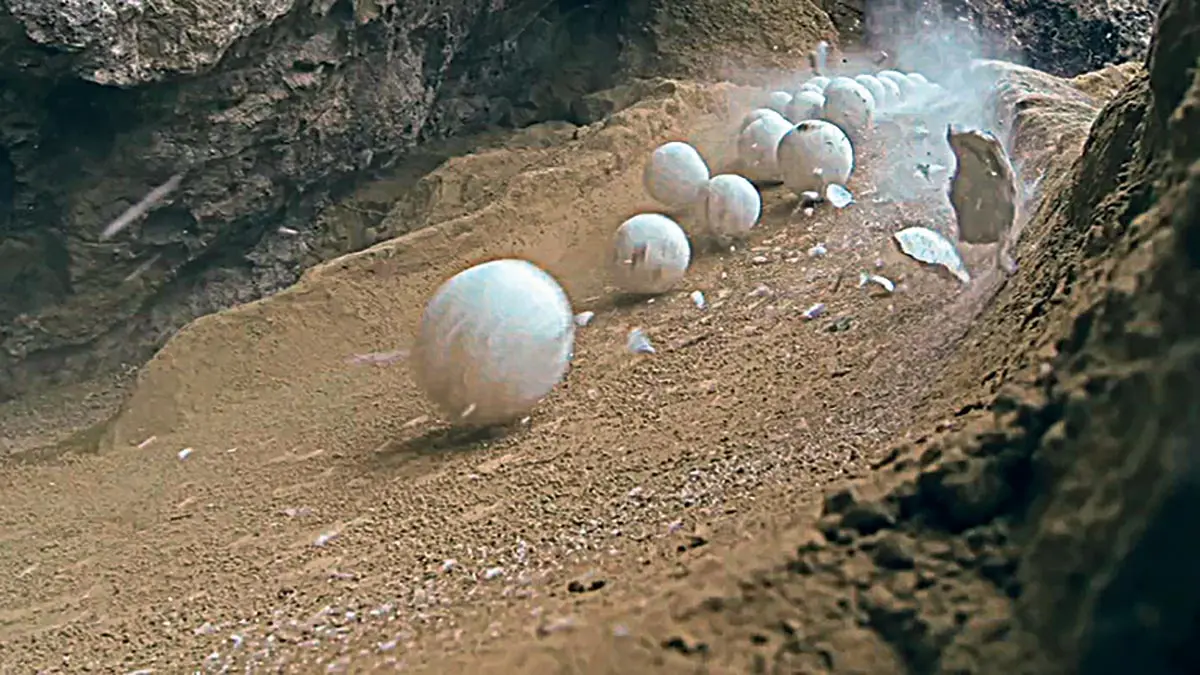
Many of the 3,200 balls of Piedras Blancas were built to be shock-resistant in order to withstand the precipitous fall, while others were designed to burst on impact. The next step of production was to move the white balls to the top of a mountain. Then, in a continuous flow, the balls were released, and their spontaneous downhill rush was tracked by seven video cameras. The cameras were placed along the route the balls were predicted to travel in order to record their migration, as well as the natural surroundings. Many were lost along the way, scattered in the landscape that they caressed, or burst to smithereens as they hit a rock or each other. Nevertheless, a group of them followed a path that landed them in a final resting place at the foot of the mountain.
This description of what happens in the video is itself not devoid of metaphor, but the whole avalanche of balls rolling downhill suggests a plethora of metaphorical interpretations. Gravity propels their fall as if it were one of those unstoppable forces that cause war, tsunamis, hunger, forest fires, epidemics, mass migrations, earthquakes, poverty, hurricanes, greed, flooding, disease, etc.
Back in 2007, Miguel Angel Ríos had an exhibition at the Blaffer Gallery of the University of Houston. Rios’s video On the Edge was shown on a synchronized double-screen video installation; and Aquí on five screens. These were two of several Rios’s videos about spinning tops. In On the Edge white tops spin on a black background, and black tops spin on a white background in a choreography that would not have been more perfect if the “dancers” were willful entities. The video’s soundtrack was the grinding of the tops’ points as they marked the surface of the stage. Needless to say, the driving force of the tops’ spin was no gravity, nor any other natural force, but the dexterity of the 80 Mexican top spinners Ríos recruited by going with a megaphone from town to town. Thanks to their skill and aesthetic understanding, the tops spin precisely and hypnotically, at times they stay almost motionless; while at other times, they dart across the stage and disappear into darkness or lightness.
Although one is tempted to view the spinning tops as two, three, or up to a dozen tops dancing at a time, their movement is more enigmatic than a dance because it follows the laws of angular momentum and inertia. That realization makes their performance even more awe-inspiring and sublime. The artistic choice of black and white tops—antagonistic albeit elegant colors—renders their interaction suggestive of many a human conflict: black versus white, dark versus light. On the edge alludes to death as an inevitable part of a trompo’s diminishing spin, but it is nonetheless, not the point of the work. A top can be restrung and given a new impulse. Death, on the other hand, is the point of A morir (To death; as in, to the bitter end). Here only black tops spin on what appears to be a 3x3 chalk grid on the floor, reminiscent of popular warlike top games. Tops finish their spin (they “die”) by losing momentum and slowly stumbling into a clumsy demise. They also “die” by being bumped by a new “dancer.” In actual top games, one player “kills” his rival’s top by violently striking with its spike the prostrate top. The impact often cracks the rival top in half. But the tops of A morir die a natural death, and at the end, they lie strewn on a ground that is more mathematical than warlike.
Perhaps other Rios’ videos deserve as much or even more attention. We have focused on three—On the Edge (2005), Piedras Blancas (2015), and A Morir (2005)—because they fit our cause. They share movement and conflict, an initial impulse with human intervention, and ending with the loss of momentum and increased chaos, and a subtle way of referring to life and strife.
FERNANDO CASTRO R.