
The first sensation upon entering the enormous space of the Galería Barro is of having been invited to a party. With music in the background, the gaze is immediately directed to the large and attractive neon figure that dominates the back wall. Reminiscent of a high altar in a church, it hangs well above the other elements of the installation. It is an immense and garish head with feline features from whose mouth unfolds a tongue in the shape of a penis.
At first glance, the intense colors in the center of the space are predominant and serve as an invitation to continue the walk through the exhibition. The music continues and so does the promise of happiness through the imagined body dancing, immerse in the vitality of the movement. Nonetheless, the initial happy impressions soon subside once viewers become completely immersed in the installation.
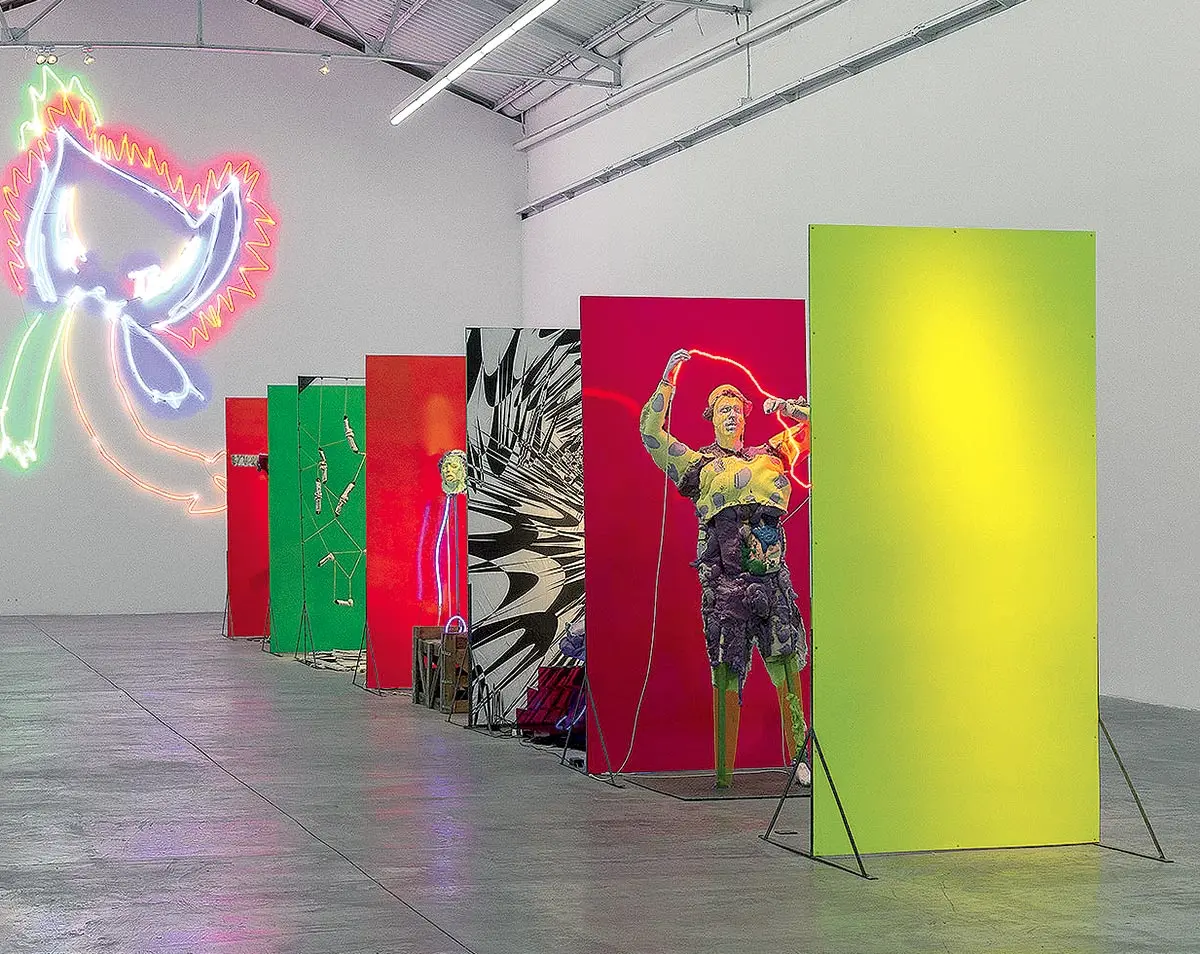
A line of cabinets can be observed one after another. The shine sculptures created from an unlikely combination of dissimilar materials like polyurethane foam, polyester resin, marble, acrylic, animal skin, and neon lights. They form incomplete human figures, all of them with their eyes closed. Some appear to be in a latent state, their wills suspended as if they were waiting for something; others appear to have experienced some sort of tragic outcome like the epilogues of apocalyptic stories. Highly expressive, the figures cannot diminish a sensation of silence that, paradoxically, increases in contrast to the strident colors. Then, viewers find themselves suddenly overwhelmed by the idea of a story that will not be told, of an unsung tragedy. Glottis is the opening through which air enters the lungs and transforms into words through the vocal cords. It is a place in which air turns into that uniquely human activity that permits interaction with the world and connects the interior with the exterior. Like death masks, these mute faces are the constant feature amid a disparity of elements. The contrasts and the absence of integrating structures trigger a perceptive compensation that attempts to make the whole something more than the mere sum of its parts. But the feeling of an incomplete, untold, story prevails and only a few incoherent fragments are revealed, simultaneously illuminating and darkening our understanding.
According to the text about the exhibition, “For Nicanor Aráoz (Buenos Aires, 1981) Glottic is a combined word, something similar to the guttural sound of a scream elicited by the pleasure that has been drowned by gushing blood. In this exhibition, Aráoz works with referents that range from the sadomasochistic scenes in Pasolini’s Salò, or the 120 Days of Sodom, to the spiritism of Southern Gothic literature from the 19th century to psychedelic trips caused by LSD. All of these, instances associated with freedom rituals that hide the fear of transcendence succumbing to the impending darkness of a nightmare. And Aráoz looks into such abyss: a limbo in which social taboos are dispelled, where the boundaries between pain and pleasure are blurred, and where victims and victimizers cannot be told apart.”
Upon discovering the giant black and white counter-images located behind each sculpture, the idea of opposites is further intensified, not solely because of the absence of color, but also as a result of the abrupt passage that exists between the representation and assimilation of the accounts of actual victims of violent, premeditated, deaths. They are low-resolution photographs printed on paper that resemble street posters; enlarged until they have lost definition. But the visible pixelation does not completely hide the horrific scenes. They are present/absent and, once again, they stand for the nullification of language. As viewers, we also remain silent, our bodies overwhelmed by unsettling feelings provoked by those lifeless bodies, as a knot forms in our throats prompting a barely contained grimace that could turn into crying. To compensate, we divert our gaze toward the strident colors and the neon lights, while attempting to normalize our breathing in order to recover from the shock. The music continues to play like the introductory passage of a soundtrack; like the constant preamble to that which will once again unsettle us.
As a whole, the montage inevitably underscores the theme of a “cult,” sophisticated death, subverted through literature, cinema, and manufactured drugs. Nonetheless, the image never stops being the source of existential angst, and, in this instance, it also appears to merge opposites. In Nicanor Aráoz’ own words, it could be about “a horror novel in which love is the monster.”
VIVIANA SAAVEDRA