
Two artists, Peter Bonde and Javier Tapia; two countries, Denmark and Chile; two exhibition spaces, the D21 Proyectos de Arte gallery and the Museo Nacional de Bellas Artes; all to generate results adjusted to the equation: bicephalous. Tapia, from Chile, lives in Denmark and long ago befriended the veteran painter Peter Bonde. Together they conceived a project that combines travel, research, and the creation of a link between their respective native countries. The result of their collaboration is a film set in the periphery of Copenhagen and the Chilean coast. A physical and metaphysical journey with a biker in the central role witnessing cultural and popular elements in both countries, connected without a clear narrative thread through a series of winks and classic movies. In this exhibition in two sites, there are many dual heads.
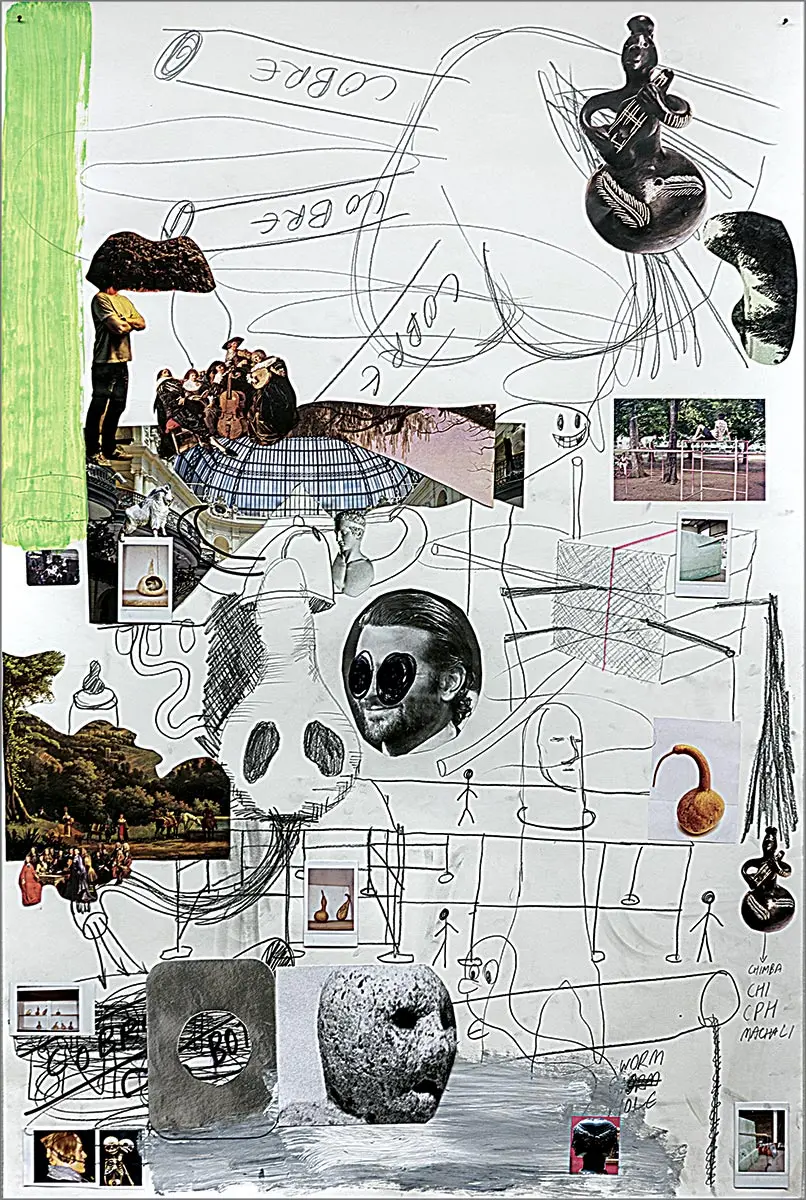
The curator, Catalina Mena, makes a reference from Roman mythology: Janus. The god of doors, of beginnings and ends, Janus was always represented with two faces. In the gallery, we find a figure of Odin (from the Viking Museum in Denmark), the god of wisdom, war, and death. And various sketches and drawings also display bicephalous figures: from the famous twins Abigail and Brittany Hensel to the study of a multi-headed dog. The latter figure outlines a concept that can help interpret the exhibition as a whole: everything has two faces. Tapia’s and Bonde’s main proposal is a road movie, but the exhibition expands into different media and spaces. The movie is shown as inside a large installation located in the middle of the museum lobby. A series of scaffolds serve as containers and supports for other works and images that complete the experience. We are talking, thus, of a “museum within the museum” model. Inside, besides the viewing of the movie, there are several display cases containing objects connected to ancestral cultures. The scaffolding connects with a minor structure crowned by some artificial pine trees via a large pipe. It all resembles a colostomy bag, and what is staged looks like the remainders of a B movie. Over the larger structure, an inflatable piece based on a kind of pre-Columbian Andean clay and made using a material that simulates a reflecting metallic surface, á la Jeff Koons. Several layers of meaning can be analyzed here, such as the updating of icons, the banalization of indigenous cultures, or the conflation of the archeological with the popular; as is true of the movie, these layers are there without any logical connection between them is proposed. Perhaps the amalgam of references, of unfinished ties, of horror vacui, is a way of translating today’s visual madness, the superficiality that derives from globalization. We visited the project’s associated space, Galería D21. It is there that desolation came to our aid. The drawings, sketches, and collages of the transit, which could offer clues to the creative process, obscure and confuse what is on offer. One does not fully understand what a realistic drawing of a pair of testicles is doing there, next to a roughly finished collage, or a pencil doodle titled Fuck Aliens. In an adjacent gallery, we find another installation with a “work zone” kind of aesthetic, functioning as the supporting table for a projector. According to the accompanying text, it projects a sequence of everyday scenes from the 1970s and 80s. What we see in the gallery is maddening. Forced amateurism and “cool” aesthetics. One goes back to the Museo de Bellas Artes and re-read it with a different impetus, but it is all in vain. The combination of Tapia’s contributions (he has worked for a long time with accumulative installations that combine poplar and indigenous elements) and Bonde’s work (with some precedents in video installations, as in his previous collaborations with Jason Rhoades) doesn’t fully jell. We are left with the impression of having witnessed an unscripted work (the movie) decorated with elements intended, one presumes, to add meaning or stimuli to the central video. If the leitmotif of the whole enterprise, where both artists have traveled and researched in their respective countries, is to provoke reflection on the basis of terms such as hybridization, miscegenation, or anthropophagy, it should have reached greater depths. In the case of the annex at D21, presenting discarded ideas or processes—when they don’t have, as is the case, anything to add but the opposite—is not a viable solution. This show of two is actually a show by half.
JUAN JOSÉ SANTOS