
Gory’s career had for a long time now demanded an exhibition that valued him as an artist who, both in terms of his poetics and of his discourse, is key to understanding the state of post-revolutionary Cuban photography. The show Rogelio López Marín, ‘Gory’: Notes for a Retrospective (1975-2015), curated by Aluna Curatorial Collective (Adriana Herrera & Willy Castellanos), covers his production over more than three decades, featuring, for example, works from the series Solo entrada (Entrance Only, 1975-1979) as well as works from the still unpublished series Still Alive (2015). In between, this rich exhibition also includes works that remind us of Gory’s beginning as a hyperrealist painter. All of this makes this not only an interesting and ambitious retrospective in its documentary reach and coverage but also this important artist’s most complete presentation to date.
To talk about the work of Rogelio López Marín (Gory) is to talk about the most significant and personal photographic gaze of the 1980s generation, alongside Arturo Cuenca and Marta María Pérez Bravo. This outstanding group of artists produced an essential renewal of the Cuban visual art scene during the post-revolutionary period. Up until that moment, photography had been, in a general way, marked by a strongly documentary realism, with expressive codes that came colored with ideology and with lightning-fast revolutionary transformations of reality. The epic and the heroics that are constitutive of the Revolution’s utopian project had been the central nucleus for the discourse of Cuban photography since 1959. (Of course, we are not talking here about essential Cuban photographers of the period who worked outside Cuba, like Mario Algaze or Jesse Fernández). Let’s consider, for example, the work of Korda, Raúl Corrales, Roberto Salas, Rolando Pujol, among many others. All of them developed a photographic poetics with a sensibility permeated by the drive to take the pulse of immediacy, to capture the transcendence of daily mass activities or events that were part of the revolutionary process. Thus the dynamics of a pulsating movement, the language of photographic reportage that avoids the poetic ambiguity, deployed by most of these artists. It was a language coded to establish a kind of unequivocal relationship between the image and the message it communicates to the viewer. Image and message that, at the discursive level, translate into the omnipresence of the masses. The masses (with their leaders) and their expression in agricultural or construction labor, in the defense of the fatherland, or in parades and rallies in favor of the Revolution give shape to a paradigmatic subject for Cuban photography during the early decades of the process.
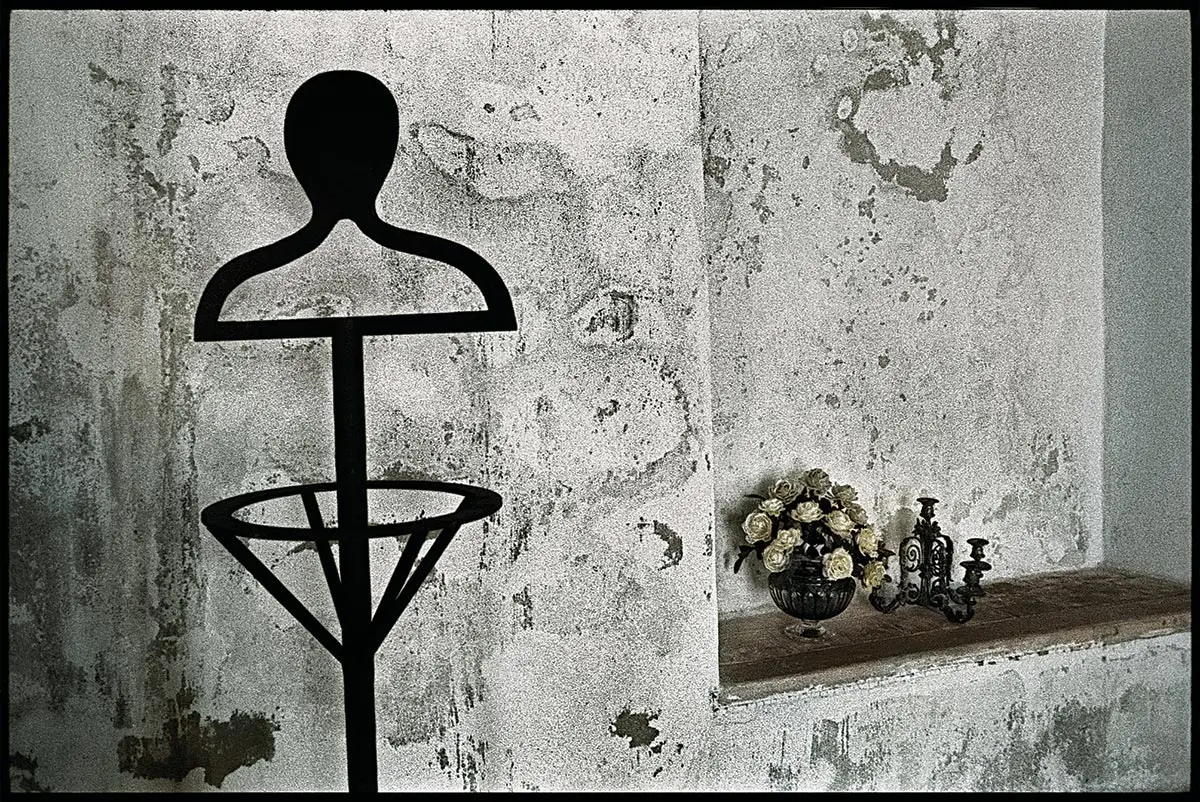
It is not by chance that Gory’s early works, for example, the series Solo Entrada (1975-1979), with photographs of Havana’s Colon Cemetery and of Cienfuegos, remain closely attached to the aesthetics of reportage. Yet they already suggest a shift in the gaze towards different ways to interpret reality. A realistic aesthetics is retained, yes, but the presence of the masses begins to slip away, making room for the emergence of objects and things, as happens more deliberately in Ausencias (Absences, 1980-1991). These photos have a slowed-down tempo; their images seem to freeze-frame motion, and this gives them the aura of something that, while being outdoors and “public”, is filtered as a kind of private memento. This is a gaze that sounds out and investigates reality in an attempt to unveil the remainder of experiences, of moments salvaged as visual archives of personal memory. Up to that moment, Gory’s work had assumed reality almost with a naturalistic vocation, but it works like the series Piscina (Swimming Pool) and the triptych 1836-1936-1984, 1987 (1-2-3), overflows from these boundaries to construct a highly aestheticized referent for the real. These works have as many elements of objective photography as neo-figurative realist painting, given the relationship they establish between figure and ground. Here, objects are once again omnipresent, but these are objects whose semantic values have been set in contraposition and their meanings made to collide. For example, in imagen # 3 (image #3), Gory uses photomontage to superimpose something as soft and slippery as the ocean to a heavy, tangible material element like a train coach, as well as a strange and disquieting bust that repeats in the three images that comprise the triptych. This image immerses us in a reality “convoked” by the artist, where history and memory, fiction, and reality intertwine to generate narratives and visions that are as unprecedented as they are personal.
DENNYS MATOS