
The Museo de Arte Contemporáneo de Oaxaca has tinged its galleries with three primary colors—red, blue, and yellow—for the new exhibition of works by Tania Candiani, Cromática (Chromatics). The exhibition explores the textile traditions of the state of Oaxaca and their use of natural pigments. Candiani decided to work with three kinds of traditional dyes, animal, plant-based, and mineral, using cochineal, indigo, and clays, respectively.
The exhibition features works created by the artist in collaboration with local artisans who preserve ancient techniques for the extraction of pigments from endemic species. Curated by Blanck de la Torre, this moving exhibition emphasizes the value of traditional manual crafts with interdisciplinary works that include video, embroidery, performance, and sound art.
Cromática starts with a critical posture regarding the disappearance of artisanal practices and promotes the empowerment of these modes of knowledge, valuing them as potential elements in the reconstruction of individual memories, but especially of collective memories, that provide communities with their identity and sense of belonging. The recovery of traditional practices like those seen here not only promotes the use of endemic local materials but also reinforces social practices based on communitarian exchange and reciprocity, which in turn enhances relationships and ties that the capitalist system of production inhibits and denies.
The exhibition included works in progress that unfolded live inside the gallery. For example, the large-format weaving loom Colores primarios (Primary Colors), which weaver Juan Pérez Martínez built during the exhibition. The loom represents a scheme of the central concepts investigated by Candiani. Words like tools, traditions, process, language, sustainability, history, nature, and synesthesia are presented accompanied by a graphic scheme created using wool dyed with natural pigments that range from red to blue and yellow.
In coherence with Candiani’s previous investigations, this exhibition attempts to involve different senses, with hearing as one of the most important. Zanfona en telar (Hurdy-Gurdy in a Loom) is a sound-producing loom based on a Fourteenth-Century musical instrument, the hurdy-gurdy, which could be activated by the audience. Following similar premises, Candiani produced another musical instrument in Ocarinas amarillas (Yellow Ocarinas), inspired by the wind instrument of its title and consisting of several ceramic pieces representing birds of different sizes, activated by the audience to play different tones from high to low. The birds are colored yellow with natural mineral pigments and correspond to the “yellow” section of the exhibition.
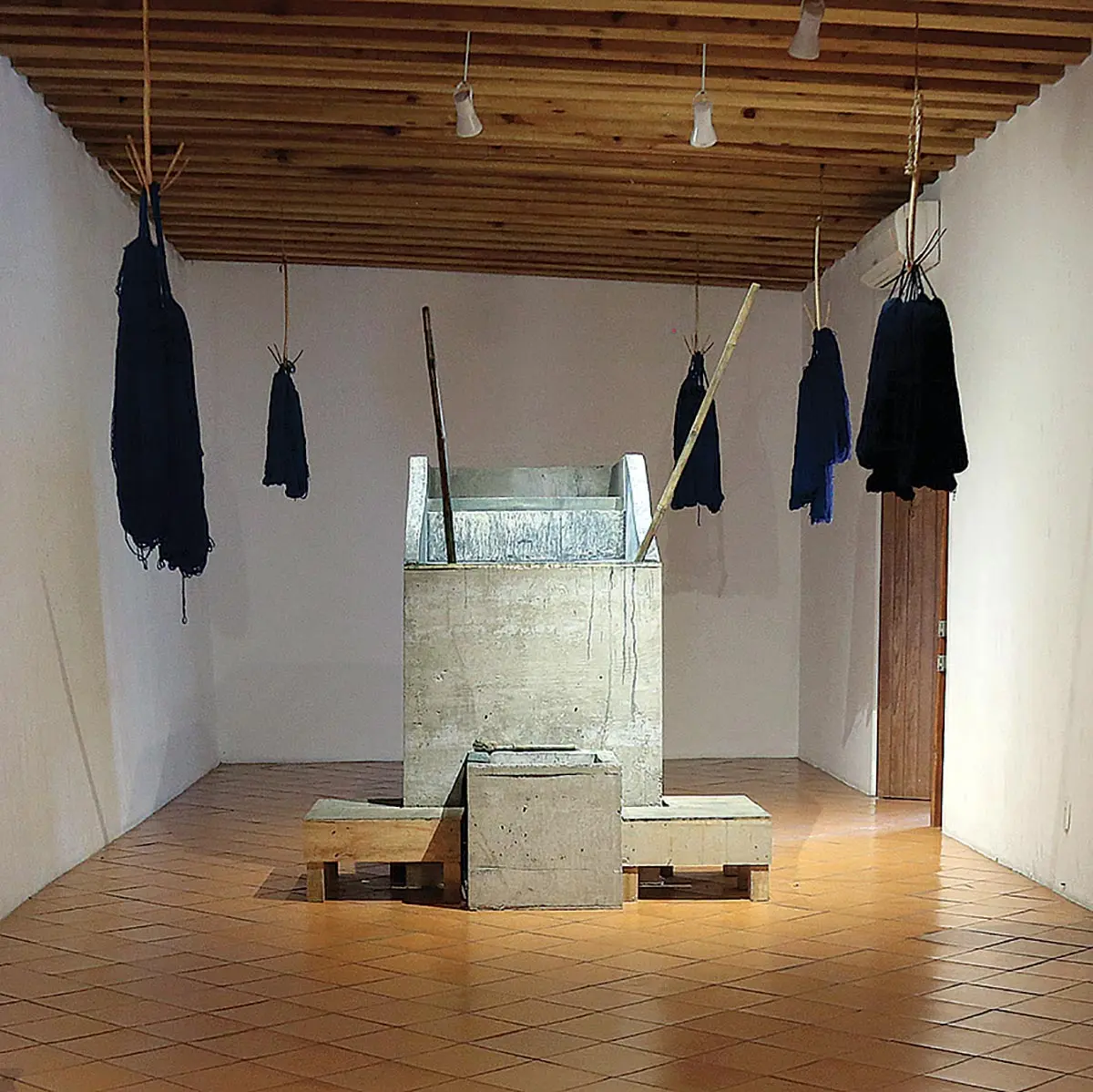
In the section devoted to indigo, Candiani reconstructed a sculpture titled La urdimbre (The Warp), which reproduced the way thread is prepared for the loom. Similarly, the artist reproduced fabric-dying piles like the ones used to extract pigment from indigo and used them to perform the process of pigment extraction. Once finished, Candiani left the piles there as a memory of the process.
Regarding cochineal, the exhibition presented the various phases in the extraction and preparation of the pigment. In one of the museum patios, audiences encountered Nocheztli, an installation titled with the name of the insect in the Náhuatl language and comprising 800 prickly-pear stalks covered by cochineal insects. The installation presents the way in which the insect is raised and farmed. Cochineal has been used as a red pigment in Mexico since pre-Columbian times. To accompany the stalks, the walls around the patio were painted red, which produce an enveloping experience and immerses viewers in the color. On exhibit in a different gallery were flat stones of the kind used to grind the insect, accompanied by a video of several women engaged in the activity.
Candiani also created a number of embroideries that reproduce phrases connected to the three colors. Incorporating texts of various kinds, their reading provides us with an approach to the way in which they have entered the collective imagination, and the symbolic content they have been assigned.
The exhibition also included a series of old recipes for the preparation of the mineral, plant, and animal pigments. By including these references, Candiani ratified her intention of showcasing and revaluing traditional processes as relevant stores of knowledge.
JOSEFA ORTEGA