
A new installation in the Jewish Museum’s entrance lobby presents the work of New York-based Brazilian artist Valeska Soares. The installation is part of an ongoing program titled Using Walls, Floors and Ceilings, a contemporary version of the museum’s 1970s exhibition program, which at the time was called Using Walls. Back then, as now, the museum was acquiring works by contemporary artists with the intention of integrating their discourses into a dialog with earlier modes of expression already in its permanent collections.
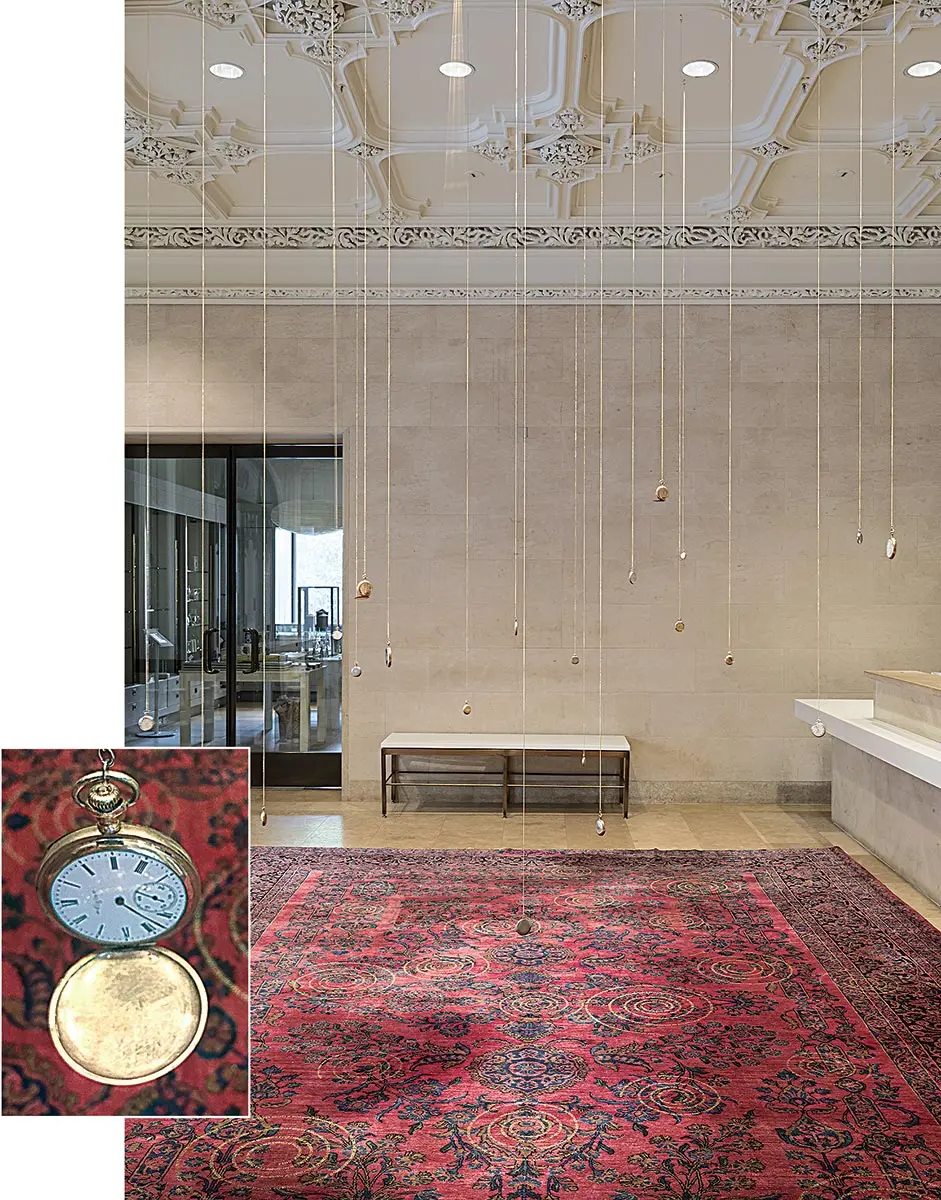
Soares’ installation features a large, old carpet placed right at the museum entrance, in front of the admissions desk; over the carpet hangs a selection of old pocket watches. The installation ponders the transience of all human settlement since both carpets and watches are portable and evoke the ideas of travel and motion. It also calls our attention to the feelings of melancholy and nostalgia for the past, and, situated in this public context of urban traffic and social exchange, emphasizes the background of alienation and loneliness that is such an integral component of contemporary artistic practice.
Some years ago, in an exhibition titled Ultra Baroque Aspects of Post Latin American Art at the Museum of Contemporary Art San Diego, Soares presented a deeply emotional installation made from reclining chairs and wax pillows, where viewers could see the imprints of a pair of knees and traces of leg hair left behind by an after a parishioner’s reclining prayer. The general impression was that of contemplating the remains of an offering; the hairs signaled the possibility of an expiatory ritual, similar to the funeral practices of ancient Greece and Rome, where the grieving pulled strands of hair and added them to the pyre where the body of the deceased burned.
Soares’ installation at the Jewish Museum evokes, through the objects, it contains, the absence of the bodies that used them in the past. In this case, the carpet is also a paradigm of silence, of muted steps that cannot be heard, even if their presence can be felt as their memory is evoked. The use of the carpet is particularly moving in such a densely populated megacity as New York, where a large carpeted area is often required in apartments, rented or owned. The Asian carpet in this installation also brings to mind the era when the museum building was a private home, and its placement at the entrance resembles that era’s inviting sense of decoration, a reflection of Upper East Side gentility and the way in which such barometers of wealth still affect us today.
Often, the works of artists are assembled from antiques and old, well-used materials. A 2012 exhibition at Eleven Rivington Gallery in New York City (today 11R Gallery) was based on recycled books, using only their covers to create designs that resembled a map by Boetti with their graphics in contrasting colors. Before then, in 2008, Soares presented an installation at Fortes Vilaça gallery in São Paulo that was formed by a large floor item made from first pages torn from books (the pages that were manuscript dedications are inscribed); evidently, this work focused on written expressions of love and affection. In consequence, the testimony of feelings was recycled and transformed into a visual presentation that differed entirely from its original format’s intent, becoming more expressive in this context as a testament to the whims of time and of human emotion.
In a broader context of international art production and practice, Soares’ evocations are inscribed in today’s international trends toward making viewers focus on an emotion, a memory, or a sentiment through the use of installation. I was reminded of the French pavilion at the 2007 Venice Biennale, filled with Sophie Calle’s prints of romantic rejection letters received by the artist via email, which, with their expansion and amplification of correspondence in the occupied space prompted considerations about the nature of the subject, and the way in which such emotions are expressed today through the changes provoked by technology, and what feelings arise as we contemplate such private narratives as an artistic discourse.
The process of recycling and reinterpreting gives new, different life to what has been discarded, and it augments the variety of the histories viewers have access to as they examine the marked, scratched, worn, patched fragments of the past, put together by Soares into a new narrative. The exhibition is titled Time Has No Shadows, a very appropriate label for the experience of constant reinterpretation. It also produces a magic-lantern-like effect by projecting the words of the title onto the carpet in a spiral shape, with an old pocket watch hanging over each text. These modifications and alterations of the objects’ original purpose, which give us a multiplicity of the reflections, the carpet, and the watches with their chains, connect a universe of stories with these frayed relics of a different time, inviting viewers to contemplate and project their own narratives of this installation and the objects it contains.
ALBERTO BARRAL