
Firm and indestructible confidence in painting and figurative art became one of the main slogans in the work of Brazilian artist Walter Goldfarb (Rio de Janeiro, 1964), author of a complex oeuvre permeated by multiple and interrelated references. An example of this was the exhibition titled Walter Goldfarb. Retrospective 1995-2015: She Did Not Like Monet, recently presented at the Centro Cultural Correios RJ.
Curated by Vanda Klabin, the exhibition celebrated a two-decade career. Occupying 1,000 m2 of space, it included forty works from institutional and private collections in Brazil and abroad, some never before shown from Goldfarb’s personal collection, as well as canvases from 2015. They are works that attest to the peculiar development of Goldfarb’s laborious artistic practice and reveal technical innovations and vigorous visual solutions.
The curatorship favors the visual and symbolic confrontations between the works, without regard for the dates on which the pieces were created. This idea of not following a chronological order is consistent with an understanding of Goldfarb’s approach to his work: consistent but nonlinear, intricately deep, and populated by an extensive network of symbologies.
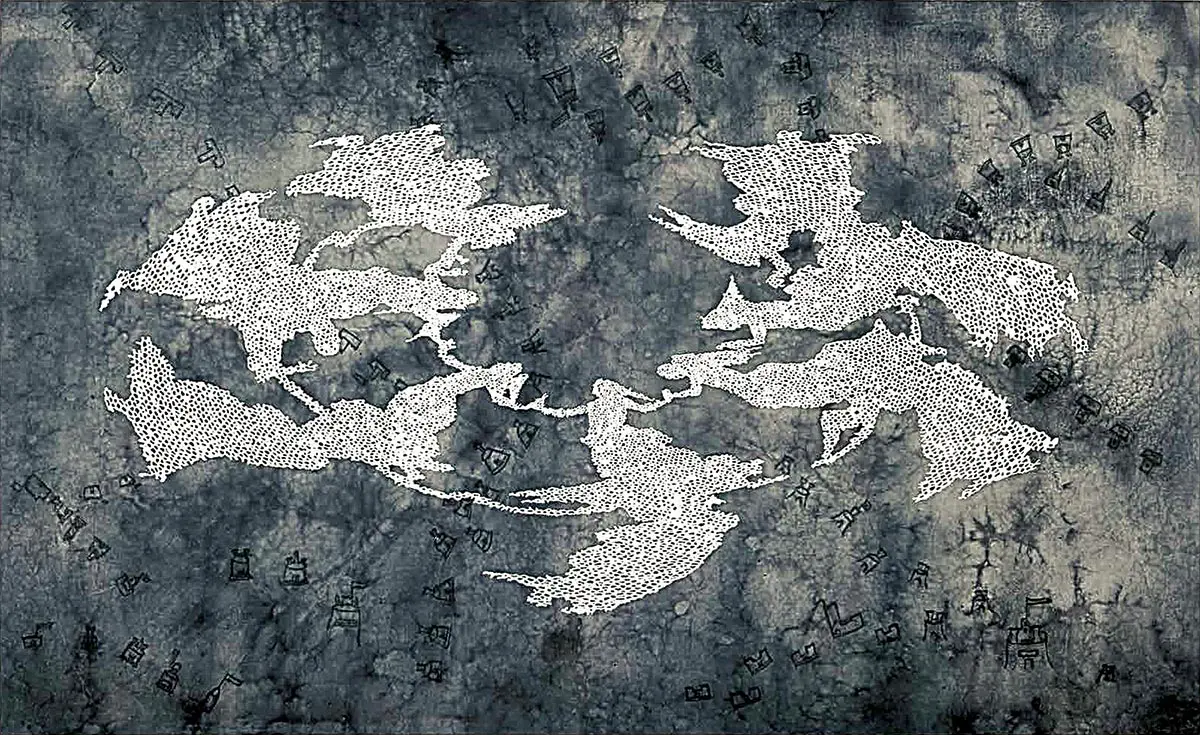
Goldfarb reveals a paradoxical pictorial narrative. Rational and sensible at the same time, his images are charged with a variety of themes always connected to the evocation of a historical-cultural time. Through his peculiar language, which combines the dexterity of masters from the Renaissance and upholsterers from the Middle Ages with the modernist vanguards, Goldfarb creates monumental canvases rendered with unusual techniques. He rarely uses brushes. The work titled A Ella No Le Gustaba Monet (She Did Not Like Monet), for example, was created with an original technique: grinding, which replaced the use of a brush, and embroidery using thread extracted from the support.
Printing with fire, embroidery, sewing with hemp, tar, and cow leather on canvas were the techniques developed for the works in the Biblical Theatres series, which shows the relationship between writing with geometry and figuration through Scripture and biblical architecture. The painting titled Mezuzá (Mezuzah) is shaped in the form of a six meters long scroll that contains Judaic writings engraved on raw canvas.
In the Black series, the painting without light alludes to Rembrandt, Velázquez, and to other references that reaffirm Goldfarb continuous dialogue with the history of art. He replaces the white areas of the raw canvas with black, using thousands of charcoal sticks. Washed with chlorine, the works reveal shades of orange and magenta that correspond to the tree that produced the charcoal.
In the Theaters of the Body, the canvases address sexuality in art, fetish, and the construction of the contemporary body, reflected in the Greco-Roman archetype, from research performed by the artist in gyms located in the south section of Rio de Janeiro and along the city’s coastline. The artist “deforms” the images of bodies taken from works by Michelangelo, Caravaggio, Gustav Klimt, and Egon Schiele by replacing them with bodies from postcards of women wearing string bikinis on the beaches of Ipanema and Copacabana, male and female pornographic magazines, the carnival and martial fights. The works in the Lysergic series explore the solar element in Rio de Janeiro; color and light unfold into a reflection on the possibility of a neo-impressionist painting combined with baroque that is so present in Goldfarb’s work. The color palette was created with a mixture of Indian ink with alcoholic anilines. It changes according to the brightness and continuously modifies through the irradiation and temperature of light.
Goldfarb’s most recent series, Wheeled Toy, is based on the nursery rhymes composed by Heitor Villa-Lobos. The research for this project and the physical construction of the pieces began in 2012. The series consists of six large diptychs rendered in pastel shades. Each diptych has two canvases: one with details of architectural ornaments from the Empire of Brazil rendered with lacquer injected into the raw canvas and handsewn gobelin-stitch embroideries, and the other with sheet music by Villa-Lobos, where random musical notes dance like rebellious children on the lines of pentagrams.
Walter Goldfarb showed his work for the first time in 1995 at the Centro Cultural Correios. Since then he has participated in important exhibitions in Brazil and abroad. In 2010 he was designated by the Latin Recording Academy in Hollywood as the official artist of the 11th Annual Latin Grammy Awards in Las Vegas. His work illustrated the catalog of the nominees, thousands of tickets, and the official poster of the event.
More than anything else, Goldfarb’s work sheds light on a scary outcome of contemporaneity: the loss of faith in art. He does so by reclaiming elements that are dear to the visual arts and frames them in the context of modernity: catharsis, flirtation, and ecstasy. Painting, figuration, and materiality make up much of this optimistic work. He chooses beauty over all things as a kind of the last gasp in the struggle for the cultural survival of mankind.
ALESSANDRA SIMÕES