
The work of Ximena Garrido-Lecca is circular: its themes converge at the beginning and the end, outlining a totality between seemingly distant worlds such as the world of industrial production and the system of traditional rituals.
Garrido-Lecca (Lima, 1980) has carved a growing space for herself in the Latin American scene. She recently participated in the Mercosul Biennial, the International Art Encounter of Medellin, and the United States of Latin America exhibition at the Detroit Museum of Contemporary Art.
In Madrid, Galería Casado Santapau is presenting Toma de tierra (Taking Earth), Garrido-Lecca’s second solo exhibition. It features four sculptures that unfold on the walls and on the floor of the exhibition space, and explore the earth as a source of physical and spiritual energy. In almost every religion, the land, earth, is a fundamental element for creation and life. It is also one of the oldest building materials, in use over many centuries. Recently, earth has even been used in electrical conductors, protecting users from possible shock. The show at Casado Santapau deals with this dual aspect of earth, and it interrogates the role played by science and its implication of a distance from nature and its potential.
The Peruvian artist had already worked with this material in previous projects, like Paredes de progreso (Walls of Progress) and Arquitectura de humo (Smoke Architecture), where she pondered the relationship between tradition, industry, and progress. Often in her works, we find an analysis of matter and modes of production, as well as an incisive exploration of the past, the present, and the concept of innovation.
Disecciones I consists of a vertical block of compacted dirt held together by screws. The simplicity of the material and its display—with the theatrical frame provided, on the surface and otherwise, by the white cube of the gallery—contrast intensely. The work’s reddish hue refers to a slow, manual effort, and the way in which it is presented necessarily evokes the coldness and serialized character of minimalist art.
This seriality continues in Disecciones II, this time with two blocks arranged in vertical parallel on the wall. A very interesting effect is again produced between the intense whiteness of the exhibition space and the sensorial nature of the clay, which involves a very concrete feel to the touch, as well as a color and a taste. From there, Garrido-Lecca continues the sequence into the ternary: Disecciones III presents us with three similar pieces that play with frequencies and intervals. A further curiosity: in the midst of this play of mathematics and abstraction we encounter some straw fragments and small particles mixed with the clay, which push us immediately away from the domain of the conceptual.
With these “elementary particles” as their launching platform, Morfología de contención (Morphology of Containment) features seventeen pieces anchored to the wall. This time, they tend towards infinity: there is a set number, but there could be many more because the idea is to expand the progression almost to the length of an electrical grid. The pieces here are smaller, more compact. As Elena Vozmediano rightly points out,1 sculpture combines the fragility of adobe and the firmness of industrial anchorings. There is a clear intention of giving shape to a spatial architecture, even if it is as a result of the impact of industrial development on natural resources.
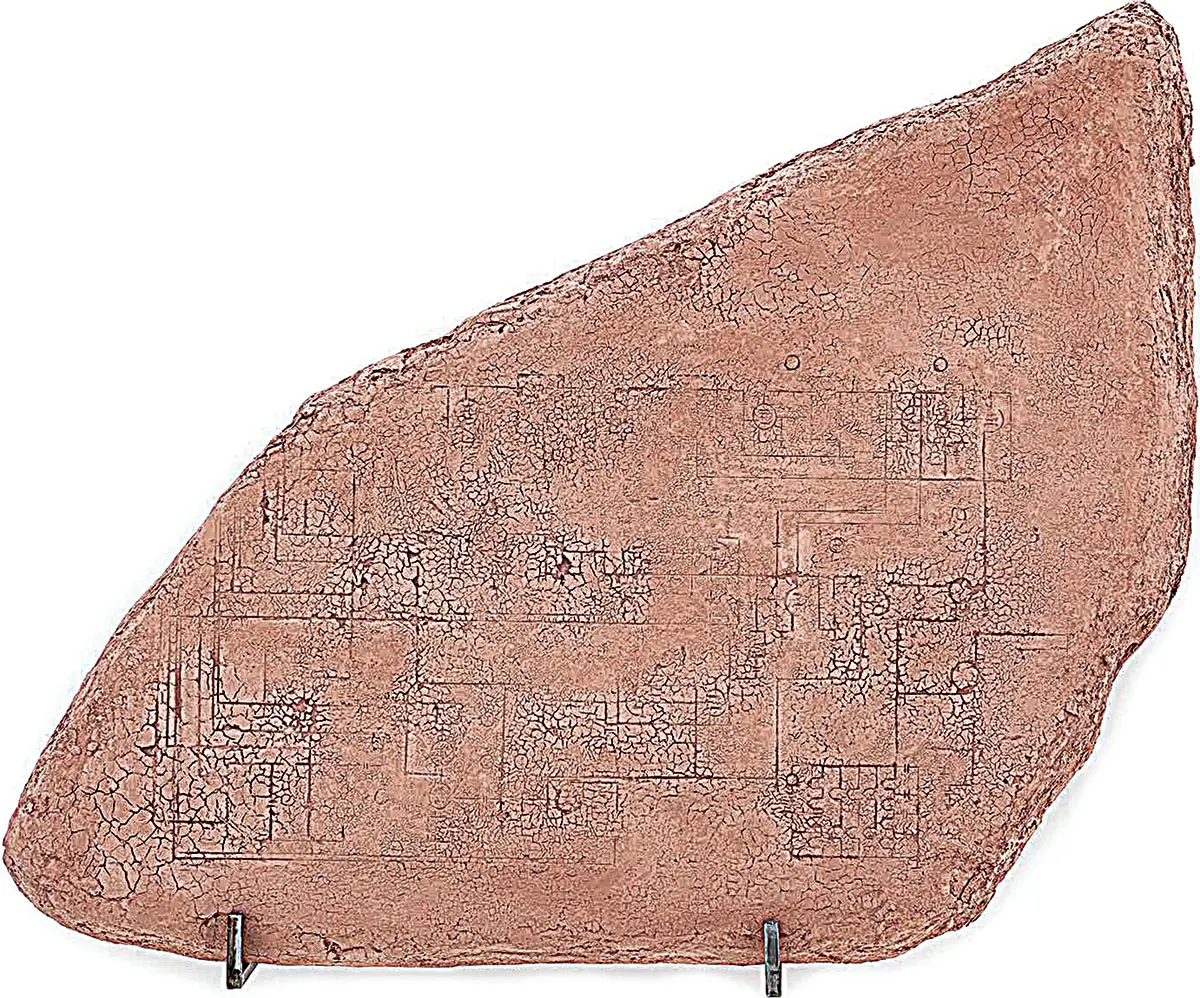
Writing mediates between the past and the present: the text as an intervention of the subject in the outside world. All codes are invention and creation. The clay fragments in Diagrama de seguridad I, II & III (Security Diagram I, II & III)—this time without a regular geometric shape—present on their surface a series of incisions that resemble linguistic signs. The roughness of the carving in the two blocks and the simplicity of the graphic system put us in mind of Neolithic culture and a primary relationship with nature.
In principle, the earth remains. But it also moves, and this is what Garrido-Lecca seems to be emphasizing. The physical energy of the land is transferred through contemporary materials like a copper thread (copper extraction being one of her native Peru’s main industries). The installation Toma de tierra, from which the exhibition takes its title, consists of a clay receptacle and a copper-thread net arranged on the floor. The receptacle alludes to Illapa, the god of thunder in Andean mythology, who was able to produce rain by rattling a jar from which water poured on the Earth Goddess, Pachamama.2 The material that flows in this case, however, is the copper net, which, despite its industrial origins, is woven with handicraft-like delicateness and care. A circle in the process of expanding, connecting the past and the present.
NOTES
1. Elena Vozmediano: “Ximena Garrido-Lecca, la tierra y el rayo”, El Cultural, December 11-17, 2015, p. 36.
2. Elena Vozmediano: Ibid, p. 36.
ANA FLOGUERA