
Ángel Ricardo Ríos started his career in Cuba in the tumultuous decade of the 1980s, when he exhibited his edgy installations. Later on, his interest in architecture and design took him to focus on sculpture, and to produce works dominated by the principles of both disciplines. These objects, indebted to Pop Art, became his personal seal and identified his work for years. Ríos’ path towards painting was forged almost as a logical consequence of the sketches and projects he created for his installations and sculptures, many of them situated in public spaces.
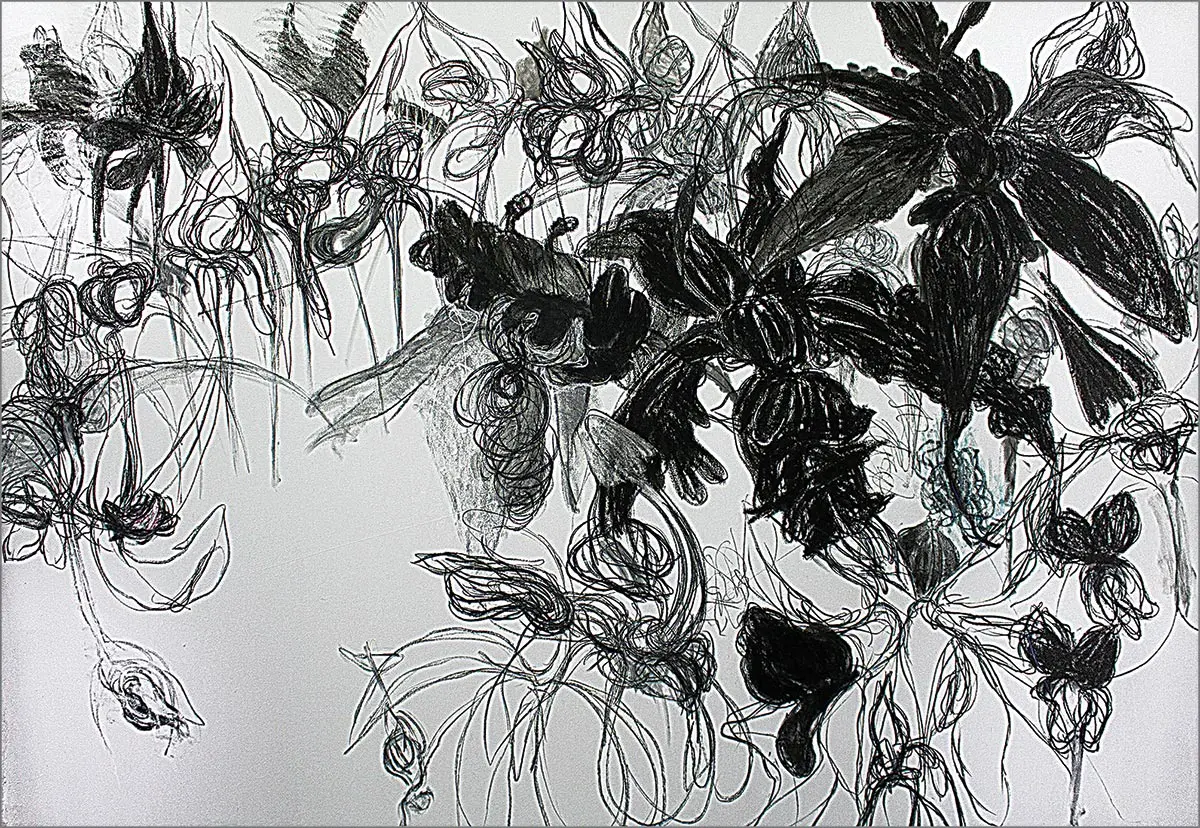
Ríos, who currently lives in Mexico, has participated over the years in many group exhibitions and a variety of projects in Miami; this is, however, his first solo appearance in the city, for which he decided to present a selection of his paintings. In an act of postmodern appropriation, he has adopted for his exhibition the title of Manet’s well known, and in his time controversial, Le Déjeuner sur l’Herbe. This homage to the famous artist is also a way to condition viewers, at the very least, for the subject matter of Ríos’ own work. It is a highly sensual painting, where greenery and vegetation are pretexts to talk about eroticism and sexuality. We can trace these subjects in Rios’ oeuvre back to a series created between 2011 and 2012 as a tribute to US artist Georgia O’Keefe, known for these kinds of images. In his earlier pictorial work, Ríos explored volume in an almost three-dimensional fashion, perhaps as a logical station in his passage from sculpture to two-dimensionality. In 2013, however, he began to experiment with the type of composition we see in this exhibition, dominated by a kind of horror vacui. Nature invades the entire space, and Ríos over the totality of the surface with superimposed elements, lines, and colors. He uses a mixed technique of pastels and oils to create layers and transparencies; the final results are images similar to graffiti, where elements from different planes come to mix. There is a palpable tension in these works, certain violence in their execution, which extends over the entire space; we can almost visualize the gesture through the brushstrokes.
One of the best summaries of the show’s general idea is the triptych Tapiz de la habitación del Sr. Donatien Alphonse François de Sade. (A Tapestry in Mr. Donatien Alphonse François de Sade’s Room). The title’s reference to the famous Marquis de Sade is an explicit marker of the work’s sexual intent. The vine-like flowers that form the composition create a tangle without an evident beginning or end. We are inevitably reminded of Baudelaire’s Les Fleurs du Mal, which, in a context similar to that of Manet’s painting, also engages erotic themes (and, like Ríos, use a flower as its pretext).
With these works, Ríos is also questioning the presuppositions and stereotypes that attach to painting as an academic genre. Although he uses a traditional technique, formally he gambles for shifts that may shock some observers. A good example is Grafiti sobre flora (Graffiti on Vegetation), where Ríos manipulates a traditionally academic theme, the still life, and takes it to a different place by incorporating elements of popular visual language, like graffiti. In Grafiti rosa en el baño azul (Pink Graffiti in the Blue Bathroom), meanwhile, Ríos revisits the O’Keefe-inspired symbolism that was present in earlier works, using orchids as an allusion to female sexual organs. The most suggestive work in the show is perhaps the highly explicit La fantasía del florero es la tuya también (The Flower Vase Fantasy is Also Yours). A table becomes a human body, and the flower vase is an allegory of the male sexual organ.
Desayuno sobre la hierba (The Luncheon on the Grass), an exhibition of large-format paintings on canvas and paper, offers a rather complete panoramic on the way Ríos works in sequences and makes it possible for us to discover a sense of continuity in Ríos’ oeuvre: with his performances in the selection of subject matter, and with his installations via the presence of a strong histrionic element reinforced by the format and the themes of his work. A unifying characteristic cutting across Ríos’ entire body of work is its stage-like nature, evident in his sculptures, his installations, and his paintings. The most notable difference, of course, is the treatment of volume and the use of space. While Ríos’ sculptures feature more minimalistic handling of the object, his painting is a kind of exercise in catharsis, seemingly unfiltered, and the product is more visually spontaneous.
IRINA LEYVA