
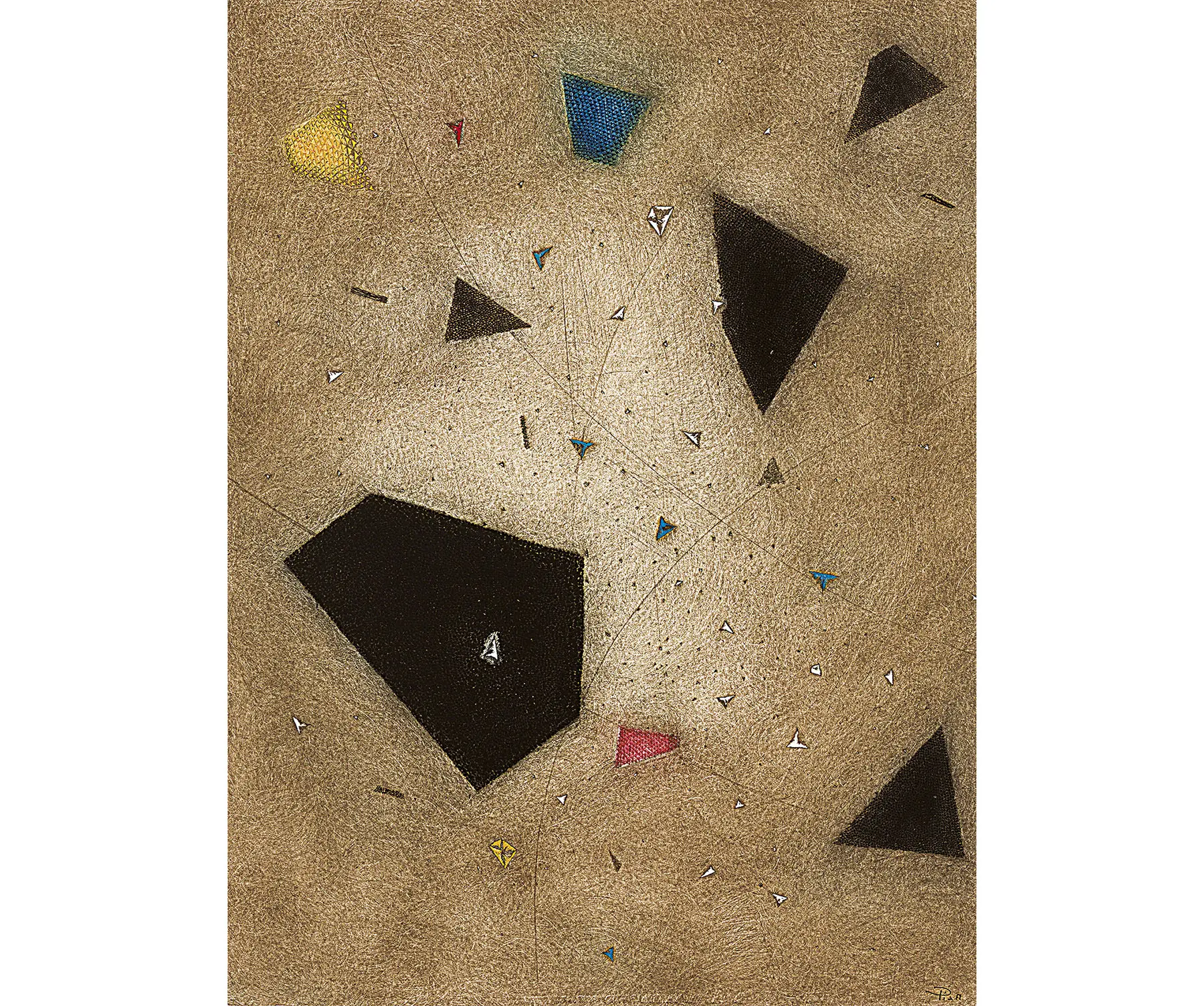
In the course of a six-decade career, Arthur Luiz Piza has brought printmaking and engraving to its ultimate consequences, exploring the technique’s deepest formal possibilities. In Piza, metal plates, incisions, and traces are what gives direction to the artist’s incursions into a collage, canvas, and sculpture, not the other way around. In sum, for this Brazilian artist, the craft of engraving and printmaking is, rather than a mere reproduction technique, a source for creative experimentation.
This is why the two Piza exhibitions that opened simultaneously in São Paulo last November are complementary. The first one, titled A gravura de Arthur Luiz Piza (Arthur Liza’s Art of Engraving) and curated by Carlos Martins at Estação Pinacoteca, features 137 graphic works organized chronologically, covering sixty years of work. The second exhibition, titled Piza 1947-2015 and presented at Raquel Arnaud Gallery, is guided by a different proposal. Here, curator Ricardo Sardenberg opted for a juxtaposition of different periods and techniques, creating sets of works where Piza’s early figurative paintings dialog with his later abstraction and three-dimensional works establish a connection with works on paper.
In that sense, the exhibition at Estação Pinacoteca reveals—literally—the matrix from which Piza’s art emerges, whereas the curatorship at Raquel Arnaud presents us with the vast interplay of splits and folds in this artist’s oeuvre. Arthur Luiz Piza was born in 1928 in São Paulo. His earliest works were created at Antonio Gomide’s workshop; these were figurative works with references both to Surrealism, notably in the deformation of the figures, and to post-impressionism (and, more specifically, Van Gogh), which can be seen in his use of primary colors and the juxtaposition of layers of oil paint.
In 1952, after participating in the First São Paulo Biennial (1951), Piza traveled to Paris, intent on devoting his efforts entirely to the technique of engraving on metal. It was during that period that he met Johnny Friedlander, a master engraver who would lend Piza not only his knowledge but also his tools, the entire apparatus required for the genre. Piza remembers Friedlander as gracious and patient; once, when the young Brazilian damaged a press in his studio by inserting wire between the roller and the plate, Friedlander not only didn’t get upset, he celebrated the results.
Settled in Paris to this day, Piza was a founder, along with Julio Le Parc and Luis Tomasello, among others, of Espacio Latinoamericano, an initiative intended to promote Latin American art in Europe and help Latin American artists make a living from their work, a difficult task during any era1. Piza tells that when they found themselves in need of funds, they went to Roberto Matta, who was already renowned and well established. At first, Matta always refused to contribute, but he wasn’t difficult to convince; with a little push, he’d give them one or two of his paintings. After collecting a sufficient number of works in that manner, the group would present an exhibition, and the money from the sales would go to purchasing materials for them to continue with their projects.
Artist-Artisan
Arthur Luiz Piza acknowledges no difference between an artist and an artisan. He has said that his craft is like that of a shoemaker, where manual dexterity and technical know-how are essential. With this, Piza goes against the grain of two pillars of the arts in the second half of the Twentieth Century, one that prioritizes concept over execution, and one that understands the work of art as strictly geometrical. Both abdicate manual skill as a foundation of artistic exploration. In that sense, Piza says he has never professed the religion of his era: pure geometric abstraction, which characterized the work of kinetic and concrete artists in the 1950s.
Thus, while there is a certain degree of geometry in his works, Piza was never concerned with the minute calculation of lines or angles. His figures cannot be described in mathematical terms; on the contrary, they are a sensible experience, intimately connected to how he works on a metal plate, which in his case is equivalent to the work of a sculptor. Arthur Luiz Piza carves the plate, sculpts it with burin and gauge, leaving traces in the shape of diamonds and triangles that, over the decades, escaped their original genre boundaries and became collages, cuts on canvas, and folded metal plates.
This is why, concerning a canvas with incisions, Piza warns: “I have nothing in common with Lucio Fontana. He is a barbarian.” And, indeed, their respective interventions are different by nature: Fontana arrives at cutting via the problem of how to transcend the plane in conceptual terms; Piza arrives at cutting through an exploration of the burin and its marks. Thus, experimentations on canvas emerge from the matrix of engraving—a key point, as Piza here inverts the sequence of techniques, their standard hierarchy. In his oeuvre, engraving is not subservient to painting, but the other way around. The incision on the canvas comes from the incision on the metal plate. It is his engraver’s craft that brings Piza to breaking and perforating the canvas.
A Deep Surface: Estação Pinacoteca
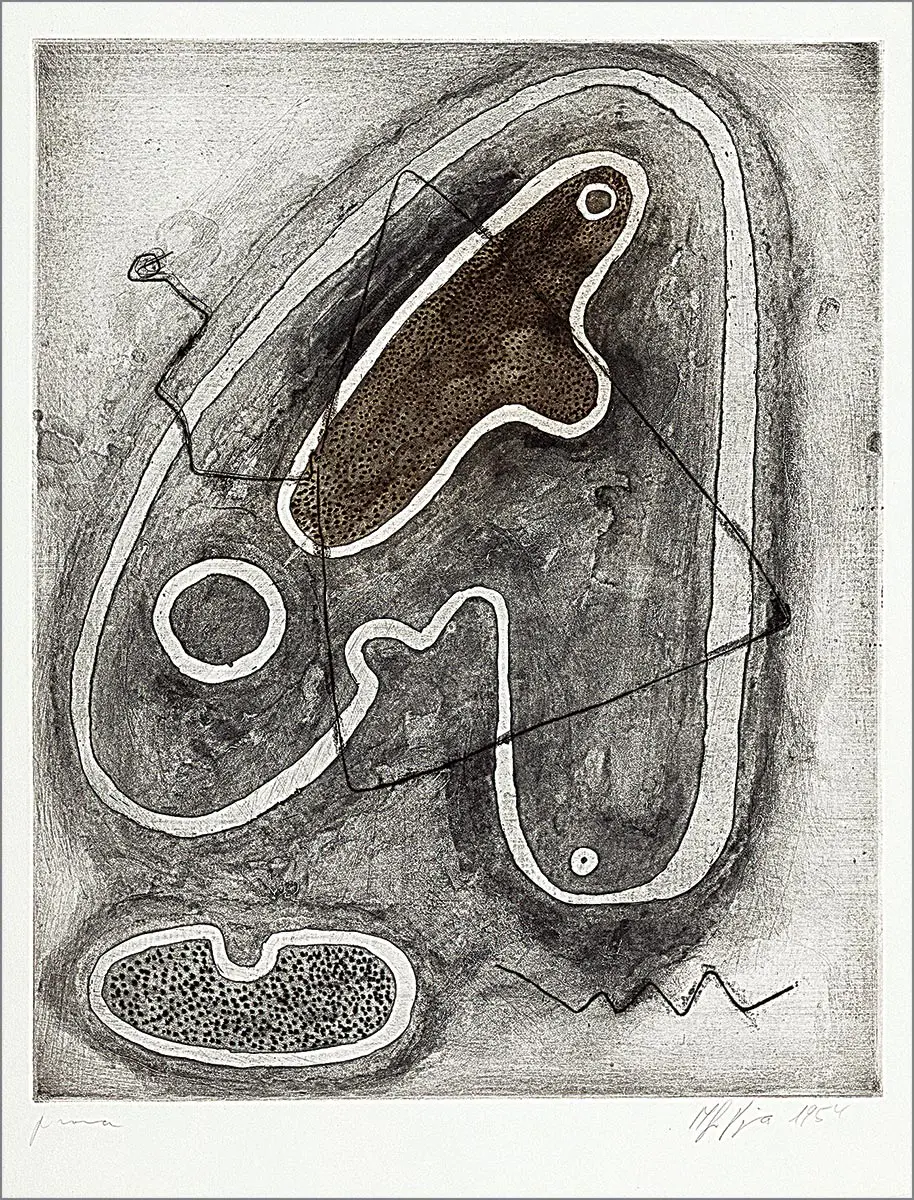
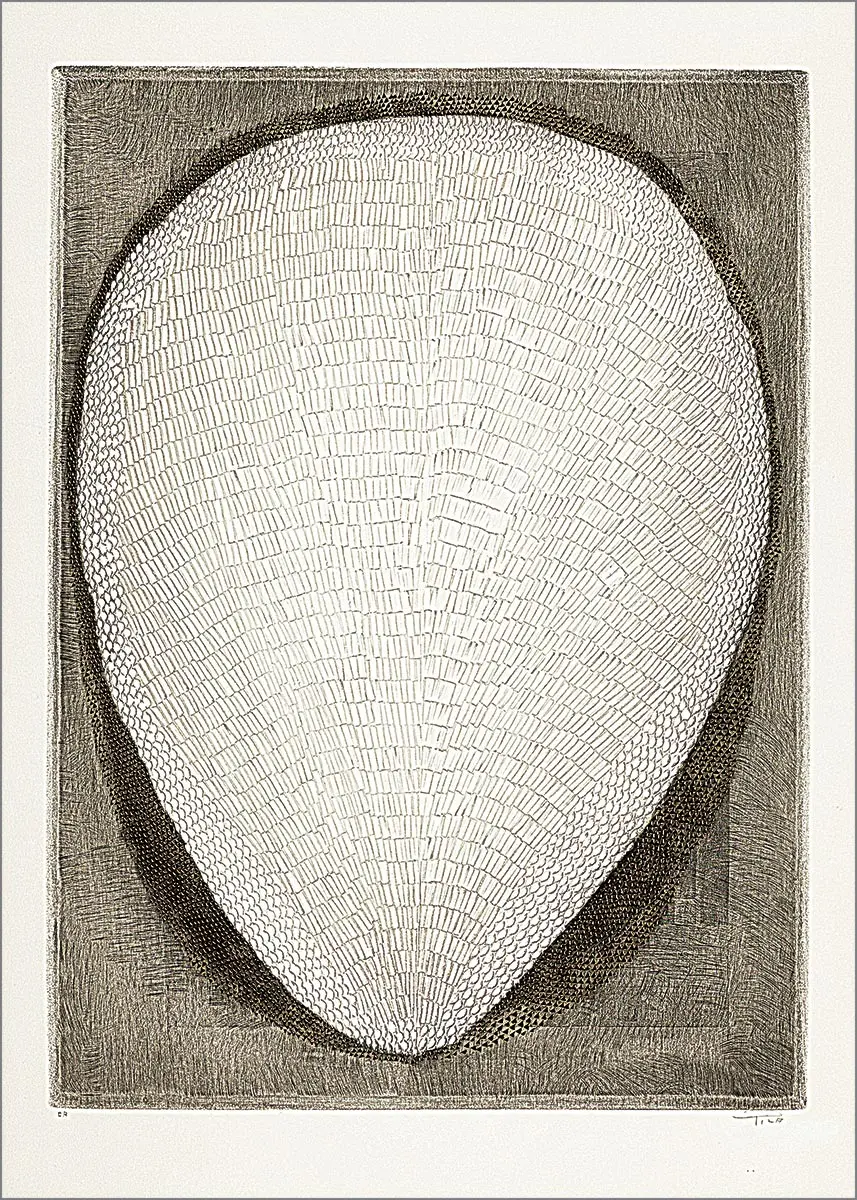
Arthur Luiz Piza’s works are eminently tactile. Although they reach us through our eyes, they are fully perceived only through the tips of our fingers. This is so because the metal plate is no longer the matrix for an image, but an image in itself. The exhibition at Estação Pinacoteca makes this abundantly clear. At the entrance to the show, before they begin their tour through the chronological sequence of works, visitors encounter three items, separated by twenty years, which curator Carlos Martins decided to place together in order to concisely summarize the artist’s process. These are Células (Cells), from 1954; Tatú-bola (Armadillo-Ball), from 1971, and El rojo y el Amarillo (The Red and The Yellow), from 1995.
In Células we find an artist interested in learning the technique. A young Piza who combines the three main methods for working with metal plates: Durer’s drypoint, Rembrandt’s etching, and Goya’s aquatint. They are all juxtaposed in a work that, from the start, transcends the figure and focuses on the incision on metal, be it direct or by means of acids and minerals. Piza explores the trace of the plate on paper: the velvety line of the drypoint, the clean marks left in etching, and the watercolor-like feel of the aquatint. Everything is examined in a single work because by that decade, the 1950s, the question was already not how to create an image on the basis of the technique, but how to show the technique in its own image. In other words, showing the trace, rather than placing it at the service of anything else, which is to say, of a figure.
In Tatú-bola, from 1971, Piza is no longer an engraver, but a sculptor of plates. His burin carves the copper surface to create a topography so rugged that the engraving becomes a kind of dry stamp. The groove is brought to its ultimate consequence, so deep as to no longer necessitate ink: the paper suffices to reveal the matrix. Piza, however, is not a purist; in this engraving, the ink is around the matrix, highlighting the topography of a figure that, coincidentally, appeared as a balled-up armadillo, turned into a sphere to protect itself from the world and its fury.
Finally, in El rojo y el amarillo, from 1995, we encounter an artist who has developed his handling of color, a key element in his process that even resulted in clashes with several printers due to its technical demands. In El rojo y el Amarillo, made with gauge and drypoint, the figures are as important as the ground. A series of colorful triangles and diamonds fluctuate in a half-grey, half-brown space; the shapes were produced by the gauge, which made deep incisions on the plate, perceptible thanks to the thickness of the paint or to its absence (which is to say, when the incision became an orifice, and the paper did not come into contact with the matrix). The ground, made with delicate strokes, is entirely tactile, a surface to be seen with our eyes and to be felt, as I said before, with our fingers. A deep surface.
Here, then, begins a course through six decades of artistic work in engraving and printmaking techniques. And I say this because, in Piza, the engraver’s methods (be it the cross hatchings used to create a shadow, be it the networks of diamonds used to build a cheek on a face or the fold of a dress), gain autonomy, expand, and become perceptible in large formats. In this way, the grids that in a traditional engraving (or a banknote) would be noticed only with the help of a magnifying glass, can be seen here with the naked eye. In this experimentation, the artist began to expand the formats to a point where the matrices overtook the boundaries of the paper. Thus, some of Piza’s works move beyond the borders of traditional engraving techniques.
Engraving as Matrix
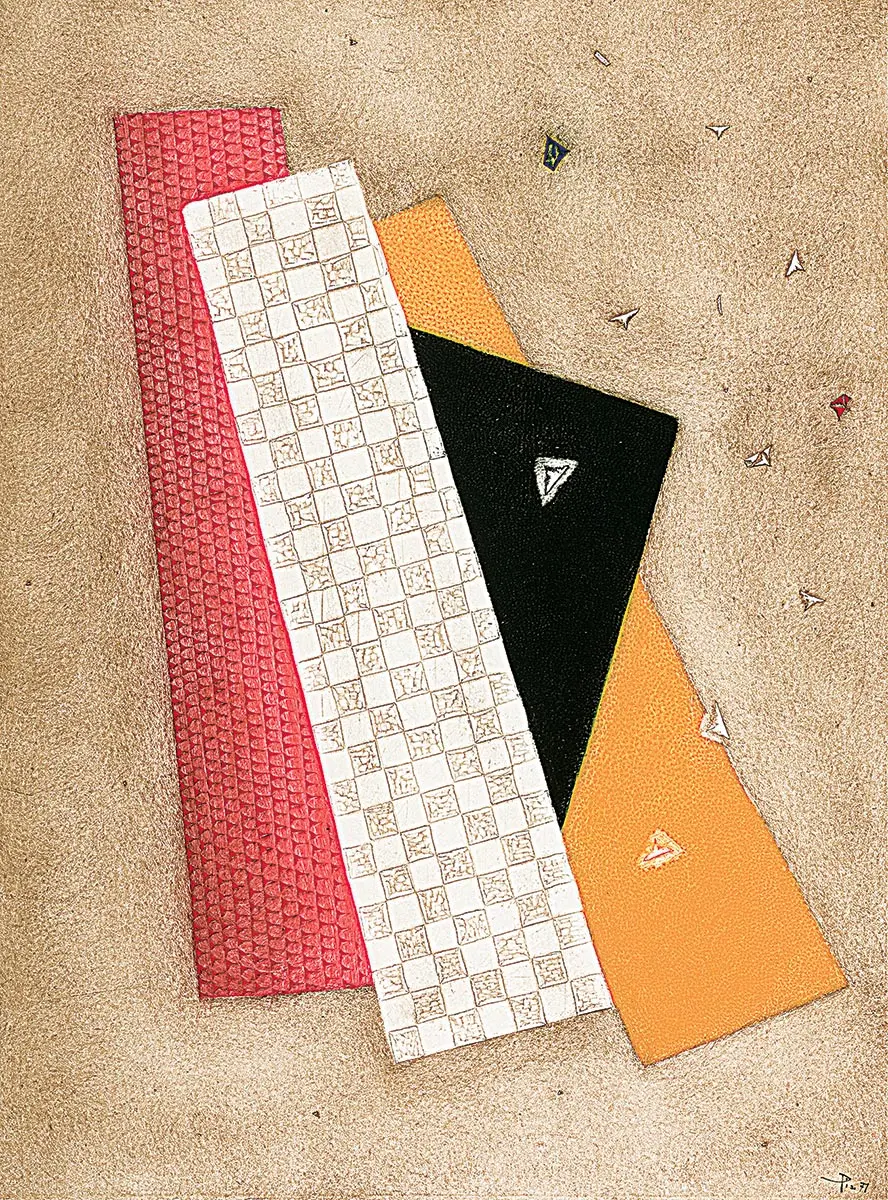
For Piza, engraving is a starting point, not a point of arrival. In his work, engraving is the matrix for experimentation. Figures emerged from the burin and the gauge, such as diamonds and triangles, gain autonomy and become cuts and collages on thick pieces of paper, working with the help of scissors and scalpels.
This aspect of Piza’s oeuvre takes us from Estação Pinacoteca to Raquel Arnaud Gallery. There we see how the diamonds and the triangles of the engravings transcend the paper to become, in a way, three-dimensional paintings based on geometric shapes made from juxtaposed sheets of metal and grids, or sculptures like Tatú (Armadillo, 2008), made from a succession of folded sheets arranged directly on the gallery floor.
As we apprehend Piza’s process, his aesthetic obsessions, we come to realize where that 2008 work comes from. This is to say, we realize that, in the end, this armadillo emerges from an incision made so many decades before by the burin and the gauge, an incision that Piza freed and developed along with a diversity of paths: ink imprints, absence of ink, folds on paper, or folded sheets that give shape to an object.
Piza turns the act of engraving—the action of leaving an imprint—into its own referent. He unleashes and frees the engraver, and instead of abandoning the craft in a liberating-modern outburst, brings it to its ultimate formal consequences.
NOTE
1. The participants in the initiative were Arthur Luis Piza (1928), Rodolfo Krasno (1926-1982), Julio Le Parc (1928), Luis Tomasello (1915-2014), Luis Felipe Noé (1933), Jack Varnarsky (1936-2009), Fernando Maza (1936), Leopolodo Novoa (1919-2012), José Gamarra (1934), Gontran Netto (1933), Juvenal Ravelo (1934), and Alberto Guzmán (1927).
JULIA BUENAVENTURA
Art critic.