
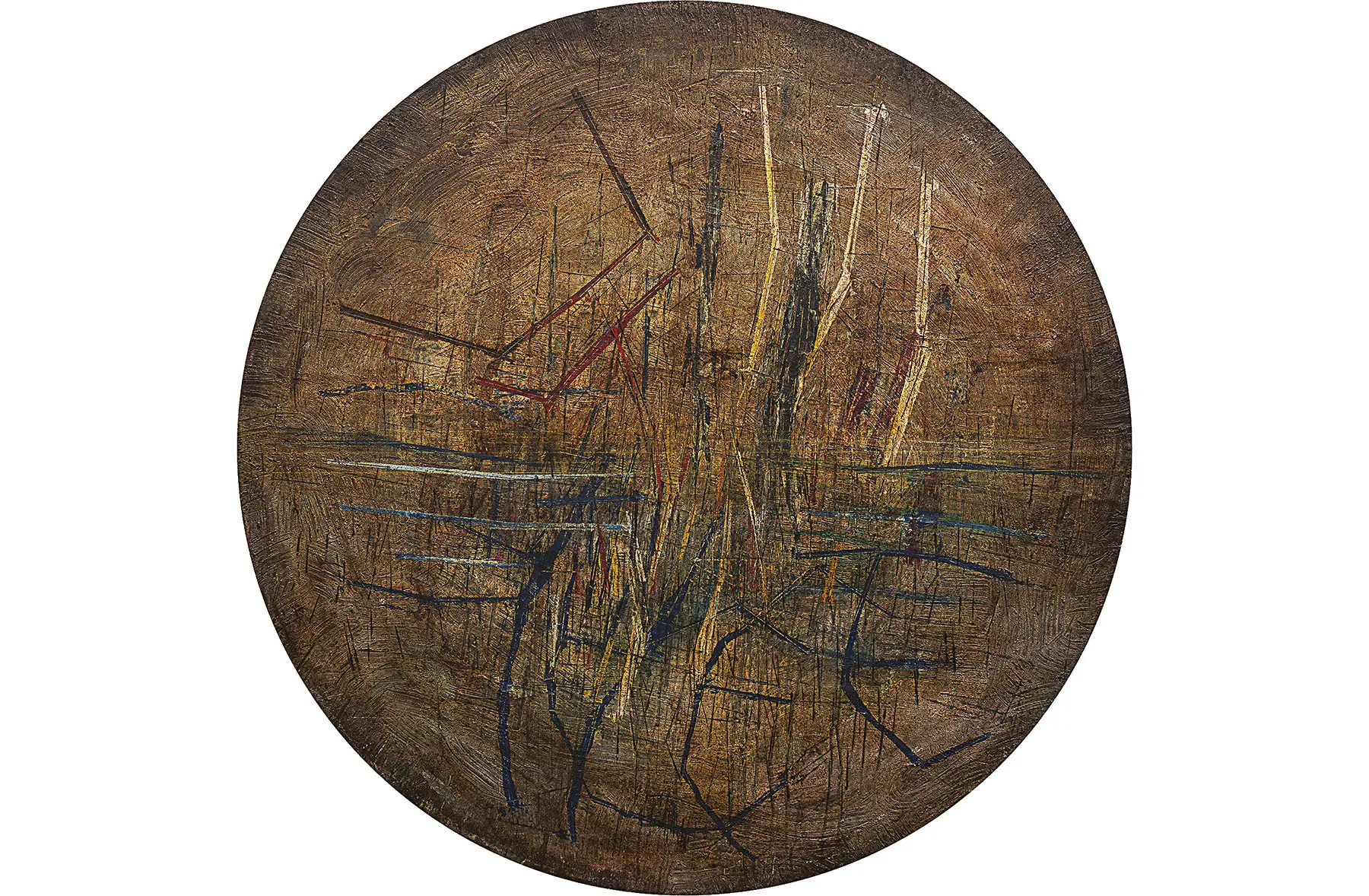
Coinciding with the dates of the various international art fairs held in Miami, a solo exhibition of works by Colombian artist Carlos Salas (Pitalito, Huila, 1957) opened last December at the MoCA (Museum of Contemporary Art of North Miami). This exhibition, Salas’ first in the United States, was part of the Global Imagination project launched by the museum with the purpose of including first-rate artists who, because they are considered peripheral, have not had a presence in the dominant international circuits. This generous exhibition, contributing greatly to a new articulation of the artistic landscape of the global Twenty-First Century and breaking with outdated schematics of the “center” and the “periphery,” focused on Carlos Salas’ production of the last five years, after his extensive retrospective at the MAMBO (Museo de Arte Moderno de Bogotá) in 2014.
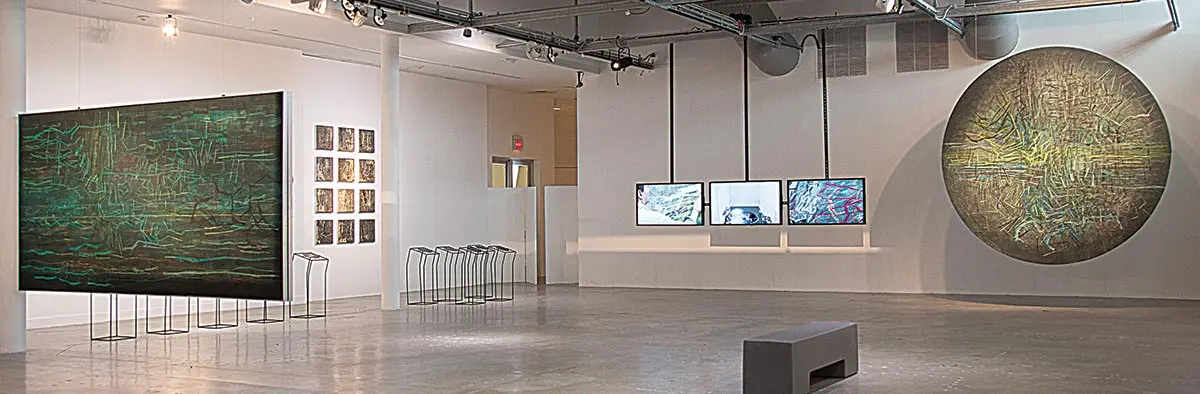
Implicit in this presentation is a critique of the supposed Euro/US monopoly on abstract art, by bringing forth a contemporary proposal in abstract expressionism (rather than in geometric abstraction, which has been given wide recognition as a Latin American forte). Over the course of a decades-long career, Salas’ oeuvre has expressed premises that emerge from a distinct context, bringing into play its own aesthetic and historical issues and presenting them for consideration in their own terms.
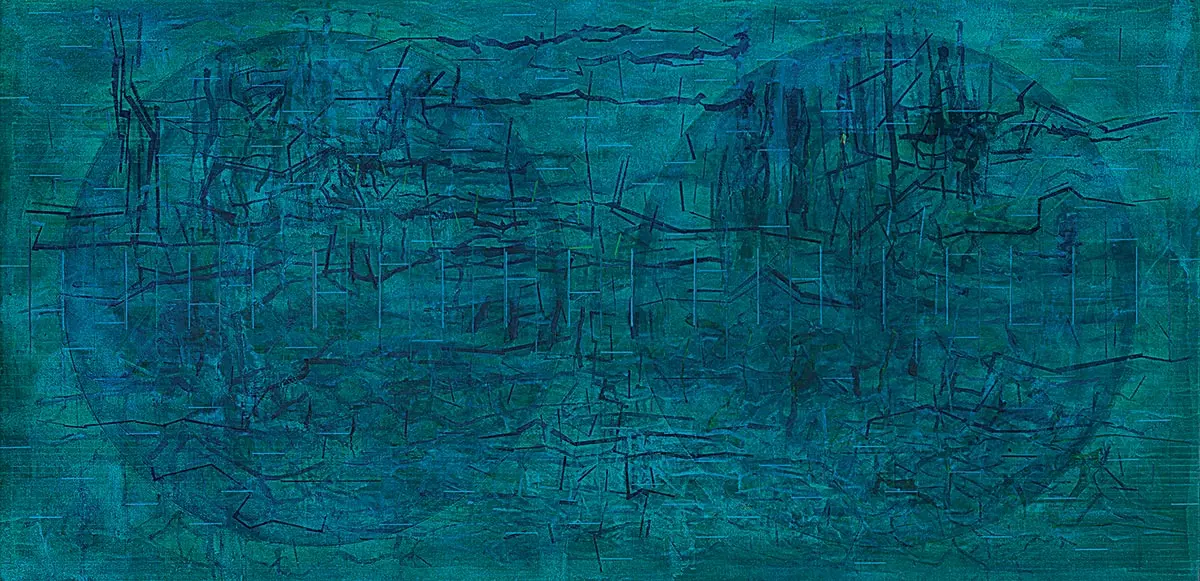
In Salas’ work, which has evolved mainly in series, the exercise of painting as a lived experience, correlated to the artist’s emotions and events in his life that converse during his creative process, has been recurrent. Formally, Salas’ paintings feature many structural and semantic layers: a reticulated, geometric organizing substratum; atmospheric zones and blotches dominated in each series by a monochromatic concept; and freer writing of markings, notations, and scratchings whose emotional import often implies an impetuous struggle with the pictorial field. The paintings in the 2010 series Marcas del sentimiento (Marks of Feeling)—as well as the earlier Cartografía del sentimiento (Cartography of Feeling), not included in the exhibition—are mappings of Salas’ emotions, recording each event or injury, what happens in his body and his mind, as though they were landforms and geographical features.
One outstanding aspect is the gradual appearance and evolution of the circle as an iconographic element, to the point of becoming dominant or foundational. In the ninth work in the 10-piece series Cada cuadro su historia (Each Painting its Own Story), from 2011 (a sequence of topographical terra-cottas and atmospheric blues), we notice two circles, and in the 10th the figures are fully defined; later, in the six works that comprise the 2014 series Desde lo profundo del alma (From the Depths of the Soul), Salas breaks decisively with the rectangular frame in order to paint directly on the circular support. The final exaltation of this shape came in En el abismo (In the Abyss, 2014), a monumental circle, three meters in diameter, that is the exhibition centerpiece. This element appears with the connotation of a Jungian archetype, intermittently and simultaneously a womb, a point of origin, an infinite universe or world, a Mandala that recreates the possibility of complete integration; the field of a dialog with the potential for life, for rebirth, in this case in connection with personal processes of chaos and recovery.
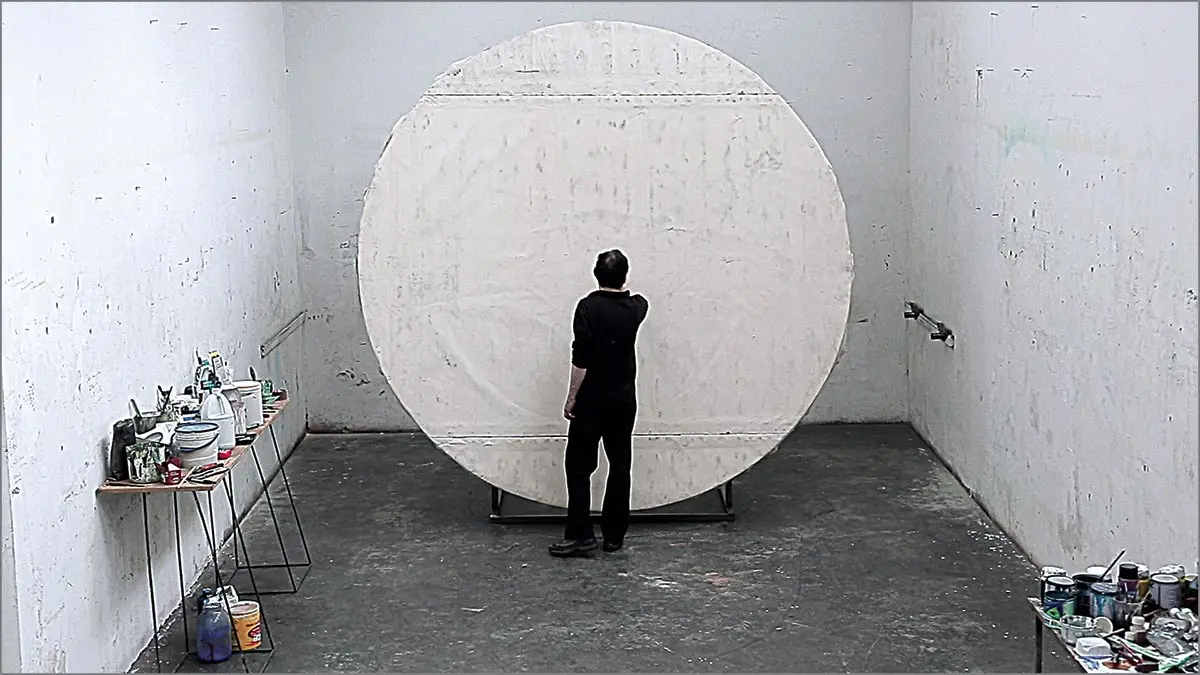
The exhibition also features, in full, the documentary En el Taller (In the Studio), filmed in Bogotá by Ana Salas, a Paris-based filmmaker who is also the artist’s daughter. The film follows Carlos Salas in his creative process and sheds a light on its vicissitudes as he produced his monumental En el abismo. The abyss is the artist’s approach to the large circular canvas, which he confronts and into which he inserts himself like the Vitruvian man in the process of creating and reasserting life in the face of the unknown. The film is a look into an artist’s inner world and his studio, and a view of the production process. Here, the sounds of the pictorial labor underscore, like augmented reality, the materiality of the craft, and a context is provided for the Salas’ process, situation, and philosophy; his everyday action and routines; his relationship with his daughter and others; his view of the country and the news; and his own feelings. All of these elements impact Salas and he dialogs with all of them; at the same time, they catalyze the markings and the dialog that Salas establishes with his own work. The documentary is explicitly self-referential, both with regards to the artist’s production and to the production of the film itself.
The sustained, inquisitive gaze that Salas was subjected to during the filming of the documentary, like a magnifying glass, derived towards the creation of another series of paintings and sculptural objects, Una daga clavada (A Stabbing Dagger, 2015), where the circles, in turn, refer to and magnify the viewer’s prying eye, inspecting and amplifying regions of Salas’ painting.
Originally educated as an architect, Carlos Salas is personally involved in the design and installation of his exhibitions. At the MoCA he decided to replicate the staging of his oeuvre presented at the Bogotá MAMBO, transforming the gallery space by tearing down walls and opening up space into an imposing continuous expanse. There, his work exemplified fundamental aspects of the survival and renewal of abstract painting, in a proposal that tended to the universal via the establishment of a dialectical relationship between art and life, and where the empty canvas becomes, rather than a window to the outside world or a page for the construction of intellectual paradigms, an open field for reflection and dialog with life, integrating formal, structural, and semantic aspects.
NATALIA VEGA
Historian and art critic, museologist.