
From Foucault’s theories about a society ruled by disciplinary structures to writer Nelson Rodrígues’s affirmation that unanimity is dumb and to Sartre’s existentialism, the idea of confinement permeates many contemporary poetics. Among them is the work by Cinthia Marcelle, who in her third solo,p0o exhibition at the gallery Silvia Cintra + Box 4, returned to that subject.
Titled In-Between-For-Before, the exhibition consists of an installation with paintings and objects that directly remits to the central concept of confinement and reveals paradoxes like jail and escape. The proposal by Marcelle was to explore the symbolic (and historic) space of Brazilian prisons, approached from outside by someone who experiments with the socio-economic and psychological confinements of society, the boundaries of everyday life, while also projecting a line of escape through her aesthetic exercise.
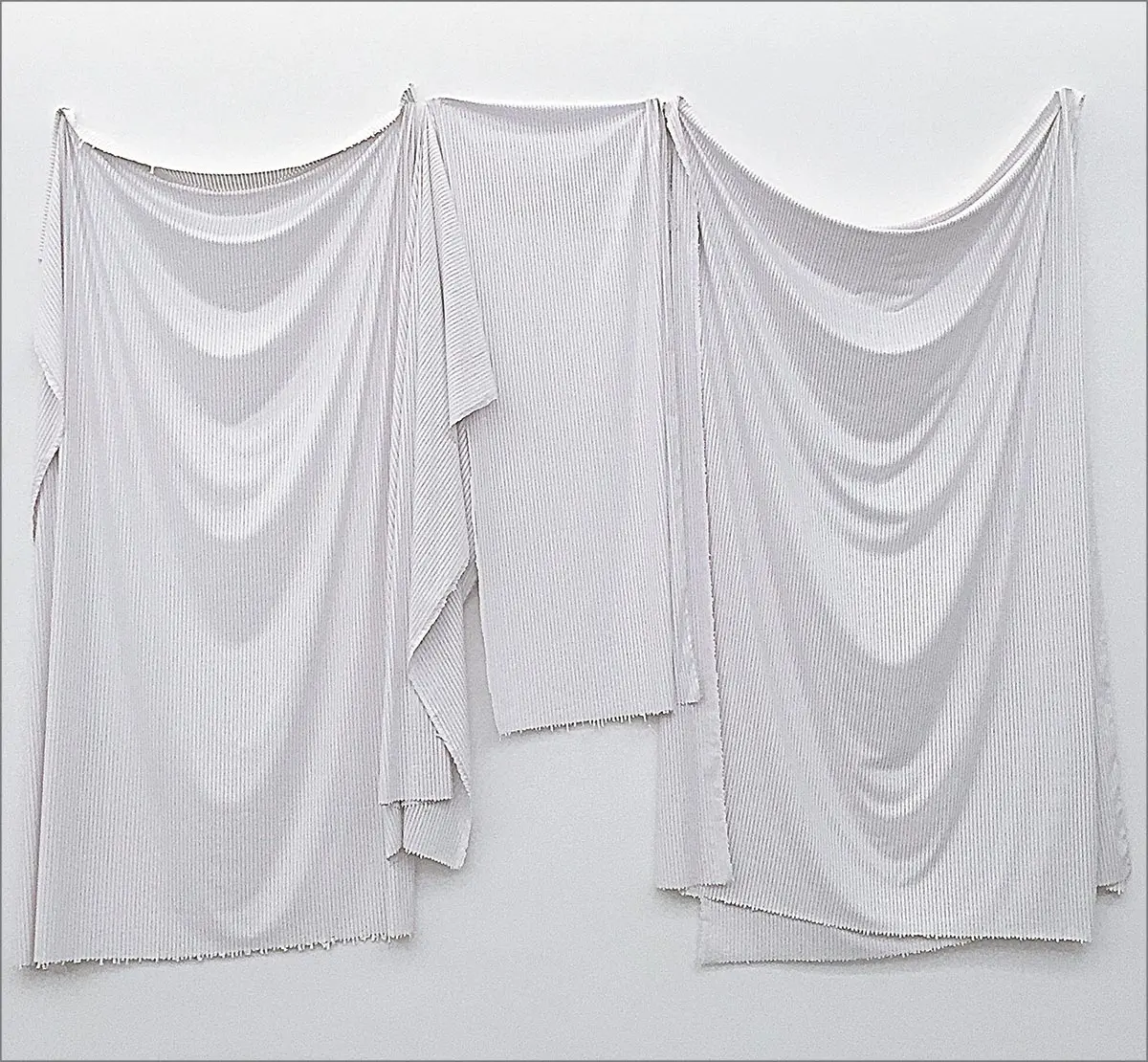
A series of stripe fabrics hang quite high on the walls. With their black stripes painted white, the group refers to the image of a central patio in a prison. A group of works on the floor has been covered with black laces; most of them are instruments that suggest tools used for escaping. Viewers walk through a narrow corridor in a game of opposites between the things that are high and those that are low, between that which is uncovered and hidden, loose and tied.
Once again, Marcelle resorts to a leitmotiv in her work: the shortcomings of a modern capitalist society in which the false idea of liberty is predominant. Her work often relies on narrative resources expressed through multiple languages, like installation, photography, and video, among others. Her operational processes also favor multiplicity and Marcelle turns such diversity into the unifying element of her poetic.
This does not mean that her work is incoherent; its internal structure is marked by a complex network of references in which reminders of the real world converge. Yes, Marcelle is a builder of images that always speak of a real and harrowing world. It is no accident that works by her have already become anthological: the small mountains of chalk on an empty blackboard, a man carrying a long and improbable line of bricks piled so high that they hide his face, or the garbage bags staked to infinity.
One common characteristic in all of her works could be their surreal atmosphere. In the piece Fuente 193 (Fountain 193, 2007), for instance, Marcelle rented a fire truck and had it constantly running on a full circle with the hose aiming the water stream to the center of the circle. The scene was recorded from above, inside an iron mine in Minas Gerais. After a while, the red soil that fills the entire image frame becomes mud, making the circular movement of the fire truck increasingly more difficult. In a continuous loop, the video is presented in animated form created with the equation of man-machine-soil, where the action is activated by time through the changes in light.
Another video titled Confrontación (Confrontation, 2005) from the series Unus Mundus depicts jugglers on a pedestrian crossing provoking drivers anxious to continue on their way after the traffic light turned green. Another resource often employed by Marcelle is inviting the public to participate in the work. In Legendarios (Legendaries, 2008)—also from the series Unus Mundus, at the Centro Cultural São Paulo—she wanted to showcase those individuals who are usually left out of the artistic scene, but who are nonetheless recognized in the place in which they work by workers and visitors. She composed a highly expressive portrait that uses the element of surprise by showing a flabby looking woman in the background with her breasts exposed.
Cinthia Marcelle was born in Belo Horizonte in 1974 and currently lives in São Paulo. She earned a degree in Fine Arts from the Universidad Federal Minas de Gerais. Her work has been shown in important exhibitions, including The Havana Biennial (2006), the Lyon Biennale (2007), Panorama de Arte Brasilero in São Paulo, and Madrid (2007-2008), and the São Paulo Biennial (2010), among others. Marcelle was also awarded the International Prize for Performance, Trento, Italy (2006), the Annual Train Artist in Residency Award at Gasworks, London (2009), and The Future Generation Art Prize, Kyiv (2010).
Despite the expressive multiplicity of languages, her work appears to converge towards the hybrids of “video-performance” and “photo-performance,” because of the syntactic organization that such combinations offer, as they underscore notions of temporality, ambiguity, and allusions to the ephemeral and the incredible. All elements converge in a poetic common thread: the senselessness of mankind.
ALESSANDRA SIMÕES