
Coproduced by the Jeu de Paume, the Fondation Nationale des Arts Graphiques et Plastiques, and the CAPC Bordeaux (Musée d’Art Contemporain), Mesoamerica: The Hurricane Effect, a 16’ 20’’ video by Mexican artist Edgardo Aragón (1985) was presented at the Jeu de Paume as part of its Satellite 9 program. Titled Notre océan, notre horizon (Our Ocean, Our Horizon), this ninth edition of the program deals, as its catalog states, with notions of oceanic identity and terrestrial identity, two prisms through which each one of us is able to focus our relationship with the world as a whole. Four more solo exhibitions (by Patrick Bernier, Olive Martin, Guan Xiao, and Basin Magdy) complete the Satellite 9 project. Accompanied by a series of ten maps of Mexico intervened by Aragón, Mesoamerica: The Hurricane Effect is intended to denounce American meddling in a southern region of Mexico, in the state of Oaxaca: the Cachimbo Peninsula, often devastated by violent hurricanes as well as by emigration, corruption, and drug cartels. The subject matter explored by Aragon (a native of the region) is eminently political, and his goal is to bring viewers to a greater awareness of the issue via a series of images built into an artistic and political discourse intended to move us to indignation and/or resistance.
Resistance is indeed one of the defining characteristics of the history of Oaxaca, one of Mexico’s poorest states along with Chiapas and Yucatán, and, like them, host to a large indigenous population. The Oaxaca region cultivates a tradition of opposition since the days of Benito Juárez, Mexico’s first indigenous president, who confronted and defeated the invading French army in 1864. Two artists have perpetuated this tradition: Francisco Toledo “the Insurgent” (Olivier Debroise), with his adherence to the struggle of the Free Municipality of Juchitán, implemented by the COCEI (Worker, Peasant and Student Coalition of the Isthmus, in its Spanish acronym) in 1981; Alejandro Santiago (1964-2013), with his exploration of exile and his 2051 clay sculptures depicting migrants from a depopulated highland village who flee the endemic poverty of the region in the direction of the United States. In 2006, under pressure from striking education workers and the generalized demand for the State Governor to resign, the city of Oaxaca was occupied for six months by special police forces. The occupation provoked a flood of solidarity among artists, who, in support of the opposition movement, produced stencils for street propaganda, videos, performances, prints, and posters.
There can be no doubt that the content of the issues brought forth by Aragon is correct and just, but perhaps the form of his production can be questioned. Indeed, is a message based on the juxtaposition of images of desolation, homes in ruins, the disembodied voices of victims and affected populations, abandoned fields, draught, barbed-wire fences, fallow land, and nature at its most feral—a spectacle of misery in stark contrast with the sparklingly new park built eight kilometers from Cachimbo—sufficiently clear? When Edgardo Aragón tells us that this town (more precisely, this ghost town) lacks electricity and that he has to make do with a car battery to charge his phone and turn on his fan, we understand his intention of having us reflect on the gap separating a US-led project and the realities of Mexican life; according to the curator, Heidi Ballet, “Mesoamerica is also the name of a US-financed multi-million-dollar project intended to promote development in the region through investment in infrastructure, energy, telecommunications, and transportation.” Yet, not all is despair (for the artist): he invokes Andrés Henestrosa, a Cachimbo-born writer and politician, by showing a copy of his book Los hombres que dispersó la danza (The Men that the Dance Dispersed) and having a local Cachimbo citizen read fragments of an old Zapotec legend.
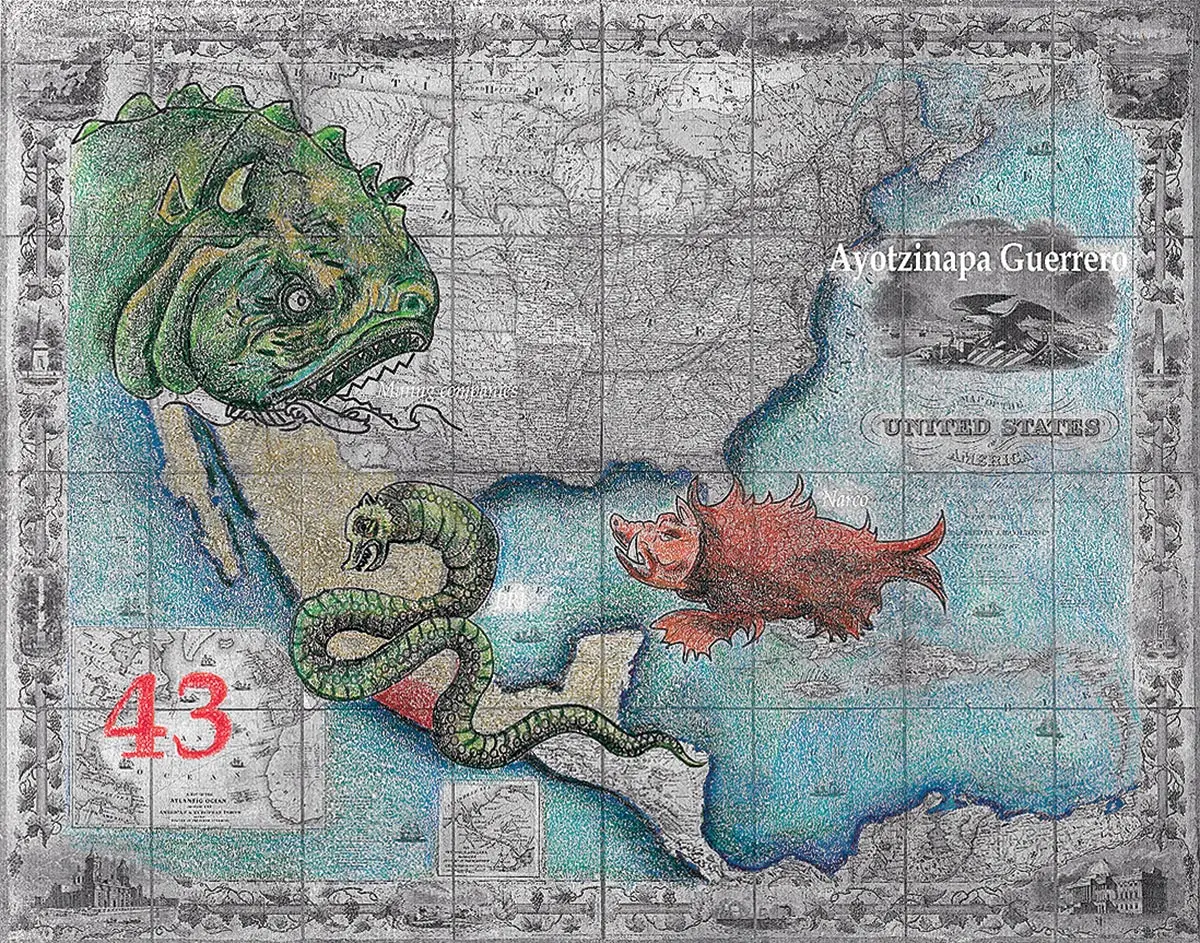
Aragón’s images are not vehicles for intrinsic violence; they are violent due to the situation they depict or suggest. Aragón poses a question about the meaning of the images and their reception by viewers. Must images be violent to be convincing? Must visual discourse be sufficiently structured in conceptual and political terms, in order to meet its goals? Or is meaning produced by the brute image itself? The core of the issue here is the intellectual effectiveness of the relationship between an idea and the format in which it is expressed. On a display case in a different gallery, several hand-colored maps explore the evils afflicting Mexico, such as the drug cartels, the dominance of the old PRI (the corrupt Institutional Revolutionary Party, which governed the country unchallenged for 71 years), mass migration, and depopulation, and The Beast, the train that crosses the country loaded with undocumented migrants. One can also mention the village of Ayotzinapa, where 43 teachers and college students disappeared without anyone being able to account for their deaths. These documents complement Edgardo Aragón’s proposal of cartography where hope travels hand in hand with the unbearable, both communicated by the oral and written transmission of local cultural traditions.
CHRISTINE FRÉROT