
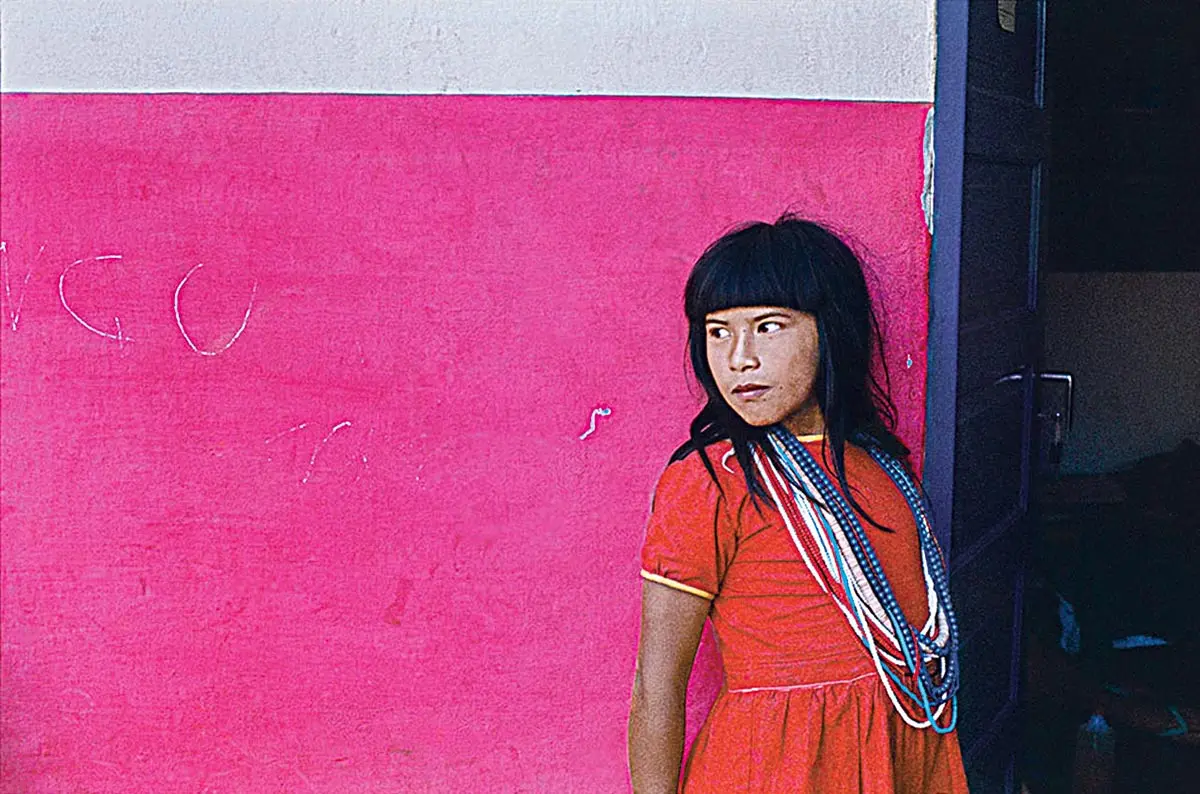
Between the months of August of 2015 and January of this year, one element attracted the attention of visitors upon entering the space at the SESC Ipiranga in São Paulo. From the entrance of the institution, one was able to observe the external space of one of the exhibition rooms painted in bright green and pink colors. Any person from Brazil who knows about the history of the carnival in the country would quickly associate those chromatic options with the colors of the traditional Mangueira samba school, one of the oldest in Rio de Janeiro. Inside the exhibition rooms the usually white walls—often used in the curatorship of photographic exhibitions—had also been replaced by those carnivalesque colors.
What was the reason behind this daring chromatic option that certainly conferred liveliness to the exhibition? It was a collection of nearly 250 photographs by Eduardo Viveiros de Castro, a prominent Brazilian anthropologist, and professor at the Universidade Federal do Rio de Janeiro. An increasingly known author, both in the academic scene of the Human Sciences and among the general public interested in his research on the various indigenous groups in Brazil, some of his most important publications include A Inconstância da Alma Selvagem e Outros Ensaios de Antropologia (The Inconstancy of the Wild Soul and Other Essays on Anthropology, 2002) and the recently published Metafísicas Caníbales (Cannibal Metaphisycs, 2015).
Variations of the Wild Body, the title of the exhibition, references Viveiros de Castro’s publication from 2002 in which the author reflects on the so-called “indigenous perspectivism;” namely, an inquiry into the various points of view from different indigenous groups on the anthropological quest for a shared perspective regarding the “other.” In this sense, through this theory, beyond reciprocity between researcher and researched, Viveiros de Castro suggests the juxtaposition of several simultaneous perspectives, setting aside the usual western vanishing point found both in pictorial traditions and in a large number of anthropological approaches.
As result, the exhibition consisted of both images created by the (also) photographer, focused on his fieldwork experiences with the Arawetél Yanomami, Yawapalaliti, and Kulina indigenous groups between the decades of 1970 and 1990, as well as records of the activities of artists that were important to his generation, like Ivan Cardoso, Hélio Oiticica and Waly Salomão. Based on this, it is possible to explain why the colors of Magueira, the samba school that Oiticica attended, set the tone of the curatorship. According to the curators Eduardo Sterzi and Verónica Stigger, the “wild body” to which the exhibition referred, is not part of an exotic reading that attempts to insert the indigenous body in the realm of savagery, but rather an invitation to the public to enjoy photographs that capture ways of experimenting with the body that escapes the hegemonic pressures that we struggle within our everyday life.
This curatorial approach made the exhibition particularly strong because it opened the possibility of comparing different ways of exploring the human figure through corporal painting and the use of devices for the body. One of the exhibition rooms, for instance, showed the contrast between the image of a black man dancing with one of the yellow parangolés by Hélio Oiticica, and an indigenous child dressed in red standing in front of a pink wall. The strong colors, an element easily perceived in the exhibition, do not solely refer to the expography, but to a greater extent to the importance given to color, both by Oiticica’s generation as well as by the various indigenous groups photographed by Viveiros de Castro.
The formal approaches of his gaze as a photographer come about in different ways. The public was exposed to many open planes of routine interactions between some indigenous groups and the landscape, as well as to individuals portrayed comfortably posing for the camera. Also interesting is the confirmation that photographic and curatorial choices did not by any means constrained the figures of those indigenous bodies amid the exotic environment of an untouched natural world; on the contrary, many of the images include them in activities like watching television, participating in documentaries focused on them, listening to the radio and hanging balloons for some celebration. The individuals photographed by Viveiros de Castro adopt and actualize western habits in their routines. It is curious to observe those images that often discuss in a metalinguistic manner with adjacent photographs that depict images of scenes from films by Ivan Cardoso; with his actors and friends dressed as mummies, Egyptians, and other film costumes.
At the end of the exhibition, it was possible to perceive the narrative effect of organizing the photographs in sequence. It became clear that creating fiction with images is evident in both the artists close to Viveiros de Castro in Rio de Janeiro and the records that he compiles in his anthropological expeditions. Both groups of images push the boundaries between documentation and storytelling, and there is the option that they may also be confronted with the exhibition space.
The exhibition becomes significant when, for instance, a new pavilion dedicated to Claudia Andujar is inaugurated in Inhotim, and when her most recent retrospective is presented at the Institute Moreira Salles. It is a moment in which the curatorial and historic fields clearly converge to address the indigenous presence in art and in the visual culture of Brazil. It is important that the public knows Viveiros de Castro’s photographic production and see it interact with names like Andujar and Maureen Bisilliat. But more than that, by articulating very different geographies in the same exhibition, a door is opened to include new interpretations of the works by Oiticica and Ivan Cardoso—so they can also be placed in the articulation between the so-called “contemporary art” and the multiple perspectives of the different indigenous groups that live in Brazil.
May those green and pink colors and sounds from Mangueira encourage future generations of researchers to continue enriching the history of photography in Brazil.
RAPHAEL FONSECA