
Full-blooded Cubans are always aroused by music and dancing, even those who lack a musical ear or any semblance of dance-floor grace. That is, at any rate, the stereotype, a wide-ranging sociological construct, an ontological identification with the art of sound (and of silence) that helps understand the titles and contents of documentaries like Nosotros la música (“We the Music”) and Yo soy del son a la salsa (“I Am from Son to Salsa”). So, anyone born and raised in the greatest of the Antilles who does not develop a sense of rhythm can suffer an enduring trauma, or at least moments of cultural-identity crisis.
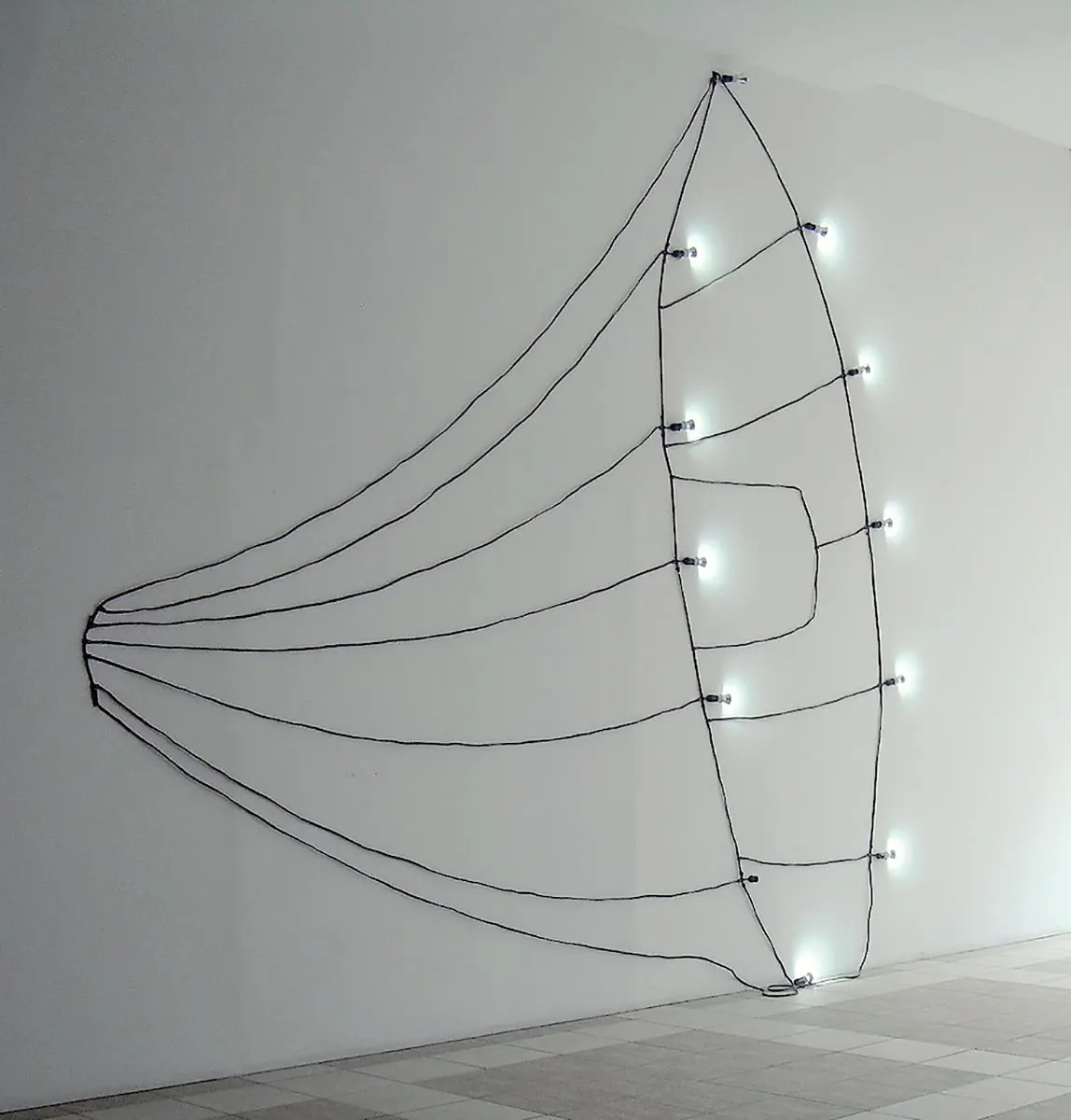
In an archipelago of such a broad sound spectrum and such a long roster of figures in what can be called creole surrealism, the first time I heard the name of Esterio Segura, I thought of music. What else? I imagined it was “Stereo”, and that people mispronounced it. Moreover, when I saw it in writing, I assumed it had been misspelled. But I was wrong. Not only was it Esterio, but he himself had also chosen to delete the “José” that preceded it in official documents (which surprised many). But, regardless of any other considerations, what artist would eschew the name that has singled him out since birth (in this case, since 1970)? I mention this anecdote because, almost twenty years after my initial confusion, I have once again connected Segura with the musical arts. This time, in connection with the Les voix humaines festival, for which Esterio composed the inaugural exhibit, Altavoz contra la pared (“Loudspeaker Against The Wall”). With that title, the exhibition could have been interpreted as connected to the excellent vocal quality one enjoyed in an essentially musical event, in which the museum’s Theater was also involved. However, the name came from one of the works featured within, as happens in many musical recordings. The connection with music was established, one presumes, on the basis of the symbolic, expressive potential of the device used to magnify sound and transmit information.
At any rate, Altavoz… was not the main focus of the show, which included around fifteen works, but it did become a significant point of reference for non-musical reasons. Created in 1999-2000, it marked the beginning of a retrospective where the remaining works on exhibit were not dated. Only a viewer well informed about Esterio’s production would have sensed the déjà vu and noted some expressive lines already developed by the artist in the 1990s. In the museum’s lower level, visitors encountered sculptures and installations that put the attributes of color and of symbols into play; questioned all doctrinaire social foundations; explored racial, politico-ideological, and religious mestizaje; reveled in erotic-pornographic; dealt with the contingencies of travel, and problematized the use of some information and communication technologies. This happened not only with the megaphone, here devoid of the human referent for its use. Radar? A parabolic antenna? Wrapped in nylon, what use would they be in an airplane or a submarine? All they produced was noise, interference, distortions in the emission and reception of signals. Their only purpose could be, indeed, a parable of thought.
Undoubtedly, the (coaxial?) cables used in the assembly of these works pointed towards a discourse based on the materials themselves and corroborated the well-known theory about the medium and the message. Yet they also described visual lines that established a formal correlation between the works mentioned above, those resolved using metal rods, and a couple of drawings on canvas that the audience covered with graffiti in an attempt at relational art. The reliefs outlined on flat surfaces, in turn, displayed another sculptural projection by an artist already renowned by his freestanding anthropomorphic sculptures, indebted to Baroque imagery in stucco. These works were also represented in the exhibition that opened on September 25th, where Esterio also put on display his skill with materials by versioning, in metal, La diestra (“The Right Hand”), a kind of remake or cover (to speak in musical terms) of a 1994 work of his on exhibit in the museum’s permanent gallery.
In the temporary exhibition that remained open in January of 2016, Esterio revealed his great ductility for both minimal and more complex compositions. He brought forward the conceptual and formal manipulation of transportation vehicles, like an airplane transformed into a very large sofa. Using bricolage, he changed and multiplied the functions of some devices; he brought together art, design, and reality. Looking at his mutant mixture of fish, airplane, and war tank placed in the museum patio, I remembered Esterio’s car-submarine, which was detained at a police station when on the move to an art center near Havana’s barrier beach. Why? Because it’s the owner was suspected of wanting to leave the country illegally. Awesome! some said. An involuntary performance said others. Esterio documented this misadventure. What name may he have used to record it?
ISRAEL CASTELLANOS LEÓN