

Seen in the Twenty-First Century, the work of Gunther Gerzso retains its force and its mystery, as did the personality of its author, who never, as a child and a young man, though he’d study art or become a painter. This essay, at 100 years of Gerzso’s birth, intends to delve into the transcendence of his oeuvre, treasured internationally, by offering a synthesis of his evolution as an artist; explaining how he was able to develop his unique body of work, with reference to his sources, themes, and periods; and dispelling the mistaken notion, often heard in his native country during his life, that he was not originally from Mexico. The artist himself cleared that up, and it was a deep concern for him until his last day.1 Educated in the European fashion, methodical, well organized, responsible, and possessed of a sharp sense of humor, Gerzso didn’t show painterly inclinations early on, but the appreciation and collecting of art were part of his family tradition. Although he had known notable artists in person, in the end, two specialists in stage and costume design motivated him. An abbreviated biography will take us with Gunther Gerzso who taught himself to paint as a young adult. He was born to a relocated European family in Mexico City, on June 17, 1915. His father died the following year, and his mother sent the boy—12 at the time—to Switzerland, to live with his uncle Dr. Hans Wendland, a disciple of Heinrich Wölfflin. Gunther acquired there a foundational education of his character and interests, living in a home with a vast art collection and learning from his uncle, an art historian, dealer, and collector. Gerzso became familiar with the history of art and the great masters of the past, but even in this milieu he does not think of becoming an artist. He once said that being an artist wasn’t socially acceptable, while being a purchaser and collector was. In his uncle’s home he met Nando Tamberlani, a successful set designer with a strong personality who impressed young Gunther and planted in him the idea of going into that profession. This was the first of three situations that connected Gerzso with set design.
His uncle’s financial situation became unstable with the Depression in Europe, and Gerzso returned to Mexico in 1930, to study at the German School. His mother’s situation wasn’t entirely secure, either; she was forced to rent out rooms in her home to make ends meet. One of her tenants was Fernando Wagner, the actor, who stokes in Gunther the interest in the theater, costumes, and set design. Wagner took him to visit Arch Lauteret, a drama professor, and Lauteret saw in Gunther’s drawings a potential for theater work, especially in costumes. He suggested to Gunther’s mother that the boy be sent to Cleveland, to an academy where tuition could be covered by working on theatrical productions. This was Gerzso’s second move towards stage design. Between 1935 and 1941, at the prestigious Cleveland Play House, he developed his skills in drawing, handling space, themes, materials, and colors in ways that differed from the art history he had learned in Europe. After four years, Gerzso had gained some renown not only as a designer, but also as a technical assistant to directors, garnering good reviews and critiques, and taking part in a number of exhibitions. The amount of physical and intellectual work required for each play was staggering and the pay was low, a situation that could not be sustained for long. Meanwhile, many who see Gerzso’s drawings when he began to frequent the Cleveland Art Museum—which housed an outstanding modern art collection—encouraged him to paint. In 1940, Gerzso married Gene Cady, and the following year the young couple decided to resettle in Mexico. Gunther was to devote himself fully to painting.
The drawings, oils, gouaches, and notebooks of those years reveal the variety and volume of work created by Gerzso, some connections with Matisse, De Chirico, and the expressionists, and a free, musical poetics reminiscent of Klee, albeit in a more telluric vein. He never copies, save for an occasional and clearly indicated exercise; nothing is forced or stereotypical but related to the human condition, brutality, eroticism, the deformed and the grotesque; more and more, he is engaged in a quest "à la Gerzso”. There are also more intellectual and more classical drawings, in the manner of Cocteau. Gunther Gerzso’s path was one of line and expression. The line as an element was never to abandon him, be it visible as such or created by the contrast of colors and hues. There are also sketches of spaces that emerged as stage designs. Schematic analysis of the artist’s process tells us that he filtered his goals, reducing the size of the set to the paper, the board, or the canvas on which he painted. Devoid of characters or script, the space of his paintings is dual, filled with restrained and contradictory emotion.
Financially, living off his painting proved difficult, so in 1942 Gerzso accepted Gelman’s offer to design sets for films and the stage. At the time, he frequented surrealist artists like Benjamín Peret, Remedios Varo, Leonora Carrington, and Wolfgang Paalen, among others. Between 1943 and 1946 Gerzso filled a notebook with 55 original drawings, the majority of them using carbon paper, some retouched by color pencil and ink, with his annotations and an original carbon paper drawing.2 The somewhat naïve drawing of a little train with a character appearing in its steam anticipates Gerzso’s Retrato de Benjamín Peret (Portrait of Benjamin Peret), where smoke transforms into a monumental female nude, a couple, and a visual inflection. We note that the texture of matter in a good portion of this work is not thick but dry, dragging on the canvas; the train has mechanical elements that can be seen as simplified pre-Columbian ideographs.
As it moved from metaphysics to surrealism—this is to say, from the final years in Cleveland to the first years of the return to Mexico (1939 to 1945)—Gerzso’s work became more mythological and figurative. Technical painterly resources enter it with the intense self-training process he had decided to follow in order to arrive at painting “à la Gerzso”. Although brief, his surrealist period unfolds in several stages: European, biomorphic, naïve, architectural, and landscape-centered/anthropological/pre-Columbian. This is a period of questions about his mission: Why follow European trends, if native surrealism is emerging in my country?3 In his surrealist drawings we find distorted human figures, graphic elements, interwoven planes, diagonals, and asymmetries. They are dominated by a narrative of tension, grouping, and energy that differs from other works. The importance of Gunther Gerzso’s surrealist oeuvre and the historical significance of the Surrealist group in Mexico are matters that exceed the boundaries of this essay. The artist engages figurative art in a variety of ways and creates a highly personal synthesis that, erroneously, some have deemed abstract. “I don’t see myself as an abstract painter, but you know that I’ve been labeled in that way. I won’t put you in the difficult position of telling me your opinion. We know each other very little (yet, a lot), and if you are in my studio it is because you are patient and have a sense of humor.”4 Landscape; architecture; set designs; spaces; Le Corbusier;5 the interior spaces of the Mexican School; formal purity; anti-narrative; the significance of form, volume, and planes; Cubism and some traces of Informalism: all of this peppers Gerzso’s oeuvre in various and subtle ways.
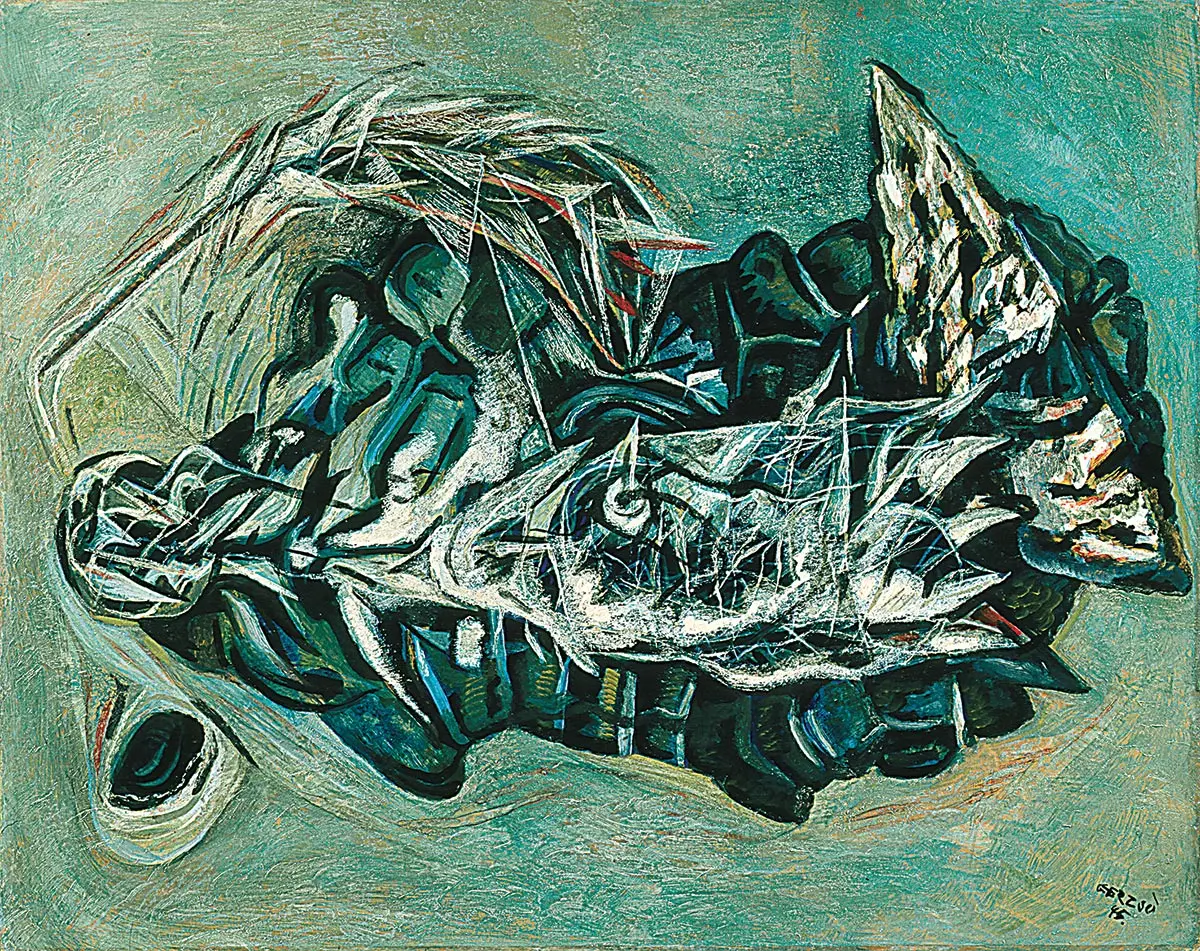
Visiting Mexico while still residing in Cleveland, Gerzso developed a friendship with Julio Castellanos and an interest in Orozco Romero’s painting. Working outside the consensus of mainstream Mexican muralism, these artists are his friends, the objects of his admiration, and his guides in technical matters. During the second and third decades of the Twentieth century, Castellanos and Orozco, rather than following the prescriptions of muralism, focused on a post-revolutionary painting infused with a certain neo-classicism.6-7 Traveling with film crews (1942 to 1962), Gerzso discovered a Mexico that had previously remained hidden for him. His paintings of the 1940s and 1950s begin to emerge as a way of identifying with his native country. With Paul Westheim and Castellanos—with whom he traveled across the country—he developed a deep respect for the pre-Columbian element and for the then-fledging disciplines of anthropology and archaeology. In La Isla (The Island), from 1945, the artist explores the boundary between nature and a dreamlike state using shapes of birds, peaks, facets, contours, and iridescences. Around that time, Gerzso had decided to bring his surrealist period to a close. He wanted to communicate profound emotions and he worked as he traveled, creating set designs for 250 films by important directors: Luis Buñuel, Emilio Fernández, and John Ford. In 1962 he put an end to this dual professional life, although in 1983 John Ford convinced him to work with him in Under the Volcano.
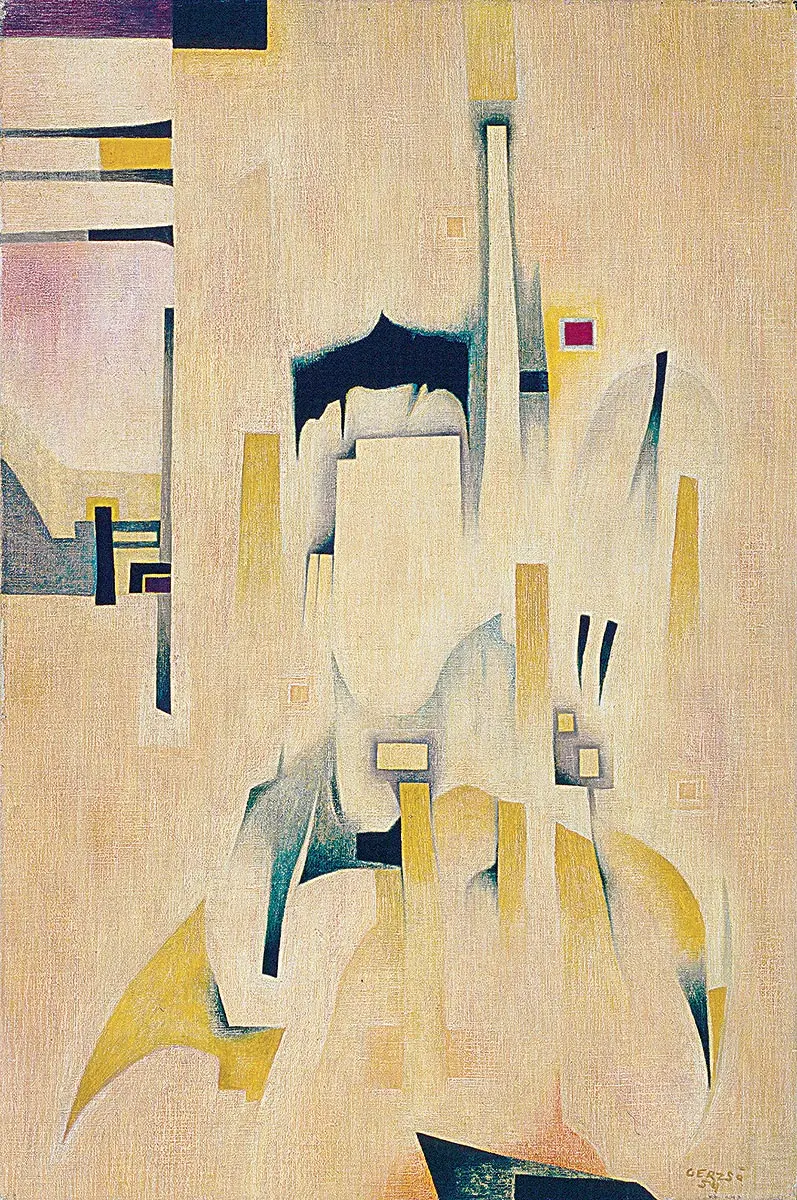
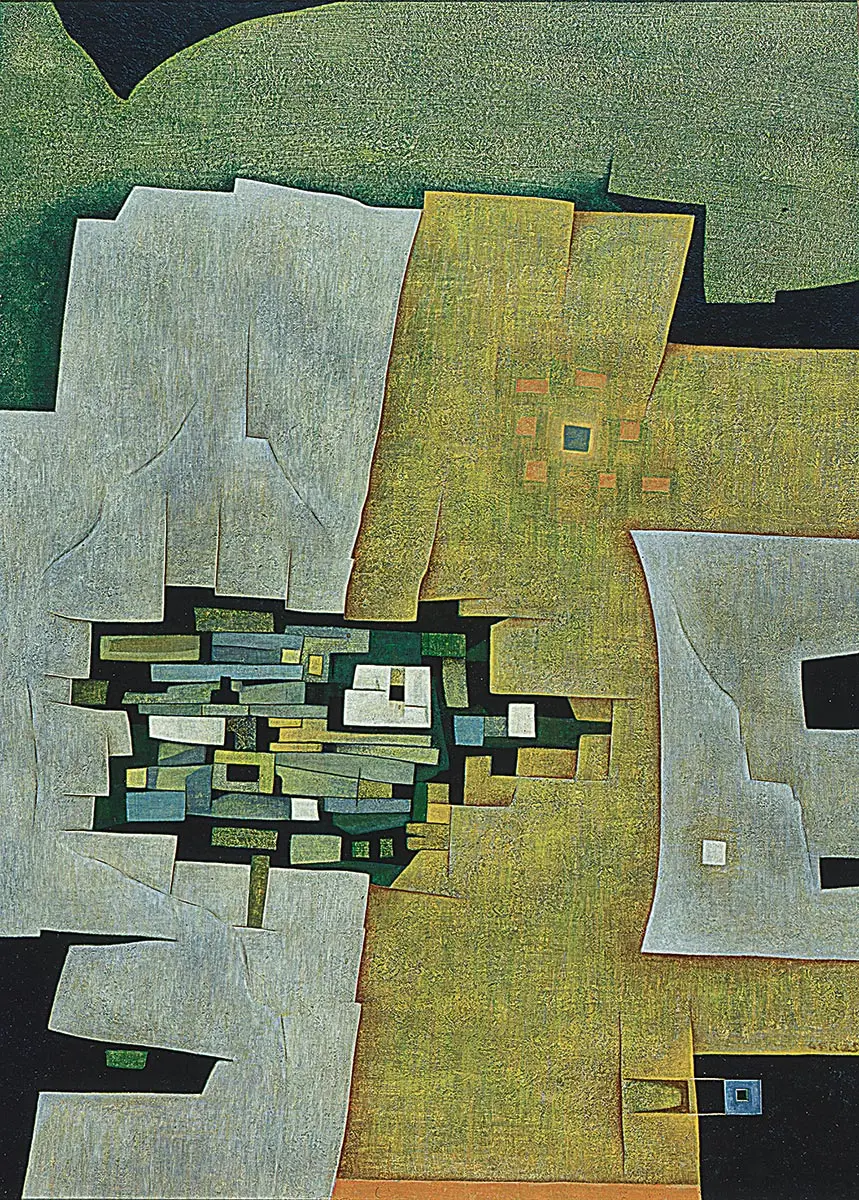
Cenote (Sinkhole), Naufragio (Shipwreck), and La ciudadela (The Citadel) are transitional works. They are elaborate centralized nuclei articulated from within by many non-figurative, geometric, and even amorphous elements. Bird’s eye vistas of an island, perceptions of a city sunk into the sea, constructions on elevated ground, and unending combinations of chambers inside a pyramid. Alternating with these paintings, Gerzso created a number of frontal, set-like works, an example of which is El Mago (The Magician). Seeing or describing this work, we discover the painter-set designer and his handling of pictorial space. Gunther Gerzso fully reached a pictorial style of his own in the inscription of clashing emotions not represented by human figures Paisaje amarillo y negro (Hacia el Sol) [Yellow and Black Landscape (Toward the Sun)] is an early vertical work treated in a somewhat gothic style, an anomaly in the context of Gerzso’s compositions. It is the meeting of the horizontality of landscape painting, the pyramidal plateau, and the gaze that continues with its ascent. Although the artist worked in horizontal and vertical rectangular formats, in small and medium sizes, the contents of Paisaje amarillo y negro (Hacia el Sol) corroborate what we have said. The elements are still small, and we find them in dimorphic and disymbolic dispersion. In 1955, Ciudadela consolidates one of the earliest “à la Gerzso” conjunctions. It is vertical and composed from a bird’s eye point of view, in three large planes, with a small organic (curved) element on the upper right, a smaller and some minor planes, with the emergence of “the wounds” and an ascending nucleus of Maya relieves. Yellow and black create a balance between the natural and the intellectual pigments that prevail in Gerzso’s work.
Up to then, no one in Mexico had shown interest in the pre-Columbian element, be it as an object of research or collecting, or as something to be valued and understood. Suddenly, the pre-Columbian emerged as a passion of intellectuals of the era.8-9 This is a central point in any approach to Gerzso’s work: the gaze that he trained at the time on pre-Columbian art, like our gaze today, was informed by the proportions and coordinates of European art history. Neither Gerzso not his contemporaries conceived of the need to understand other motivations/scales/aesthetics and functions that such objects could have had in their places and times of origin. Also, current legislation concerning the excavation, sale, ownership, and custody of such findings didn’t exist at the time. The difference between Gerzso’s native Mexico and the Europe of his education—a Europe focused on the representation of the human form—posed a great dichotomy for the artist.
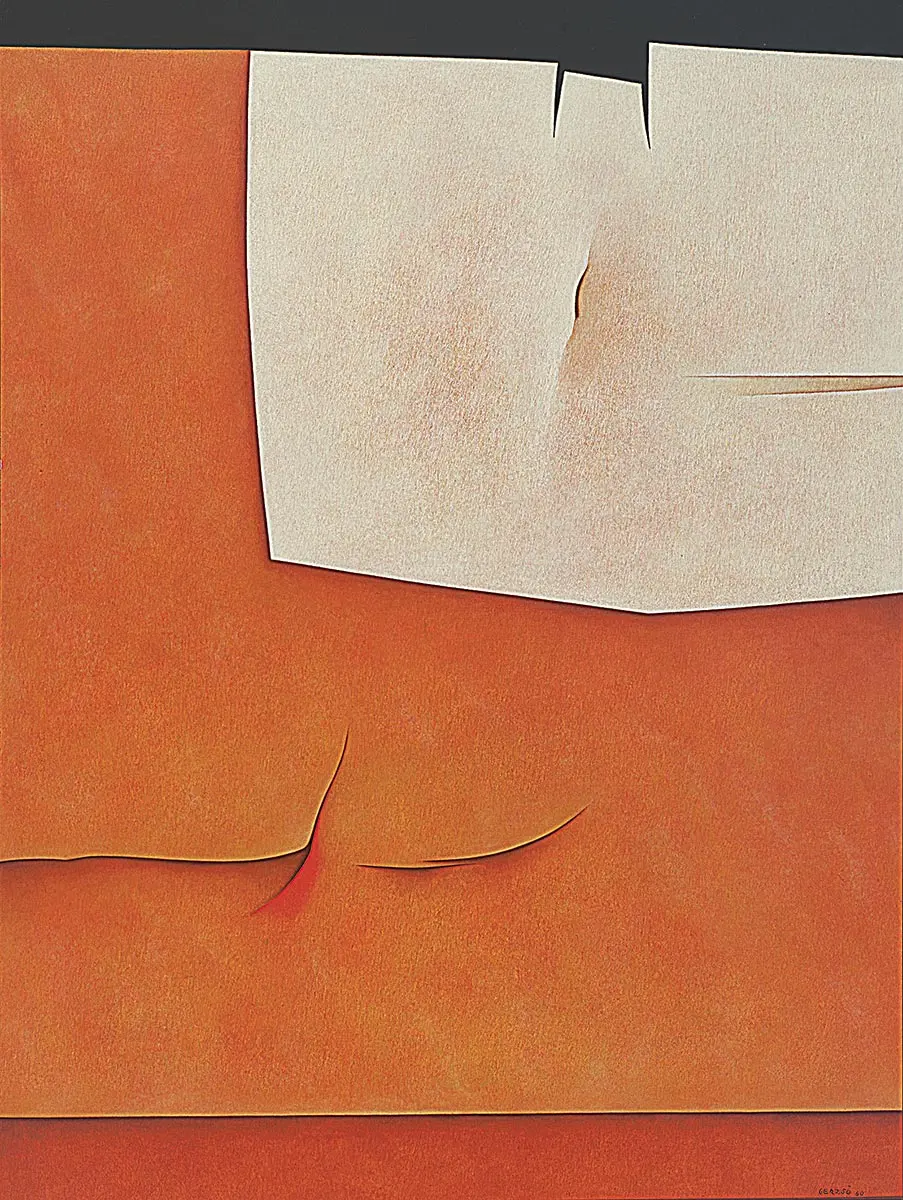
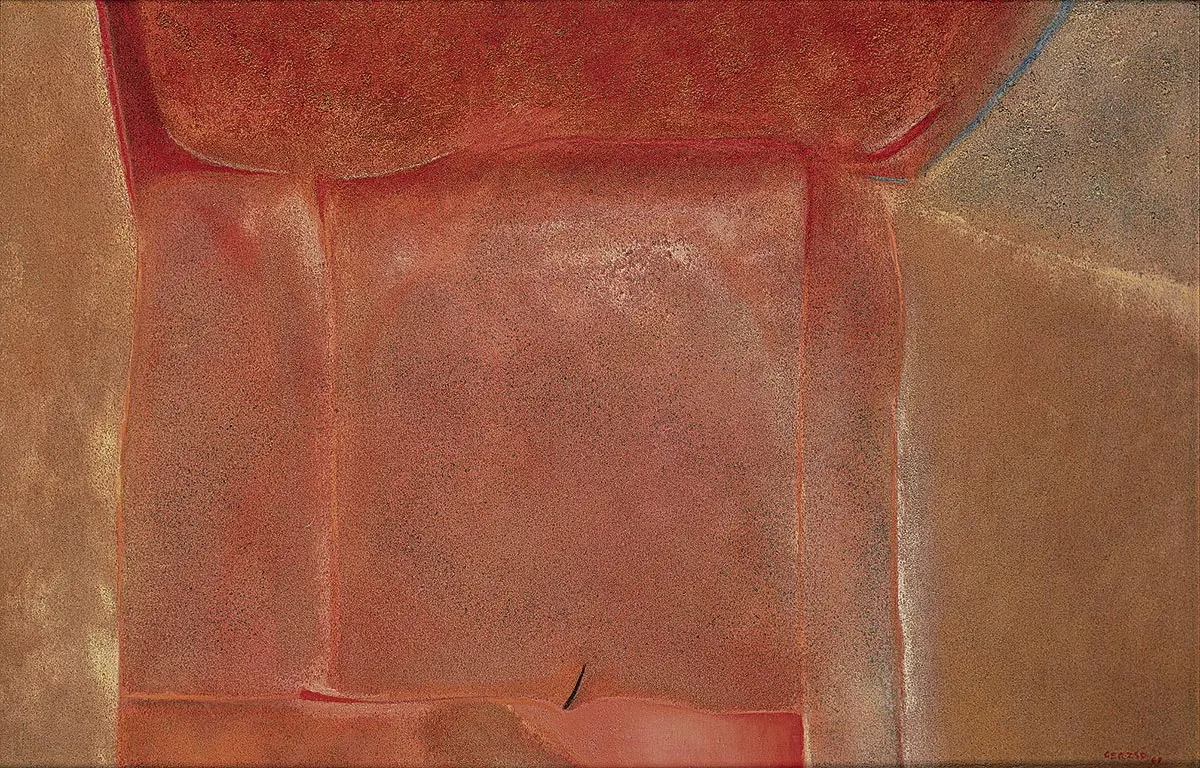
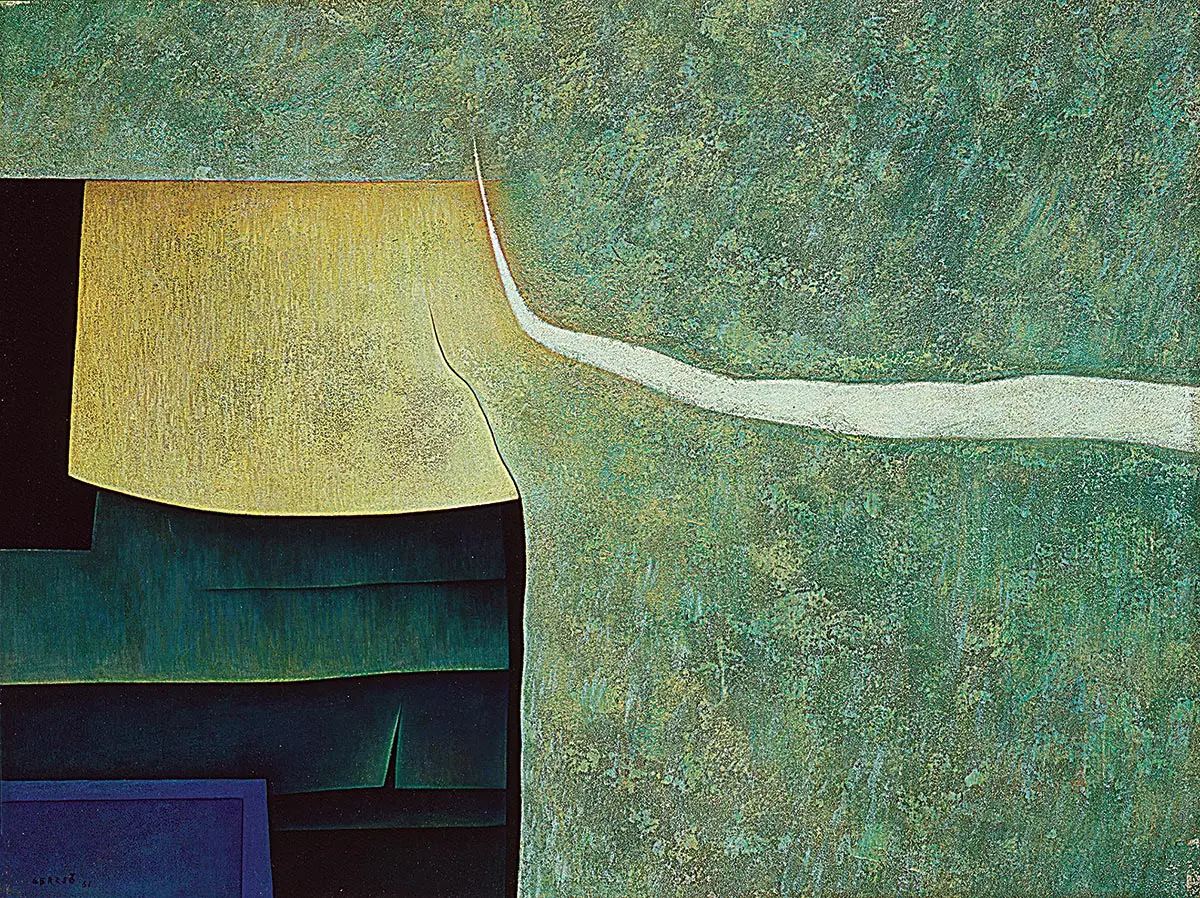
Dating from the same year, 1955, Paisaje de Papantla (Papantla Landscape) expands the resonance of overlapping planes, with others seen at ground level and in secret chambers. Vibrations, bells, and transparencies are announced. In total contrast, Aparición (Apparition) rests only on three planes and vibrates in the magnificence of warm hues filled with the eroticism of a “painted (caressed, wounded) skin”. Desnudo Rojo (Red Nude), from 1961, belongs already to the group of paintings that inhabit the horizontal dimension. Wall and body are one, with pictorial touches that at times resemble X-rays. Muro verde (Paisaje de Yucatán) [Green Wall (Yucatan Landscape)] produces a sensation of forests and pyramids, of eroticism and intellectualism. The supports used are boards, Masonite, canvas, and paper. The latter is particularly fundamental in Gerzso’s work: after conceiving a project, he creates minute schematics and verifies the proportions and the smallest features, hues, and colors to be used. These miniatures of the artist’s work processes are carefully archived.
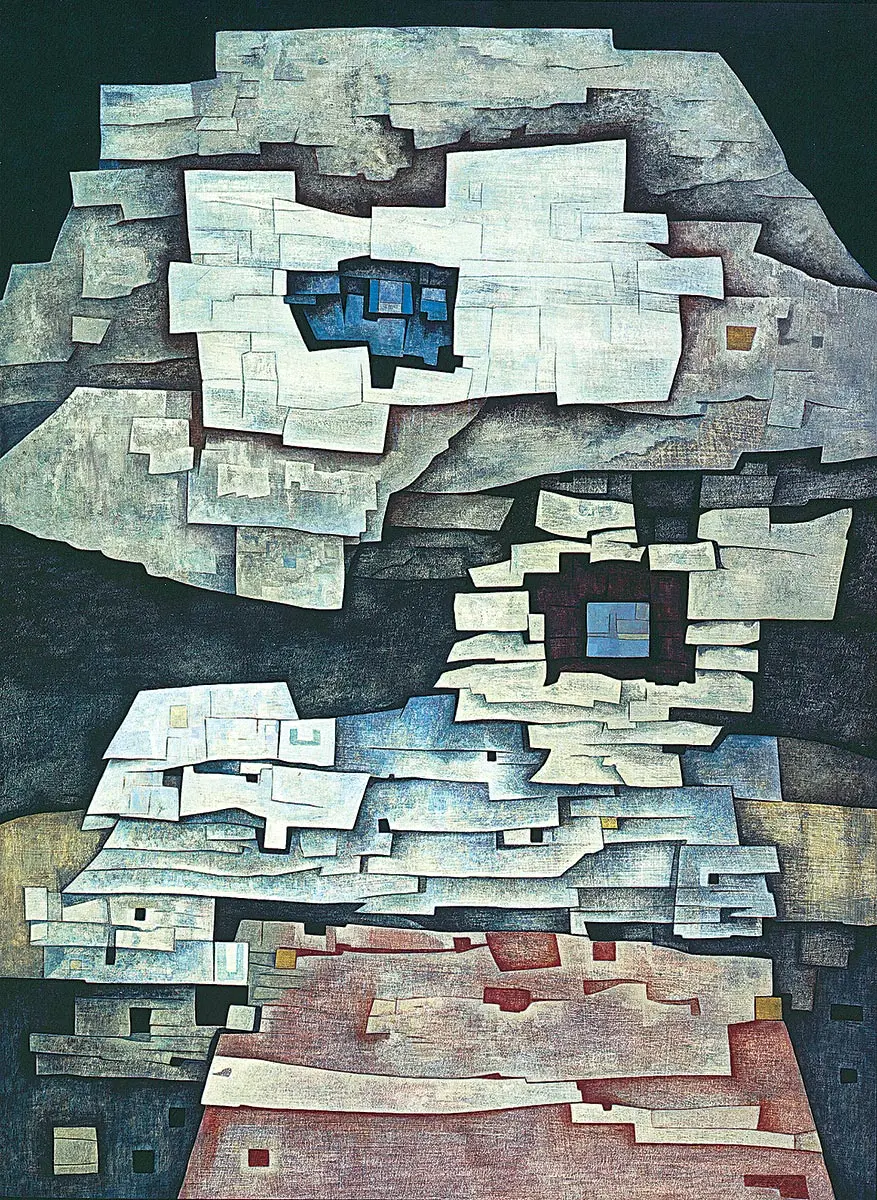
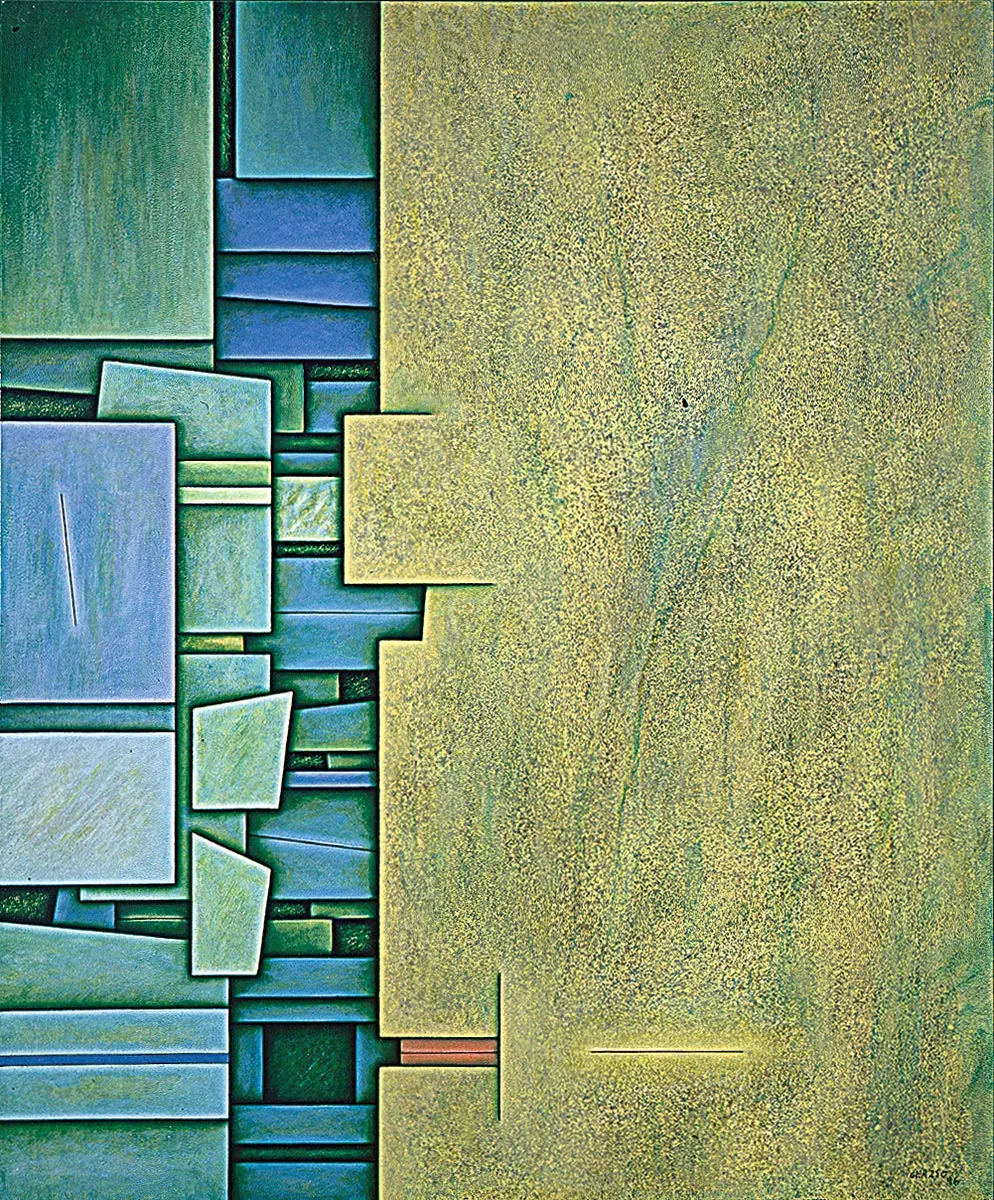
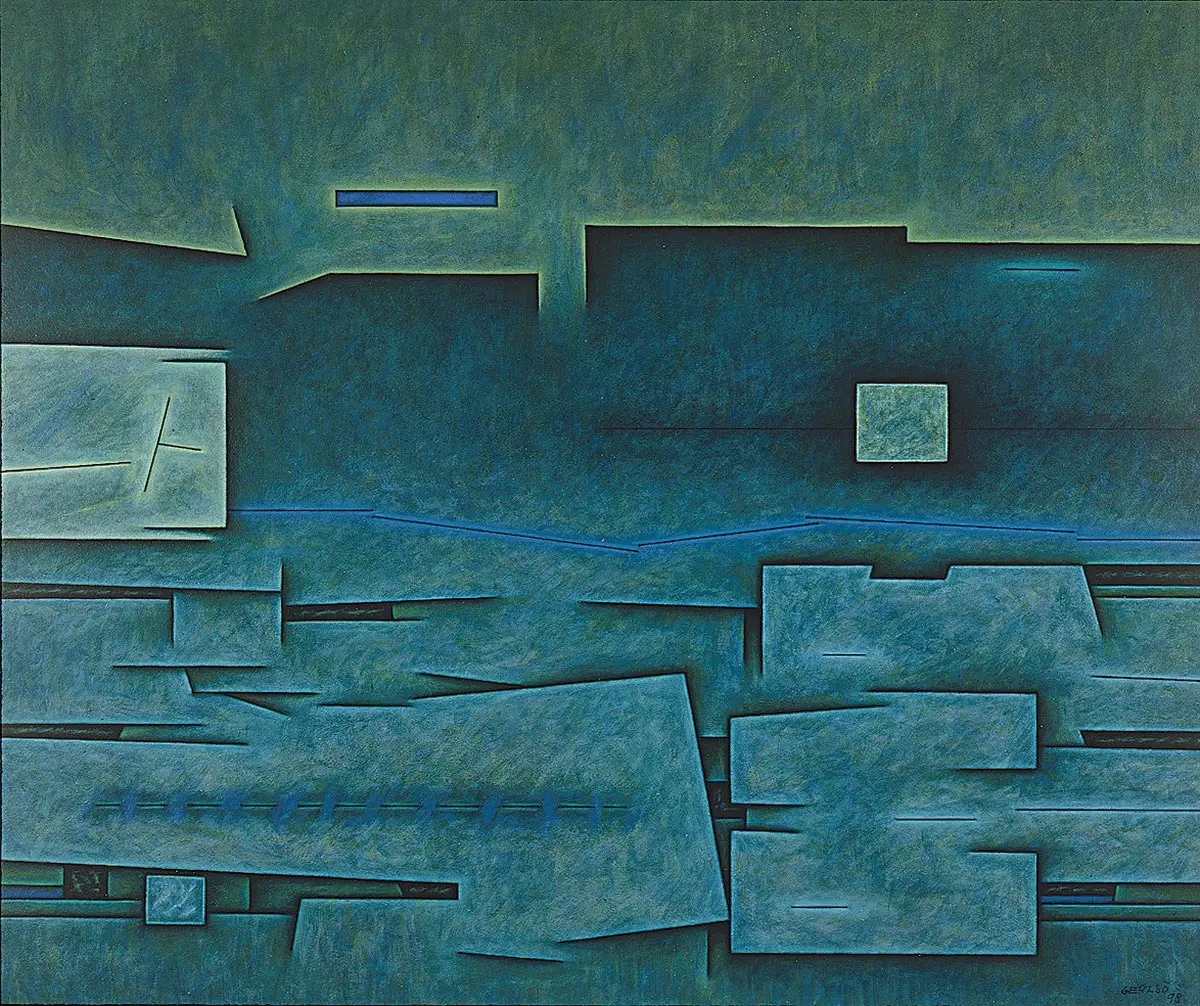
In Gerzso’s paintings, splendid and sinister elements are in permanent unresolved tension. The Aztec Coatlicue Monolith, as well as the Maya, relieves of Yucatan and Guatemala, are puzzles that the artist doesn’t copy but evokes, in a modernist manner that distances him from the conjugations of abstract painting. The small details of his works are related to this, as they are to the surrealist legacy (from the major structures from which he dislodged himself). Gerzso’s large Green-Blue-Yellow/Verde-azul-amarillo, from 1968, and Lugar Furtivo (Furtive Place), from 1996, is entire “à la Gerzso” works. Both are vertical invitations to pass through until interferences emerge in the path. They configure a welcome and anxiety, joy and laceration; claustrophobia, chambers, and perhaps portals to nothingness. In a different register, Gerzso has created sculptures and engravings—numbered originals—in a variety of techniques. These are also congealed bursts and risk-taking vehemence. Gunther Gerzso’s modernist approach combines the interesting contrast between walled-off construction and the infinite depth of the sinkhole. Many speak of coldness in his art, while in reality most of his paintings feature warm colors and hues; it is the compositional tension that establishes a play of guillotines for those who dare enter. Gerzso’s anguish in the face of criminality, war, violence, and hunger for power transpires in the harmoniousness of his paintings. His work is a profound duality balancing life and death, tension and relaxation, suspended and rebooted emotions, desire, and transgression. In the end, eroticism is life. Certain wounds can be taken into account, for instance, the tears and rips painted as part of Aztec human sacrifices. We note small wounds no longer bleeding, eyelids barely ajar, and lying bodies covered by semitransparent veils, in a sensuality framed by rectangles, as is the case with Opposite Dimension (Dimensión contraria), from 1998.
NOTES
1. Several factors promoted this confusion: his name, his physical appearance, his European education, his many years working abroad, his marriage to an American woman, his children educated in Mexico and the US, his cosmopolitan fluency in five languages, his close friendships among the community of European surrealist exiles in Mexico, his personal search for an aesthetic identity outside the dominant movement of the era, and his work as a set designer for film and stage, which was managed as a business, so unlike the life of most visual artists.
2. It is noted that Gunther Gerzso was in the habit of making drawings in carbon paper.
3. and 4. Conversation with the author during a visit to Gunther Gerzso’s studio.
5. At fourteen, Gerzso read Le Corbusier’s Towards a New Architecture, originally published in 1923. Le Corbusier, an architect and painter, inspired Gerzso (a set designer and painter) as he did many other professionals. At one point, Gerzso said, he wrote Le Corbusier because he wanted to work with him; not receiving a response, he moved more towards set design and painting.
6. Rufino Tamayo and Carlos Mérida also distanced themselves early as post-muralists. Although Mérida, as a foreigner, had to measure the freedoms he took, since the muralist establishment could promote his deportation.
7. Estridentismo and Los Contemporáneos are two interesting movements for anyone who wishes to know more about this rich period in Mexico.
8. The great Sáenz Collection began in 1944; it later moved to the Museo Amparo, where it remains today.
9. Let’s remember the importance that ancient, distant, and primitive cultures had for Cubist and Dada artists. Also, scientific developments in archaeology and anthropology during that period contributed to expanding knowledge of and interest in cultural objects that are, at the same time, valuable art objects.
* Photos Mary-Ann Martin Fine Art courtesy.
©John Michael Gerzso.
GRACIELA KARTOFEL
Art critic.