
The recent exhibition by Iván Capote (Pinar del Río, 1973) at Galería Habana builds on this artist’s interest in transforming linguistic signs into visual images and developing visual concepts through the meaning of words. Verbum I is the title that brings together a group of pieces that contain elements of both continuity and rupture with his previous work. The title suggests his intention to further develop these appropriations later. The exhibition is in line with other exhibitions organized by Galería Habana and is proof of a natural progression in the act of expanding texts beyond language and literature, an obsession that has occupied Capote for nearly a decade.
While in other exhibitions at Galería Habana, like Subtle (2009) or Morphemes,(2011), Iván Capote liked to use graphics to evoke local conflicts, such as migration and manipulation, or to disarticulate forms and turn them into a sort of puzzle that involved observers with the creative act, in this current exhibition he apparently moves away from local themes to address more universal conflicts. All the works in the show are titled either in English or Latin and so are most of the words that he uses to develop the concepts. Rather than attempting a visual disarticulation of the works, here Capote focuses on breaking apart the concepts contained in them. Rendered with steel or bronze, the forms remain unaltered but their meanings are readjusted and, unlike the material, they are malleable; it is precisely this intention that places the exhibition in a new path of inquiries.
On the other hand, the group of works exhibited is influenced by oriental philosophy, as they evoke the synthesis of communication and knowledge in a meditative state. Iván Capote knows that words are best used economically; this is the reason that his works lack gimmicks and minimize metaphoric resources, a fact that would seem contradictory in an exhibition that uses words as the center of attention. But Capote is not interested in the expressive attributes of literature, but rather in its objectual quality and potential for artification.
The installative nature of the entire exhibition is clear. Smaller pieces are alternated with larger ones, playing with the design through the refinement of their technique. It could be argued that the show is visually sober, even aseptic, especially because of the typographic selection and the subtlety employed to intervene in the words. The artist shapes language and juxtaposes it to everyday elements that define its visuality.
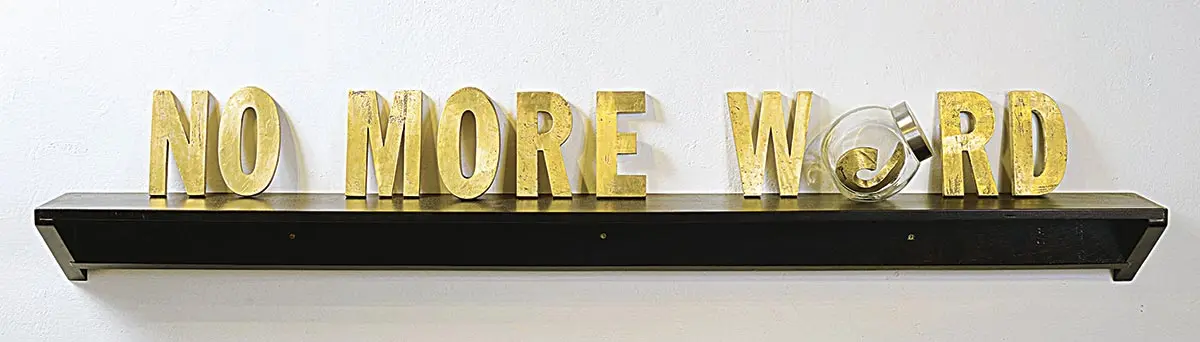
Link, one of the most striking works in the exhibition, explores the limits of meaning, evoking in its own way the horizon line. Desire is the word selected for the narrative. It is interconnected over and over again in an endless redundancy, creating a duality between the infinite act of desire and the elusive boundaries of representation. Another piece that exposes the struggles to “capture” the signifier of the text is No More Words. In this case, the phrase contracts, it closes within itself to encrypt a possible expansion. These are deeply self-reflective works in which the artist’s existential anxieties and his finite condition stay dormant; impossibilities that mimic one of his iconic pieces, in which Capote expresses that “life is a text that we learn to read too late.”1
There is also a group of works whose thematic focus lies in spirituality and in an allusion to certain meditation rituals. The piece Mantra Occidental (Western Mantra) uses the word “own” to create confusion with the syllable om used to achieve the spiritual center in relaxation exercises. The piece suggests a contradiction between the spiritual purity of meditation and the selfish nature of the act of possessing, a fact that becomes more poignant through the gesture of holding the word by burning incense, in a demonstration of how ephemeral and unreliable both are. Meanwhile, in Desnudo (Nude) Capote proposes certain theatricality to render the word and to cover it with a sort of veil; thus, the creator sacralizes the contents at the point of showing or not, of daring or hiding in the simulation.
Other works compose typography with undecipherable characters, marking the creation of a new language that abandons any understanding in favor of establishing a progressive vacuum. In works like Flow and Horror Vacui, we are witnesses to a more abstract display of the linguistic sign, in which signifier and signified are united under a single concept. The former deals with the refunctionalization of objects based on words, while in the latter writing plays a fundamental role, but only as a stroke, as a loss of content that leads to a lack of communication, to nothingness.
It is important to mention that the curatorship did not adequately support the intention of the group of works as a whole. The pieces were arranged in a disjointed manner and, thus, they were left without other works with which to establish a dynamic dialogue. Many of them also had to readapt to the complex gallery space, which is not the most appropriate for an exhibition of this kind. On the other hand, the delay in the production of several of the pieces was the most problematic point, as many of them were not ready by opening day and had to be gradually incorporated into the show. This aspect not only made the execution of the curatorship more problematic but also caused many viewers not to see the show in its entirety. This unfortunate event speaks for itself about the problems that continue to exist in the art world when it comes to producing and organizing exhibitions.
On his return to Galería Habana, Iván Capote’s work demonstrates the sharpness of an investigation in which the boundaries between language and representation have been blurred. Capote knows that, within the fragmentation of the contemporary art scene, texts lose their validity in favor of images. This is his reason for intervening signs and turning words into attractive visual expressions.
NOTE
1. I am referring to the work Dislexia from 2003. Daros Latinamerica Collection, Zurich, Sweden.
MAEVA PERAZA