
Ivana Brenner has been a quiet but effective presence in the art world of Buenos Aires for almost a decade, with several international collaborations in the United States, France, and Mexico. During that time, she has also presented two major solo exhibitions: Urpflanze at the Alejandra Von Hartz Gallery (Miami, 2011), and the exhibition here discussed at the Galería Vasari in Buenos Aires.
The initial general impression of the exhibition at the Galería Vasari was that of a very personal proposal, both from the standpoint of Brenner’s conceptual approach as well as from the perspective of her treatment of the materials— something that we were also able to confirm during our conversation with the artist. As it often occurs in contemporary art, the Kantian privilege for the form does not take precedence in Brenner’s aesthetic vision over the appearance of the materials used in the work, which she regards as equally important. In this sense, evidence of the manual handling of natural materials is present during the beginning of her creative processes as well as during the more advanced stages. Here, in choosing to work with clay—which, according to the artist, was part of her creative experiences during her childhood and has become an essential element of her artistic work—Brenner privileges the direct contact with the material. It is immediately clear that this is the reason that led her to choose it as an expressive medium.
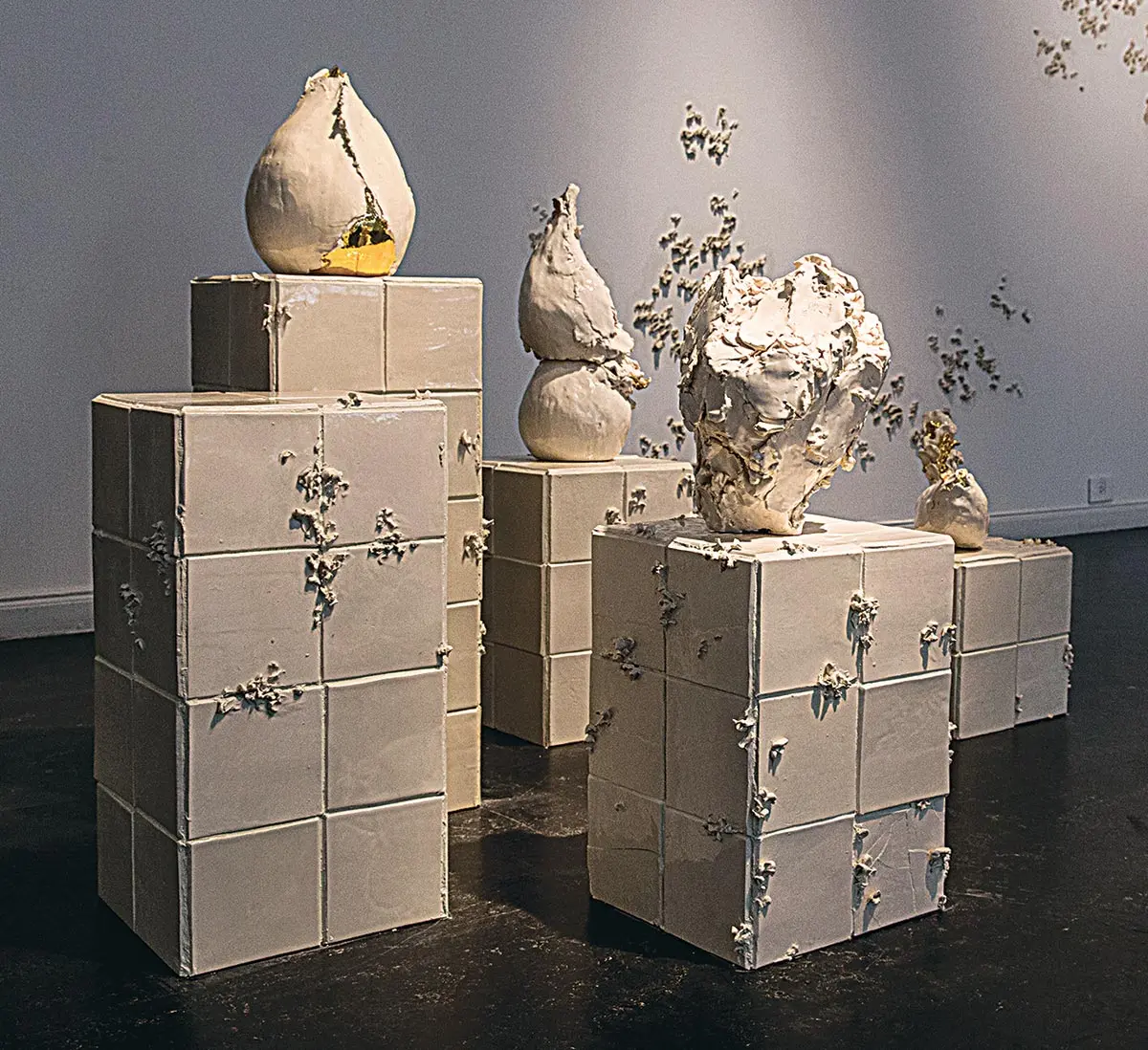
Through molding and other techniques, clay can be rendered in a variety of finishes, ranging from rustic and matte ones to others as glossy as enamel or gold. Brenner’s intention to showcase the different states of the material is evident. It is present in the treatment and intentionality that arise during the process of conceiving the pieces. Discarded the mimetic notion of form, there is nonetheless a formal, deliberate, and undefinable intention in her approach that gives the works an enigmatic quality. Matter becomes mysterious, arcane.
The display window of the gallery announced the exhibition with a single piece, the largest of the group of works presented: a vertical monument, natural or man-made, which could have very well been found in a desert, as if it were a rock formation, in black and gold, crowned by a form that points to the sky. Once inside the gallery, the exhibition space was inhabited by sculptures or objects arranged independently or as part of sets of two or three works. Forms closed upon themselves, each tending towards spherical, conical, and pointed configurations, among others. Abstraction was complemented by the organic quality of a vegetal, animal, or mineral nature. Some of the pieces were self-supporting as if they were totems of different thickness; others rested on foundations also created by Brenner— parallelepipeds of different sizes allusive to construction elements, such as tiles, but made of the same enameled ceramic used in the sculptures; and others yet, small clay fingerprints that appeared to be climbing the walls that partially supported them.
However, even within the framework of this positive duality involving the material, on the one hand, and forms, on the other, Brenner approaches art as a means to explore the world in depth and the boundaries of the very genesis of life and its transformation processes.
In the end, her abstract forms are not random: an artichoke whose white leaves allow us a glimpse at the shining gold core underneath; a contorting fish full of life, also with sparkles of gold; and other more abstract representations that, through variations in texture and color, convey the fragile and instantaneous progression of stages.
Even Brenner’s aesthetic research delves into explorations that symbolically reference materials and their connections to life, to personal and collective consciousness expanded into the cosmos. Although static, her sculptural projects and interventions on architecture and habitats have a quasi-biological identity that alludes to possible transformations of that sort. Beyond being abstract, her works challenge perception and expand the gaze towards biological and alchemical associations within that old combination of matter and profound consciousness.
MERCEDES CASANEGRA